

Quick Summary
SEBI has issued a draft consultation paper proposing major updates to its Online Dispute Resolution (ODR) mechanism. The proposed rules aim to shift conciliation and arbitration administration directly to stock exchanges and depositories to streamline enforcement and reduce delays. Key highlights include free conciliation for investors, standardized fee slabs based on claim size, local venue seating where the investor resides, and clear interim payout mechanisms if an award is challenged. The paper remains open for public comments until August 13, 2026, with existing ODR rules remaining in effect until final implementation.
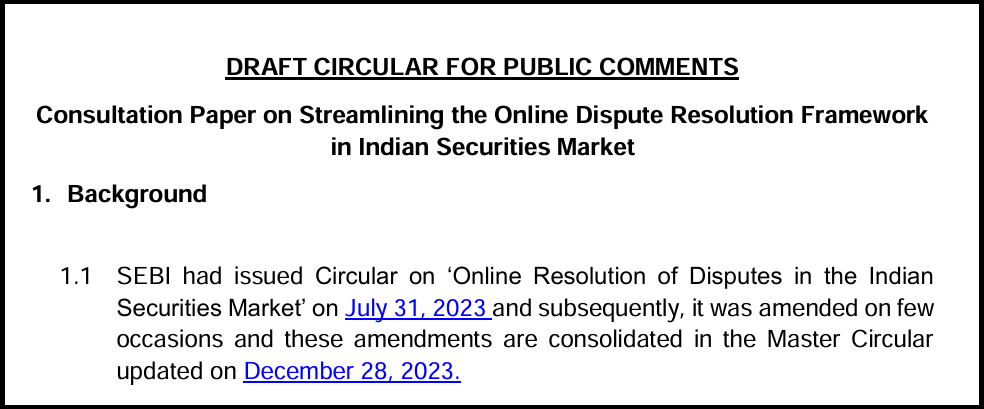
Status note: This is a draft circular issued for public comments on July 23, 2026. It is not law yet. Comments close on August 13, 2026, and the final circular is proposed to take effect three months after it is issued. Until then, the existing framework under the ODR Master Circular of July 31, 2023, as updated on December 28, 2023, continues to apply.
If you have a live complaint against a broker sitting on SCORES right now, the machinery that will eventually decide it is being rebuilt.
SEBI put out a draft circular on July 23, 2026, proposing to move the entire conciliation and arbitration process out of the hands of ODR institutions and into the hands of the exchanges and depositories, along with a set of changes to timelines, fees, arbitrator selection, and what happens after an investor wins.
Most of the coverage of it stopped at the headline about saving 21 days.
The details underneath matter far more to anyone actually running a claim, so this is a walk-through of the entire process as the draft proposes it, from the day you file a complaint to the day the money reaches you.
Why SEBI is Fixing the Current Dispute System
The current setup came in through a circular dated July 31, 2023, which shifted dispute resolution onto a common online platform run under the aegis of the market infrastructure institutions but administered by empanelled ODR institutions.
Since then, SEBI says it has been receiving complaints about the arrangement from all sides.
Four problems are named in the consultation paper. Investors said they were not consulted before an arbitrator was appointed, which they had been under the older exchange-run system.
Payments were getting stuck, first from intermediaries and listed companies to the ODR institutions, then from the ODR institutions to the arbitrators.
Enforcement was weak, because the intermediaries were not under the regulatory reach of the ODR institutions. And proceedings were dragging.
The proposed answer is to bring back the parts of the old exchange-run mechanism that worked, while keeping the process fully online. That is the single idea behind almost every change below.
Exchanges vs. Depositories: Who Handles Your Case?
Under the draft, the exchanges, depositories and clearing corporations administer conciliation and arbitration directly.
They empanel the conciliators and arbitrators, appoint them, and hold the fees. If a firm ignores the rules, the enforcement action comes from its Designated Body, which is the industry body that supervises it.
Which institution gets your case depends on who you are fighting. A dispute with a trading member over an exchange transaction, or with a listed company, goes to the relevant stock exchange.
A dispute with a depository participant or a vault manager goes to the relevant depository. Anything else against a market intermediary is distributed among the institutions on a round robin basis, with commodity-only exchanges left out of that rotation.
This matters for a practical reason. For a dispute with a stock broker, this means your case is handled by the exchange, which is also the body that supervises that broker. That is where the enforcement power sits.
Filing on SCORES: What’s Changing in the Initial Step?
The starting point does not change. You still lodge the grievance against the intermediary, listed company or market infrastructure institution on SCORES, and the process for doing that is set out in our guide on how to complaint in SEBI.
What changes is what happens next. The entity has 21 calendar days from receipt to resolve the complaint and file an Action Taken Report.
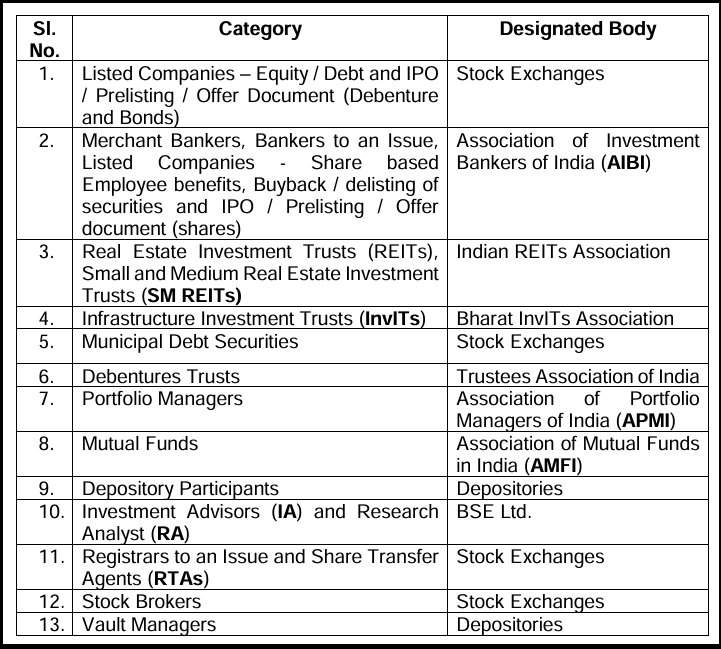
The complaint goes simultaneously to a Designated Body, which for stock brokers and listed companies is the stock exchange, for depository participants it is the depository, for mutual funds it is AMFI, for portfolio managers it is APMI, and for investment advisers and research analysts it is BSE Ltd.
If you are satisfied with the Action Taken Report, or if you do not ask for a review within 15 calendar days, the complaint is closed.
If you are not satisfied, you can ask for a review within that window, and the Designated Body then has 10 calendar days to communicate a revised report. If the entity never files a report at all, the Designated Body picks up the complaint on its own.
The saving comes at the end of this stage.
Today an unresolved grievance goes into a separate pre-conciliation step on the ODR platform after the Designated Body is done.
The draft merges the two, treating the Designated Body’s review as the pre-conciliation exercise and sending anything still unresolved straight into conciliation.
If the Designated Body itself misses its deadline, the complaint escalates automatically.
Before you count on that route, check that your dispute is one the platform will accept at all.
Warning: 2 Types of Claims the ODR Platform Won’t Take
A complaint against a stock exchange, depository or clearing corporation cannot be escalated from SCORES into the dispute resolution mechanism.
The draft is explicit about it. You would have to look at other remedies available under the general law instead.
In the opposite direction, complaints against alternative investment funds, venture capital funds, KYC registration agencies and credit rating agencies have no Designated Body mapped to them, so those complainants can go directly to the platform once the entity has failed them or missed the 21 day deadline.
Assuming your dispute passes both filters, the first real hearing stage is conciliation.
Conciliation Is Now Free for Investors: How It Works
The institution appoints a conciliator from its own panel within seven calendar days of receiving the fees and documents.
The conciliator has 21 calendar days from appointment to issue a report, extendable by another 10.
The fee point is the one to remember. Conciliation costs ₹6,000 regardless of the claim size, and it is paid upfront by the regulated entity.
The investor pays nothing at this stage. That is a meaningful change in the economics of a small claim, because it removes any cost reason to abandon a genuine dispute early.
Two outcomes are possible. If both sides agree terms and confirm them digitally, the settlement becomes binding on both.
If they do not, the conciliation is recorded as unsuccessful, and the conciliator writes down an Admissible Claim Value, which is used only to work out arbitration fees and not as a finding on what you are owed.
In service-related disputes, the conciliator may advise the intermediary to provide the service, and in trade-related disputes may record findings on whether the claim is admissible.
An unsuccessful conciliation is not the end of the road, only the point at which the process turns adversarial.
Once the conciliator is appointed, the fee is spent, and withdrawing the case later does not get it back.
Going to Arbitration: How Arbitrators Will Be Selected
This is the part investors have complained about most, and the draft responds directly. Both sides submit three preferred names from the panel.
If a common name appears, that person is appointed. If no name is common, the institution appoints a sole arbitrator through a centralised automated process that excludes all six names the parties put forward.
Claims of ₹30 lakh or below, counting claim and counterclaim together, go to a sole arbitrator.
Above that figure, a three-member tribunal is appointed, with each side choosing one arbitrator and the third picked by the automated process.
The award must be passed within three months of appointment, extendable by two months if the arbitrator records written reasons.
If a party simply refuses to participate, the arbitrator can pass an ex parte order after giving 10 calendar days notice.
How the underlying claim is framed, and which grievances even belong in this forum, is covered separately in our note on what matters can be referred to arbitration.
One procedural detail in the draft deserves more attention than it has received.
No Need to Travel: Hearings Happen in Your Home City
The seat and venue of the proceedings is deemed to be the place where the investor permanently resides, as recorded in the KYC documents. For a non-individual complainant, it is the place of registration or the principal place of business in India.
If the complainant is not resident in India, it shifts to the registered office of the entity.
For a retail investor in a small town fighting a Mumbai-based intermediary, that single line decides whether the process is realistic or not.
It also fixes which court hears any challenge to the award under section 34 of the Arbitration and Conciliation Act, 1996.
Winning the award, however, is not the same as being paid, which is where the draft does its most interesting work.
Winning Your Case: How to Claim Interim Relief Money
One rule applies to both sides. Whoever wants to appeal against the award has to first deposit the full award amount with the exchange or depository, interest free. If you lose and want to challenge it, that deposit is yours to make.
If the intermediary intends to challenge the award, it must give intimation and deposit 100 per cent of the award amount with the institution, interest-free, within seven calendar days of that intimation.
You can then apply for interim relief out of that deposit. The institution may release up to 50 per cent of the award amount or ₹5,00,000, whichever is lower, within seven calendar days of your undertaking.
Separately, if the challenging entity does not obtain a stay from the competent court within three months of receiving the award, it has to comply with the award anyway.
The undertaking is not a formality, and this is the warning to read twice.
If the challenge is eventually decided against you, you must return the money released. An investor who fails to return it is barred from trading on any exchange and from participating in the securities market, identified by PAN, until repayment.
The demat holdings and mutual fund units of that investor are frozen in the meantime.
So interim relief is genuinely useful money, and it is also a liability you are accepting. Treat it as a loan against an outcome that is not final yet.
How Long Each Stage is Meant to Take
The draft puts a deadline on every step. Reading them together tells you what a realistic wait looks like.
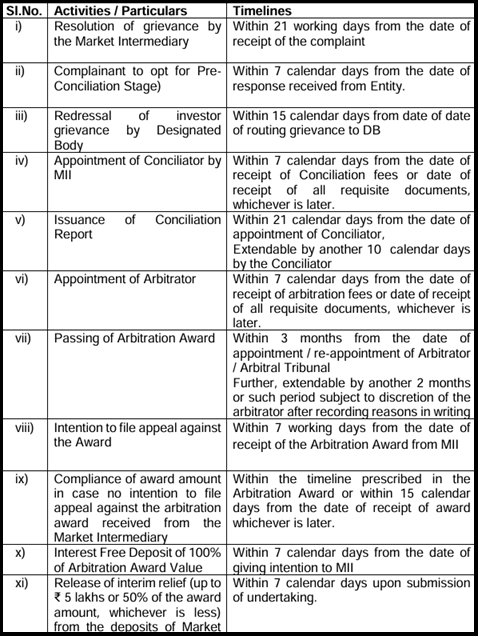
Here is the same thing as a running clock, assuming nothing goes wrong.
Your broker gets 21 days to reply to your complaint on SCORES. You then have a short window to ask for a review, and the Designated Body gets 15 days to deal with it. If it does not work out there, the case moves to settlement talks. The exchange or depository has 7 days to appoint a conciliator, and the conciliator has 21 days to give a report, which can stretch by another 10.
If the settlement fails, arbitration begins. An arbitrator is appointed within 7 days of your fee and papers reaching the exchange, and the award has to come within 3 months of that appointment. The arbitrator can take another 2 months if reasons are recorded in writing.
Add it up and the fastest realistic path from complaint to award is close to five and a half months. If the extensions get used, it moves nearer to eight. Payment comes after that, within 15 days of the award if the firm does not appeal.
Two things slow this down in practice. Every clock starts only when the fee is paid and all documents are in, so an incomplete filing quietly resets your wait. And the award being passed is not the same as the money reaching you, because a firm that appeals gets to hold the process open for longer.
Knowing the wait is one half of the decision. The other half is what it costs you.
Arbitration Fee Slabs: What You’ll Pay Based on Claim Size
Conciliation is free for the investor. Arbitration is not, and both parties pay at the point arbitration begins. The proposed slabs, exclusive of GST and stamp duty, are:
|
Admissible claim value or aggregate of claim and counter claim |
Arbitration fee |
|---|---|
| Up to ₹1 lakh |
₹5,400 |
| ₹1 lakh to ₹10 lakh |
₹9,000 |
| ₹10 lakh to ₹20 lakh |
₹13,500 |
| ₹20 lakh to ₹30 lakh |
₹18,000 |
| ₹30 lakh to ₹50 lakh |
₹67,500 |
| ₹50 lakh to ₹1 crore |
₹1,35,000 |
One rule decides which figure your fee is calculated on. If you claim more than the Admissible Claim Value the conciliator wrote down, you pay the fee on your claimed amount while the firm pays on the lower figure. Inflating a claim raises your own cost and nobody else’s.
For claims of ₹1 crore and above, the fee becomes 1 per cent of the claim value or ₹1,20,000, whichever is higher.
The lowest slab also covers service request disputes. Whoever succeeds in the arbitration gets a refund of the amount they deposited, subject to what the award says.
Note the jump between the ₹20 lakh to ₹30 lakh slab and the one above it.
Crossing ₹30 lakh takes the fee from ₹18,000 to ₹67,500, because that is also the point where a three-member tribunal replaces a sole arbitrator. If your claim sits close to that line, the difference is worth modelling before you file.
Shortcut or Blocked? Claims That Skip Conciliation Entirely
Four categories go straight to arbitration with no conciliation stage: disputes between two entities or market participants, claims by an entity against an investor to recover outstanding dues such as pay-in obligations or charges, claims above ₹1 crore, and claims against defaulting trading members, which continue to run through the existing committee route.
The mechanism is also unavailable in several situations. Cases already taken to another agreed dispute resolution platform.
Cases barred by limitation under the Limitation Act, 1963. Cases before the Investor Education and Protection Fund Authority or another regulator.
Matters pending before a court, tribunal or consumer forum, or under investigation by law enforcement. Matters already settled in conciliation.
Matters where arbitration has already been invoked anywhere. And claims against the central or a state government.
On limitation, the draft counts time from the date the issue arose, the date of the last transaction, or the date of the disputed transaction, whichever is later.
That is the clock that quietly ends most weak cases, and it runs whether or not you are ready.
Have an Active Complaint? Here’s What You Should Do Now
Nothing here is in force. Your matter still runs under the existing framework, and the sensible response to a proposed reform is not to pause and wait for it.
The reason is limitation. Time spent waiting for a better forum is time subtracted from the only window in which any forum can hear you.
If your broker has not resolved a complaint, escalate it now, and if you are unsure of the exchange stage specifically, our walkthrough of an NSE complaint against broker sets out what that involves.
The route from there into a formal hearing is explained in our guide to arbitration in stock market.
There is also a small window here for anyone with direct experience of the current system.
How to Submit Your Feedback to SEBI Before Aug 13
The consultation paper asks six questions.
They cover whether the exchanges and depositories should run the platform, whether arbitrators should be picked from the names both sides suggest, whether alternative investment fund investors should be allowed to opt out, whether unresolved SCORES complaints should go straight to settlement talks, whether the protection given to trust structured funds should apply to all fund structures, and a sixth open question for anything else.
Comments go through the public comments form on the SEBI website. If the form gives trouble, the paper gives an email address at the investor assistance division, [email protected], with a specified subject line.
If you do write in, there are two drafting mistakes worth pointing out. Both sit in the timelines table.
The first affects the broker. The body of the draft gives it 21 calendar days to resolve your complaint. The timelines table, for the same step, says 21 working days.
Working days exclude weekends and holidays, so 21 working days is roughly a month, while 21 calendar days is three weeks. On a real complaint, that is a difference of about ten days, and it decides when your right to escalate begins.
The second mistake is the one that could actually cost an investor the case. Paragraph 2.2(b) says you may ask for a review of the broker’s reply within 15 calendar days of the Action Taken Report.
The timelines table says you must opt for the pre-settlement stage within 7 calendar days of receiving the response.
That is a gap of eight days on the one deadline that belongs to the investor rather than the firm. A reader who trusts the 15-day figure and files on day 12 may find the complaint already closed.
Until SEBI fixes it, the safe assumption is the shorter of the two.
Neither of these gets corrected unless somebody raises it during consultation, which is what the comment window is for.
Frequently Asked Questions
No. It is a draft circular issued on July 23, 2026 for public comments, which close on August 13, 2026. The final version is proposed to take effect three months after it is issued. Until then the existing framework from July 31, 2023 applies to your dispute.
Not at the settlement stage. Conciliation is proposed to cost ₹6,000, paid by the firm, with nothing payable by the investor. Arbitration is where you pay, starting at ₹5,400 for claims up to ₹1 lakh and ₹9,000 for claims between ₹1 lakh and ₹10 lakh, plus GST. Whoever wins gets that deposit refunded, subject to what the award says.
No. The proceedings are online, and the seat of the case is the place where you permanently live as recorded in your KYC documents. Any later court challenge to the award also goes to the court covering that place.
Not choose, but you get a say. Both sides submit three preferred names from the panel. If a name appears on both lists, that person is appointed. If not, the exchange or depository appoints someone through an automated process that leaves out all six names you and the firm proposed.
Roughly five and a half months at best, and closer to eight if the extensions are used. Payment follows within 15 days of the award if the firm does not appeal.
Those claims skip settlement talks and go straight to arbitration, and they continue to run through the existing defaulter committee route at the exchange. The claim window notified by the exchange matters more than anything else here, because missing it usually ends the claim.
No. The draft specifically bars complaints against exchanges, depositories and clearing corporations from moving out of SCORES into the dispute resolution process. You would need to look at other legal remedies.



 Add us as a preferred source on Google »

