
Quick Summary
SEBI’s Adjudicating Officer Amit Kapoor imposed a ₹1,00,000 penalty on Intelligent Money Managers Private Limited on November 19, 2026, under Section 15HB. The order found six lapses in its delisting work, including invoices raised on the company instead of the acquirer, announcements filed 1, 4 and 15 days late, a one-day escrow delay, lapsed NISM certificates and a compliance officer paid by a related entity. The firm must pay within 45 days.
A one-day delay sounds harmless, until the rulebook says the clock starts the moment a company decides to delist.
On November 19, 2026, SEBI’s Adjudicating Officer imposed a ₹1,00,000 penalty on Intelligent Money Managers Private Limited.
The SEBI order against Intelligent Money Managers lists six lapses, from who paid the fees to which certificates had expired. Announcements that reached the exchange 1, 4, and 15 days late are part of the story.
Here is each finding in plain words, with what the firm said and what the officer decided.
Intelligent Money Managers SEBI Order on November 19, 2026
The decision came as Adjudication Order No. Order/AK/GN/2026-27/32858, passed in Mumbai by Adjudicating Officer Amit Kapoor.
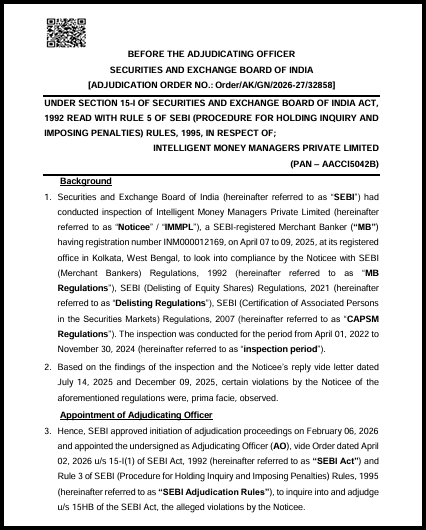
It was issued under Section 15-I of the SEBI Act read with Rule 5 of the SEBI Adjudication Rules.
The penalty falls under Section 15HB, which covers contraventions where no separate penalty is provided.
- Noticee: Intelligent Money Managers Private Limited, referred to in the order as the Noticee or IMMPL.
- Penalty: ₹1,00,000 (Rupees One Lakh Only).
- Payment window: 45 days from receipt of the order.
Delisting Rules Explained: Roles, Filings, and Key Deadlines
Every finding in this order rests on four terms from SEBI’s delisting rules.
Once you know them, the six lapses are easy to follow.
Here are the four, as the order itself describes them:
1. The Acquirer
This is the party that decides to voluntarily delist a company’s equity shares.
It must also ensure firm financial arrangements are in place before the announcement.
2. The Manager To The Offer
The acquirer appoints a manager, and the delisting activities are undertaken by the acquirer through the manager, not by the company.
The manager must exercise due diligence, care and professional judgment and ensure the acquirer complies.
In these delistings, the order treats Intelligent Money Managers as the manager to the offer.
3. The Initial Public Announcement (IPA)
On the date the acquirer decides to delist, it must make an IPA to all stock exchanges where the shares are listed.
A copy goes to the company within one working day, and the IPA must not omit relevant information or mislead.
4. The Escrow Account
The acquirer must open an interest-bearing escrow account with a Scheduled Commercial Bank within seven working days of the shareholders’ approval.
It must deposit 25 percent of the total consideration there.
How An April 2025 Inspection Became A November 2026 Order?
This case did not start with a complaint. The order says it began with an inspection, and then moved through a notice, a reply, and a hearing.
The dates below show how long each step took:
- April 7 to 9, 2025: SEBI inspected the firm’s registered office in Kolkata, West Bengal. The inspection period was April 1, 2022 to November 30, 2024.
- July 14, 2025 and December 9, 2025: The firm replied to the inspection findings.
- February 6, 2026: SEBI approved the start of adjudication proceedings.
- April 2, 2026: The Adjudicating Officer was appointed to inquire into and adjudge alleged violations under Section 15HB.
- April 22, 2026: A Show Cause Notice was sent by SPAD and email.
- May 5, 2026: The firm submitted its reply.
- May 19, 2026: The hearing took place after a notice dated May 6, 2026. The firm’s authorised representatives reiterated their earlier reply.
- November 19, 2026: The order was passed.
The inspection checked compliance with the Merchant Bankers Regulations, the Delisting Regulations and the CAPSM Regulations, which cover certification of associated persons.
The Fee Row: Should The Acquirer Or The Company Pay For A Delisting?
The first allegation covers all the delisting offers the firm handled as manager.
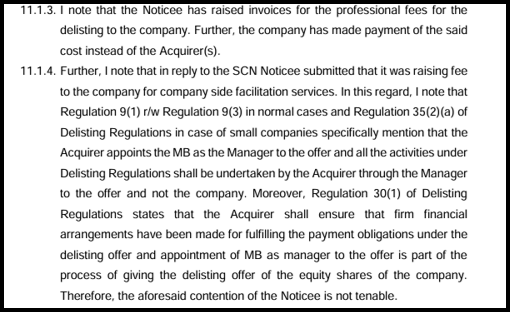
SEBI said the firm raised invoices for its professional fees on the company, and the company paid, instead of the acquirer.
This matters because the rules put the acquirer, not the company, at the centre of a delisting offer.
1. What The Firm Said
The firm said the company takes Board and shareholder approvals and works with exchanges, a valuer, a scrutiniser and other intermediaries.
It called its fee a charge for company-side facilitation services.
It said this arrangement did not compromise due diligence, shift statutory burdens or prejudice public shareholders.
It also gave an undertaking dated January 27, 2026 to exercise due care on invoices, and said it would seek a Director’s consent before raising them.
2. What The Officer Found
The officer did not accept this. The order says the rules provide that the acquirer appoints the manager and that all activities are undertaken by the acquirer through the manager and not the company.
The firm was found to have failed to exercise due diligence and ensure proper care.
The violations were of Regulations 9(1), 9(3), 30(1) and 35(2)(a) of the Delisting Regulations, and Regulation 13 read with Clauses 4 and 21 of Schedule III of the Merchant Bankers Regulations.
Why Was A Compliance Officer’s Salary Paid By A Group Firm A Problem?
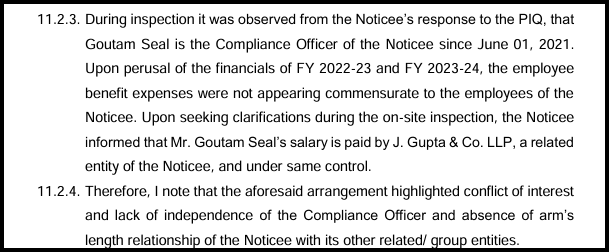
The second allegation concerns who paid the firm’s Compliance Officer, referred to here as G.S. The order says his salary was being paid by J. Gupta & Co. LLP, a related entity under the same control.
The officer noted that G.S. had been the Compliance Officer since June 1, 2021.
Employee benefit expenses in the FY 2022-23 and FY 2023-24 financials did not look commensurate with the firm’s employees, and during the on-site inspection, the firm explained the arrangement.
SEBI saw it as a question of independence. The order says the arrangement highlighted a conflict of interest, a lack of independence, and the absence of an arm’s length relationship with group entities.
1. What The Firm Said
The firm said that from May 2025, the compensation is paid exclusively by the firm.
It acknowledged SEBI’s observations, which it said were caused by liquidity concerns, and said it had taken steps to reinforce the Compliance Officer’s independence.
2. What The Officer Found
The firm was found to have violated Regulation 13 read with Clauses 2, 3, 11, 18 and 21 of Schedule III.
These cover integrity and fairness, prompt and ethical conduct, avoiding conflicts of interest, keeping an arm’s length between business activities, and abiding by the rules.
Which NISM Certificates Were Missing and When Were They Renewed?
The third allegation is about exams. SEBI’s notifications require certain people in an intermediary to hold NISM certification, and the order found gaps for three people.
The firm’s own table gave the dates on which each gap was closed.
1. A Key Managerial Person (KMP), A.K.
Not holding NISM-Series-IX: Merchant Banking Certification Examination from October 2, 2024 to November 25, 2024.
The firm’s table shows the gap was corrected on November 26, 2024.
2. A Key Managerial Person (KMP), N.G.
Not holding the same Series IX certificate from August 2, 2022, to December 18, 2024. The corrected date given is December 19, 2024.
3. The Compliance Officer, G.S.
Not holding NISM-Series-III A: Securities Intermediaries Compliance (Non-Fund) Continuing Professional Education from June 25, 2022 to December 18, 2024.
The corrected date given is December 26, 2024.
The rule comes from SEBI notifications of March 11, 2013, and August 2, 2013. The first requires compliance officers to pass Series III A, and the second requires at least two KMPs to pass Series IX.
The firm acknowledged the gaps.
It said all certifications have been renewed and are valid up to December 2027, a compliance calendar with automated renewal alerts has been set up, and it said no regulatory assignments or investor matters were compromised.
The officer held that it is the firm’s responsibility to ensure compliance.
The violations were of the two notifications read with Regulation 3 of the CAPSM Regulations, Regulation 9A(1)(e), and Regulation 13 read with Clause 21 of Schedule III.
Process gaps draw penalties elsewhere too, as readers can see when SEBI penalizes Sharekhan Anand Rathi for violations linked to authorised persons’ terminals and call records.
Why Three Delisting Announcements Were 1, 4, and 15 Days Late?
The fourth allegation covers delays in making the Initial Public Announcement to the Calcutta Stock Exchange (CSE) for three delisting offers.
The officer worked out the delay by comparing the day the plan was finalised with the day the IPA was filed.
The three offers below are taken in turn, with the firm’s reason and the officer’s response.
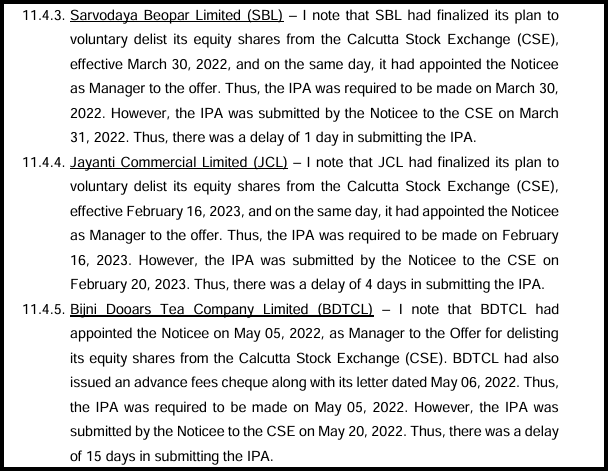
1. Sarvodaya Beopar Limited: 1 Day
The plan to delist from the CSE took effect on March 30, 2022, and the firm was appointed the same day. The IPA was due that day but was submitted on March 31, 2022.
The firm said the signed appointment letter from the acquirer, Basil Tracon Pvt. Ltd., arrived on the late evening of March 30, after the CSE’s operating hours had ended.
It said the one-day difference did not prejudice anyone.
2. Jayanti Commercial Limited: 4 Days
The plan was finalised on February 16, 2023, and the firm was appointed that day. The IPA was filed on February 20, 2023.
The firm said the documents needed for the IPA, including the shareholding pattern, MGT-7 filing and audited financials for the year ended March 31, 2022, were received only on February 20.
It said the delay was neither wilful nor avoidable.
3. Bijni Dooars Tea Company Limited (BDTCL): 15 Days
The company appointed the firm on May 5, 2022, and issued an advance fees cheque with a letter dated May 6, 2022. The IPA was submitted on May 20, 2022.
The firm said it lacked provisional financials for FY 2021-22 for the floor price and escrow amount, and the shareholding pattern and Company Secretary’s due diligence report.
It said the Board could not approve the proposal within 21 days from the IPA because the report arrived only on June 9, 2022.
The firm also cited two Securities Appellate Tribunal cases, DSE Financial Services Ltd vs. SEBI and Religare Securities Ltd vs. SEBI, to argue that technical delays without material prejudice should not be treated as breaches.
Tribunal outcomes can differ from case to case.
The officer noted that the firm admitted the delays. The reasons were not accepted, since Regulation 8 requires the IPA to be made when the acquirer decides to delist.
The violations were of Regulation 8 of the Delisting Regulations and Regulation 13 read with Clauses 3 and 21 of Schedule III.
Also Read: Abhipra Capital SEBI Order
Why Did SEBI Treat A Second IPA For Bijni Dooars As A Problem?
The fifth allegation grew out of the same delisting offer. The firm had sent two IPAs to the CSE, one by email on May 20, 2022, and another on June 27, 2022.
The firm said the company was not prepared with documents, the assignment was not pursued, and the process was later restarted with an IPA on June 27, 2022, without any delay.
It denied any wilful intent to camouflage the original submission.
The officer disagreed. The order says the delisting process was started afresh with the second IPA, and that the firm’s claim could not stand because the rules require the IPA to be submitted when the acquirer decides to delist.
The officer also noted that timelines for later steps are linked to the IPA date. Restarting with a new appointment letter was held to show the action was taken, in the order’s words, “to camouflage the delay as alleged.”
The firm was found not to have exercised due diligence and care, or ensured the acquirer complied.
The violations were of Regulations 29(4) and 29(6) of the Delisting Regulations and Regulation 13 read with Clauses 3 and 21 of Schedule III.
A One-Day Delay In Opening The Escrow Account For Bijni Dooars
The sixth allegation is about the escrow account for the same delisting offer. The rules allow seven working days from the shareholders’ approval to open it.
The shareholders approved on August 20, 2022, so the account should have been opened by August 30, 2022. It was opened on August 31, 2022, a delay of one day.
The firm blamed technical issues at HDFC Bank. It said it had been coordinating with the bank since August 23, 2022, submitted all documents by August 25, and executed the escrow agreement on August 29, 2022.
It said the bank confirmed the account by phone on August 31 at 12:05 pm, and the agreement said the account should open within one business day.
The officer held that the regulation clearly gives seven working days from approval, so the firm’s contention was not tenable.
The violations were of Regulation 14(1) of the Delisting Regulations and Regulation 13 read with Clauses 3 and 21 of Schedule III.
Is Intelligent Money Managers Private Limited SEBI Registered Or Not?
Readers often ask whether the penalised firm is registered. The order answers this in its opening paragraph.
It describes Intelligent Money Managers Private Limited as a SEBI-registered Merchant Banker with registration number INM000012169.
Paragraph 14 also calls it a SEBI-registered intermediary under a statutory obligation to follow applicable circulars, rules, and regulations.
You can check if a broker is SEBI registered yourself on SEBI’s records.
Why Did The Officer Choose ₹1 Lakh Under Section 15HB?
Section 15HB sets a penalty of not less than ₹1 lakh but up to ₹1 crore. The ₹1,00,000 imposed here is the lowest amount that the section allows.
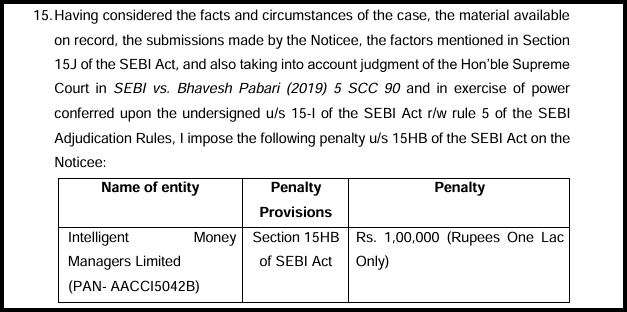
In deciding the amount, the officer was required to look at the three factors in Section 15J. The order lists them as unfair gain, loss caused to investors, and the repetitive nature of the default.
The officer also referred to the Supreme Court’s judgment in SEBI vs. Bhavesh Pabari (2019) 5 SCC 90. The order records that, as per available records, no past action has been taken by SEBI against the firm.
The officer concluded that the penalty is commensurate with the lapse or omission. The order does not record an investor complaint or a loss figure.
Also Read: SEBI Penalty Against Motilal Oswal, 51 Lakh fine across five orders.
How Must The Penalty Be Paid, And What Happens If It Is Not?
The firm must pay within 45 days of receiving the order. Payment is online on SEBI’s website at www.sebi.gov.in.
- Path: Enforcement, then Orders, then Orders of AO, then Pay Now.
- Help with payment: [email protected].
If the amount is not paid in time, SEBI may take consequential action.
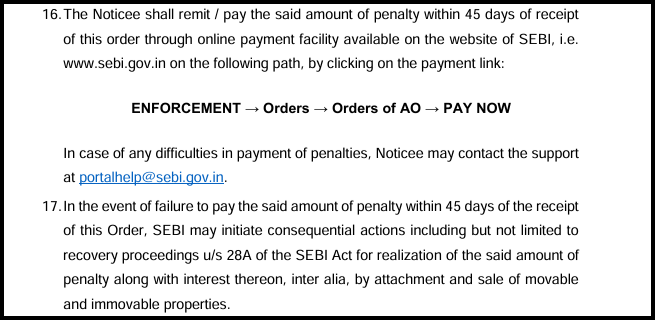
The order says this includes recovery proceedings under Section 28A of the SEBI Act, with interest, by attachment and sale of movable and immovable properties.
A copy of the order goes to the firm and to SEBI under Rule 6. The order does not say whether the firm will challenge it.
What Should Investors Take From This Order?
This order is about how a firm ran delisting assignments, and it records no investor complaint.
Still, it shows how SEBI checks fee flows, timelines, certifications, and independence during an inspection.
If you ever have a grievance against a SEBI-registered intermediary, the steps for a SCORES SEBI complaint show how to file and track it.
Keep your documents and messages ready before you file.
Conclusion
SEBI’s November 19, 2026 order penalised Intelligent Money Managers Private Limited ₹1,00,000 after an April 2025 inspection.
It found six lapses covering delisting fees, a compliance officer’s pay, NISM certificates, three late announcements, a second announcement for one offer, and a one-day escrow delay.
The firm gave explanations and undertakings on each point, and the officer did not accept them.
The firm has 45 days to pay.
Report. Recover. Stay Fraud Free.
SEBI penalised Intelligent Money Managers Private Limited ₹1,00,000 for six lapses found in an inspection of its delisting work. The order is dated November 19, 2026. Adjudicating Officer Amit Kapoor passed it under Section 15-I of the SEBI Act. The penalty was imposed under Section 15HB. The penalty is ₹1,00,000, payable within 45 days of receiving the order. Payment is online through SEBI's website. They were delisting fees invoiced to the company, the Compliance Officer's pay by a related entity, lapsed NISM certificates, late announcements for three offers, a second announcement for one offer and a one-day escrow delay. The delays were 1 day for Sarvodaya Beopar Limited, 4 days for Jayanti Commercial Limited and 15 days for Bijni Dooars Tea Company Limited. SEBI may take consequential action, including recovery proceedings under Section 28A with interest. This can include attachment and sale of properties. No. The order records no investor complaint or loss figure. It does note that SEBI has taken no past action against the firm.Frequently Asked Questions


 Add us as a preferred source on Google »