

Quick Summary
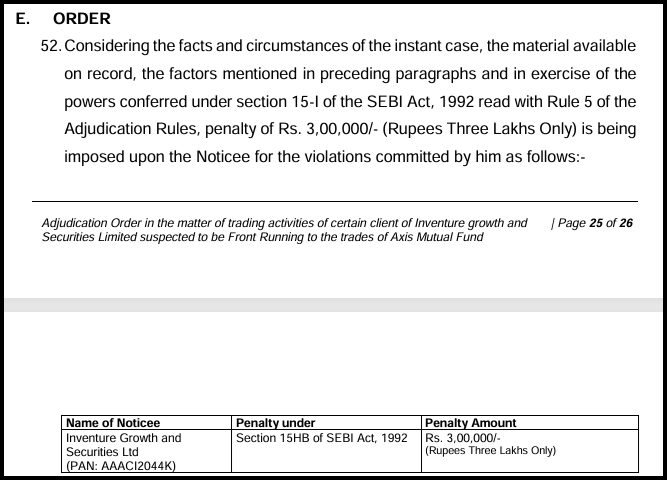
SEBI Adjudicating Officer Medha Sonparote fined Inventure Growth and Securities Ltd ₹3,00,000 on November 6, 2026 under Section 15HB. The officer found that Inventure could not show who placed a client’s orders, that a terminal was logged in from Dubai on three days, and that its authorised person’s audit reports were self-signed. The authorised person, Rushbha Vinay Nisar, was named but not penalised. Inventure has 45 days to pay.
Twelve logins. Three days in September 2021. One trading terminal that belonged in Mumbai but showed up in Dubai.
SEBI’s order of November 6, 2026 says that was only part of what went wrong at Inventure Growth and Securities Ltd.
It also could not show who placed 140 orders for one client, and its oversight of an authorised person leaned on trust.
Here is how the officer weighed each charge, and why the penalty stopped at ₹3 lakh.
How A Client Alert Led SEBI To Inventure Growth And Securities?
SEBI’s internal alert system flagged the trades of one client of Inventure. The order calls this person Client M.
The alerts suggested Client M might be front-running the trades of Axis Mutual Fund, which the order calls the “Big Client”. SEBI looked at trades from April 1, 2020 to March 31, 2022.
That Axis Mutual Fund trail is the same one that led to the Axis Mutual Fund front running order against other brokers and their directors. Inventure’s case is a separate branch of that probe.
In this branch, Client M’s account was opened through Inventure’s authorised person, Rushbha Vinay Nisar. The order also spells his name “Rushabh Vinay Nisar” on its first page.
Trades were punched from terminals Inventure had given him.
So the charges that followed are about Inventure’s own conduct, and front running by Client M is not one of them.
Who Faced The Charges, And What Was Alleged?
There are two noticees in the order.
- Inventure Growth and Securities Ltd. The stock broker, called Noticee 1.
- Rushbha Vinay Nisar. Inventure’s authorised person, called Noticee 2.
SEBI appointed an Adjudicating Officer on July 18, 2025, and the case moved to a second officer on September 19, 2025.
It was assigned to the present officer on June 9, 2026.
A Show Cause Notice dated November 11, 2025, asked why a penalty under Section 15HB should not be imposed.
Three alleged violations came out of it, and the sections below take them one by one.
Why Could Inventure Not Show Who Placed Client M’s Orders?
Client M and the authorised person told opposing stories.
Client M said the authorised person handled the account, and that trades were placed without his knowledge.
The authorised person said Client M gave instructions through calls, WhatsApp calls, and visits to his office.
Disputes like this are common in Unauthorised Trading cases, where only a record of the order can settle who is right.
So SEBI asked for proof of how orders were placed. Neither Inventure nor the authorised person could produce any document.
What Does the SEBI Circular Demand?
A March 22, 2018 circular says brokers must keep evidence of a client placing an order.
That can be a signed record, a phone recording, an authorised email, a log or a message record.
The records must be kept for the period in which arbitration accepts complaints, currently three years.
Where a dispute is raised, they must be kept until it ends.
Our explainer on why trade records are not held by SEBI shows why the broker’s own file matters so much for an investor.
Inventure’s Defences And The Officer’s Answers
Inventure did not accept the record-keeping charge.
It raised four arguments, and the officer answered each one in order.
Here is how the defence and the findings lined up:
1. COVID Relaxation On Call Recording
- SEBI had relaxed call recording from March 23, 2020 to September 30, 2021.
- The officer agreed that the relaxation applied.
- But 140 orders were placed after September 30, 2021, all between October 1 and October 26, 2021.
2. “No Orders Were Identified”
- Inventure said the notice named no order after that date.
- The officer said the orders were given to the noticees as Annexures 2 and 3 of the notice.
3. Three-Year Retention Limit
- Inventure said the rule no longer required old records by the time SEBI asked on February 25, 2025.
- The officer pointed to SEBI’s email of November 15, 2023, which sought these details.
- The officer held that the records had to be kept until the investigation ended.
4. Exception For Technical Failure
- The circular allows other evidence in exceptional cases such as technical failure.
- The officer found nothing on record to show such a case here.
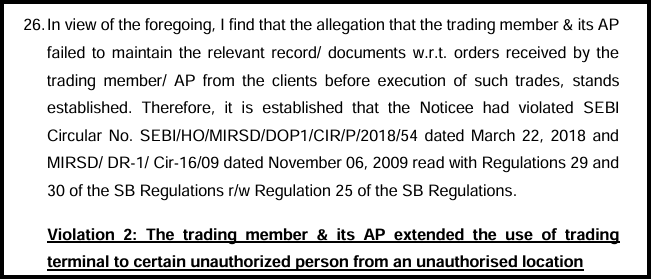
The finding is clear. The allegation that the broker failed to keep records of client orders stands established.
Dubai Logins: 12 Entries On 3 Days From A Terminal Meant For Mumbai
SEBI went through the connection logs of the terminals used for Client M’s trades. One terminal was logged in under a dealer ID belonging to an approved dealer.
Those logins came from IP addresses located in Dubai, UAE, on September 24, 27 and 28, 2021.
The authorised person himself said none of his dealers travelled outside India.
The dealer in whose name the terminal was taken had not been to Dubai either, according to the order.
How Inventure Challenged The IP Evidence?
Inventure argued that the finding rested on a free public IP lookup site, which itself says city-level accuracy is only 50% to 75%.
It also said no outsider had been named and no admission had been made.
The officer noted the same document says IP geolocation is about 99% accurate at the country level. Twelve logins across three days showing Dubai, the officer said, cannot be treated as a coincidence.
The order leans on a Supreme Court principle from the Kishore R. Ajmera case.
Proof can be drawn by logical reasoning from the overall facts when direct evidence is missing.
The Axis Final Order Argument
Inventure also pointed to SEBI’s final order on Axis Mutual Fund front running dated July 24, 2026.
There, the charge that two trading members extended terminals to an outsider in Dubai was established.
Inventure used it to argue the evidence here was thinner. The officer rejected that, saying each case stands on its own evidence.
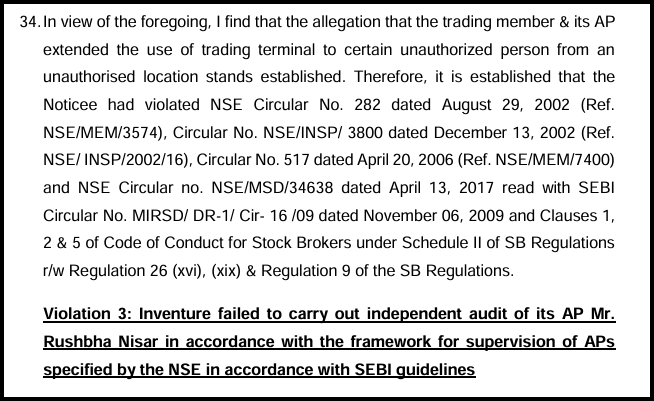
The result is that the allegation of extending terminal use to an unauthorised person from an unauthorised location stands established.
Audit Reports Signed By The Authorised Person Himself
The third charge is about supervision. A broker must inspect its authorised persons, and an NSE circular of October 18, 2019 sets the guidelines.
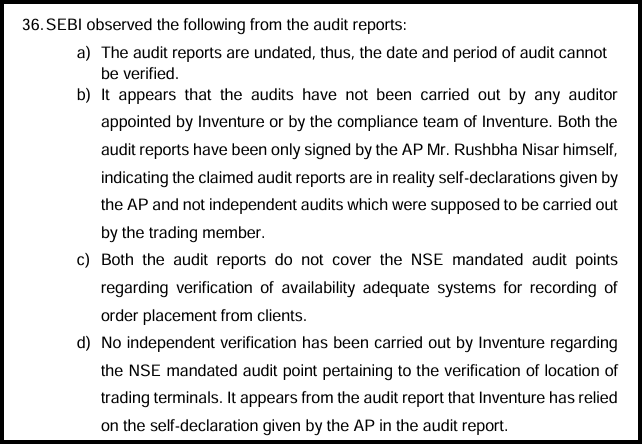
Inventure produced two internal audit reports for FY 2021-22 and FY 2023-24.
SEBI flagged four problems with them:
- Both reports were undated. The date and period of the audit could not be verified.
- Only the authorised person signed them. The officer called them self-declarations, not independent audits.
- They missed an NSE audit point. Neither covered the check for systems that record client order placement.
- No independent location check. Inventure relied on the authorised person’s own word about where terminals sat.
The Trust Statement That Hurt Inventure
A promoter and director of Inventure told SEBI under oath on January 3, 2025, that independent verification of terminals was not done in 2020 to 2021.
He said Inventure relied on trust during the COVID period.
The officer set this against Inventure’s claim of due diligence and called the submissions contradictory.
Inventure accepted the “Date of Inspection” field was left blank, and called it a record-keeping lapse. It also said the rule does not require an appointed auditor.
The officer rejected that, noting the report was signed by the authorised person.
Inventure also showed no document proving any inspection during the investigation period or within a year of it.
Why Was the Authorised Person Not Penalised?
Rushbha Vinay Nisar was a noticee, but the penalty table lists only Inventure.
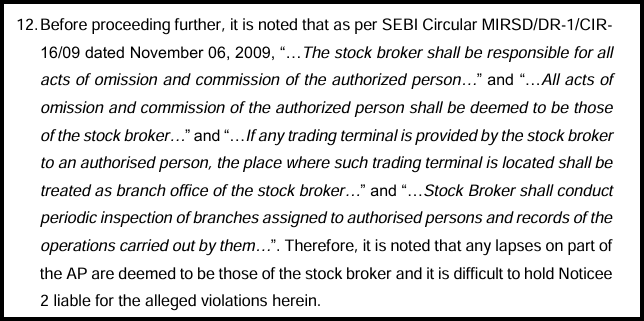
The officer explained why in paragraph 12. SEBI’s 2009 circular makes a stock broker responsible for all acts of omission and commission of its authorised person.
Because lapses of the authorised person are deemed to be those of the broker, the officer said it was difficult to hold him liable for the alleged violations.
A Technical Objection: Are NSE Circulars Enforceable Here?
Inventure argued that exchange circulars are enforced by the exchange itself, not by SEBI under Section 15HB.
The officer disagreed. Regulation 9(b) of the Stock Brokers Regulations attaches a condition to a broker’s licence that it must abide by the exchange’s rules and bye-laws.
So breaching an exchange circular amounts to breaching a licence condition, and that can be adjudicated under Section 15HB.
Why The Penalty Is ₹3 Lakh Under Section 15HB
Section 15HB covers failures where no separate penalty exists. It allows a penalty from ₹1 lakh to ₹1 crore.
The officer looked at three factors. The material did not show any quantifiable gain or unfair advantage, and it did not show loss caused to investors.
On repeat violations, the order lists earlier SEBI proceedings against Inventure.
These include 11B proceedings in the matter of Pyramid Saimira Theatre Limited, adjudication proceedings in the matters of GFL Financials Limited and Pyramid Saimira Theatre Limited, and adjudication proceedings as a stock broker.
The result is a penalty of ₹3,00,000 on Inventure under Section 15HB.
For how SEBI treats other broker lapses, see our overview of SEBI action against brokers.
Timeline: From SEBI’s Notice To The Final Order
Here are the dates the order records.
- July 18, 2025: SEBI appoints an Adjudicating Officer.
- November 11, 2025: Show Cause Notice issued to both noticees.
- January 21, 2026: Noticees are given inspection of documents, after asking on December 4, 2025.
- February 10 and 11, 2026: The authorised person and Inventure reply.
- August 5, 2026: Inventure’s request to cross-examine Client M is rejected.
- August 20, 2026: Inventure files further submissions.
- September 22, 2026: Both noticees appear at an online hearing.
- November 6, 2026: Final order passed in Mumbai.
Is Inventure Growth And Securities Ltd SEBI Registered Or Not?
The order describes Inventure as a SEBI registered trading member and stock broker. It lists the SEBI registration number INZ000221934.
This order is a monetary penalty only. It does not suspend or cancel that registration.
The officer also notes that stock brokers carry statutory responsibility for their authorised persons.
Always check a broker’s live status on SEBI’s intermediary list before you open an account.
Penalty Payment Deadline And Recovery Steps
Inventure must pay within 45 days of receiving the order, through SEBI’s online payment link under Enforcement, Orders, Orders of AO.
If it does not pay, SEBI may start recovery under Section 28A of the SEBI Act. That can include attachment and sale of movable and immovable property, with interest.
A copy of the order goes to the noticees and to SEBI.
What Investors Can Learn From This Order?
Three lessons stand out from the findings.
- Ask how your orders are recorded. Brokers must keep evidence of who placed an order.
- Know who handles your account. The order shows what happens when stories between a client and an authorised person do not match.
- Keep your own records. Save call logs, messages and contract notes for your trades.
If you see trades you did not place, you can file a complaint on SEBI’s portal. Our step-by-step guide on how to file a SEBI SCORES complaint covers the process.
Conclusion
Frequently Asked Questions
SEBI imposed a penalty of ₹3,00,000 on Inventure under Section 15HB of the SEBI Act, 1992. Section 15HB allows a penalty from ₹1 lakh to ₹1 crore, so the amount sits at the lower end of that range.
Adjudicating Officer Medha Sonparote passed the order in Mumbai on November 6, 2026. The case was assigned to her on June 9, 2026, after two earlier officers handled it.
No. The three charges decided in the order concern Inventure’s order records, terminal use and supervision. The order describes Client M as a suspected entity and does not give a finding on front running.
He was a noticee, but the penalty table lists only Inventure. The officer noted that an authorised person’s lapses are deemed to be those of the stock broker. Because of this, the officer said it was difficult to hold him liable for the alleged violations.
Inventure must pay within 45 days of receiving the order, through SEBI’s online payment link. If it does not, SEBI may start recovery under Section 28A, including attachment and sale of property, with interest.
No. The order imposes only a monetary penalty and does not suspend or cancel Inventure’s registration. Investors should still check a broker’s live status on SEBI’s intermediary list before opening an account.



 Add us as a preferred source on Google »