

Quick Summary
Adjudicating Officer Jai Sebastian passed the order on November 3, 2026 against 10 noticees: Woodstock Broking Pvt. Ltd., Marfatia Stock Broking Pvt. Ltd. and their directors. SEBI held both brokers helped place front-running trades by installing trading software and giving IT support to a user in Dubai. Four noticees were fined ₹10 lakh each under Section 15HA. Five directors faced no penalty, and proceedings against one abated after his death.
Picture a trading terminal in Mumbai, an IT employee on a remote screen-sharing call, and orders landing on the exchange from Dubai.
That is the picture SEBI’s adjudicating officer examined in its order of November 3, 2026.
The Axis Mutual Fund front running case now has a ruling on the brokers whose terminals were used, and on the directors behind them.
How Did The Trail Start In April 2021?
SEBI’s surveillance system raised alerts on trades that looked like front-running of Axis Mutual Fund’s orders. The order calls the fund house the “Big Client”.
The investigation period ran from April 1, 2021 to March 31, 2022.
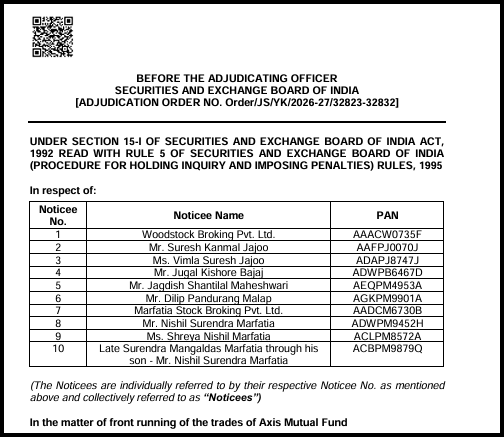
The order names ten noticees. Two are broker companies, and eight are people linked to them.
| Noticee no. | Name | Link to the case |
|---|---|---|
| 1 | Woodstock Broking Pvt. Ltd. | Broker company |
| 2 | Suresh Kanmal Jajoo | Director of Woodstock |
| 3 | Vimla Suresh Jajoo | Director of Woodstock |
| 4 | Jugal Kishore Bajaj | Director of Woodstock |
| 5 | Jagdish Shantilal Maheshwari | Director of Woodstock |
| 6 | Dilip Pandurang Malap | Director of Woodstock |
| 7 | Marfatia Stock Broking Pvt. Ltd. | Broker company |
| 8 | Nishil Surendra Marfatia | Director of Marfatia |
| 9 | Shreya Nishil Marfatia | Director of Marfatia |
| 10 | Late Surendra Mangaldas Marfatia, through his son | Director of Marfatia |
What Was Alleged Against The Two Brokers?
The show cause notice did not say the brokers passed on any inside information. It said they made the trades possible.
The allegation was that they gave access to trading terminals and supported their use from outside India.
SEBI said that amounted to a breach of Sections 12A(a), (b) and (c) of the SEBI Act and Regulations 3(a), (b), (c), (d) and 4(1) of the PFUTP Regulations. Directors faced the same charge read with Section 27.
The first show cause notice is dated October 31, 2023. Another notice dated June 18, 2025 repeated the allegations.
Who Played What Role in the Alleged Scheme?
The order names several people who are not noticees here. To protect their privacy, this blog uses initials for them.
The roles below are what the show cause notice alleged.
The order does not decide them afresh.
| Person | Alleged role |
|---|---|
| V.J. | Axis Mutual Fund chief dealer and information provider |
| S.D. | Arranger |
| P.V. | Arranger |
| V.P. | Arranger |
| P.K. | Order and trade executor based in Dubai |
| D.D. | Brother of S.D., dealt with Mr. Jajoo |
| K.D. | IT head at Woodstock |
| Y.M. | IT officer at Marfatia |
The notice grouped the accounts used for trading into a “Marfatia Group”, a “Woodstock Group” and a family group linked to P.K.
How The Trades Allegedly Reached Dubai?
Two chains are laid out in the order. Each one begins with someone arranging an account and ends with a screen in Dubai.
SEBI has seen similar patterns before, as in the Madhav Stock Vision front-running case.
1. The Woodstock Chain
The Woodstock side centred on Visa Capital Partners, a firm in which Mr. Suresh Kanmal Jajoo was a partner.
- The account was shared. Mr. Jajoo said he gave the firm’s account details to D.D., on a profit split of 70:30 in D.D.’s favour.
- The software was installed. K.D. installed Woodstock’s ODIN trading software on P.K.’s system in Dubai using the remote tool AnyDesk.
- The trades were placed. Mr. Jajoo said the large intraday trades produced around ₹14.50 crore in profit, which he said stayed with the firm.
2. The Marfatia Chain
The Marfatia side involved accounts held with Marfatia Stock Broking, including one belonging to Mr. Nishil Surendra Marfatia.
- Accounts were arranged. The notice alleged S.D. approached P.V., who arranged the accounts.
- The software was installed. Y.M. installed ODIN on a system in Dubai through AnyDesk, according to the notice.
- Profits moved on. The notice alleged profits were passed as cash to S.D. and then to V.J.
The Technical Evidence Behind The Dubai Link
The order leans on technical records, not only on chats. Each broker’s terminal software leaves IP and MAC ID records.
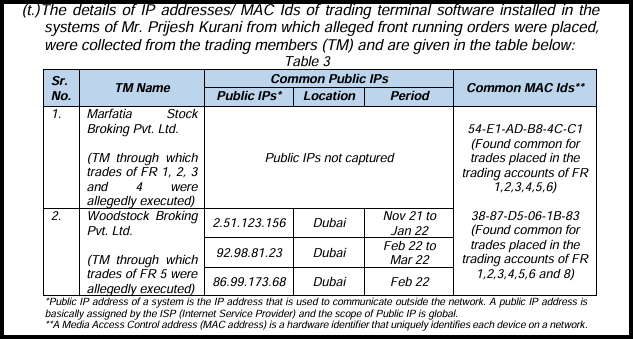
Woodstock’s records showed Dubai public IP addresses from November 2021 to January 2022, and again from February 2022 to March 2022.
Marfatia’s database had not captured public IP addresses.
The notice relied on common MAC IDs instead, which pointed to the same computers being used for trades routed through both brokers.
What The May 2022 Search Brought Out?
SEBI carried out a search on May 12, 2022, at the premises of one of the suspected entities. The mobile devices of two family members were backed up and seized.
The notice said WhatsApp chats on P.K.’s phone showed:
- Installation help. Chats with K.D. and Y.M. about installing ODIN on his system in Dubai through AnyDesk.
- Trade screenshots. Screenshots of front-running trades shared with two of the arrangers.
- A Dubai company. Chats about a company set up in Dubai by family members of V.J., with alleged routing of funds.
The order treats these as part of the allegations, supported by statements and technical data.
Why Two Orders Run Side By Side?
This adjudication did not stand alone. A separate final order dated July 24, 2026 dealt with the front runners and the information chain.
The officer kept this case in abeyance until that order came, then issued hearing notices on July 27, 2026.
Noticees 1 to 6 called this an inordinate delay. The officer disagreed, noting they showed no specific prejudice and had full chances to reply.
That connected order is relevant for another reason. It found the unlawful gains linked to the front-runner accounts, which SEBI had already acted on.
Woodstock’s Defences And How The Officer Replied?
Noticees 1 to 6 filed replies on December 1, 2023 and January 19, 2024, and again on August 24, 2026. The core defence was that Woodstock was only a broker for a client.
The points below are drawn from the order’s own findings.
- “We were only a broker.” The officer said the case was about facilitation, not trading. A broker is not a passive bystander when its terminal is set up and supported for someone who is not its dealer.
- “We dealt only with D.D. on a profit-share.” The officer said a profit-sharing arrangement called for more caution, not less. The technical data pointed to Dubai, not to the claimed user.
- “We did not know P.K. operated the terminal.” Woodstock’s own IT head installed the software and was in contact with P.K. The officer held that a broker acts through its staff and that knowledge cannot be separated from it.
- “At worst this is unauthorised terminal use.” The officer held the same acts can breach an exchange circular and also amount to facilitation of a fraudulent scheme.
- “D.D. was never made a noticee, so the chain is broken.” The officer said the case rested on direct acts of Woodstock’s own people and did not depend on D.D. being named.
- “We ended the arrangement ourselves.” The noticees said they stopped it from February 2022. The officer said later termination does not undo earlier facilitation.
Also Read: What Action Does SEBI Take On Account Handling
Marfatia’s Defences And The Officer’s Answers
Marfatia Stock Broking and its directors argued that the case revolved around others. They said the broker only installed software at the request of a person linked to its authorised person.
Here is how the officer handled each point:
- “ODIN is freely downloadable.” The charge was not about software installation alone. It was about installing it on the system used for the trades, with remote support.
- “We acted on P.V.’s request in good faith.” The officer said a regulated intermediary must verify who the end user is before enabling remote access. Accepting informal instructions routed through third parties did not meet that standard.
- “We never shared any login ID or password.” The officer said credentials and terminal installation were complementary roles, and one does not cancel the other.
- “The WhatsApp chats need cross-examination.” The officer noted the chats were only one component. Statements, technical data and the connected order also supported the findings.
- “Fraud needs strict proof.” The officer agreed fraud cannot rest on suspicion. But citing the Supreme Court’s own approach, the officer held that civil proceedings can rely on a higher degree of probability from cogent material.
Why IT Support Counted As Dealing In Securities?
The key legal step is a definition. Regulation 2(1)(b) of the PFUTP Regulations defines “dealing in securities”, and it was amended with effect from February 1, 2019.
The officer read it to include those who assist in or enable dealings, not only those who place orders.
For fraud, the officer applied the Supreme Court’s decision in Reliance Industries Limited and Others v. SEBI dated May 29, 2026. It treats both injury through a wrongful act and blatant misconduct as routes to a finding.
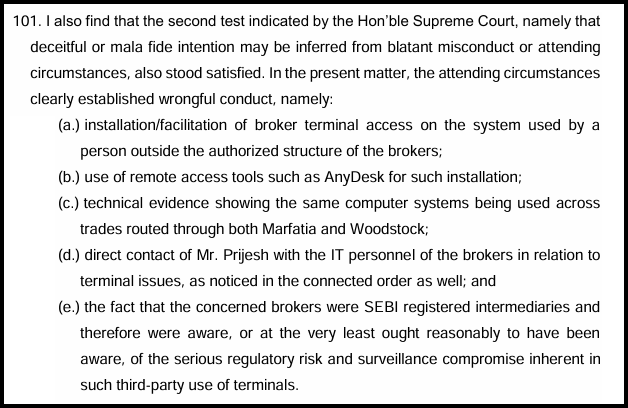
The order lists five circumstances that pointed to wrongful intent:
- Outside the authorised structure. Terminal access was facilitated on a system used by someone who was not a dealer or authorised person.
- Remote tools. Remote access tools such as AnyDesk were used for installation.
- Same computers. Technical evidence showed the same systems used across trades routed through both brokers.
- Direct contact. The Dubai user was in direct contact with the brokers’ IT staff on terminal issues.
- Known risk. The brokers were intermediaries who were, or ought to have been, aware of the surveillance risk in third-party use.
The officer concluded that both brokers had violated Section 12A(a), (b), (c) and Regulations 3(a), (b), (c), (d) and 4(1).
Which Directors Were Penalised?
Section 27 does not make a person liable merely for holding the title of director.
The officer checked each director’s role separately.
| Noticee | Outcome | Reason in the order |
|---|---|---|
| Suresh Kanmal Jajoo (2) | Penalised ₹10 lakh | Sole decision-maker at Woodstock, partner in Visa Capital Partners, admitted sharing account details |
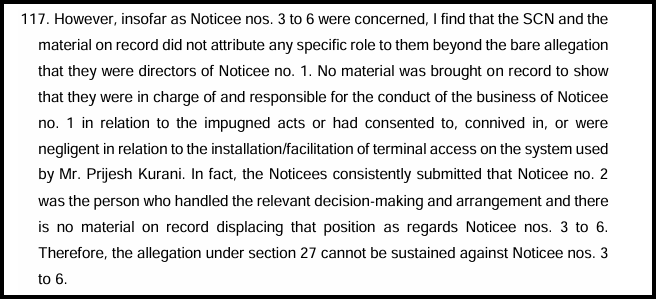
| Vimla Suresh Jajoo (3) | No penalty | No specific role shown beyond directorship |
| Jugal Kishore Bajaj (4) | No penalty | Same as above |
| Jagdish Shantilal Maheshwari (5) | No penalty | Same as above |
| Dilip Pandurang Malap (6) | No penalty | Same as above |
| Nishil Surendra Marfatia (8) | Penalised ₹10 lakh | Managing director, acknowledged the IT role in the installation, own account was used |
| Shreya Nishil Marfatia (9) | No penalty | SCN rested only on directorship |
| Late Surendra Mangaldas Marfatia (10) | Proceedings abated | Died on October 25, 2024 |
For the late noticee, the officer relied on the principle that a personal action ends with the person. The order did not go into the merits for him.
How Did the Officer Arrive at ₹10 Lakh Each?
Section 15HA sets a penalty of not less than ₹5 lakh, up to ₹25 crore or three times the profit, whichever is higher.
The officer applied Section 15J, which looks at gain, loss, and repeat conduct.
- No quantified gain. The material did not quantify gain made by the brokers or loss to investors. The unlawful gains were attributed to the front-runner accounts.
- Connected penalties. The July 24, 2026 order had already barred and fined people linked to these accounts, including Mr. Jajoo and Mr. Nishil Marfatia.
- Record. The order listed earlier SEBI penalties against Marfatia Stock Broking and Mr. Nishil Marfatia for repeated misconduct.
The connected order showed wrongful gains of ₹3,08,28,714.16 in the Marfatia account and ₹14,07,03,340.80 in the Visa Capital Partners account. It barred both men from the market for three years and fined each ₹40 lakh.
The earlier penalties listed in the order for Marfatia are shown below:
| Noticee | Matter | Date | Penalty |
|---|---|---|---|
| Marfatia Stock Broking | 20 Microns Limited | August 9, 2019 | ₹1,00,000 |
| Marfatia Stock Broking | Marfatia Stock Broking Private Limited | March 18, 2024 | ₹1,00,000 |
| Marfatia Stock Broking | Alankit Limited | May 22, 2024 | ₹8,00,000 |
| Marfatia Stock Broking | Securities of SecUR Credentials Limited | September 3, 2025 | ₹3,00,000 |
| Nishil Surendra Marfatia | Illiquid stock options on BSE | February 28, 2022 | ₹5,00,000 |
| Nishil Surendra Marfatia | Veronica Production Limited | June 27, 2022 | ₹5,00,000 |
| Nishil Surendra Marfatia | Alankit Limited | May 22, 2024 | ₹6,00,000 (joint) |
The order says the ₹6 lakh in the Alankit matter was imposed jointly and severally on Noticees 7 and 8.
Mr. Nishil Marfatia has also appealed the July 24, 2026 order before the Securities Appellate Tribunal (Appeal No. 285 of 2026), and the order notes that there is no stay.
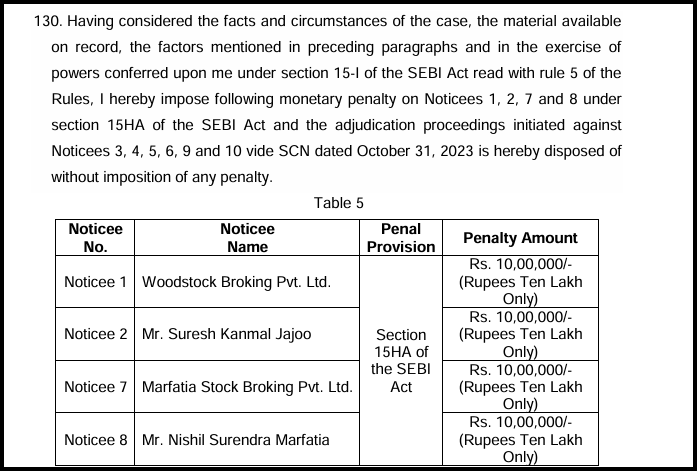
The final penalty table is below:
| Noticee | Penalty | Provision |
|---|---|---|
| Woodstock Broking Pvt. Ltd. | ₹10,00,000 | Section 15HA, SEBI Act |
| Mr. Suresh Kanmal Jajoo | ₹10,00,000 | Section 15HA, SEBI Act |
| Marfatia Stock Broking Pvt. Ltd. | ₹10,00,000 | Section 15HA, SEBI Act |
| Mr. Nishil Surendra Marfatia | ₹10,00,000 | Section 15HA, SEBI Act |
Also Read: SEBI Penalties On Motilal Oswal For Supervision Lapses
Is Woodstock Broking Or Marfatia Stock Broking SEBI Registered Or Not?
Yes. The order treats both as SEBI-registered stock brokers, and that is why the officer held them to a higher standard.
The show cause notice records Marfatia Stock Broking under Reg. No. INZ000215330 and Woodstock Broking under Reg. No. INZ000245232.
The officer wrote that a registered broker is expected to exercise heightened care over its terminal access, user chain and trading infrastructure.
Payment Deadline And Recovery Steps
The four noticees must pay within 45 days of receiving the order. Payment is online on the SEBI website through the path given in the order, under Enforcement, Orders, Orders of AO, Pay Now.
If they do not pay, SEBI may start recovery under Section 28A of the SEBI Act, with interest, including attachment and sale of movable and immovable property.
The proceedings against Noticees 3, 4, 5, 6, 9 and 10 stand disposed of without penalty.
Lessons For Investors And Market Participants
This order is about intermediaries, but investors can learn from it.
- Your orders can leak. Large orders are a target when insiders can see them in advance.
- Brokers must verify users. A terminal is not just software, it is market access.
- Account lending is risky. Letting someone else use your trading account can pull you into an enforcement case.
- Directors are checked one by one. Titles alone did not decide liability here.
If you believe an intermediary broke the rules, you can file SCORES SEBI complaint and track it online.
Conclusion
The Axis Mutual Fund front-running order shows how far SEBI looks when a scheme uses market infrastructure.
Brokers who lend access, even through IT staff, can be held to account, while directors are tested on their individual roles.
The penalties are ₹10 lakh each, but the finding on facilitation is the bigger message.
Report. Recover. Stay Fraud Free.
Adjudicating Officer Jai Sebastian passed it on November 3, 2026 in Mumbai, under Section 15-I of the SEBI Act. Woodstock Broking Pvt. Ltd., Mr. Suresh Kanmal Jajoo, Marfatia Stock Broking Pvt. Ltd. and Mr. Nishil Surendra Marfatia were fined ₹10 lakh each under Section 15HA. No. The finding was about facilitation. The officer held the brokers helped by installing terminal software and giving IT support to a Dubai user. The officer found no specific material showing they were in charge of the conduct of business, or had consented to or neglected the acts. He died on October 25, 2024. The officer treated the personal proceedings as abated without examining the merits. No. The order refers to it as the "Big Client" whose trades were allegedly front-run. The noticees are the brokers and their directors. They have 45 days from receipt of the order, and SEBI may recover the amount with interest if they do not pay.Frequently Asked Questions





 Add us as a preferred source on Google »