
Quick Summary
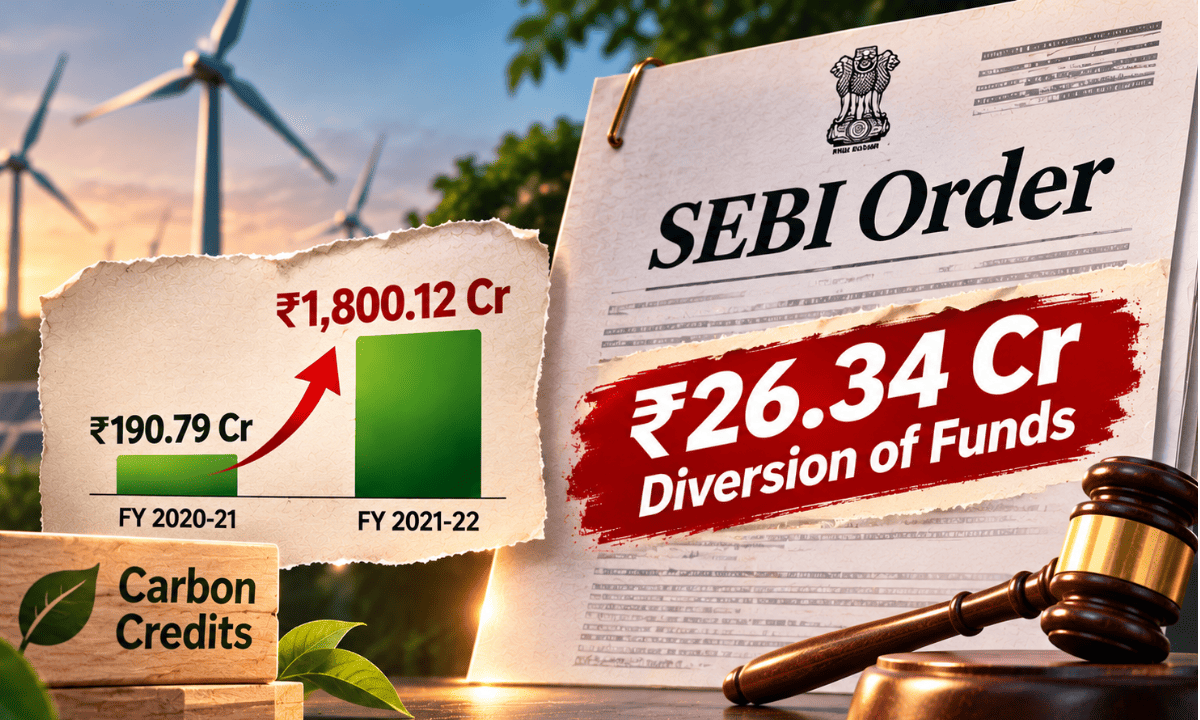
SEBI’s Quasi-Judicial Authority, N. Murugan, passed the order on October 30, 2026 against EKI Energy Services Ltd and seven others. SEBI held ₹197.04 crore of revenue was recognised too early across three quarters of FY 2022-23. It also held ₹26.34 crore of expenses were booked for services not rendered. Five noticees are barred from the market for 1 to 12 months. All eight face penalties from ₹1 lakh to ₹15 lakh per violation, payable in 45 days.
EKI Energy SEBI order highlights show ₹197 crore in premature revenue booking and ₹26.34 crore in fund diversion penalties.
EKI Energy Services booked ₹1,800.12 crore in revenue in FY 2021-22, up from ₹190.79 crore the year before.
Within a year, a new auditor questioned how some of that revenue was counted.
The EKI Energy SEBI order of October 30, 2026 now sets out what SEBI held, who it held responsible, and where it stopped short.
From ₹190 Cr to ₹1,800 Cr: The Meteoric Rise and Fall of EKI Energy’s Revenue
The case starts with a business that grew very fast and then fell just as fast. The order opens with those numbers, so they are the best place to begin.
EKI was incorporated in 2011 and trades in carbon credits globally. It also works in climate change, carbon offset solutions, and carbon asset management.
It was listed on the BSE SME platform on April 7, 2021, and moved to the mainboard on July 4, 2022.
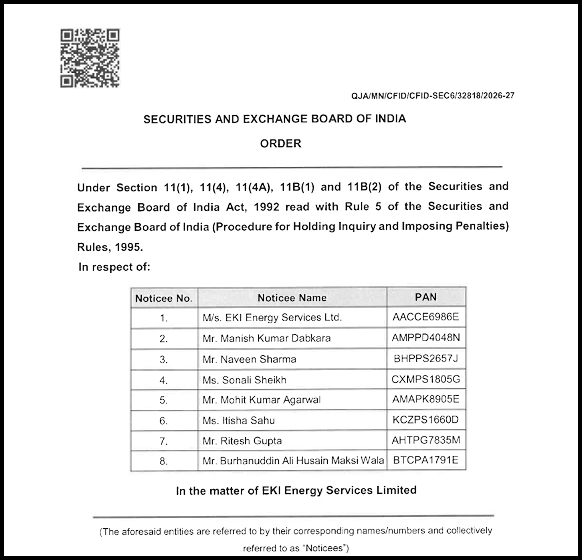
The order sets out the consolidated figures below, taken from the company’s annual reports.
| Financial year | Revenue from operations | Profit (loss) before tax |
|---|---|---|
| 2020-21 | ₹190.79 crore | ₹24.92 crore |
| 2021-22 | ₹1,800.12 crore | ₹515.41 crore |
| 2022-23 | ₹1,286.45 crore | ₹165.60 crore |
| 2023-24 | ₹263.39 crore | loss of ₹129.19 crore |
The quarterly pattern in FY 2022-23 shows the slide. Revenue was ₹509.71 crore in Q1, ₹460.36 crore in Q2, ₹413.62 crore in Q3 and ₹99.80 crore in Q4.
For comparison, Q4 of FY 2021-22 stood at ₹475.49 crore.
SEBI’s investigation covered FY 2020-21, 2021-22 and 2022-23. It looked at possible misrepresentation in the financial statements and possible diversion of funds by management.
How Did The Auditor’s Objection Set The Case In Motion?
Cases like this rarely start with SEBI. This one started with the company’s own statutory auditor.
Here is the sequence of events:
1. A New Auditor Takes Charge
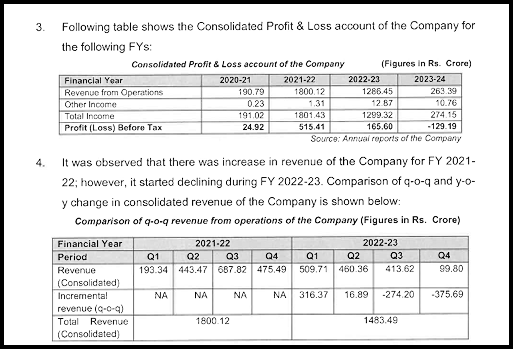
Walker Chandiok & Co. LLP (WCC) became the statutory auditor with effect from December 7, 2022.
2. The First Review Report Is Qualified
In its very first limited review report for the quarter and nine months ended December 31, 2022, WCC qualified the financial statements.
It cited a violation of Ind AS 115, the accounting standard on revenue from contracts with customers.
3. The Market Reacts
The qualified opinion is dated February 10, 2023. The scrip hit its lower circuit limit on February 13, 2023.
4. WCC Writes To The Audit Committee
On July 10, 2023, WCC wrote to EKI’s Audit Committee under Section 143(12) of the Companies Act, 2013. The order calls this the WCC Fraud Report.
5. EKI Revises Its Revenue
On September 23, 2023, EKI announced results for the quarter and year ended March 31, 2023, and revised its annual revenue downward.
The revision showed premature recognition of ₹197.04 crore.
6. SEBI Issues The Show Cause Notice
SEBI issued the show cause notice on September 18, 2025. It was served by speed post and by email on September 19, 2025.
What SEBI Alleged In The Show Cause Notice?
The notice made several separate allegations.
Reading them one by one makes the final findings much easier to follow.
1. Revenue Booked Upfront
EKI signed cook stove agreements with domestic and foreign entities. Under them, it had to distribute cookstoves and also deliver verified carbon credits (VCUs) over time.
SEBI alleged EKI booked revenue as soon as stoves were distributed, before delivering the credits.
That covered the quarters ended June 30, 2022, September 30, 2022 and December 31, 2022.
2. Revised Numbers Hard To Find
When EKI revised annual revenue on September 23, 2023, it did not revise the quarterly statements for the quarters ended June 30, 2022 and September 30, 2022.
Those revised figures only appeared in the comparative columns of later results.
They were published on September 23, 2023, and November 9, 2023.
3. Expenses Overstated
SEBI alleged EKI diverted ₹23.58 crore in FY 2021-22 and ₹24.42 crore in FY 2022-23, adding up to ₹48 crore.
The route was said to be overstated commission, legal and professional, and consultancy expenses.
The notice pointed to missing certified invoices, missing evidence of services received, and little public information on several vendors.
4. Individual Roles
The notice named the Managing Director, two Whole-Time Directors, and the CFOs. It alleged they could decide on financial matters.
It also named the independent directors who sat on the Audit Committee.
5. Summons Not Fully Answered
SEBI alleged the CFO and the Compliance Officer did not answer its summons of August 7, 2023, on the unexplained expenses. It said this hampered the investigation.
I only changed heading capitalisation (every word title-cased) and left the body text as you wrote it.
Who Faced Action In This Case?
Eight noticees were named.
Each was charged under different provisions depending on the role the notice gave them.
| No. | Noticee | Role as described in the order |
|---|---|---|
| 1 | EKI Energy Services Ltd | The company |
| 2 | Mr. Manish Kumar Dabkara | Managing Director and Audit Committee member |
| 3 | Mr. Naveen Sharma | Whole Time Director |
| 4 | Ms. Sonali Sheikh | Whole Time Director and CFO (till September 2021) |
| 5 | Mr. Mohit Kumar Agarwal | CFO |
| 6 | Ms. Itisha Sahu | Compliance Officer |
| 7 | Mr. Ritesh Gupta | Independent Director, Audit Committee Chairman |
| 8 | Mr. Burhanuddin Ali Husain Maksi Wala | Independent Director, Audit Committee member |
From Reply to Final Order: Inside EKI Energy’s Year-Long SEBI Proceeding
The proceedings took more than a year after the notice.
The order records each step, including several adjournments the noticees sought.
- Time sought, reply not filed: On October 10, 2025, the noticees asked for a month to reply. SEBI gave 15 days. No reply came, so hearing notices dated November 10, 2025, went out for a hearing on December 3, 2025.
- Inspection of documents: The noticees asked to inspect documents and to adjourn the hearing. Inspection finally took place on February 2, 2026, and they later received more documents, including the Investigation Report.
- Settlement applications: The noticees applied for settlement under SEBI’s Settlement Proceedings Regulations, 2018. The order records that the applications were rejected.
- Hearings and replies: A hearing set for May 6, 2026 was adjourned at their request. The authorised representatives appeared on June 25, 2026. Written replies came on October 5, 2026. Hearings followed on October 12 and October 16, 2026.
- Last submissions: The representatives sought time until October 26, 2026, for an additional reply. The order says no communication was received after that.
Why SEBI Rejected The Cook Stove Revenue Explanation?
This is the heart of the first finding. EKI said its accounting was a fair reading of a new kind of business.
SEBI read the contracts and disagreed.
What EKI Argued?
EKI said the Improved Cook Stove business was relatively new, with no specific SEBI circular, ICAI note or MCA notification on revenue recognition for such projects.
It said deployment and project registration transferred the carbon-generating asset to the customer. In its view, later credit issuance was only an administrative step.
EKI also said it received about ₹200 crore in advances during FY 2022-23 and had to distribute about 8 lakh stoves. It added that it set up a manufacturing facility at Nashik.
Its cost per stove was about ₹1,100, against customer consideration of ₹2,500 to ₹3,000, according to EKI.
EKI argued that restating its numbers showed good faith. It also pointed out that promoter holding stayed at about 73.4%, from 73.47% on June 30, 2022 to 73.42% on March 31, 2023.
What The Contracts Said?
SEBI examined sample agreements EKI itself shared on December 21, 2023.
They included Vitol Asia Pte Ltd, Shell Eastern Trading Pte Ltd, Aarav Investment & Consultant, Pinkcity Tourist Village Complex Pvt Ltd, BSAS Infotech Ltd and Renew Foundation.
The officer looked closely at the Shell and Vitol agreements.
1. The Shell Payments Bought Carbon Credits
Clause 5.1(a) gave Shell the right to take 80% of all issued volumes of VERs generated from the project. The order reads this as payment for credits, not for stoves alone.
2. Upfront Money Funded The Work
Clause 4.1(c) required EKI to apply upfront payments towards stoves, working capital, approvals and household induction. Schedule B released US$400,000 against an advance purchase order for 40,000 stoves, before distribution.
The order says a release of funds does not show the amount has been earned.
3. EKI’s Work Did Not End At Deployment
Clause 3.1(f) required EKI to do all things necessary to get the credits issued. Schedule C required monitoring surveys, reports and verification.
The officer said these steps contradict EKI’s description of issuance as merely administrative.
4. Registration Is Not Delivery
Clause 5.2(a) provides for credits to be issued into Shell’s registry account after project registration and first verification. The agreement separates registration from issuance and receipt.
5. The Vitol Agreement Says The Same
Vitol’s recital says EKI seeks to sell credits to be generated from the project. Clause 6.1 requires EKI to deliver the project VCUs.
Clause 1.2 defines an advance as one against VCUs to be delivered, and clause 5.1 adjusts advances against delivered credits.
6. An Inconsistency In EKI’s Own Case
EKI called the credit stage administrative. Yet it also treated credit delivery as a separate obligation to justify phased revenue.
The order says the second point accepts the substance the first point dismisses.
The officer concluded that the real obligation was the promise to generate and deliver credits, with deployment and registration as parts of it.
Only the headings changed; the body text is as you wrote it.
The Quarter-Wise Effect
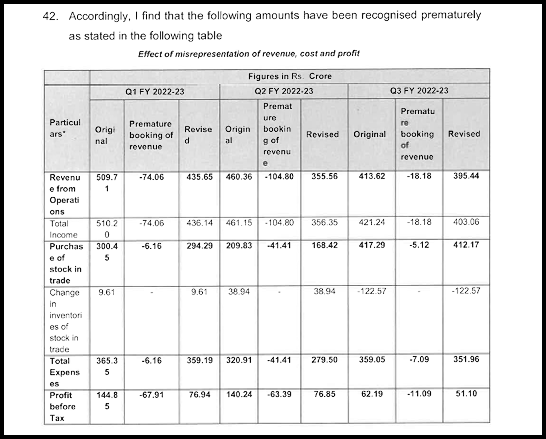
SEBI compared original and revised figures for the first three quarters of FY 2022-23.
| Quarter | Original revenue | Premature booking | Revised revenue |
|---|---|---|---|
| Q1 FY 2022-23 | ₹509.71 crore | ₹74.06 crore | ₹435.65 crore |
| Q2 FY 2022-23 | ₹460.36 crore | ₹104.80 crore | ₹355.56 crore |
| Q3 FY 2022-23 | ₹413.62 crore | ₹18.18 crore | ₹395.44 crore |
The three amounts add up to the ₹197.04 crore the officer found was recognised prematurely.
Q1 profit before tax fell from ₹144.85 crore to ₹76.94 crore on revision. Q2 fell from ₹140.24 crore to ₹76.85 crore.
Why SEBI Called It Reckless?
The officer did not stop at the accounting error. The order also looks at how EKI published and defended the figures.
The same treatment ran across three quarters. The results went to the stock exchange on July 29, 2022, November 4, 2022 and February 10, 2023.
The qualification dated February 10, 2023, named the issue and quantified its effect. EKI’s clarification of February 15, 2023 still defended the deployment explanation.
EKI revised the figures only on September 23, 2023. The order says Q1 stayed unrevised for more than a year, Q2 for more than ten months, and Q3 for more than seven months.
EKI had argued that WCC raised the issue after the Audit Committee decided to remove it. The order notes the February 10, 2023 qualification came before the July 5, 2023 decision on WCC’s removal.
The officer held that the claim of a bona fide interpretation did not explain the repeated recognition. The order finds the representations were made recklessly and without reasonable grounds.
SEBI held the publication also broke the LODR Regulations, including Regulations 4(1), 33(1) and 48 read with Ind AS 115. It held EKI contravened Section 12A(c) of the SEBI Act and the PFUTP Regulations.
The order also records price and volume data around the results. The scrip closed at ₹1,097.15 on February 10, 2023 and sat at ₹877.75 on February 13, 2023, its lower circuit.
Also Read: Praveg Limited SEBI Order
The ₹26.34 Crore Expense Finding Explained
The notice alleged ₹48 crore of overstated expenses.
The final finding is narrower, and the order explains exactly why.
What EKI Said About Its Commission And Consultants?
EKI said its cook stove business needed local agents across Bihar, Uttar Pradesh, Madhya Pradesh and Rajasthan. It also used international intermediaries who introduced global buyers.
It said that ₹39 crore of commission across FY 2021-22 and FY 2022-23 was small against revenues of about ₹1,800 crore and ₹1,258 crore.
EKI argued that missing certified invoices and thin vendor information show record-keeping gaps, not fake transactions.
It relied on a forensic review by M. Borar & Co. dated August 21, 2023 (the Borar Report), legal opinions of August 21 and 23, 2023, and an MCA inspection.
It also cited Income Tax scrutiny assessments and four orders of the Registrar of Companies, Gwalior, dated June 29, 2026.
Why SEBI Did Not Accept That Evidence?
The officer tested each source against the transactions.
The order explains why none of them settled the question of the amounts finally held diverted.
1. The Borar Report Had Gaps
In some cases, the report recorded that the claim of services not being rendered was “disproved”. The agent’s commission agreement, however, covered a purchase while the actual deal was a sale.
Elsewhere, agreements were missing or defective, or only transaction confirmation receipts existed. The order says the report did not explain how these gaps were resolved.
The same report treated 34 vendors supported only by invoices as “proved” on non-receipt of services. The officer read that as recognising that invoices alone do not prove services.
2. The Legal Opinion Rested On Limited Documents
The opinion said it relied on documents submitted for it. EKI did not show in its reply that the same documents were placed before SEBI.
3. The MCA Outcome Was Not Decisive
The MCA directed no penal action by letter dated April 2, 2026. The officer said that the decision does not show that every disputed vendor rendered the claimed services.
The order notes EKI did not say which documents or issues the MCA examined.
4. The Tax Assessments Did Not Help Either
The officer said non-disallowance in scrutiny does not help unless EKI shows what was verified. The order adds that Section 32 of the SEBI Act lets SEBI act alongside other laws.
5. Documentation Gaps Alone Were Not Enough
The officer agreed that a missing certified invoice, limited public information on a vendor, or a one-off engagement does not alone make an expense fictitious.
The order says a vendor may exist and still not have rendered the particular service.
The adverse findings cover only transactions where the cumulative evidence supported that conclusion.
6. The Final Number
The officer held that, to the extent identified in the transaction-wise findings, EKI booked fictitious expenses against services not rendered.
The payments were a diversion of its funds.
The order puts the amount at ₹26.34 crore across FY 2021-22 and FY 2022-23. The vendor-wise findings sit in the annexure to the order.
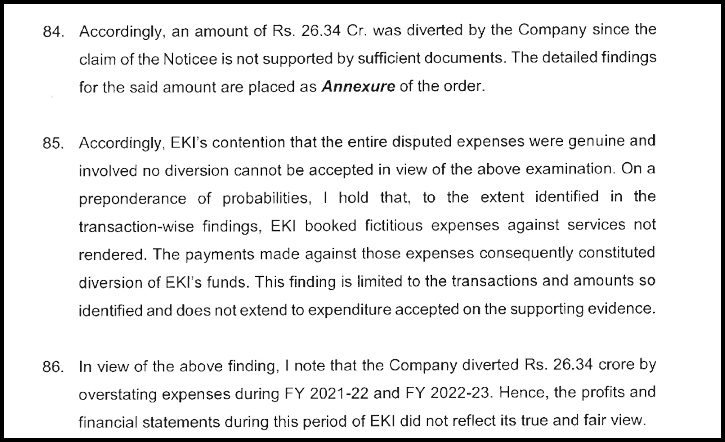
The finding does not reach expenditure accepted on the supporting evidence. The order also says money returning to promoters or directors is not needed to prove diversion of company funds.
Also Read: Brightcom Group SEBI Order And The Interim Bar On Its CEO And CFO
What SEBI Found Against Each Noticee?
The company and its officers did not get identical findings.
The officer tied each person to the period and role in the record.
1. EKI Energy Services Ltd
SEBI held that the company published and continued to disclose revenue prematurely recognised by ₹197.04 crore.
It also held that the company reported expenses that were fictitious by ₹26.34 crore.
These findings fall under Section 12A(c) of the SEBI Act and the PFUTP Regulations, with a penalty under Section 15HA. The LODR breaches carry a penalty under Section 15HB.
2. Mr. Manish Kumar Dabkara
The order describes him as the Managing Director who incorporated EKI in 2011. It says he was an Audit Committee member from November 28, 2020.
On revenue, the officer found “reckless fraud” at the stage when the quarterly results were first approved. The order says it does not attribute deliberate falsification merely from the later objection or reversal.
The deliberate element attaches to later conduct. After WCC’s qualification on February 10, 2023, EKI kept defending the treatment on February 15, 2023.
On expenses, the order notes that he signed several carbon-credit trade and commission agreements.
It also notes that he took part in the Audit Committee’s review of the WCC concerns, the legal opinion, and the Borar Report.
Those materials were available before the board meeting of September 23, 2023, which he attended. The officer found fraudulent misrepresentation and diversion in the identified payments.
The officer also held that his CEO/CFO certificate under Regulation 17(8) for FY 2021-22 and FY 2022-23 was “grossly misleading”. Section 27(1) of the SEBI Act also applied.
3. Mr. Naveen Sharma
He was a Whole-Time Director for FY 2021-22 and FY 2022-23, with a role in trading and business development. Mr. Sharma argued he had no part in accounts or approvals.
The officer held that taking part in approving financial information carried a duty of independent care. The order finds “reckless fraud” in the quarterly revenue approvals attributable to him.
It finds the same for the commission-related reporting on the established transactions.
4. Ms. Sonali Sheikh
Her case shows how closely the officer matched liability to the record. She was CFO from November 1, 2020 to September 30, 2021, and a Whole Time Director from November 5, 2020.
The officer was not held liable for the quarterly revenue issue, which arose after her CFO tenure. The notice also did not allege she signed the FY 2021-22 or FY 2022-23 financials.
The order confines her liability to reckless misrepresentation of expense reporting for the part of FY 2021-22 up to September 2021.
5. Mr. Mohit Kumar Agarwal
Mr. Agarwal worked as a consultant from January 19, 2021 to September 30, 2021, and became CFO from October 1, 2021. The accounts team reported to him.
The officer held him responsible for the premature revenue and the identified fictitious expenses, calling it reckless fraudulent disclosure. His certificates under Regulation 17(8) were also held misleading.
The order also found him in breach of the summons, covered below.
6. Ms. Itisha Sahu
The Compliance Officer faced a narrower charge. SEBI’s summons of August 7, 2023 asked for clarifications and documents on the transactions in Annexure B to the WCC Fraud Report.
Information for FY 2022-23 was provided. Information for FY 2021-22 was not provided.
The officer rejected the plea that FY 2021-22 had already been audited and that FY 2022-23 was prioritised. The order holds that willingness to comply does not discharge the duty to furnish.
The same finding applies to Mr. Agarwal. His response of December 19, 2023, after he undertook to reply on December 12, 2023, still lacked the FY 2021-22 material.
7. Mr. Ritesh Gupta And Mr. Burhanuddin Ali Husain Maksi Wala
Both were independent directors on the Audit Committee. The officer gave the committee credit for acting on WCC’s concerns.
It appointed outside experts and considered their reports before recommending the FY 2022-23 statements on September 23, 2023.
The failure lay elsewhere. FY 2021-22 information was not given to the experts, and the order says no evidence shows the committee questioned this before relying on their reports.
The officer found a failure of due diligence to that extent only, under Regulation 18(3) of the LODR Regulations.
Where SEBI Drew The Line In The Order?
A fair reading of the order shows several points that went the noticees’ way, fully or partly.
They matter when you judge how far the findings reach.
- Later objection did not prove early intent: The officer wrote that deliberate falsification was not attributed to Mr. Dabkara for the earlier quarterly approvals merely because WCC objected later.
- The annual statements carried corrected revenue: The FY 2022-23 annual statements approved on September 23, 2023 included the revised revenue. The order says they do not carry the impugned misrepresentation.
- The expense finding is narrower than the allegation: The notice alleged ₹48 crore. The finding is ₹26.34 crore, limited to identified transactions.
- Role limits for some noticees: Ms. Sheikh was held liable only for expenses during her CFO tenure. The independent directors were not held liable for the earlier quarterly approvals because no red flag was shown to be apparent to them then.
- Mitigating factors in the penalty: The officer took into account that EKI revised its first three quarters’ revenue when announcing audited results for FY 2022-23.
Market Bars And Penalties Imposed On Each Noticee
The final directions combine market bans and monetary penalties.
This is where each noticee’s outcome becomes clear.
Market Bar From The Date Of The Order
The five noticees below are restrained from accessing the securities market and from buying, selling or dealing in securities, including mutual fund units, directly or indirectly.
| Noticee | Period of bar |
|---|---|
| EKI Energy Services Ltd | 2 months |
| Mr. Manish Kumar Dabkara | 12 months |
| Mr. Naveen Sharma | 5 months |
| Ms. Sonali Sheikh | 1 month |
| Mr. Mohit Kumar Agarwal | 8 months |
Anyone with open positions in exchange-traded derivatives can close them within 3 months from the date of the order or at expiry, whichever is earlier.
They may also settle pay-in and pay-out obligations for trades done before the close of trading on the order date.
The order also directs Mr. Dabkara to take immediate steps to recoup the diverted amount for EKI.
Monetary Penalties
The order imposes a separate penalty for each violation.
Here is the full list:
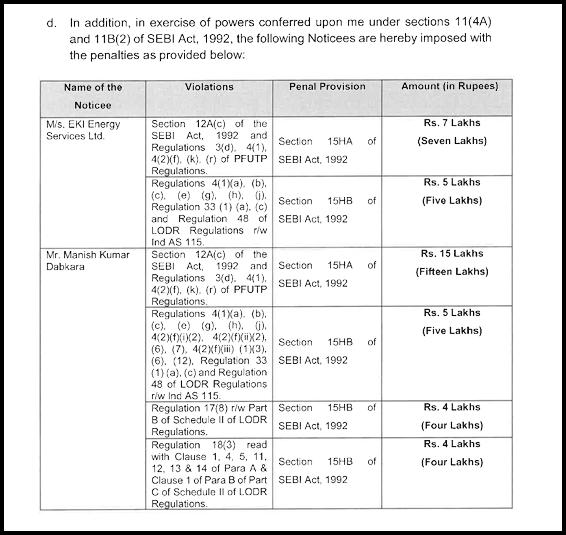
| Noticee | Violation | Provision | Penalty |
|---|---|---|---|
| EKI Energy Services Ltd | PFUTP Regulations and Section 12A(c) | Section 15HA | ₹7 lakh |
| EKI Energy Services Ltd | LODR Regulations read with Ind AS 115 | Section 15HB | ₹5 lakh |
| Mr. Manish Kumar Dabkara | PFUTP Regulations and Section 12A(c) | Section 15HA | ₹15 lakh |
| Mr. Manish Kumar Dabkara | LODR Regulations read with Ind AS 115 | Section 15HB | ₹5 lakh |
| Mr. Manish Kumar Dabkara | Regulation 17(8) certification | Section 15HB | ₹4 lakh |
| Mr. Manish Kumar Dabkara | Regulation 18(3) Audit Committee duties | Section 15HB | ₹4 lakh |
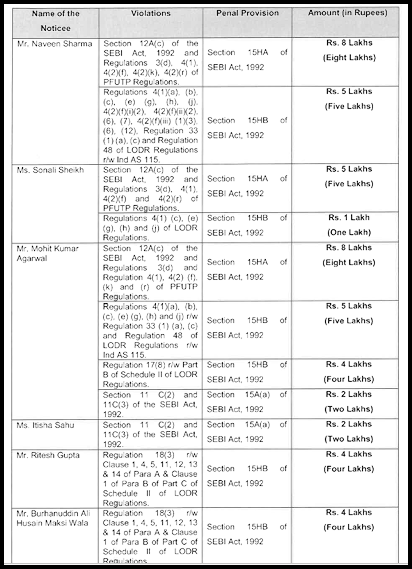
| Mr. Naveen Sharma | PFUTP Regulations and Section 12A(c) | Section 15HA | ₹8 lakh |
| Mr. Naveen Sharma | LODR Regulations read with Ind AS 115 | Section 15HB | ₹5 lakh |
| Ms. Sonali Sheikh | PFUTP Regulations and Section 12A(c) | Section 15HA | ₹5 lakh |
| Ms. Sonali Sheikh | LODR Regulations 4(1)(c), (e), (g), (h), (j) | Section 15HB | ₹1 lakh |
| Mr. Mohit Kumar Agarwal | PFUTP Regulations and Section 12A(c) | Section 15HA | ₹8 lakh |
| Mr. Mohit Kumar Agarwal | LODR Regulations read with Ind AS 115 | Section 15HB | ₹5 lakh |
| Mr. Mohit Kumar Agarwal | Regulation 17(8) certification | Section 15HB | ₹4 lakh |
| Mr. Mohit Kumar Agarwal | Sections 11C(2) and 11C(3), summons | Section 15A(a) | ₹2 lakh |
| Ms. Itisha Sahu | Sections 11C(2) and 11C(3), summons | Section 15A(a) | ₹2 lakh |
| Mr. Ritesh Gupta | Regulation 18(3) Audit Committee duties | Section 15HB | ₹4 lakh |
| Mr. Burhanuddin Ali Husain Maksi Wala | Regulation 18(3) Audit Committee duties | Section 15HB | ₹4 lakh |
Ms. Sahu, Mr. Gupta and Mr. Maksi Wala face penalties only. The order does not bar them from the market.
How SEBI Sets the Amounts?
Each section has its own range. Section 15HA starts at ₹5 lakh and goes up to ₹25 crore or three times the profits made, whichever is higher.
Section 15HB runs from ₹1 lakh to ₹1 crore. Section 15A(a) starts at ₹1 lakh and can go up to ₹1 lakh per day of default, with a ₹1 crore cap.
The officer then went through the Section 15J factors.
- Gain: No quantifiable disproportionate gain or unfair advantage was on record.
- Loss: No directly quantifiable loss to specific investors was on record. The officer still noted that diversion of company funds is inherently detrimental to shareholders.
- Repetition: Nothing on record showed earlier similar violations.
- Mitigation: The revision of the first three quarters’ revenue in the audited FY 2022-23 results counted in the noticees’ favour.
How To Pay The Penalties And What The Order Says Next?
The order takes effect immediately. The noticees must pay within 45 days of receiving it.
Payment is online on sebi.gov.in through ENFORCEMENT > Orders > Orders of EDs/CGMs > PAY NOW. For payment trouble, the order lists [email protected].
After paying, the noticees must send the payment details to the Division Chief, CFID SEC-3, SEBI Bhavan II, Plot No. C-7, G Block, Bandra Kurla Complex, Mumbai 400051.
They must also email [email protected].
The details must cover the case name, payee name, date, amount, transaction number, bank details, and whether the payment is for penalty or disgorgement.
SEBI will send a copy of the order to the noticees, all recognised stock exchanges, depositories and registrars and transfer agents of mutual funds, so the directions are followed.
What Shareholders And Investors Can Learn From The Order?
The order is long, but a few practical lessons stand out for anyone holding a listed stock.
1. Advance Payments Are Not Always Revenue
The order says money received against an ongoing promise is not revenue earned until the performance is complete.
Look at how a company explains big revenue jumps.
2. An Auditor’s Qualification Is A Signal
WCC’s qualified opinion on February 10, 2023, was followed by a lower circuit within days. Read the auditor’s remarks before the numbers.
3. Other Agencies’ Outcomes Do Not Bind SEBI
MCA and tax outcomes went EKI’s way in some respects.
The officer said they do not exclude SEBI’s own findings, as Section 32 of the SEBI Act allows SEBI to act alongside other laws.
4. Roles On The Board Matter
The officer matched each person’s liability to the period and duties on record. A director’s title alone was not treated as proof of liability.
5. Price Moves On Announcements Need A Closer Look
SEBI has examined sharp price swings tied to company announcements in other matters too, such as the LS Industries SEBI case.
6. Complaints Have A Proper Channel
If you believe a listed company or intermediary broke the rules, you can file a SEBI SCORES complaint and track it online.
Only the headings changed; the body text and both links are as you wrote them.
Conclusion
The EKI Energy SEBI order shows how closely SEBI reads contracts before accepting a revenue explanation. It tied the finding to specific clauses, not just to the auditor’s view.
It also shows SEBI limiting its findings. The expense finding came down from ₹48 crore to ₹26.34 crore, and several noticees were held liable only for a defined period or duty.
Penalties ran from ₹1 lakh to ₹15 lakh per violation, alongside market bars of one to twelve months for five noticees. The order took effect immediately.
For investors, the lesson is simple. Read auditor remarks, check how revenue is explained, and use the proper complaint channels when something looks wrong.
Report. Recover. Stay Fraud Free.
SEBI imposed ₹1,00,000 under Section 15HB of the SEBI Act and ₹1,00,000 under Section 23H of the SC(R) Act. Adjudicating Officer Amit Kapoor passed it on November 2, 2026 in Mumbai. The order number is Order/AK/BK/2026-27/32819. Three provisions of Annexure I to the SEBI circular of March 10, 2017, read with Regulation 11 of the LODR Regulations. They are Clauses I.A.3(a), I.A.8(b) and I.A.10. It fell from 93.40% to 26.03%, according to the order's tables. The officer said it did not erase the violation. It was counted when deciding the amount of the penalty. 45 days from receipt of the order, through the SEBI website payment link.Frequently Asked Questions

 Add us as a preferred source on Google »