
Quick Summary
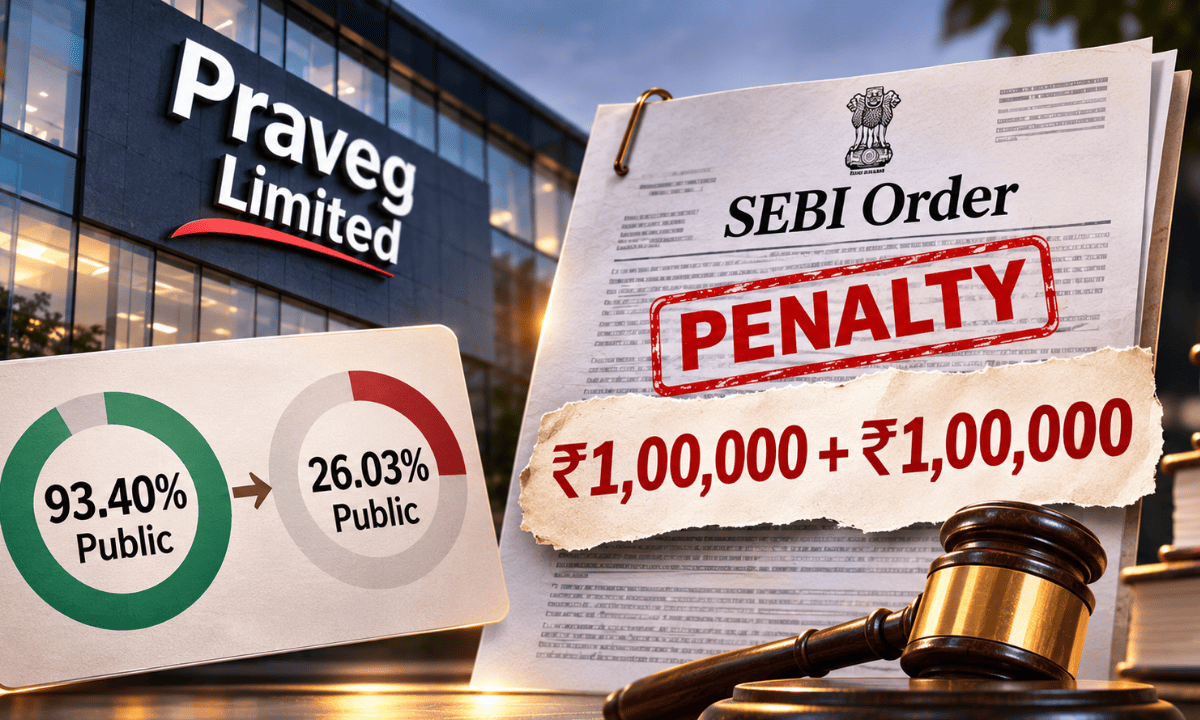
SEBI Adjudicating Officer Amit Kapoor fined Praveg Limited (formerly Praveg Communications (India) Limited) in an order dated November 2, 2026. The 2018-19 merger paperwork missed prescribed disclosures and left out a voting safeguard in the scheme filed with the NCLT. The penalty is ₹1,00,000 under Section 15HB of the SEBI Act and ₹1,00,000 under Section 23H of the SC(R) Act. Payment is due in 45 days. Praveg’s delay and “already cured” arguments did not erase the lapses.
Public shareholders held 93.40% of a listed company. After one merger, they held 26.03%.
Did they get the full picture before they voted?
The Praveg Limited SEBI order says key information was missing at the time, and it ends with a penalty of ₹1,00,000 under each of two laws.
Praveg Communications Merger With SSPL: Timeline Of Events
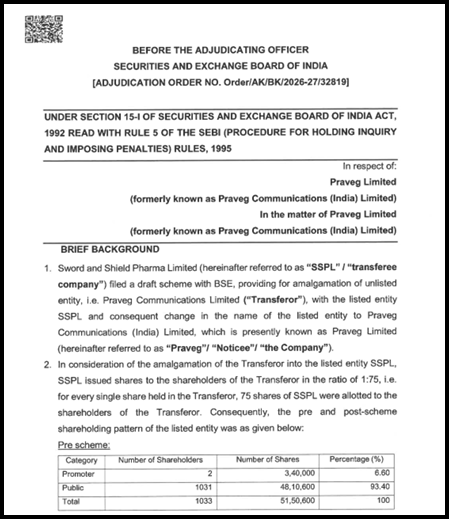
To follow this case, you need the merger story first. The order starts there, and every date matters later.
Here is how it unfolded, step by step:
1. The Draft Scheme
Sword and Shield Pharma Limited (SSPL), a listed entity, filed a draft scheme with BSE.
It proposed amalgamating an unlisted entity, Praveg Communications Limited, into SSPL.
2. The Name Change
After the amalgamation, the listed entity was to be renamed Praveg Communications (India) Limited.
It is presently known as Praveg Limited, the Noticee in this order.
3. The Share Swap
SSPL issued shares to the unlisted company’s shareholders at a 1:75 ratio.
That means 75 SSPL shares for every single share held in the unlisted company.
4. BSE’s Observation Letter
BSE issued its observation letter on May 5, 2018, after incorporating SEBI’s comments.
5. The NCLT Stage
The NCLT, Ahmedabad Bench, sent BSE a notice dated March 6, 2019.
BSE then wrote to Praveg on May 3, 2019, seeking clarifications. It sent its observations to the NCLT and the Regional Director, MCA, on May 29, 2019.
6. Approval And The Condonation Request
The scheme came into effect after NCLT approval in January 2020.
SEBI received a condonation application from Praveg dated September 16, 2020. Prima facie violations were found, and SEBI rejected the application by letter dated November 25, 2020.
Public Shareholding Fell From 93.40% To 26.03% After The Merger
The share swap changed who controlled the company. That is why the disclosure rules matter so much here.
The order gives these before and after figures.
| Category | Shares before scheme | Holding before | Shares after scheme | Holding after |
|---|---|---|---|---|
| Promoter | 3,40,000 | 6.60% | 1,36,73,500 | 73.97% |
| Public | 48,10,600 | 93.40% | 48,10,600 | 26.03% |
| Total | 51,50,600 | 100% | 1,84,84,100 | 100% |
The public’s shares stayed at 48,10,600. Their percentage fell because the promoter side received a very large block of new shares.
The order’s tables also list shareholder counts, but the post-scheme counts do not add up on their face. This blog therefore sticks to the share numbers and percentages.
Three Merger Disclosure Violations SEBI Found Against Praveg
SEBI’s circular of March 10, 2017 sets out what a listed company must do before a merger goes to the NCLT. The Adjudicating Officer read it together with Regulation 11 of the LODR Regulations.
That regulation says a scheme must not violate, override, or limit securities laws or stock exchange requirements. SEBI found three gaps.
Violation 1: Unlisted Company Details Missing In Abridged Prospectus Format
Clause I.A.3(a) of Annexure I requires information on the unlisted entity in the abridged prospectus format under the ICDR Regulations.
It must sit inside the explanatory statement sent to shareholders.
BSE had flagged on May 29, 2019, that SSPL had not done this.
Praveg said it acted in good faith and with no mala fide intent. It added that the shortcoming was later fixed with shareholder and regulatory approval.
The Adjudicating Officer looked at Praveg’s own 2021 shareholder resolution. It referred to additional disclosures “not earlier included in the Explanatory Statement” for the meeting held on April 10, 2019.
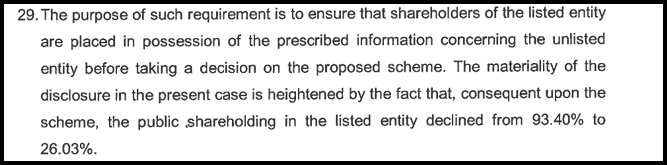
The order notes the materiality was heightened because public shareholding fell from 93.40% to 26.03%. Praveg was found to have violated Clause I.A.3(a) read with Regulation 11.
Violation 2: Pre- and Post-Merger Shareholding Pattern Not Disclosed
Clause I.A.8(b) requires the explanatory statement to disclose the expected capital structure and shareholding pattern before and after the merger. It also requires the fairness opinion from a merchant banker.
Here, the order notes that Praveg did not specifically dispute the non-disclosure. It called the lapses procedural.
Shareholders were being asked to approve a scheme that cut the public stake sharply. The order calls the missing pattern material information for that decision.
Praveg was found to have violated Clause I.A.8(b) read with Regulation 11.
Violation 3: Public Voting Safeguard Left Out Of The NCLT Scheme
This gap is different. It is about a sentence that existed in one version of the scheme and vanished from another.
The revised scheme submitted to BSE, when it sought its no-objection, carried a statement based on para 9(b) of the circular.
It said the scheme would be acted upon only if votes cast by public shareholders in favour exceed the votes cast against.
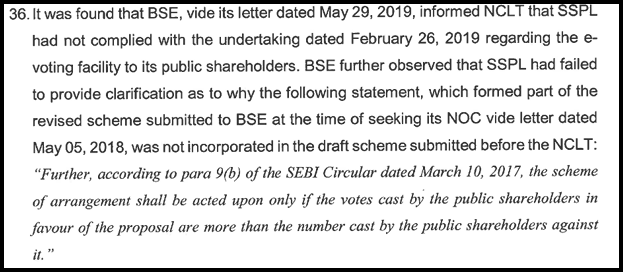
BSE told the NCLT on May 29, 2019 that this statement was not in the draft scheme submitted to the NCLT.
It also said SSPL had not complied with its undertaking dated February 26, 2019 on an e-voting facility for public shareholders.
Praveg said it filed the scheme with the NCLT on November 2, 2018. It amended it after the NCLT order of December 13, 2019.
It added that the changes did not touch commercial terms, the exchange ratio or structure.
The Adjudicating Officer rejected that link. The December 2019 amendment was not the change in question, because the omission came earlier.
No material showed that a regulator, authority or tribunal had directed the omission. Praveg was found to have violated Clause I.A.10 read with Regulation 11.
Also Read: DB Realty Penalty Order On Disclosure Gaps
BSE Listing Agreement Clauses: Why No Separate Finding?
Besides the SEBI circular, the show cause notice alleged breach of Clauses 2(i) and 2(iii) of the BSE Listing Agreement.
These were alleged as a consequence of the three violations above, not as separate lapses.
The Adjudicating Officer had already found the substantive violations of the circular read with Regulation 11 of the LODR Regulations.
So the officer did not consider it necessary to record a separate finding on the Listing Agreement clauses. The penalty rests on the three circular violations
From Show Cause Notice To Hearing: Praveg’s SEBI Proceedings
The merger paperwork dates to 2018-19, but the penalty order came in November 2026. The gap between them was itself a major point in the case.
Here are the steps of the proceedings:
1. Appointment Of The Adjudicating Officer
SEBI approved adjudication and appointed the Adjudicating Officer by order dated July 11, 2025. The appointment was communicated on July 14, 2025.
2. The Show Cause Notice
The notice is dated August 19, 2025. It was served by SPAD and a digitally signed email.
It sought reasons why a penalty should not be imposed under Section 15HB of the SEBI Act and Sections 23H and 23E read with Section 21 of the SC(R) Act.
3. Reply And Settlement Attempt
Praveg replied on September 22, 2025. It filed a settlement application on September 25, 2025.
That application was rejected, and the rejection was communicated by letter dated July 10, 2026.
4. The Hearing
A hearing notice went out on August 4, 2026. The hearing was held online on August 17, 2026 through Praveg’s authorised representative.
Praveg filed further submissions the same day.
Praveg’s Defences Against The SEBI Penalty And The Officer’s Replies
Praveg did not simply deny the facts. It argued the case should never have reached a penalty at all.
Each defence is below, with how the Adjudicating Officer responded.
1. “The Delay Is Too Long”
Praveg said adjudication was approved on December 30, 2020. Yet the officer was appointed only on July 11, 2025, and the notice came on August 19, 2025.
It said that it was more than six years after the alleged defaults. It relied on Supreme Court rulings and SAT decisions, including Rakesh Kathotia and Ashok Shivlal Rupani.
The officer noted that the SEBI Act and the SC(R) Act prescribe no limitation period for starting adjudication. Whether a delay matters depends on the facts.
The officer cited SAT decisions in Hemant Sheth (January 7, 2022), Metex Marketing (June 4, 2019) and Pooja Vinay Jain (March 17, 2020).
In Bharat J Patel (September 8, 2020), SAT said prejudice depends on the facts of each case.
2. “We Were Prejudiced”
Praveg argued the matter was closed in 2021 and that personnel had changed. It said it was answering in 2025 for 2019 lapses cured for over four years.
The officer found no specific prejudice beyond a general assertion about changed personnel. Praveg had also relied on contemporaneous records in its replies.
3. “The NCLT Already Settled This”
Praveg said BSE’s three allegations were before the NCLT during sanction. It pointed to the NCLT order of September 20, 2021, which recorded that BSE’s objections “have been complied with”.
It also said a sanctioned scheme binds all stakeholders, and called this proceeding a collateral attack.
The officer disagreed. That order records compliance with BSE’s objections, not that the original disclosures were compliant.
4. “SEBI Itself Suggested The Cure”
Praveg relied on BSE’s letter of June 4, 2021, which proposed a way to comply with the March 2017 circular. BSE had shared the proposal with SEBI.
Praveg then put Resolution number 5 before shareholders at its 26th AGM on July 23, 2021. It passed by the requisite majority, and BSE granted listing approval on November 1, 2021.
The officer noted these steps. He treated them as relevant to the amount of penalty, not as a defence to the violation.
5. “We Were Punished Twice”
Praveg said it was already punished once by a 19-month deprivation of listing. It also cited a lock-in of over 1.33 crore shares.
The order does not treat this as a bar. It does count Praveg’s subsequent steps when fixing the penalty.
6. “It Was Technical And In Good Faith”
Praveg said it acted on professional advice and that any breach was, at the highest, technical and venial.
The officer noted the submission of no mala fide intent. It does not alter the fact that the prescribed information was missing at the relevant time.
7. “No Market-Wide Impact”
Praveg argued the lapses did not affect market integrity, and that a penalty would be formalism.
The officer said compliance with securities laws, regulations and circulars is essential for orderly functioning of the market and investor protection.
Also Read: Integra Switchgear SEBI Order
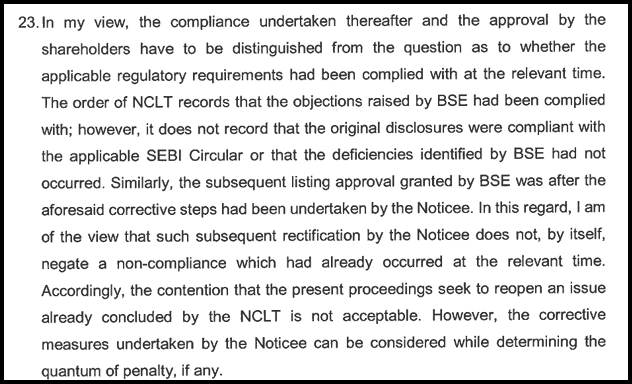
Why Later Shareholder And NCLT Approval Did Not Cancel The Penalty?
This is the heart of the order. It answers a question many companies ask: if we cure the problem, can we still be penalised?
The officer said yes. Corrective steps and later approvals have to be separated from whether the rules were met at the relevant time.
The NCLT order did not record that the deficiencies identified by BSE had not occurred. Likewise, BSE’s listing approval came only after the corrective steps.
In the officer’s words, later rectification “does not, by itself, negate a non-compliance which had already occurred”.
Merger and deal approvals through courts and tribunals often raise disclosure questions of their own, as the Future Retail and Amazon SEBI case showed on a much larger deal.
SEBI Penalty On Praveg: How ₹1 Lakh Under Each Law Was Fixed?
The penalty provisions allow a range. Sections 15HB and 23H both set a floor of ₹1 lakh and a ceiling of ₹1 crore where no separate penalty is provided.
The officer had to weigh the factors in Sections 15J and 23J.
Here is what he recorded:
1. Gain Or Loss
The record does not quantify any disproportionate gain or unfair advantage. It also does not quantify any loss caused to investors.
2. Repetition
There was nothing on record showing any past violations by Praveg.
3. Corrective Steps And Delay
The later disclosures, the July 2021 shareholder approval, the NCLT’s record, and BSE’s listing approval were all taken into account. So was Praveg’s point about the time taken to start proceedings.
The officer added that these do not affect the findings on the violations.
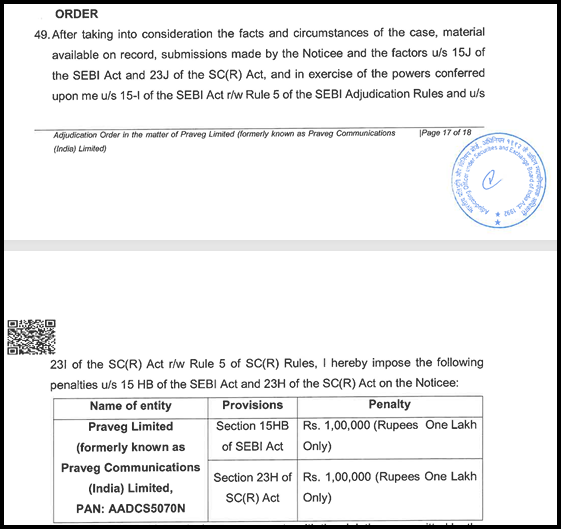
4. The Final Penalty
| Entity | Provision | Penalty |
|---|---|---|
| Praveg Limited (formerly Praveg Communications (India) Limited) | Section 15HB, SEBI Act | ₹1,00,000 |
| Praveg Limited (formerly Praveg Communications (India) Limited) | Section 23H, SC(R) Act | ₹1,00,000 |
The officer called the penalty commensurate with the violations. Both amounts sit at the lowest point each section allows.
How To Pay The SEBI Penalty: 45-Day Deadline And Recovery Risk
Praveg must pay within 45 days of receiving the order. Payment is online on sebi.gov.in.
The path is ENFORCEMENT > Orders > Orders of AO > PAY NOW. For payment difficulties, the order lists [email protected].
If Praveg does not pay in time, SEBI may start consequential action. That includes recovery proceedings under Section 28A of the SEBI Act and Section 23JB of the SC(R) Act.
Recovery covers the penalty with interest, including attachment and sale of movable and immovable properties. A copy of the order goes to Praveg and to SEBI.
Lessons For Shareholders From The Praveg Merger Case
Most investors never read a merger explanatory statement closely.
This case shows why the details inside one can matter.
1. Check What The Notice Actually Contains
A merger notice should show the pre- and post-merger shareholding pattern and the expected capital structure. If it does not, that is a question worth raising.
2. Watch What Happens To Your Percentage
Here, the public’s share count did not change, but its stake fell from 93.40% to 26.03%.
3. Delay Does Not Wipe Out A Lapse
SEBI can act years later. The Adjudicating Officer found no limitation period in the SEBI Act or the SC(R) Act.
4. Complaints Have A Proper Channel
If you believe a company or intermediary has broken the rules, you can file a SEBI SCORES complaint and track it online.
Conclusion
SEBI recorded that no gain or investor loss was quantified in this case.
It is about whether shareholders received the prescribed information at the right time, before they approved a scheme that reshaped ownership.
The officer held that fixing things later, with approval from shareholders, the NCLT, and BSE, did not undo the original lapses. It did, however, shape the final penalty at the lowest level the law allows.
Report. Recover. Stay Fraud Free.
SEBI imposed ₹1,00,000 under Section 15HB of the SEBI Act and ₹1,00,000 under Section 23H of the SC(R) Act. Adjudicating Officer Amit Kapoor passed it on November 2, 2026 in Mumbai. The order number is Order/AK/BK/2026-27/32819. Three provisions of Annexure I to the SEBI circular of March 10, 2017, read with Regulation 11 of the LODR Regulations. They are Clauses I.A.3(a), I.A.8(b) and I.A.10. It fell from 93.40% to 26.03%, according to the order's tables. The officer said it did not erase the violation. It was counted when deciding the amount of the penalty. 45 days from receipt of the order, through the SEBI website payment link.Frequently Asked Questions




 Add us as a preferred source on Google »