
Quick Summary
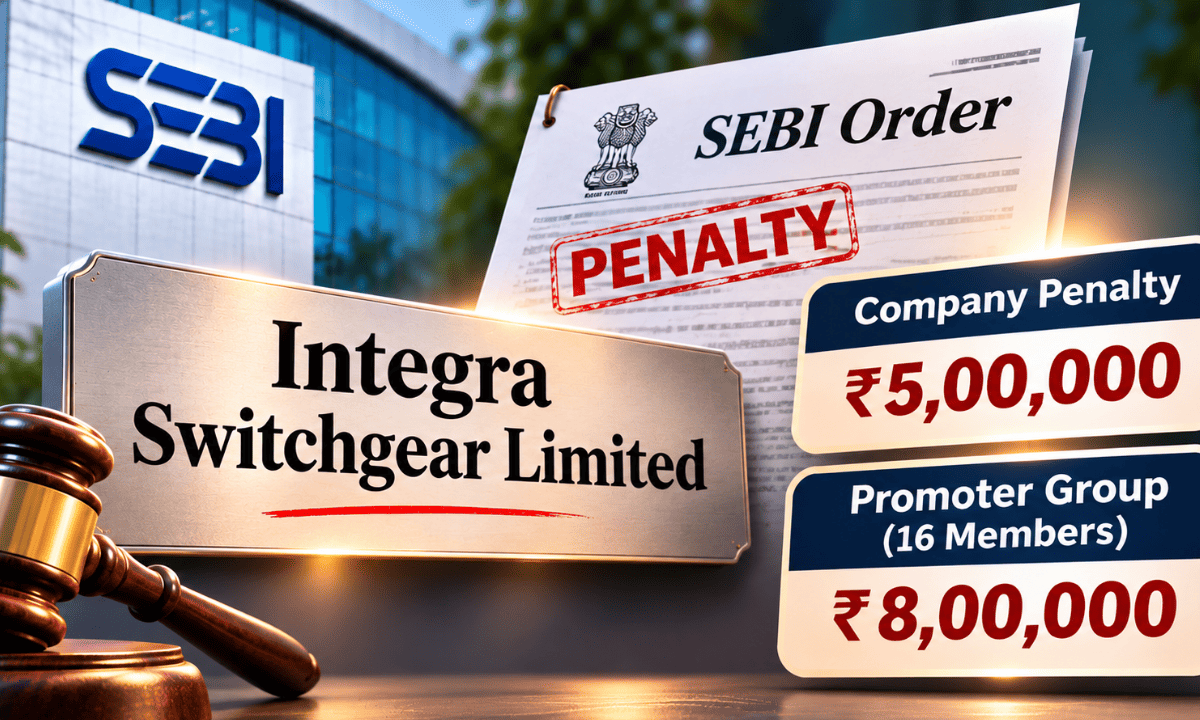
Adjudicating Officer Medha Sonparote fined Integra Switchgear Limited ₹5,00,000 under Section 15HB for wrong shareholding filings and reclassifications without BSE approval. Sixteen promoter group noticees were fined ₹8,00,000, jointly and severally, under Section 15A(b) for late disclosures under SAST Regulation 29. The disclosures were delayed by 2, 1,763 and 1,123 days. The officer found no quantifiable gain or investor loss on record. Payment is due within 45 days of the October 30, 2026 order.
A 2024 takeover offer sent people digging through Integra Switchgear’s old filings. What they found stretched back to 2015.
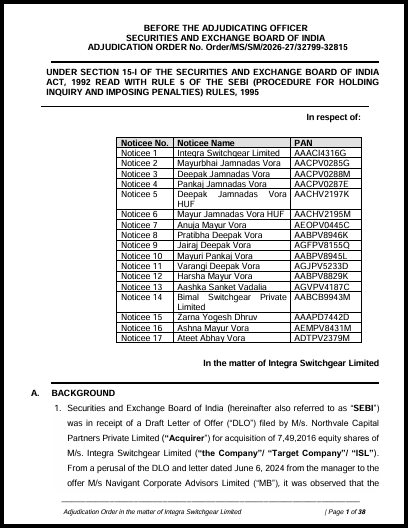
On October 30, 2026, SEBI Adjudicating Officer Medha Sonparote penalised Integra Switchgear Limited and 16 members of its promoter group.
This Integra Switchgear SEBI order covers wrong shareholder classifications and disclosures that reached BSE up to 1,763 days late.
How Did A Takeover Offer Expose Shareholding Gaps Going Back To 2015?
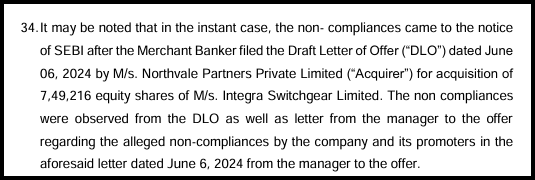
The trail began with a Draft Letter of Offer filed by Northvale Capital Partners Private Limited. It proposed acquiring 7,49,216 equity shares of Integra Switchgear Limited.
A letter dated June 6, 2024, from the offer manager, Navigant Corporate Advisors Limited, flagged the company and its promoters for possible violations.
Integra Switchgear was founded by the late Shri Jamnadas Vora and listed on BSE on June 6, 1994. The company later ceased operations, which it told BSE in July 2020.
The order also records that the company was small, with capital below ₹3 crore.
The case then moved through several hands.
The key steps are below:
1. Approval And A Failed Settlement Route
The competent authority approved action on March 27, 2025. Summary settlement notices went to the 16 promoter group noticees on April 22, 2025.
Only one settlement application came in, filed by Mr. Pankaj Vora for all of them. The others neither filed one nor paid the processing fees, so the route failed.
In April 2026, they were told it failed for want of proof of remittance of the settlement amount.
2. Adjudicating Officers Changed Twice
An officer was first appointed on June 25, 2025, to look at the company.
The matter moved to another officer on September 19, 2025.
It reached Medha Sonparote on May 27, 2026.
3. Two Show Cause Notices
The company received its notice on October 15, 2025. The 16 promoter group noticees received a common notice on January 7, 2026.
The company replied on December 2, 2025, and the promoter group filed preliminary submissions on January 19, 2026.
4. Hearing Requests And The Final Hearing
The company sought several adjournments between April and August 2026, citing unavailability in India.
The hearing finally took place on August 24, 2026, with additional submissions on August 27, 2026.
Who Was Penalised, And For How Much?
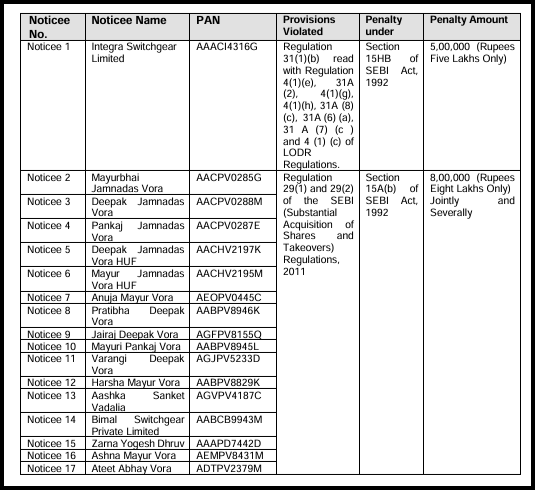
The order treats the company and the promoter group separately, under two different penalty sections.
| Noticees | Provisions found violated | Section | Penalty |
|---|---|---|---|
| Integra Switchgear Limited (Noticee 1) | LODR Regulations 31(1)(b), 4(1)(e), 31A(2), 4(1)(g), 4(1)(h), 31A(8)(c), 31A(6)(a), 31A(7)(c) and 4(1)(c) | 15HB | ₹5,00,000 |
| 16 promoter group noticees (Noticees 2 to 17) | SAST Regulations 29(1) and 29(2) | 15A(b) | ₹8,00,000, jointly and severally |
The second penalty is one combined amount for the group. The 16 noticees are listed below.
1. The Promoters And Their Family Members
Mayurbhai Jamnadas Vora, Deepak Jamnadas Vora, Pankaj Jamnadas Vora, Anuja Mayur Vora, Pratibha Deepak Vora, Jairaj Deepak Vora, Mayuri Pankaj Vora, Varangi Deepak Vora, Harsha Mayur Vora, Ashna Mayur Vora and Ateet Abhay Vora.
2. The Two Legal Heirs
Aashka Sanket Vadalia and Zarna Yogesh Dhruv became promoters by inheritance.
3. The Entities
Deepak Jamnadas Vora HUF, Mayur Jamnadas Vora HUF and Bimal Switchgear Private Limited.
Penalties can land on a company and its people together, as in the DB Realty penalty order on disclosure gaps we covered earlier.
How Three Sets of Shareholders Triggered Classification Lapses?
SEBI’s Listing Regulations require a company to file an accurate shareholding pattern every quarter.
A change in a shareholder’s status also needs a request to the stock exchange, with evidence.
The order found Integra Switchgear short on both counts for three sets of shareholders.
The Founder’s Late Son: Public Shareholder, Then Promoter Group
The first case involves the late son of the founder-promoter.
His 2,500 shares made up only 0.0867% of the company’s capital.
1. What The Filings Showed
He appeared as a public shareholder from March 31, 2000 to December 31, 2015.
He then appeared in the promoter or promoter group category from March 31, 2016 to September 30, 2020.
BSE confirmed on March 12, 2025, that it never received any reclassification application.
2. What The Company Argued
The company said it was correcting a historical error, not reclassifying.
It added that he died in 2001, the holding was negligible, and the family relationship never changed.
3. Why The Officer Disagreed
The officer held that any move from the public to the promoter group category is a reclassification under the Listing Regulations, however, it is described.
He also noted that Regulation 31A does not exempt small holdings, and that a lack of market impact or intent does not remove the lapse.
Two Heirs Left In The Public Category For Nearly Three Years
The second case concerns inheritance. After the deaths of members of the promoter family, shares passed on December 30, 2020, to Aashka Sanket Vadalia and Zarna Yogesh Dhruv.
1. The Numbers
Aashka Sanket Vadalia received 13,200 shares (0.46%). Zarna Yogesh Dhruv received 43,200 shares (1.5%).
2. How They Were Classified
Both were shown as public shareholders from the quarter ended December 2020 to June 2023. They were moved to the promoter group from the September 2023 quarter.
3. The Surname Argument
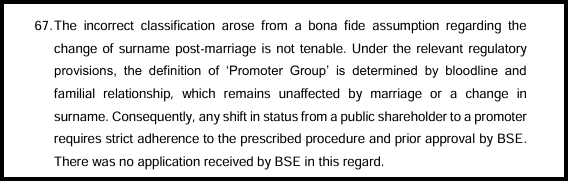
The company said it assumed married daughters and granddaughters who changed their surnames would not count as promoter group members.
The officer called this assumption not tenable. The promoter group is defined by bloodline and family relationship, which marriage or a surname change does not alter.
4. Four Provisions Found Violated
The officer held that the company broke Regulation 31A(6)(a), which requires heirs to be classified as promoters immediately on succession.
It also broke Regulation 31A(2) read with 4(1)(g) and 4(1)(h), Regulation 31A(8)(c) and Regulation 31(1)(b) read with 4(1)(e).
Promoter to Public Without Proof: How Unapproved Reclassifications Failed?
The third case runs the other way. Mr. H. D. Shah and Mrs. H. H. Shah were shown as promoters from the quarter ended September 30, 2009 to December 31, 2015.
From March 31, 2016, they were shown as public shareholders until December 2024.
1. The Company’s Position
The company said it acted on a letter dated February 3, 2016, and that the two had no direct or indirect relationship with the promoters.
It admitted reclassifying without any specific BSE approval.
2. The Missing Acknowledgement
The company could not produce proof that the letter reached BSE, and BSE said it received and approved no application.
The company cited emails with its IT vendor, since the old email backup was no longer available.
3. Why It Was Not Accepted
The officer said the vendor emails only suggest a letter was sent, and do not show that BSE approved the request.
He held the company violated Regulation 31(1)(b) read with 4(1)(e), Regulation 31A(2), Regulation 31A(7)(c) and Regulation 4(1)(c), which require a listed entity to refrain from misrepresentation.
Also Read: MCS Share Transfer Agent SEBI order and what missing records cost another intermediary.
How Three Transactions Triggered Three Late Disclosures?
Regulation 29 of the SAST Regulations requires promoters acting together to disclose certain share changes to the stock exchange within two working days.
BSE’s data, quoted in the order, put the delays at 2, 1,763 and 1,123 days.
| Transaction date | Regulation | Due date | Actual date | Delay |
|---|---|---|---|---|
| March 29, 2016 | 29(2) | March 31, 2016 | April 2, 2016 | 2 days |
| March 30, 2019 | 29(1) | April 2, 2019 | January 29, 2024 | 1,763 days |
| December 30, 2020 | 29(1) | January 1, 2021 | January 29, 2024 | 1,123 days |
March 29, 2016: Two Days Late
Pankaj Jamnadas Vora and Mayuri Pankaj Vora jointly acquired 1,30,000 shares (4.08%) off-market.
The noticees said they submitted the disclosure on March 31, 2016. BSE said it received a PDF on April 2, 2016 and uploaded it on April 3, 2016.
The officer noted the noticees could not trace acknowledgements. Receipt by BSE on April 2 did not prove they filed within the deadline.
March 30, 2019: Four Transfers And A 1,763-Day Delay
Four transfers on this date involved Deepak Vora, Harsha Vora, Jamnadas Vora and Pankaj Vora, together with persons acting in concert. They added up to 1,45,000 shares (5.03%).
The noticees argued that Regulation 29(1) was wrongly used, since the group already held about 50%. They said any change above 2% would fall under Regulation 29(2).
The officer noted the group held 50.01% before the transactions and acquired more than 2%. The disclosure was therefore due to BSE within the stated time.
December 30, 2020: Transmission After Deaths In The Family
The shares moved to legal heirs and family members after the deaths of Jamnadas Vora, Narmada Vora and the founder’s son.
Seven acquirers were named, each receiving between 0.46% and 1.5% of the company.
The noticees said these were successions, not purchases, and that the promoter group’s holding fell by less than 2%, from 55.48% to 53.52%.
They added that the company had told BSE about the transmission.
The officer held that merely informing BSE does not absolve the noticees. Any shift in status requires the disclosures under Regulation 29.
The Resubmission in January 2024
When the open offer due diligence brought the gap to light, Mr. Pankaj Vora emailed the earlier disclosures to BSE on January 29, 2024. BSE uploaded them that day.
The noticees said earlier filings had gone out by email, but the email account had become inaccessible. They could produce no proof.
The officer relied on the Securities Appellate Tribunal’s reasoning in Premchand Shah v. SEBI, that when a law prescribes a manner for doing a thing, it must be done in that manner.
Also Read: Future Retail Disclosure Delay And The ₹10 Lakh SEBI Penalty
Ten Years Too Late? The Defences That Did Not Work
The noticees raised a long list of objections.
Several were about timing and procedure, and the officer dealt with them before the merits.
1. The Delay In Issuing The Notices
The noticees pointed out that the show cause notice of January 7, 2026 came nearly ten years after the first transaction and over five years after the last.
The officer said the lapses came to SEBI’s notice only after the Draft Letter of Offer, and that the case was approved on March 27, 2025.
He quoted the Supreme Court in Bhavesh Pabari, that reasonable time depends on the facts, the nature of the default and any prejudice.
2. Combined Stages Under The Inquiry Rules
The noticees said the officer wrongly mixed the stage of deciding whether to hold an inquiry with the stage of fixing the penalty.
The officer replied that notices were issued under Rule 4(1), hearing notices followed under Rule 4(3), and no penalty was set at either stage. He found no prejudice to the noticees.
3. A Small Company With Negligible Holdings
The company said it was closely held, with capital under ₹3 crore and free float market capitalisation of about ₹1 crore. It said Regulation 3 of the Listing Regulations applied only after December 31, 2018.
It also cited percentages of 0.09%, 0.04%, 1.50%, 2.08% and 7.80%.
The officer said the size of the variance does not cancel the duty of timely and accurate disclosure, and treated these points only as mitigating.
4. No Company Secretary And An Earlier Penalty
In 2015, the company had no qualified company secretary, and the late founder handled compliance. The company said it had been penalised in 2019 for not appointing one.
It also said no investor suffered loss and that it never meant to hide the shareholding.
5. Records Lost And Management Changed
The company pointed to management changes, lost records and the death of key people.
The officer said a company is a legal person with perpetual succession, so a change in promoters or management does not affect its liability.
He also noted the erstwhile promoters were cooperating but had produced no evidence of their filings.
6. Regulation 102 And The Settlement Route
The company relied on Regulation 102 of the Listing Regulations, which lets SEBI relax certain requirements. It also asked for an administrative warning instead of a penalty.
The company said it put its settlement application on hold after SEBI clarified that settlement would only keep the final order in abeyance.
The findings do not discuss Regulation 102 separately.
7. Liability Of Relatives And Entities
Seven noticees argued that no transaction was attributed to them.
They were Deepak Jamnadas Vora HUF, Mayur Jamnadas Vora HUF, Anuja Mayur Vora, Jairaj Deepak Vora, Varangi Deepak Vora, Bimal Switchgear Private Limited and Ashna Mayur Vora.
The officer pointed to Regulation 2(1)(q) of the SAST Regulations. Promoters and promoter group members are treated as persons acting in concert unless they show otherwise, and none of them did.
8. Pratibha Deepak Vora’s Share Purchase
Pratibha Deepak Vora argued that her purchase of 12,000 shares on January 30, 2019, about 0.42%, was below the threshold.
The officer said the charge covered only three transactions, so her point was out of context.
9. Later Amendments To The Rules
Parts of Regulation 31A were amended with effect from November 16, 2018, and December 13, 2024.
The officer held that the amendments do not erase the obligation that applied during the relevant period.
How Did The Officer Fix ₹5 Lakh And ₹8 Lakh?
Having found violations, the officer first asked whether a penalty applied at all. He relied on the Supreme Court’s ruling in SEBI v. Shriram Mutual Fund, which holds that a penalty follows once a contravention is established.
He then turned to the amounts.
1. Two Penalty Sections
The company was held liable under Section 15HB, which sets a penalty from ₹1 lakh up to ₹1 crore.
The 16 promoter group noticees were held liable under Section 15A(b), which covers failing to furnish information within the time the regulations prescribe.
2. The Section 15J Factors
The officer noted the record did not show any disproportionate gain or unfair advantage to the noticees, or any quantified loss to investors.
It also did not show that the violations were repetitive.
3. The Final Amounts
He imposed ₹5,00,000 on the company and ₹8,00,000, jointly and severally, on Noticees 2 to 17. He called the penalties commensurate with the violations.
Also Read: Abhipra Capital SEBI Order And What The Tribunal Changed
When and How Must The Penalties Be Paid?
The order sets one payment window for all noticees.
1. The Deadline
The noticees must pay within 45 days of receiving the order.
2. The Payment Route
Payment goes through SEBI’s online facility on sebi.gov.in.
The path is ENFORCEMENT > ORDERS > ORDERS OF AO > PAY NOW.
3. If Payment is Not Made
SEBI may begin consequential action, including recovery under Section 28A of the SEBI Act. This can include interest and attachment and sale of movable and immovable properties.
A copy of the order goes to the noticees and to SEBI under Rule 6.
What Can Shareholders And Promoter Families Take From This Order?
The order is a reminder of how much sits in a quarterly shareholding filing.
Several points stand out from the findings.
1. Promoter Group Status Follows Family Ties
The officer held that the promoter group is defined by bloodline and family relationship. A surname change after marriage does not alter it.
2. Inheritance Triggers Immediate Classification
Under Regulation 31A(6)(a), heirs of promoter shares are to be classified as promoters or promoter group members immediately on succession.
3. Proof Of Filing Matters
Across all three transactions, the noticees could not produce acknowledgements. The officer treated bare assertions without records as insufficient.
4. A Lapse Can Surface Years Later
A takeover offer triggered this case, and the oldest filing issue dated back to the December 2015 quarter.
Shareholders who notice a filing problem in a listed company can learn how to file a SEBI SCORES complaint against a listed company.
Conclusion
A small, dormant company still has to keep its shareholding filings right. The officer held it to that standard, whatever the size of the holdings.
The promoter group faced the same rule on disclosures.
Without proof of timely filing, their assertions did not carry the day.
For investors, the lesson is to check how a company classifies its promoter group and when its disclosures actually reach the exchange.
Report. Recover. Stay Fraud Free.
SEBI imposed ₹5,00,000 under Section 15HB on Integra Switchgear Limited on October 30, 2026. It found wrong shareholding filings and reclassifications without BSE approval. Sixteen promoter group noticees were fined ₹8,00,000, jointly and severally, under Section 15A(b). They include promoters, family members, two HUFs and Bimal Switchgear Private Limited. Adjudicating Officer Medha Sonparote passed Order/MS/SM/2026-27/32799-32815 in Mumbai on October 30, 2026. The delays were 2 days for the 2016 transaction, 1,763 days for the 2019 transactions and 1,123 days for the 2020 transmissions. The order says the material on record does not indicate any quantified gain, investor loss or repetitive nature of the violations. He held that promoter group status depends on bloodline and family relationship. Marriage or a change of surname does not alter it. Within 45 days of receiving the order, through the online payment facility on sebi.gov.in.Frequently Asked Questions




 Add us as a preferred source on Google »