
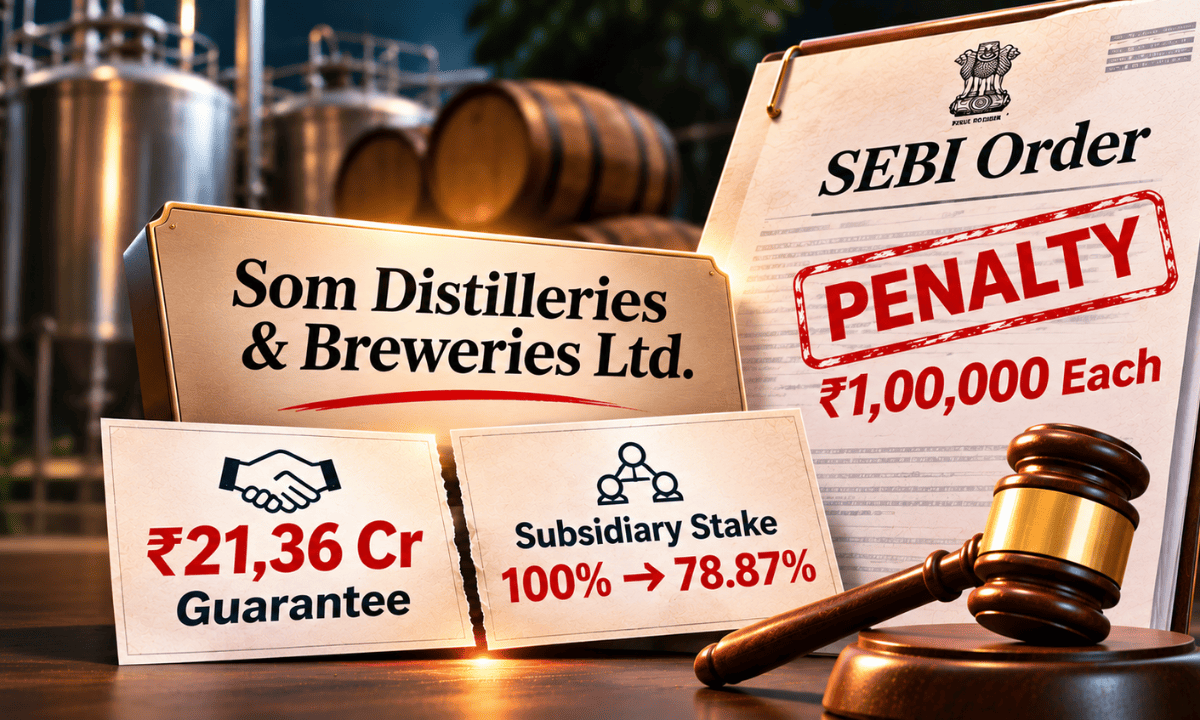
Quick Summary
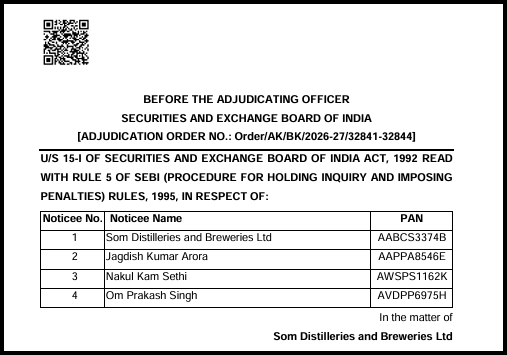
Adjudicating Officer Amit Kapoor passed the order on November 4, 2026 against Som Distilleries and Breweries Ltd, Chairman and MD Jagdish Kumar Arora, Whole-Time Director Nakul Kam Sethi and Company Secretary Om Prakash Singh. SEBI held a ₹21.36 crore guarantee lacked prior Audit Committee approval, and a stake cut from 100% to 78.87% lacked shareholder approval. Each noticee must pay ₹1 lakh under Section 15HB within 45 days.
Picture a ₹21.36 crore guarantee for a related firm, signed without the Audit Committee’s prior nod.
Now add a key subsidiary whose stake slipped from 100% to 78.87%, with no shareholder vote.
That is what SEBI found in the Som Distilleries SEBI order of November 4, 2026.
So who signed off, and why was even the Company Secretary, who had no vote on the Board, penalised?
The order answers each of these in detail, so here is how the findings and defences played out.
How Did the Look At Som Distilleries’ Books Begin?
SEBI investigated Som Distilleries and Breweries Ltd, a company listed on BSE and NSE, to check whether its books of account were manipulated or misrepresented.
The investigation covered FY 2021 to FY 2024. Two transactions came under the lens, both involving related parties or promoters.
The proceedings then moved step by step, as the table below shows.
| Date | Step |
|---|---|
| February 20, 2026 | Amit Kapoor appointed Adjudicating Officer |
| March 24, 2026 | Show cause notice issued by Speed Post AD and email |
| April 6, 2026 | Separate reply from Noticee 4 by email |
| April 22, 2026 | Common reply of Noticees 1 to 3, and request for inspection |
| May 7, 2026 | Inspection of documents conducted |
| September 22, 2026 | Separate personal hearings |
| November 4, 2026 | Order passed in Mumbai |
On August 20, 2026, the authorised representative clarified that he appeared only for Noticees 1 to 3. So Noticee 4’s reply was considered on its own.
Who Received the Show Cause Notice?
The notice named four noticees. One is the company, and three are its officials.
| Noticee no. | Name | Position |
|---|---|---|
| 1 | Som Distilleries and Breweries Ltd | Listed company |
| 2 | Jagdish Kumar Arora | Chairman and Managing Director |
| 3 | Nakul Kam Sethi | Whole-Time Director |
| 4 | Om Prakash Singh | Company Secretary and Compliance Officer |
Decoding the ₹21.36 Crore Corporate Guarantee
The first charge was about a loan the company did not take itself. It stood behind someone else’s loan.
SEBI said that promise needed the Audit Committee’s nod before it was made.
What The Notice Alleged?
The show cause notice listed these points about Aryavrat Projects and Developers Private Limited (APDPL).
- A guarantee to SBI. In FY 2020-21, the company gave State Bank of India a corporate guarantee of ₹21.36 crore for credit facilities of APDPL.
- A related party. APDPL was disclosed as a related party under Ind AS 24, as a firm over which the company’s key managerial personnel could exercise significant influence.
- Civil contracts too. The company had also awarded civil contracts worth ₹14.40 crore to APDPL.
- Still running. The guarantee stayed outstanding through the investigation period.
- A 2024 request. In June 2024, the company asked its banker to cut exposure to APDPL by 50% and waive the guarantee, again with no prior Audit Committee approval alleged.
These facts led to the charge under Regulation 23(2) of the LODR Regulations.
The Defences And How The Officer Answered Them?
Noticees 1 to 3 filed a common reply. The officer dealt with each argument in turn.
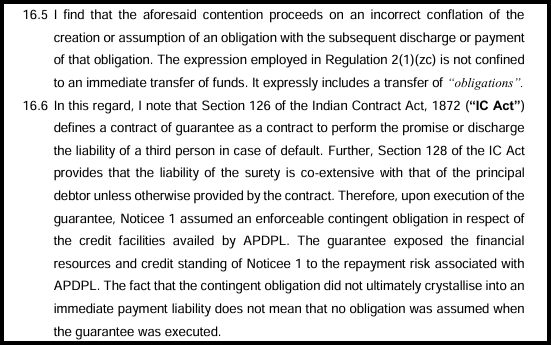
- “No resources moved.” The noticees said the guarantee was never invoked, so nothing was transferred. The officer said the rule covers a transfer of “obligations”, and a guarantor takes on a contingent obligation the moment it is signed.
- “Shareholders already allowed guarantees.” The noticees pointed to special resolutions of September 30, 2016 and March 26, 2019 under Section 186, with limits of ₹200 crore and ₹500 crore. The officer called these general enabling limits, not a transaction-specific Audit Committee approval.
- “Our internal committee cleared it.” The Executive Legal and Borrowing Committee (ELBC) approved the guarantee by a resolution of June 1, 2020, and two of its three members sat on the Audit Committee. The officer held that they are separate bodies, though it was a mitigating factor.
- “It was disclosed and shrank over time.” The guarantee appeared in annual reports and fell from about 9.42% of standalone revenue in FY 2020-21 to about 3.73% standalone and 1.43% consolidated. The officer said disclosure and a falling ratio do not replace prior approval.
- “The June 2024 request only reduced risk.” The company had told SEBI by email of June 24, 2024, about the proposal to the bank. The officer treated the reduction and waiver as a material modification, and found no material that it went to the Audit Committee first.
The officer also noted the guarantee was terminated by March 31, 2025, without any liability crystallising. That counted as mitigation, not a cure.
Why A Guarantee Counts As A Related Party Transaction?
The officer relied on the law of guarantees. Under Sections 126 and 128 of the Indian Contract Act, 1872, a surety’s liability matches the borrower’s unless the contract says otherwise.
The officer added that Ind AS 24 lists “provision of guarantees or collateral” among related party transactions.
Waiting for approval until a guarantee is invoked, the officer reasoned, would make “prior approval” meaningless.
The company was held to have violated Regulation 23(2).
How the Rights Issue Diluted the Stake to 78.87%?
The second charge was about Woodpecker Distilleries and Breweries Private Limited (WDBPL), then a wholly-owned subsidiary.
WDBPL made a rights issue in FY 2023-24, and the company’s stake dropped by 21.13%.
The subscriptions were split as shown below:
| Subscriber | Shares | Amount |
|---|---|---|
| Som Distilleries and Breweries Ltd | 50 lakh | ₹10 crore |
| Jagdish Kumar Arora (Noticee 2) | 1 crore | ₹20 crore |
| D.A., another promoter | 50 lakh | ₹10 crore |
The company took up only part of its entitlement and renounced the rest in favour of two promoters. The three subscriptions add up to the ₹40 crore the noticees said was needed.
Also Read: EKI Energy SEBI Order
Why WDBPL Was Treated As An Undertaking?
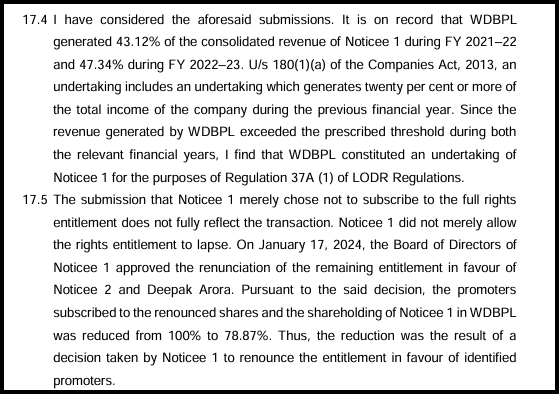
The order records that WDBPL generated 43.12% of consolidated revenue in FY 2021-22 and 47.34% in FY 2022-23.
Under Section 180(1)(a) of the Companies Act, 2013, an undertaking includes one that earns 20% or more of total income in the previous year. WDBPL cleared that mark in both years.
The company’s Board approved the renunciation on January 17, 2024. That meant the stake reduction came from a decision, not from a lapsed entitlement.
The Defences And The Officer’s Replies
The noticees raised five arguments on this charge.
- “We only chose not to subscribe.” The officer said the Board approved renunciation in favour of identified promoters. Regulation 37A(1) also covers an “otherwise disposal”, not just a sale or lease.
- “We still hold 78.87% and control WDBPL.” The officer said the rule does not need a full disposal or loss of control. A 21.13% fall in interest crossed the 20% mark in the Explanation.
- “The second proviso to Regulation 37A(2) saves us.” That proviso deals with an undertaking first transferred to a wholly-owned subsidiary. The officer said no such transfer was alleged, so Regulation 37A(1) applied.
- “Two readings were possible, so no penalty.” The noticees cited Tolaram Relumal v. State of Bombay, SEBI v. Sunil Krishna Khaitan and Capitalvia Global Research Limited v. SEBI. The officer said the case was not a mere refusal to subscribe, so those rulings did not help.
- “The money was urgently needed.” The noticees said the proposed qualified institutions placement did not materialise in October 2023, and ₹40 crore was needed to keep a ₹70 crore capex plan moving. They added that the promoters paid ₹20 a share against a stated fair value of ₹17.
On the last point, the officer said the explanation could have been put before shareholders for approval. The commercial purpose was treated as mitigation.
The officer held that the company violated Regulation 37A(1).
Why Were the Two Directors Held Responsible?
Noticees 2 and 3 argued that their liability under Section 27 was vicarious. They said that with no violation by the company, nothing could pass to them.
Once the company’s violations were established, that argument fell away.
The officer set out the basis for each director.
- Executive roles. Both were executive directors and key managerial personnel in the conduct of the business.
- The ELBC link. Nakul Kam Sethi chaired the ELBC that approved the guarantee on June 1, 2020.
- A direct benefit. Jagdish Kumar Arora subscribed to 1 crore WDBPL shares for ₹20 crore after the company renounced its entitlement.
- Not just titles. The officer said liability did not rest merely on designation.
Both were held to have violated Regulations 4(2)(f)(ii)(2) and (7) and 4(2)(f)(iii)(3), (6) and (12) read with Sections 27(1) and 27(2) of the SEBI Act.
Also Read: Axis Mutual Fund Front Running Case
The Company Secretary’s Defence And Why It Fell Short?
Om Prakash Singh filed his own reply. His position was that a Compliance Officer advises and does not decide.
The officer weighed his points one by one:
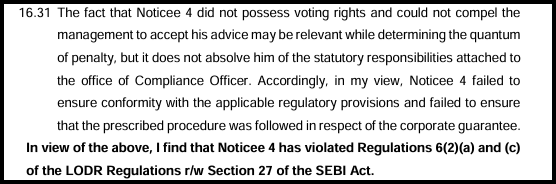
- “I had no vote.” He said the Board and shareholders decide, and a Company Secretary does not vote. The officer said this may matter for the penalty amount, but it does not remove the duties under Regulation 6(2)(a) and (c).
- “The guarantee was given without my knowledge.” The officer noted it stayed outstanding for years and appeared in annual reports. So it could not reasonably have stayed outside his knowledge.
- “I advised preventive action.” He said he advised management, including Noticee 3, his reporting manager. The officer found no contemporaneous email, note or step showing he sought Audit Committee approval or raised it with the Board.
- “Approvals were obtained later.” He said Audit Committee, Board and shareholder approvals followed once he flagged the issue. The officer held that later steps do not cure missing prior approval.
- “I had no say on the stake cut.” On the WDBPL transaction too, the officer found no contemporaneous material showing he advised that shareholder approval was needed.
He also said he resigned in the first week of January 2026, effective by the end of the second week of February 2026. He raised grievances about unpaid remuneration and his reporting manager.
The officer held that these were employment matters outside the proceedings and recorded no finding on them.
He was held to have violated Regulations 6(2)(a) and 6(2)(c) read with Section 27.
How SEBI Calculated the ₹1 Lakh Penalty?
Section 15HB provides a penalty of not less than ₹1 lakh and up to ₹1 crore where no separate penalty is provided.
The officer then applied the Section 15J factors.
- No quantified gain. No figures were available for disproportionate gain or unfair advantage.
- No ascertainable loss. The exact monetary loss to investors could not be worked out.
- A past penalty. The record showed SEBI had imposed a penalty on the company in the past. The order gives no further detail on it.
The order also relied on the Supreme Court’s decision in SEBI v. Bhavesh Pabari (2019) 5 SCC 90.
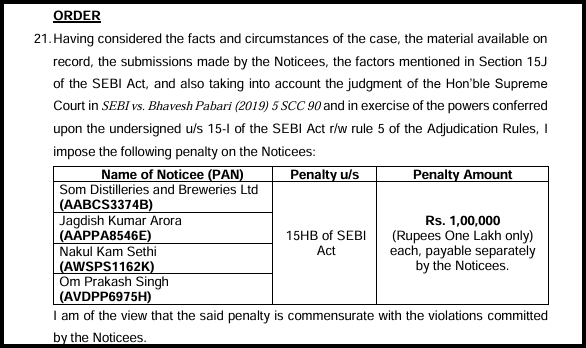
The final penalties are shown below:
| Noticee | Penalty | Provision |
|---|---|---|
| Som Distilleries and Breweries Ltd | ₹1,00,000 | Section 15HB, SEBI Act |
| Jagdish Kumar Arora | ₹1,00,000 | Section 15HB, SEBI Act |
| Nakul Kam Sethi | ₹1,00,000 | Section 15HB, SEBI Act |
| Om Prakash Singh | ₹1,00,000 | Section 15HB, SEBI Act |
Each penalty is payable separately by the respective noticee.
Payment Deadline and Consequences of Default
The noticees must pay within 45 days of receiving the order. Payment is online on the SEBI website under Enforcement, Orders, Orders of AO, Pay Now.
For payment difficulties, the order lists [email protected].
If they do not pay, SEBI may start recovery under Section 28A of the SEBI Act, with interest. That can include attachment and sale of movable and immovable property.
What Shareholders Can Learn From This Order?
This case is about process, not about a loss shown on record. Still, it offers a few checks any shareholder can run.
- Read the related party notes. Guarantees for promoter-linked firms appear in annual reports. Look at who benefits and how large the exposure is.
- Check who approved it. Prior Audit Committee approval is a separate step from board or shareholder limits.
- Watch subsidiary stake changes. A fall of 20% or more in a key subsidiary can need a special resolution and a public shareholders’ vote.
- Note who benefits. In this case, a promoter director subscribed to the renounced shares.
If you spot a lapse by a listed company, you can file a SCORES SEBI complaint and follow its progress online.
Conclusion
The Som Distilleries SEBI order is a reminder that approvals must come before the deal, not after it.
A guarantee that was never invoked still needed the Audit Committee’s nod. A stake cut that kept control still needed shareholders’ consent.
The penalty is ₹1 lakh each, at the lower end of the Section 15HB range, but the findings on what counts as a related party transaction and a disposal carry the real weight.
Report. Recover. Stay Fraud Free.
Adjudicating Officer Amit Kapoor passed it on November 4, 2026 in Mumbai, under Section 15-I of the SEBI Act. Each of the four noticees was fined ₹1,00,000 under Section 15HB, payable separately. Regulation 23(2) of the LODR Regulations for the guarantee and its later modification, and Regulation 37A(1) for the stake reduction in WDBPL. The officer said yes. The obligation arises when the guarantee is signed, so prior Audit Committee approval was needed even though it was never invoked. WDBPL earned more than 20% of the group's income, so it was an undertaking. The Board's renunciation cut the stake by 21.13%, and the rule covers an "otherwise disposal". No. The officer held that the absence of voting rights may affect the penalty amount, but it does not remove the duties of the Compliance Officer. No. The officer treated them as mitigating factors only. They did not cure the missing prior approvals. No. The order says no figures were available for gain, and the exact monetary loss to investors could not be ascertained.Frequently Asked Questions



 Add us as a preferred source on Google »