
Quick Summary
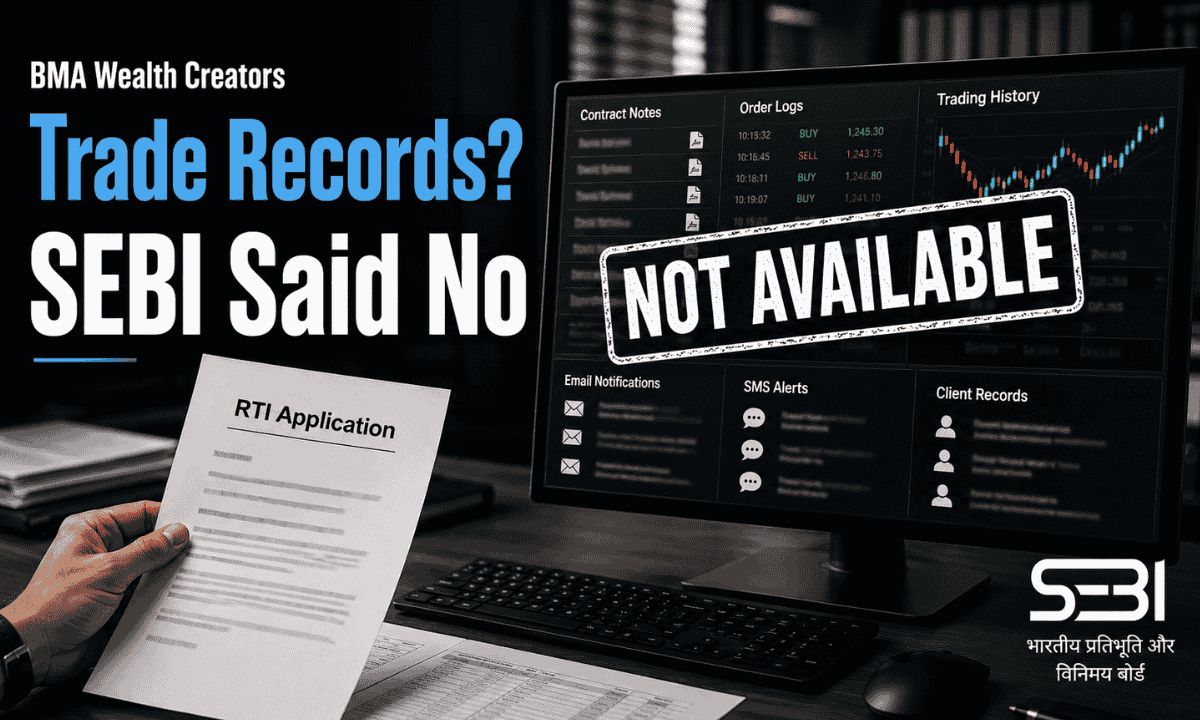
An investor asked SEBI for certified copies of trade records, contract notes, SMS alerts, email confirmations, and other documents relating to trades executed in his account. SEBI replied that it does not maintain these records, and the Appellate Authority upheld that decision. The order makes it clear that records such as contract notes, trade logs, and client data are generally held by the broker, the stock exchange, or the depository, not by SEBI. For investors, the lesson is straightforward: preserve your trading records and raise any dispute quickly, because delays can make it much harder to obtain evidence or pursue a claim.
When an investor decides to fight a broker, the fight is really about documents. Who placed the order. Whether a contract note ever left the broker’s system.
Whether the SMS and the email went out. Which terminal the trade came from.
Sudhir Agarwal went looking for exactly that set of documents.
On May 31, 2026, he filed an application under the Right to Information Act, 2005 with SEBI, asking for certified copies of the records behind trades executed in his own account by BMA Wealth Creators Ltd.
The reply came on June 22, 2026; he appealed on June 30, 2026, and the Appellate Authority decided Appeal No. 6951 of 2026 on July 28, 2026.
The answer he got is the one every investor in his position needs to hear early rather than late. SEBI does not keep those records.
What Trade Records Did the Investor Ask SEBI For?
Before diving into the specific list, it is worth looking at the background of this request.
The investor filed an RTI application with SEBI after facing issues with trades executed in his account by his broking firm, BMA Wealth Creators.
He turned to the market regulator hoping to get official proof of his trading activity, dispatch records, and account logs to support his case.
Read in plain terms, the application asked for:
- Certified copies of everything evidencing dispatch or delivery of contract notes, trade confirmations, emails and SMS alerts for trades in his account, including system-generated logs and delivery records held by the exchange or filed by the trading member.
- Historical quarterly client database submissions and client registration data held by the exchange for him.
- The database entries maintained against his UCC code.
- Inspection reports, observations, correspondence, internal notes, findings or orders with SEBI relating to trading activity in his account by the broker.
- The provisions, circulars, bye laws or directions under which a trading member could allow someone other than the registered client to place trades on the client’s behalf, if such permission existed at the time.
- Records relating to an observation he says was recorded during IGRP and arbitration proceedings, to the effect that the trading member could not justify the trades in the complainant’s account and should not have permitted its own dealer to trade on the complainant’s behalf.
- NEAT system-generated records, audit trail records and electronic logs held by SEBI or NSE for the account and the disputed trades.
Query 6 is where the case lives. An observation of that kind, if it exists on the record of a grievance panel, is close to decisive in a dispute over who was actually operating the account.
The question of when a person other than you may legally place your orders is one we have dealt with separately in our explainer on whether someone can trade on your behalf.
Before the reply itself, the identity of the broker is worth pausing on.
Which Broker Was Involved in the SEBI RTI Dispute?
BMA Wealth Creators Ltd, later renamed BRH Wealth Kreators Ltd, was a Kolkata-based broking firm.
SEBI barred it and seven connected entities from the securities market by an interim order in October 2019, after NSE reported a shortfall of roughly ₹100 crore worth of client securities against actual records.
SEBI confirmed those directions in January 2020. NSE declared the firm a defaulter and expelled it on February 13, 2020, and BSE did the same on February 17, 2020.
SEBI later imposed a penalty of ₹11.50 crore across the group and cancelled the firm’s registration certificate, citing misuse and diversion of client securities and funds along with failure to redress investor complaints.
Investors from that firm have been chasing paperwork ever since.
That is the situation in which people turn to the regulator, on the reasonable assumption that a regulator which has acted against a broker must be holding the broker’s records.
How SEBI Responded to the RTI Request?
On queries 1, 2, 3, 6 and 7, the answer was that the information sought is not maintained by SEBI in the normal course of regulation of the securities market, and so is not available with it.
On query 4, the answer was that the request was vague and not specific, and therefore did not amount to information as defined under section 2(f) of the RTI Act.
On query 5, the applicant was pointed to Para 35 of the SEBI Master Circular for Stock Brokers dated June 17, 2025, which sits in the public domain on the SEBI website.
The appeal followed on the ground that the information supplied was incomplete, misleading or false.
Why SEBI’s Appellate Authority Dismissed the RTI Appeal
The Appellate Authority, Ruchi Chojer, upheld the reply on every count.
On the records SEBI does not hold, the order relies on the Supreme Court in Central Board of Secondary Education and another versus Aditya Bandopadhyay and others, decided on August 9, 2011.
The position there is that the RTI Act gives access to information that is available and existing.
Where the information is not part of the record of a public authority, and is not required to be maintained by any law or regulation of that authority, the Act does not oblige it to collect or collate what it does not have and then hand it over.
The order also cites the Central Information Commission in Narotam Dass Goel versus CPIO, SEBI, decided on July 9, 2012, for a point that matters even more here.
SEBI does not have unfettered power to call for information from the stock exchanges merely because a citizen has asked for it under the RTI Act.
So the exchange held records in queries 1, 2, 3 and 7 could not be routed to the applicant through SEBI either.
On query 4, the order agrees that the wording was vague and indeterminate, relying on Naresh Kadyan versus CPIO, Veterinary Council of India, decided on June 14, 2023.
Stretching section 2(f) to cover deductions and inferences puts a public information officer in the position of guessing what an applicant wants and being penalised if the guess is wrong.
On query 5, the public domain reasoning from the Delhi High Court in Registrar of Companies and others versus Dharmendra Kumar Garg and another applies, along with the Commission’s order in Shri K Lall versus Shri M K Bagri dated April 12, 2007.
The appeal was dismissed. Which leaves the practical question untouched, so here it is.
Where Are Contract Notes and Trade Records Actually Stored?
Contract notes, ledgers and statements of accounts stay with your broker, who is obliged to issue and preserve them.
Ask in writing and keep the acknowledgement, because a refusal to produce your own contract notes is itself a grievance worth recording.
Your demat leg is easier. Transaction statements and the consolidated account statement come from CDSL or NSDL directly, and neither requires anyone’s cooperation but yours.
Exchange held material is the part people get wrong.
The client database submitted by brokers, order and trade logs, terminal and dealer identifiers, and the trail behind a disputed order all sit with the exchange.
That material surfaces during the grievance and arbitration process, where the panel or the tribunal can direct the trading member and the exchange to produce it, which is a route no RTI application substitutes for.
The starting point for that route is set out in our guide on filing an NSE complaint against broker.
If it does not resolve there, the record gets tested at arbitration in the stock market.
That sequence only works if you begin it while the broker is still standing.
Why Delaying Your Trade Dispute Can Cost You Everything
Once a firm is expelled and its registration is cancelled, the ordinary route against it closes.
Claims then move to the exchange’s defaulter process, and eligible claims are considered against the Investor Protection Fund, subject to the limit and the claim window the exchange notifies.
Miss the window, and there is very little anyone can do afterwards, however strong the paperwork is.
This is why a delay of years between noticing something wrong and filing anything is the single most expensive mistake in these cases.
The warning signs of trades you did not place are listed in our piece on unauthorized trading, and none of them improve with time.
How to Protect Your Trade Records and Protect Yourself?
Keep every contract note as it arrives rather than assuming you can pull it later.
Keep the emails and the SMS alerts, since the delivery record is often the disputed fact. Note your UCC and download your demat transaction statement at least once a quarter.
If a trade appears that you did not place, put the complaint in writing the same week, to the broker first and the exchange after.
The July 28, 2026 order does not say the trades in that account were proper.
It says the regulator is not the custodian of the proof.
The custodians are your broker, your depository, and the exchange, and only one of those three answers to you directly.
Report. Recover. Stay Fraud Free.
Frequently Asked Questions
No. SEBI does not normally maintain contract notes, trade logs, SMS alerts, or email confirmations for individual investors. These records are usually held by your broker, the stock exchange, or the depository
Start by requesting them from your stock broker. Depending on the document, you may also obtain records from NSE/BSE, or account statements from CDSL or NSDL.
Not if SEBI does not hold those records. The RTI Act only allows access to information that already exists with the public authority receiving the request.
Save your contract notes, SMS alerts, emails, and demat statements immediately. Report the issue to your broker first, then escalate it to the stock exchange if the dispute is not resolved.
Delaying a complaint can make it harder to obtain evidence or use the exchange's grievance and arbitration process. Acting early improves your chances of protecting your rights and recovering your losses if wrongdoing is established.



 Add us as a preferred source on Google »

