If you are someone who is into stock market investing, you must have heard about Sharekhan, and some of you might already be using Sharekhan as your broker.
Sharekhan is one of India’s well-known stockbroking and investment service providers.
The company offers a wide range of services, including equity trading, mutual funds, portfolio management, research reports, and investment advisory.
However, with its rise in popularity, it has also attracted scams and fraud by third parties who misuse its brand name to deceive investors, such as fake websites, mobile apps, and WhatsApp groups created to trick people into investing money in fraudulent platforms claiming to be Sharekhan.
So while Sharekhan remains a leading broker in India, it’s important for investors to stay informed about both its strengths and the types of risks and scams that can occur in the market.
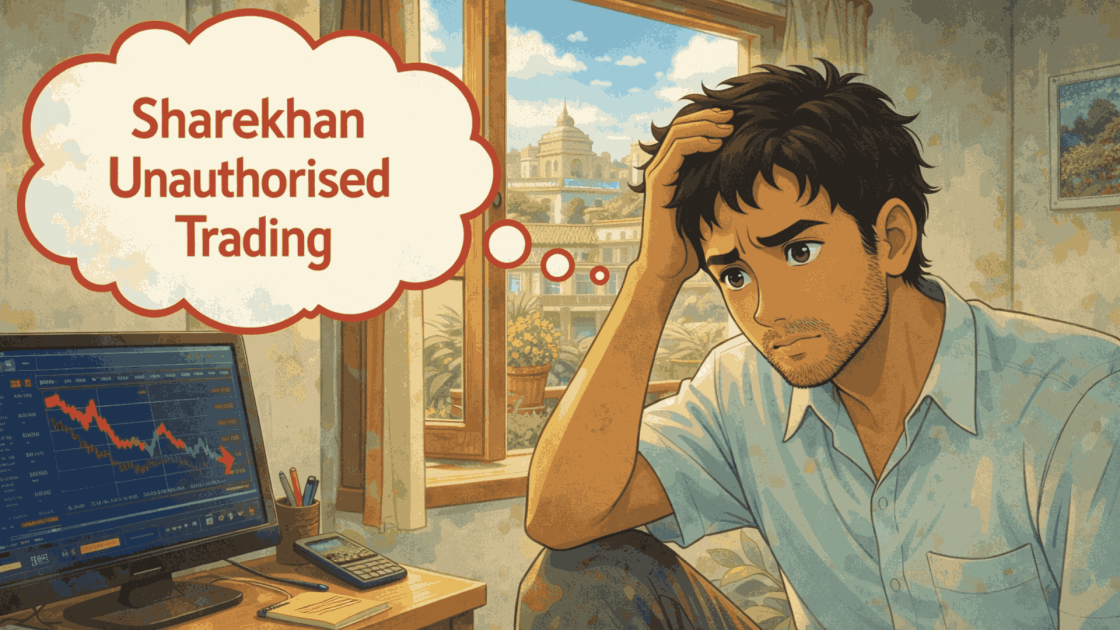
Sharekhan Unauthorised Trading Complaints
Among the various complaints, one concern that has been raised by some users is unauthorised trading.
Unauthorised trading refers to situations where trades are executed in a client’s account without their clear consent or full knowledge.
In such cases, investors claim that buy or sell orders were placed on their behalf that they did not personally approve.
This can sometimes happen due to miscommunication between the broker and client, misunderstanding of advisory services, or misuse of trading access.
Summary table: overall Complaints, unauthorised trading complaints, % of unauthorised trading
|
Year |
No. of complaints | No. of complaints for unauthorised trading |
Percentage of unauthorised trading |
|
2021-22 |
292 | 46 |
15.75% |
|
2022-23 |
178 | 33 |
18.54% |
|
2023-24 |
207 | 32 |
15.45% |
|
2024-25 |
316 | 84 |
26.58% |
|
2025-26 |
219 | 65 |
29.68% |
When we look at the complaint numbers related to Sharekhan, the table does not just show statistics.
It reflects investor sentiment, trust levels, and operational challenges over time.
While the total number of complaints fluctuates, the proportion of unauthorised trading complaints increases notably in the later years.
The sharp rise in 2024–25 and 2025–26 is particularly striking, with unauthorised trading accounting for over one-fourth of total complaints, reaching nearly 30% in 2025–26.
This suggests that concerns around trade authorisation have become more prominent relative to other grievances, highlighting the importance of clear client consent, proper documentation, and effective oversight mechanisms.
Ultimately, complaint data should not just be viewed defensively. It should be used as a diagnostic tool to strengthen systems, rebuild trust, and protect investors more effectively.
Impact on Traders
The table data shows that unauthorised trading complaints make up a meaningful and rising share of total complaints, especially in the later years.
For traders, this indicates that concerns around trade authorisation are not isolated incidents but an issue affecting a noticeable portion of users.
For individual investors, this can translate into unexpected risk exposure, unplanned losses, and additional stress related to monitoring accounts and pursuing redressal.
In some cases, traders also report technical problems such as Sharekhan Login Issues, which can make it harder to access accounts quickly and verify ongoing trades.
When nearly a quarter to a third of complaints relate to unauthorised trading, it also highlights why traders must regularly review contract notes, stay alert to account activity, and maintain clear communication with their broker to protect their interests.
When Can Action Be Taken Against a Broker?
Action against a broker for unauthorised trading can be taken only when a lack of client consent is established through evidence, not merely because losses occurred.
1. Absence of Verifiable Order Evidence
Under SEBI’s circular on the prevention of unauthorised trading, brokers are required to execute trades only after maintaining verifiable proof that the client placed the order.
If a broker fails to produce such evidence for disputed trades, regulatory and exchange authorities may treat the trades as unauthorised.
2. Failure to Maintain Mandatory Records
SEBI mandates that brokers preserve order-related records for at least three years, and longer if a dispute is ongoing.
Action may be taken when:
- Records are missing, deleted, or incomplete
- Call recordings are unavailable despite telephone-based trading
- Logs do not match contract notes or ledger entries
Such lapses are treated as compliance failures, which can weaken the broker’s defence in unauthorised trading complaints
3. Trades Executed Beyond Given Authority
Even if a client has enabled trading or appointed an authorised person, action may still arise where trades exceed agreed risk limits or position sizes.
Consent is transaction-specific, not a blanket permission.
4. Inadequate Justification in Exceptional Cases
SEBI allows limited exceptions (such as technical failures), but the broker must justify the absence of order evidence with supporting material.
If such a justification is weak or inconsistent, authorities may still hold the broker accountable.
What You Can Do in Such Cases?
Suspecting Sharekhan’s unauthorised trading in your account can feel overwhelming.
When trades appear that you did not approve, most investors are unsure where to complain, what documents are required, or how to present their case properly.
And when your hard-earned money is involved, uncertainty only increases the stress.
If you notice suspicious activity, you should act immediately:
- Secure your account.
- Change passwords.
- Review contract notes.
- Raise a written complaint with Sharekhan explaining the disputed trades in detail.
- Always communicate via email so you have proper documentation.
- File a complaint in SEBI SCORES
- If required, escalate and file an arbitration in stock exchange.
Need Help?
Beyond the first complaint, the real confusion begins.
Handling disputes with brokers, preparing for arbitration, or navigating platforms like the Securities and Exchange Board of India (SEBI) SCORES or filing a complaint via the SMART ODR platform can feel complex and intimidating.
That’s exactly where we step in, reach out to us.
Our goal is to make the entire process structured, organised, and stress-free for you.
Step 1: Documentation Assistance
We help you gather, organise, and structure every essential document, trade statements, ledger reports, contract notes, margin statements, bank entries, call logs, screenshots, and email communication.
Step 2: Drafting Your Complaint
A professionally drafted complaint makes a major difference. We prepare clear, precise, and well-structured drafts.
Step 3: Platform Filing Support
Filing on regulatory portals can be confusing. We guide you step-by-step through the submission process.
Step 4: Escalation Guidance
If your issue is not resolved at the broker level, we guide you through the correct escalation path, whether it involves stock exchange grievance redressal, IGRP proceedings, or preparing for arbitration.
Step 5: End-to-End Case Management
Once you register with us, we monitor your case from start to finish. We track timelines, help you respond to regulatory queries, and ensure no deadlines are missed. You’re never left navigating the process alone.
Step 6: Support During Counselling & Arbitration
If your matter progresses to counselling or arbitration, we assist you in preparing structured statements, organising documentary evidence, and presenting your case confidently and clearly.
When you register with us, you avoid the stress of complicated procedures, confusing paperwork, and drafting mistakes.
If something doesn’t feel right in your trading account, don’t ignore it. The right action, taken at the right time, can make all the difference.
Conclusion
Sharekhan is an established brokerage platform, but like any financial intermediary, disputes and risks can still arise.
Regulatory settlements, unauthorised trading concerns, or impersonation scam can lead to serious financial stress for investors.
When something feels wrong, whether it’s an unexpected trade, a suspicious transaction, or misleading communication, you should act immediately and follow the correct escalation process.
With proper documentation, timely complaints, and structured support, you can seek resolution through the broker’s grievance system, the stock exchange mechanism, or the Securities and Exchange Board of India (SEBI) SCORES platform, and if required, file an arbitration.
Make every investment decision with awareness and caution. Your money deserves safety, transparency, and accountability.