

Quick Summary
The Wealth Key Research offers 16 plans across five categories. The quarterly Combo Equity plan costs ₹1,50,000, sitting just ₹1,000 below SEBI’s entire annual fee cap for research analyst services. Four quarterly renewals of any plan push the combined total above the limit. The firm does not mention the ₹1,51,000 cap anywhere on its pricing pages. If your total payments to this firm in any financial year exceeded that ceiling, the excess may be recoverable.
Most people look at a subscription price and think about whether it fits their budget. Very few add up what four quarterly renewals actually cost across a full financial year.
That is the gap The Wealth Key Research’s pricing creates.
One plan costs ₹1,50,000 for three months. That is just ₹1,000 below what SEBI allows a research analyst to charge any single client in an entire year.
Before you renew or add another plan, here is every price and what it means against SEBI’s ceiling.
The Wealth Key Research’s Full Pricing Table
All prices below are as listed on The Wealth Key Research’s official website. GST at 18 percent applies separately to each figure.
The Wealth Key Research’s Equity Plans:
|
Plan |
Weekly | Monthly | Quarterly |
|---|---|---|---|
| Stock Core Cash Solution | ₹5,099 | ₹15,099 |
₹35,099 |
|
Stock Core Future Solution |
₹7,099 | ₹20,099 | ₹55,099 |
| Stock Core Option Solution | ₹5,099 | ₹15,099 |
₹35,099 |
|
Stock Prestige Cash |
Not offered | ₹30,000 | ₹75,000 |
| Stock Prestige Futures | Not offered | ₹30,000 |
₹80,000 |
|
Stock Prestige Options |
Not offered | ₹30,000 | ₹80,000 |
| BTST Cash Future Option | Not offered | ₹45,000 |
₹85,000 |
Commodity Plans on The Wealth Key Research’s Website:
|
Plan |
Weekly | Fortnightly | Monthly | Quarterly |
|---|---|---|---|---|
| Commodity Pack MCX NCDEX | ₹5,000 | ₹8,000 | ₹15,000 |
₹40,000 |
|
Commodity Prestige Pack MCX NCDEX |
Not offered | Not offered | ₹40,000 |
₹75,000 |
The Wealth Key Research’s Combo Plans:
|
Plan |
Monthly | Quarterly |
|---|---|---|
| TWK Combo Equity | ₹90,000 |
₹1,50,000 |
|
TWK Commodity Equity Combo |
₹1,00,000 |
Not offered |
Index Plans at The Wealth Key Research:
|
Plan |
Weekly | Monthly | Quarterly |
|---|---|---|---|
| Index Core Options Research | ₹6,099 | ₹18,099 |
₹49,999 |
|
Index Prestige Options Research |
₹8,099 | ₹24,999 |
₹70,999 |
One thing that stands out immediately: the pricing page offers weekly, monthly, and quarterly plans but no annual plan. That becomes significant once you understand how SEBI’s fee cap works.
Also Read: Amit Kumar Gupta, one name, three separate regulatory frameworks.
What SEBI’s Annual Fee Cap Actually Means?
SEBI caps the total fees a single client can pay to one registered Research Analyst at ₹1,51,000 per financial year. This is a combined limit across all plans and services from the same RA, not a per-plan limit.
No mention of this cap appears anywhere on The Wealth Key Research’s pricing page or on any individual service page.
Now look at what four quarterly renewals produce for each plan.
- The TWK Combo Equity quarterly plan costs ₹1,50,000. One renewal takes you to ₹3,00,000 for six months. Two renewals take you to ₹6,00,000 for the year. Every quarterly renewal after the first one exceeds the cap.
- The BTST plan at ₹85,000 per quarter becomes ₹3,40,000 annually over four renewals.
- The Stock Prestige Futures and Options plans at ₹80,000 each become ₹3,20,000 annually over four renewals.
- Even the more modestly priced Stock Prestige Cash plan at ₹75,000 per quarter reaches ₹3,00,000 annually.
The only two plans that stay below the ₹1,51,000 annual cap across four quarterly renewals are Stock Core Cash Solution at approximately ₹1,40,396 annually and Stock Core Option Solution at the same figure.
Every other plan on the pricing page exceeds SEBI’s annual cap when renewed for a full year.
Why There Are No Annual Plans at The Wealth Key Research?
The absence of annual plans is not a coincidence.
SEBI’s advance fee rules, updated in January 2025, cap advance fee collection at one year maximum.
But more importantly, publishing an annual plan price would make the annual total visible to the investor at the point of purchase.
A quarterly plan at ₹1,50,000 looks like one payment. Only when you multiply by four does the annual cost become apparent.
This is the information gap the pricing page creates. The cap sits at ₹1,51,000. The quarterly plan costs ₹1,50,000.
An investor who signs up, pays, and renews three more times would reach ₹6,00,000 annually without any visible warning that they crossed a regulatory ceiling on the second payment.
Understanding the pricing strategy is critical, but so is knowing what you’re paying for, see our complete The Wealth Key Research review for an analysis of their actual service delivery.
How to Check If You Have Already Exceeded the Cap?
Add up every payment you have made to The Wealth Key Research in the current financial year. Include every plan, every renewal, and every upgrade.
SEBI’s financial year runs from April 1 to March 31. Add every payment made between April 1 and the current date.
If the total exceeds ₹1,51,000, the amount above that ceiling may be recoverable through a formal SEBI complaint.
Before you calculate, gather your payment receipts, bank transfer records, and UPI transaction confirmations.
These are the documents that support a fee cap violation complaint. Do not rely on the firm’s own invoice if no invoice was provided. Bank statements are sufficient.
What Paying Into a Personal Account Changes?
The Wealth Key Research’s website lists a QR code and UPI ID alongside bank account details for payment collection.
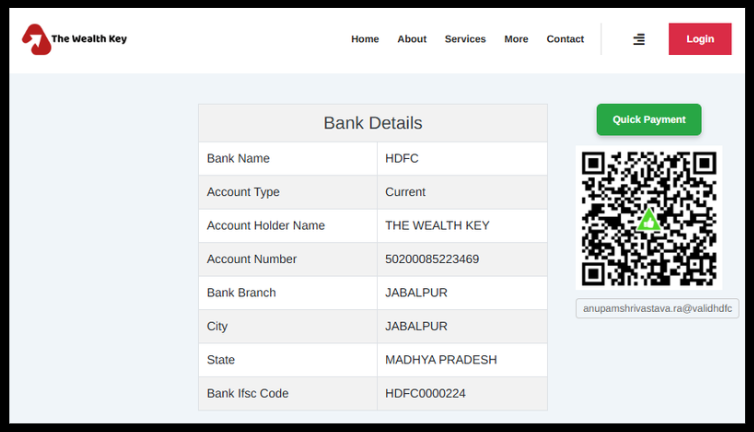
SEBI requires registered research analysts to collect all fees through the firm’s official registered bank account. Payments into personal accounts or personal UPI IDs are not compliant.
Before making any payment, confirm that the account holder name on the payment details matches The Wealth Key Research or Anupam Shrivastava as the registered entity.
If the account name belongs to an unrelated individual, that discrepancy is worth flagging in a formal complaint alongside any fee cap violation.
What to Do If Your Total Payments Exceeded ₹1,51,000?
The first step is to stop paying and calculate. Once the total crosses the cap, every further payment compounds the violation rather than adding value.
Collect all payment receipts and bank records.
Write a formal email to the firm’s compliance contact asking them to confirm the total fees collected from you in the financial year and explain how that total complies with SEBI’s ₹1,51,000 limit.
If the response is unsatisfactory or does not come within 21 days, file on SEBI SCORES. Select Research Analyst as the intermediary type.
Enter INH000011510 as the registration number. Specifically mention in the complaint description that combined fees exceeded the SEBI annual limit and include the calculated total with payment dates.
The complete step-by-step complaint process including how to escalate through SMART ODR and what arbitration looks like for fee recovery claims is on the complaint page.
Read the complete guide on how to file a complaint against The Wealth Key.
Our team files your SEBI SCORES complaint, prepares the documentation, and represents you through SMART ODR and arbitration.
Conclusion
The Wealth Key Research’s pricing structure has one plan that costs ₹1,50,000 for three months. SEBI’s annual fee cap is ₹1,51,000.
Any renewal of that plan, or any combination of plans that together exceed that ceiling in a financial year, may constitute a fee cap violation.
The cap is not disclosed anywhere on the pricing page. Annual plans do not exist on the site, which means the annual cost is only visible to an investor who calculates it themselves.
Calculate your total before renewing. If the number is above ₹1,51,000, your next step is a formal complaint.
Frequently Asked Questions
SEBI caps the total fees a single client can pay to one registered Research Analyst at ₹1,51,000 per financial year. This applies to the combined total across all plans and services from the same RA, not to each plan individually.
The TWK Combo Equity quarterly plan costs ₹1,50,000. SEBI's annual cap is ₹1,51,000. A single renewal of this plan takes the combined total to ₹3,00,000, exceeding the annual cap on the second payment.
The firm's pricing page offers only weekly, monthly, and quarterly subscriptions. No annual plan appears. SEBI's advance fee rules cap upfront collection at one year. However, the absence of annual pricing also means the annual cost is not visible at the point of purchase, only when the investor calculates it from quarterly figures.
Collect all payment receipts and bank records. Write a formal email to the firm asking for confirmation of total fees collected and how they comply with SEBI's annual limit. If no satisfactory response comes within 21 days, file on SEBI SCORES using registration number INH000011510 and specifically mention the fee cap violation with your calculated total.
Yes. Fees collected above the SEBI annual cap of ₹1,51,000 may be recoverable through a formal SEBI SCORES complaint, SMART ODR conciliation, or exchange arbitration. The strength of the recovery depends on your payment documentation showing the combined total paid in the financial year.





 Add us as a preferred source on Google »

