You open your trading app to place a quick order before the market moves further. The price is changing fast, and you want to enter or exit a trade immediately.
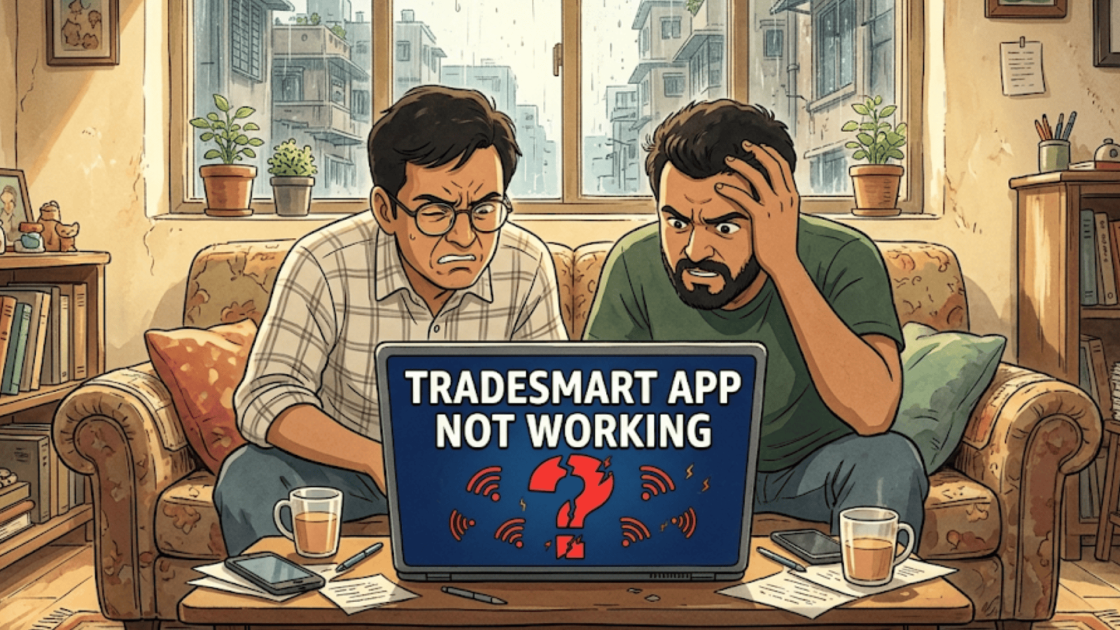
But instead of the trading dashboard loading, the app slows down, fails to log in, or refuses to execute the order. At that moment, many traders start wondering whether the TradeSmart app is not working.
Most investors who report this issue usually mean the TradeSmart: Stock, F&O Trading platform used by clients of TradeSmart Fintech Securities Limited.
The app connects traders to stock exchanges and allows them to place orders in equities and derivatives during market hours.
Online trading today depends heavily on technology.
A trading app may look simple on the screen, but behind it several systems work together to process orders and communicate with exchanges.
If any part of that chain faces a disruption, users may experience problems such as login failures, delayed order execution, or the platform not loading properly.
In this blog, we will look at how trading platforms handle such technical issues, what regulators consider a technical glitch, what exchange disclosures show about reported incidents, and what steps investors can take if they face problems while trading.
TradeSmart Technical Glitch Review
TradeSmart Fintech Securities Limited operates the TradeSmart: Stock, F&O Trading platform. Investors use this app to trade in equities, derivatives, and other market segments.
Through the platform, traders connect to stock exchanges such as the National Stock Exchange (NSE) and place buy or sell orders during market hours.
Many investors rely on the app to track prices, manage positions, and execute trades quickly.
However, a trading platform is more than just a mobile application. Several systems work together in the background to process every order.
These include the mobile interface, backend servers, order management systems, and connectivity with the stock exchange.
If any of these systems face a disruption, traders may experience problems.
The app may fail to log in, orders may take longer to execute, or the platform may stop responding for a short period.
Regulators use the term technical glitch to describe disruptions in electronic trading systems.
According to the regulatory framework issued by SEBI, a technical glitch refers to a malfunction in a broker’s electronic trading system that interrupts normal trading operations.
For investors, this simply means that the trading platform temporarily fails to work the way it should.
Some common examples include:
- Login failures while accessing the trading app
- Delays in order execution
- Server outages during market hours
- Issues in the order management system
- Connectivity problems between the broker and the exchange
These issues can interrupt trading activity for a short period and affect the ability of investors to place or manage their orders.
What Brokers Must Do During a Technical Glitch?
Regulators require brokers to follow a structured process when a technical glitch occurs.
If a disruption affects the trading system, the broker must report the incident to the stock exchange within two hours. The broker must also inform affected clients about the issue.
After identifying the problem, the broker needs to investigate what caused the disruption.
Within 14 days, the broker must submit a Root Cause Analysis report explaining the issue and the steps taken to prevent it from happening again.
Brokers must also maintain Business Continuity and Disaster Recovery systems.
These systems allow trading services to continue from backup infrastructure if the main system fails.
To maintain transparency, stock exchanges publish disclosures about technical glitches reported by brokers.
Investors can review these disclosures to understand how often such incidents occur.
TradeSmart Complaints
The TradeSmart: Stock, F&O Trading platform serves investors across India who access the markets through its online trading systems.
Many traders depend on the app to monitor market movements, place orders, and manage their portfolios during market hours.
When a trading platform with a large user base experiences a disruption, even a short outage can affect multiple traders at the same time.
Active traders, especially those dealing in intraday or derivatives, may feel the impact more quickly because they rely on fast order execution.
Stock exchanges publish disclosures about technical glitches reported by trading members.
These disclosures help investors understand whether brokers have reported system disruptions affecting their trading infrastructure.
The table below summarises technical glitches reported by TradeSmart Fintech Securities Limited based on exchange disclosures.
| Financial Year | Technical Glitches Reported |
|---|---|
| 2023–24 | 0 |
| 2024–25 | 0 |
| 2025–26 | 2 |
The available disclosure data shows that reported incidents appear limited and spread across different years.
The numbers do not suggest repeated or continuous disruptions over a short period.
Instead, they indicate that any reported glitches appear to be isolated incidents rather than frequent infrastructure failures.
However, even isolated disruptions can matter to traders if they occur during active market hours.
When a trading app stops working during market hours, traders may face immediate difficulties. Many investors rely on the platform to monitor prices and act quickly, especially in fast-moving markets.
If the app becomes slow or unresponsive, traders may not be able to place or modify orders on time.
In some cases, they may also struggle to exit open positions while prices continue to move. Such situations can lead to missed opportunities or unintended exposure to market risk.
For active traders who depend on timely execution, even a short interruption in the trading platform can create uncertainty during volatile market conditions.
How To Report a Technical Glitch?
If investors face issues while using a trading platform, they can take a few practical steps to report the problem and seek a resolution.
Step 1: Contact the Broker
Contact the broker’s customer support team and report the issue. Brokers usually provide support through phone, email, or helpdesk systems.
Reaching out to the broker first helps create an official record of the incident and allows the support team to investigate the problem.
Step 2: Keep Evidence
Keep proper evidence of the issue. This may include screenshots of error messages, order logs, or timestamps showing when the problem occurred.
Maintaining these records can help clearly demonstrate the issue if the complaint needs to be reviewed later.
Step 3: Contact the Broker
If the support team provides an unclear response, delays the resolution, or denies the issue without proper reasoning, you should escalate the matter internally.
Send an escalation email referencing your earlier ticket number and include the full timeline of events along with your evidence.
Step 4: File a Complaint on SCORES
If the issue remains unresolved, investors can file a complaint through the SMART ODR, which is the regulator’s online grievance redressal system.
This system allows investors to formally register complaints against brokers and track the status of their grievance.
Step 5: Escalate Through the Exchange
Investors can also escalate the matter through the investor grievance mechanism of the stock exchange if the complaint is not resolved by the broker.
If the support team provides an unclear response, delays the resolution, or denies the issue without proper reasoning, you should escalate the matter by complaint through SMART ODR.
Send an escalation email referencing your earlier ticket number and include the full timeline of events along with your evidence.
If a resolution is not reached through these channels, the dispute may then proceed to formal arbitration in the share market.
Need Help?
Sometimes, resolving trading issues with a broker can become complicated. Investors may report a problem, but delays in responses or unclear explanations can make the situation difficult to understand.
Technical trading issues, order disputes, or platform-related complaints often require proper documentation and knowledge of the complaint process.
Many investors are not fully aware of how to escalate such matters through regulatory channels.
If you are facing unresolved issues related to trading platforms, order execution, or broker services, you can register with us for guidance.
We can help you understand the available grievance mechanisms and the steps involved in resolving broker-related disputes.
Our goal is to help investors navigate the process and ensure that their concerns are addressed through the appropriate channels.
Conclusion
In the high-speed world of digital finance, your success isn’t just dependent on your strategy; it’s dependent on the uptime of the software you use.
Online trading has democratized the markets, but it has also introduced a specialized layer of risk: systemic reliability.
When a technical glitch in share market operations occurs, the consequences are immediate.
Traders may find themselves locked out of their accounts, unable to cancel orders as prices plummet, or watching “ghost” data that doesn’t reflect real-time market movement.
Brokers are legally required to report significant glitches to the stock exchanges within a specific timeframe.
For a trader, “staying alert” means more than just watching the ticker. It means being prepared for a system failure during peak volatility.
Taking timely action and following the proper complaint process, utilizing platforms like SEBI SCORES if the broker doesn’t compensate for proven losses, is the only way to ensure a technical failure doesn’t become a permanent financial one.