

Quick Summary
Rakesh Saini (name changed), from Alwar, Rajasthan, was told to deposit ₹1 lakh for routine account work. Within minutes, 35 orders he never placed hit his account, and brokerage ignored his zero brokerage plan, taking 91 percent of the debit. His claim of ₹1,00,000 went to the broker first and then to SEBI SCORES. Evidence from chats, call log, tariff sheet, and contract note backed the claim. Our team secured a refund of ₹72,794, about 73 percent of the claim.
What would you do if a ₹1 lakh deposit vanished overnight into trades you never placed?
One investor faced exactly this, and a complaint against a stock broker for unauthorised trades and excessive brokerage got most of it back.
Rakesh Saini (name changed) is from Alwar, Rajasthan.
He added money to a new account on a Thursday afternoon.
By Friday morning, almost all of it was gone.
Here is the full story.
Broker Representatives Demanded a ₹1 Lakh Deposit for Free Account Work
Rakesh joined a stock broker through referral links.
Two representatives guided him and kept in touch on WhatsApp and phone.
He wanted simple changes. An email update, a nominee, and activation of a segment.
None of these needs any money in the account.
How Pressure Tactics Pushed a ₹1 Lakh Deposit Before Basic Updates?
When Rakesh offered to begin with ₹50,000, he was told the matter was not in their hands.
He was also told not to take any trades until they said so.
A day later, one of them wrote that the work would not happen unless he started with ₹1 lakh.
She asked him to add the fund, and promised work from the next day.
Shifting Timelines and Promises That Triggered the ₹1,00,001 Transfer
Rakesh was also promised that something he wanted would be done below a certain level after a week.
The date kept shifting.
Each message gave a reason to wait and a reason to pay. Rakesh trusted them and sent ₹1,00,001.
Unauthorised Trades Start Minutes After the Deposit Hits
On the evening of the deposit, one representative was handling his account himself.
His own chat shows him asking which number was linked to the demat and which email was added.
At 7:37 pm, he posted the client code in a group run by the broker’s authorised person team.
He asked for an email change and a nominee addition.
The 12-Minute Gap: From “Please Wait” to the First Crude Oil Order
At 7:39 pm, he told Rakesh to wait a little and said he would call as soon as it came.
At 7:51 pm, the first order hit Rakesh’s account.
Orders in crude oil mini options ran until 9:09 pm.
There were 35 orders, broken into hundreds of fills of just 10 units each.
Missed Calls and Ignored Chats While 35 Orders Executed
At 7:56 pm, Rakesh wrote asking if a trade had been placed.
He asked what was being done and begged for some information.
His calls at 7:53, 7:55, 7:56, 7:58, 8:01, and 8:49 pm went unanswered.
So did his call the next morning at 9:27.
What the Contract Note Revealed About Excessive Brokerage Charges?
The next morning, the contract note debited ₹1,00,206.44.
That was more than the ₹1,00,001 he had deposited.
Only ₹9,044.50 of it was trading loss.
The rest, about 91 percent, was brokerage, a charge called “Oth1”, and GST.
Charged Heavy Brokerage Despite a 3-Month Zero Brokerage Plan
Rakesh’s signed tariff sheet said options carried zero brokerage for the first three months after onboarding.
His trades came eight days after the account opened.
Yet brokerage on the contract note stood at ₹73,507.50, with ₹3,692.50 under “Oth1” and ₹13,902.78 as GST.
How Far-OTM Option Trades Inflated Brokerage?
Brokerage worked out to about ₹5 per unit, on options trading at roughly ₹4 to ₹6.
On several sales at ₹4.20, the net rate on the contract note reads 0.0000.
Trading far out of the money options in fills of 10 units serves one clear purpose.
It creates brokerage.
SEBI Rules on Client Order Evidence and Broker Responsibility
SEBI’s circular for stock brokers says a broker must execute a client’s trade only after keeping evidence that the client placed the order.
The broker must produce that record when a trade is disputed.
The same circular makes the broker responsible for all acts of its authorised persons.
Anyone facing this can start a complaint against a stock broker with the chat record, the call log, and the contract note.
SEBI Fraud and Unfair Trade Practice Rules on False Promises
SEBI’s rules against fraud and unfair trade practices treat a promise made without any intention of keeping it as a fraud.
They also bar any course of business that works as deceit on a client.
A demand for ₹1 lakh as a condition for free account work, followed by orders and charges on the same night, fits that description closely.
How We Built the SEBI SCORES Complaint Against the Stock Broker?
We made the evidence tell the story in order.
Each step followed the clock on the chats and the contract note.
Step 1: Building a Minute by Minute Timeline of Chats and Orders
The WhatsApp messages, the group post, and the first order time were set side by side.
The twelve minutes before the first order mattered most.
Step 2: Listing Every Unanswered Call to the Broker
His call log showed seven attempts between evening and the next morning.
None was picked up.
Step 3: Splitting the Contract Note Into Loss, Brokerage and Charges
The debit was broken into trading loss, brokerage, “Oth1”, and GST.
The 91 percent share was shown in plain figures.
Step 4: Comparing Brokerage Charged With the Signed Tariff Sheet
His signed sheet promised zero brokerage for three months.
The contract note charged heavily on day eight.
Step 5: Writing to the Broker’s Compliance Officer for a Full Credit
Our complaint asked for a full credit, the order log with device and session details, and the proof that he placed each order.
It also asked for written confirmation of who the two representatives were.
Step 6: Escalating the Complaint to SEBI SCORES
When the broker did not resolve the matter, we filed on SCORES with the chats, call log, tariff sheet, and contract note attached.
₹72,794 Refund Secured Through the SEBI SCORES Complaint
Rakesh’s claim stood at ₹1,00,000.
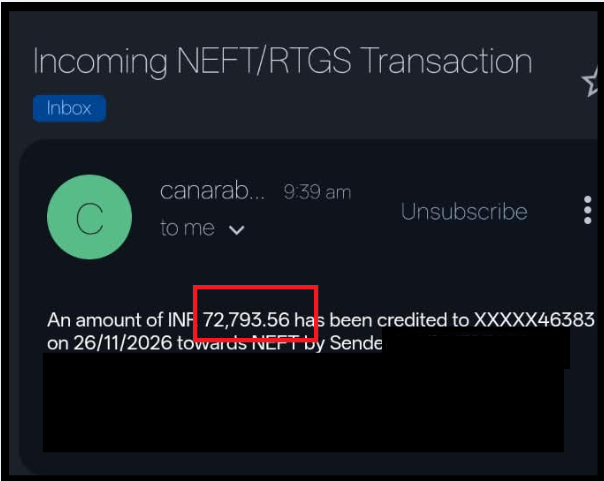
Through the SCORES process, he received a refund of ₹72,794, about 73 percent of the claim.
Did Orders Appear in Your Account That You Never Placed?
Get Expert Help for Your Broker Complaint
Save your chats, call log, tariff sheet, and contract note today.
Register with us and we will tell you which forum fits your case.
Conclusion
Rakesh’s case turned on a clock.
A deposit at noon, a request to wait at 7:39 pm, and orders at 7:51 pm.
His own chat showed who was handling the account and why he could not have placed the trades.
The charges told the second half of the story.
A tariff sheet promised zero brokerage, yet charges took 91 percent of what he lost.
Comparing the signed plan with the contract note is a check every investor can do in ten minutes.
A recovery of about 73 percent is not a full refund, and we say so plainly.
If the first complaint to your broker stalls, a SEBI SCORES complaint is the next step, and the Smart ODR portal is open if the dispute continues.
Report. Recover. Stay Fraud Free.
Call and write to your broker at once, and save every message and call attempt. Then ask in writing for the order log with device and login details. Yes. SEBI's circular requires brokers to keep evidence of the client placing the order and to produce it when a trade is disputed. Yes. The circular makes the stock broker responsible for the acts of its authorised persons, including what they say and do on client accounts. No. Charges must match your signed tariff. Compare each line of the contract note with your account opening documents. Yes. In this case the market loss was about 9 percent of the debit. The rest was charges, and those can be challenged.Frequently Asked Questions





 Add us as a preferred source on Google »