
Quick Summary
Worth Market Research holds SEBI Research Analyst registration INH000025841 under proprietor Ayusman Das, confirmed active with perpetual validity from April 9, 2026. Google’s own business listing for the same firm shows it as temporarily closed in Vadodara, Gujarat. Beyond that contradiction, a full audit found a registration date the site’s own footer gets wrong, testimonials naming exact profit and accuracy figures, pricing that breaches SEBI’s annual fee cap within a single quarter, a payment page with blank bank fields, and a refund policy that contradicts itself. This page covers each finding in order.
Worth Market Research shows a perpetual SEBI licence starting April 9, 2026. Google now lists the same firm as temporarily closed.
That single contradiction sits underneath every red flag on this page.
Ayusman Das runs this SEBI-registered Research Analyst, number INH000025841, from an address in Indore. This page goes through the site page by page, then explains what the active-versus-closed status means for anyone with a complaint pending or not yet filed.
What Is Worth Market Research and Is It SEBI Registered?
Worth Market Research is a stock market advisory run by proprietor Ayusman Das, offering trading calls and packages across equity, options, and commodity segments.
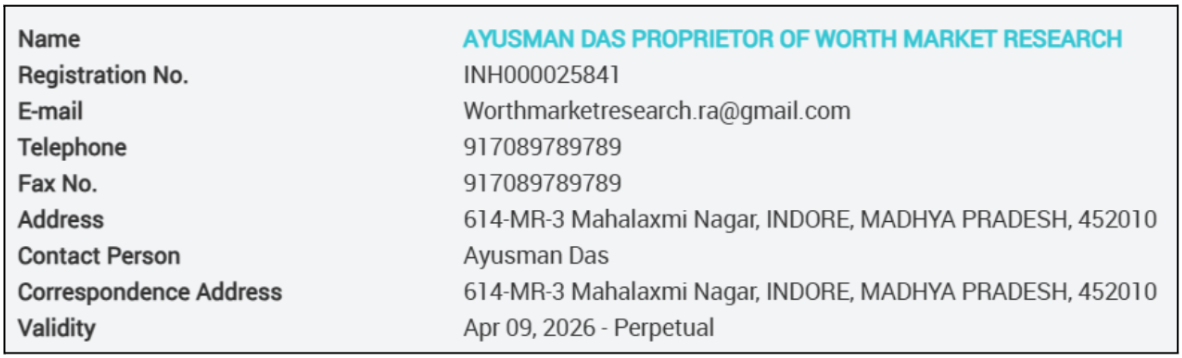
Yes, the firm holds an active SEBI Research Analyst registration under number INH000025841, confirmed on SEBI’s own registry with perpetual validity from April 9, 2026. The registered address on file is in Indore, Madhya Pradesh.
That registration is genuine and independently verifiable. What sits alongside it, starting with a contradiction on the firm’s own Google listing, is what the rest of this page covers.
Is Worth Market Research Active or Has It Quietly Shut Down?
Yes, the registration is still active, and no, that does not mean the picture is clean. SEBI’s own registry lists the licence as valid with perpetual validity.
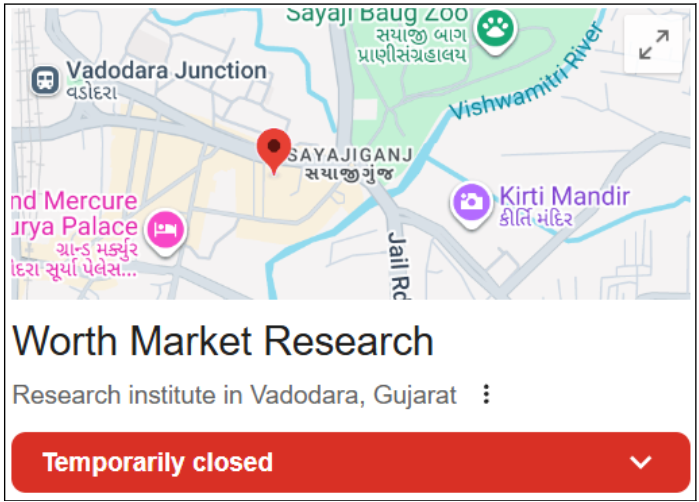
Google’s business listing for the same firm carries a different label, marking it temporarily closed in Vadodara, Gujarat.
A licence staying active on paper does not confirm an office is open, staffed, or answering calls. It only confirms SEBI has not cancelled or suspended the registration, which matters more than it sounds once a complaint enters the picture.
The rest of this page explains why that registration was already worth questioning before the closed tag ever appeared.
Also Read: Global Vision Research, one page says never, another page says maybe.
Worth Market Research’s Registration: Why Do the Numbers Not Agree?
Every page on this site carries a registration detail, and no two of those details agree with each other. This confusion touches every page a client might read, before marketing or pricing even enter the picture.
1. Two Licence Numbers in One Footer
The footer on every page lists two numbers side by side without saying which service each one covers. INA000013651 is an Investment Adviser number. INH000025841 is a Research Analyst number.
Printed together under a label reading Investment Adviser and Research Analyst, the footer implies both services are offered. The homepage banner, by contrast, claims only Research Analyst status.
The Disclaimer page goes further, stating outright that the firm does not provide investment adviser services at all, a sentence that directly contradicts the footer on the same website.
2. A Validity Date the Footer Gets Wrong
The footer states a validity date of July 19, 2019, suggesting nearly seven years of operating history.

The Disclosure page instead states the Research Analyst registration was obtained on April 9, 2026, and SEBI’s own public registry confirms that date.

That means the website’s own footer is the one showing false information. A newly registered entity displaying a validity date seven years earlier is not a small typo. Regulation 18 of the RA Regulations requires clear, accurate registration disclosure, and this website fails that on its own footer.
Also Read: Kuber Alpha Research, a no-refund policy applying the moment you actually pay.
Do Worth Market Research’s Testimonials Break SEBI’s Advertisement Rules?
With the registration confusion covered, the next place to look is how the firm actually markets itself to new clients. The homepage and About Us page both read closer to a trading tip service than a research analyst’s website.
Several testimonials name exact profit figures instead of describing a general experience.
- Suraj Pasi, a trader, credits a ₹45,000 quarterly plan and researcher Pushpendra Patel with a personal profit of around ₹40,000 in seven days.
- Abhishek Yadav, a professional trader, describes recovering his entire subscription fee within 15 days, crediting an advisor named Sekha ji for the result.
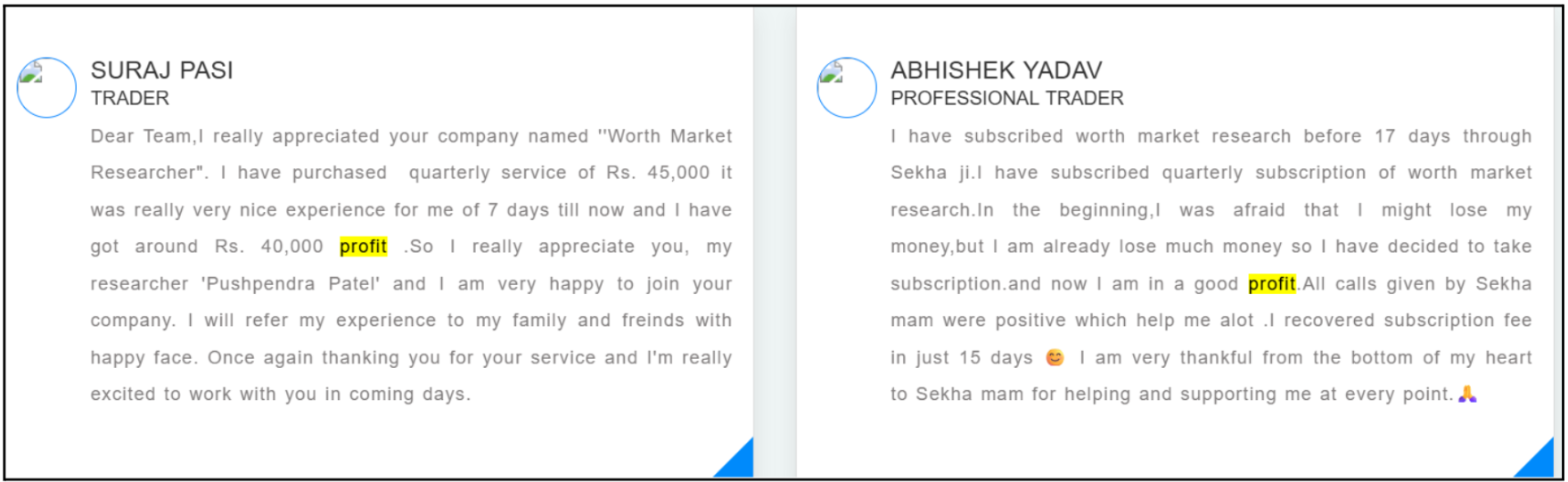
- Subramoniam Saravanaperum, a businessman and trader, credits advisor mr. Shivam with an intraday accuracy rate highlighted directly on the page at 98 percent.
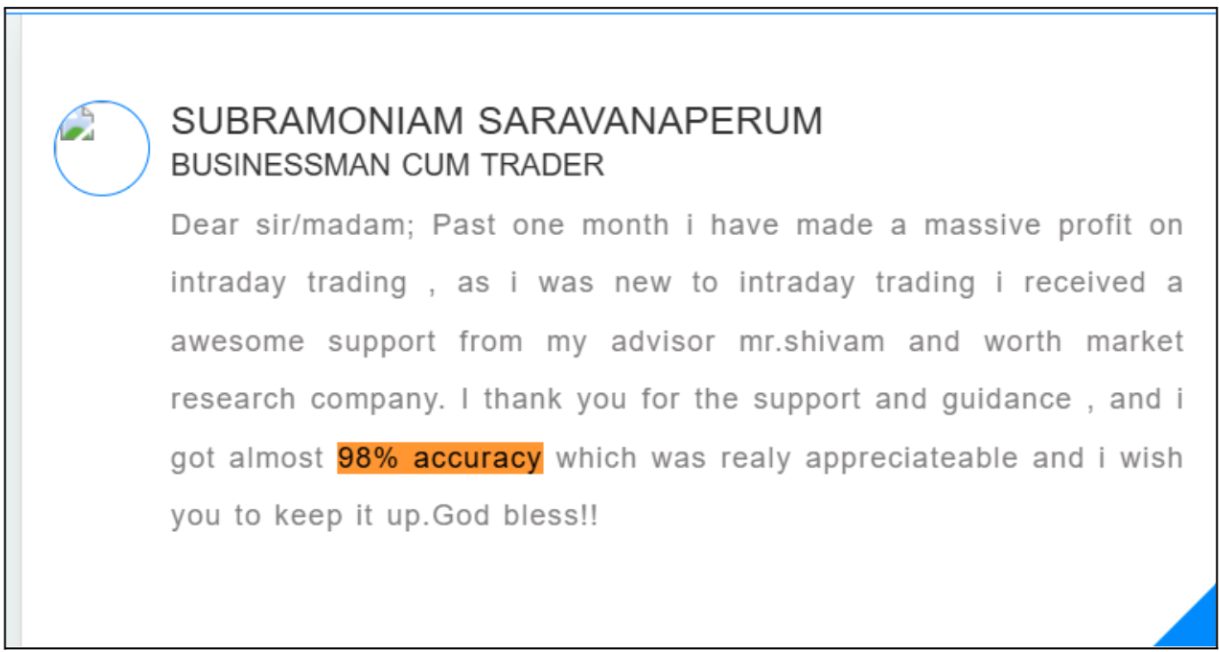
SEBI’s Advertisement Code does not allow advertisements that guarantee returns or lean on performance testimonials like these. A pop-up disclaimer on the same page states that no profit sharing or guaranteed result exists, wording that is correct on its own.
That correct disclaimer sits directly beside testimonials promising exactly the profit and accuracy it claims not to guarantee.
Beyond the testimonials, the language across the homepage reads like a stock tips service rather than independent research.
Terms like MCX Pack, book profit, and call appear throughout, alongside accuracy percentages tied to specific trades, a tone that runs through nearly every product name on the site rather than one page in isolation.
The About Us page carries this forward instead of correcting it, describing the business as providing online trading tips across intraday, positional, BTST, and STBT styles at a reasonable tariff.
Nowhere does it mention research methodology, analyst qualifications, or how recommendations actually get built.
Worth Market Research’s Services and Pricing: Does It Breach SEBI’s Fee Cap?
The Services page shows how the firm’s trading-tip tone carries into the product structure itself, and the Pricing page is where the biggest compliance problem shows up.
1. Products Sold by Call Frequency, Not Research Depth
Every product on the Services page is named and priced around call frequency rather than research depth. Stock Cash, Stock Future Premium, MCX Pack, WMR Special Cash, WMR Special Future, and WMR Equity Holding separate themselves by frequency and market segment alone.
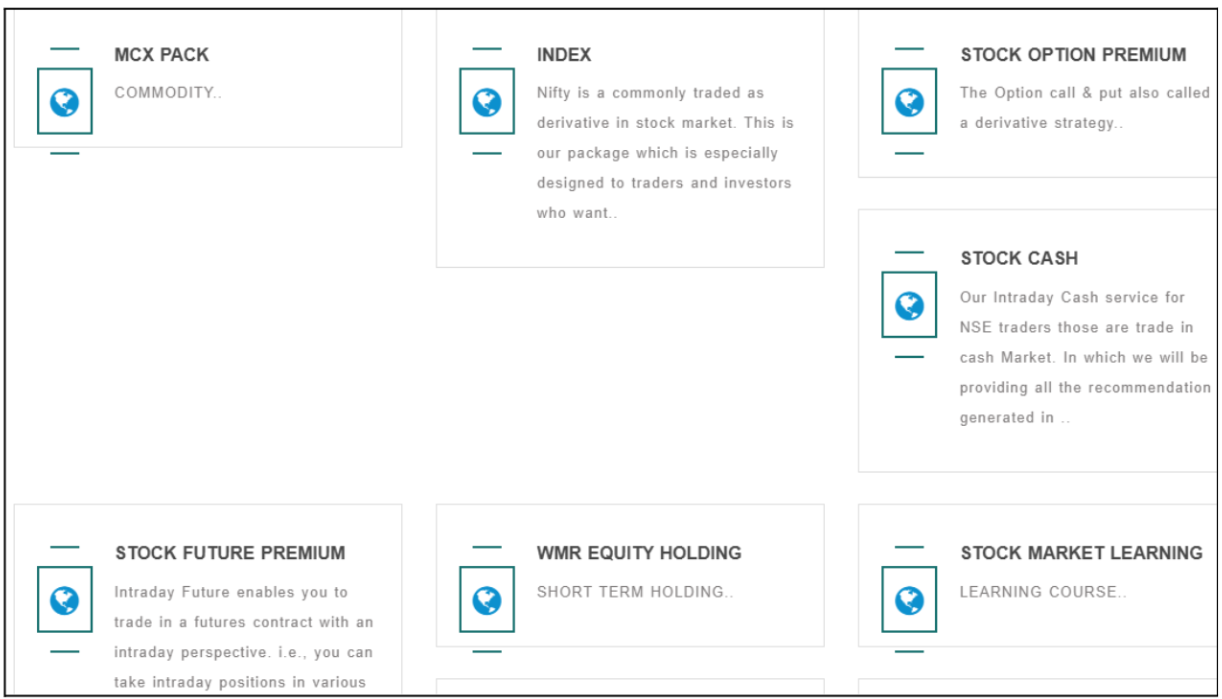
This structure matches a pattern regulators associate with tip-selling operations using a Research Analyst licence as cover.
Nowhere on this page does a risk category appear, and nothing distinguishes a recommendation from a guaranteed call.
Mixed into the same grid sits Stock Market Learning, an education course with no separation or disclosure, marking it as non-research activity.
2. A Cap Breached Within a Single Quarter
SEBI’s December 2024 amendment caps Research Analyst fees at ₹1,51,000 a year per client family, confirmed by the Master Circular dated June 27, 2025. Paragraph 1.9(b) of that circular applies this cap across every service a client buys from the same firm combined.
Nothing on the Pricing page states this cap or explains how billing stays within it.
A single quarter of just one plan already threatens the entire yearly limit. MCX Pack Quarterly and Stock Future Premium Quarterly both cost ₹49,999. Stock Option Premium Quarterly costs ₹44,999, and WMR Combo Service Quarterly costs ₹1,49,999 on its own, almost the entire annual cap in one product’s single quarter.
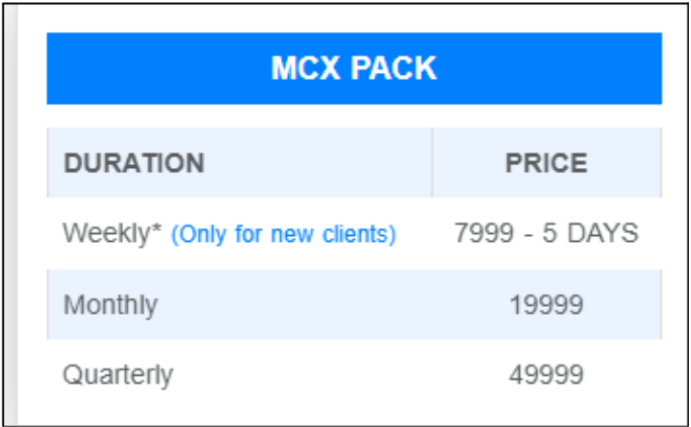
MCX Pack also runs a Weekly tier at ₹7,999 for 5 days, offered only to new clients, a lower-commitment entry point that sits alongside the Monthly and Quarterly options.
Clients rarely buy just one plan, since the site actively cross-sells MCX, Index, and Stock Future packages together. Combining two or more of these plans breaches the annual family cap inside a single quarter, without even reaching a full year.
Also Read: Dream Wealth Research Private Limited, a two-year gap in complaints, then a sudden shift.
Is It Safe to Pay Worth Market Research?
Once a client agrees to pay, the Payment page is where money actually changes hands, and SEBI is specific about how Research Analysts must collect fees.
Every bank account field on the Payment page reads blank or NA, across every option listed. The only channel that looks usable is a UPI ID, tied to a Google Pay listing.
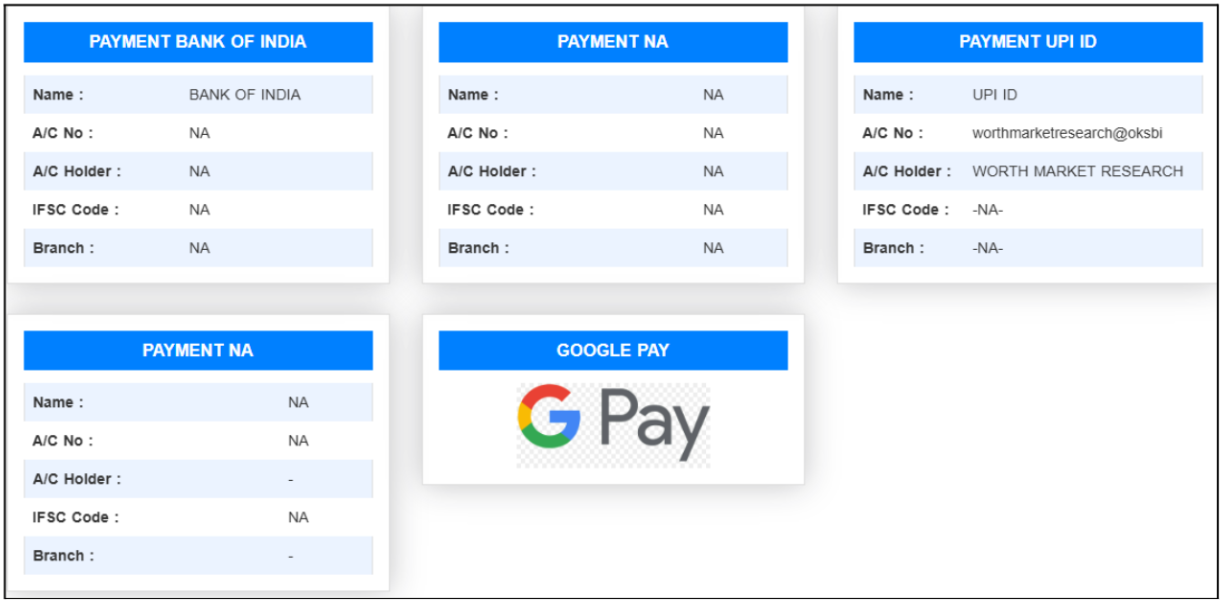
SEBI requires client fees to move through banking channels into a verified account in the registered entity’s own name, with CeFCoM, run by RAASB through BSE, as the preferred route. A generic UPI handle with every bank field left blank does not meet that standard, even if payments happen to land reliably.
The Investor Charter hosted on this same website tells investors to pay a Research Analyst only through banking channels and to keep signed receipts.
The Payment page does not confirm CeFCoM enrolment, describe a receipt process, or restrict payments coming from a relative or third-party account, a pattern of one page instructing a behaviour the firm’s own channel does not follow.
Also Read: Adroit Financial Services complaints, five registrations, and five separate complaint pathways.
Worth Market Research Complaints: What Does the Board Actually Show?
The Complaint Board is meant to give investors a transparent, month-by-month view of how disputes get handled. On this site, the numbers raise more questions than they answer.
Across three years, from 2024 to 2027, the table shows exactly one complaint received and one resolved. Every other row reads zero, with nothing carried forward and nothing pending.
| Year | Received | Resolved | Pending |
|---|---|---|---|
| 2024-25 | 0 | 0 | 0 |
| 2025-26 | 1 | 1 | 0 |
| 2026-27 | 0 | 0 | 0 |
Verified from the table alone, a single complaint across three years is not proof of a clean record either. If you file a SEBI SCORES complaint of your own, it becomes part of a table like this one going forward.
The monthly trend table beneath the yearly summary lists months out of order, mixing 2025 and 2026 dates inconsistently, with no visible “as on” date.
SEBI’s format requires this table to be refreshed monthly, updated by the 7th of each day. Dates out of sequence read like stale template data rather than a genuinely maintained disclosure.
Do Worth Market Research’s Policies Contradict Each Other?
Several of the firm’s own policy pages disagree with each other, sometimes within a few lines of the same document, and a client relies on these exact pages to know their rights before and after paying.
1. A Refund Policy That Argues With Itself
The Refund Policy opens by stating all sales are final, and no refunds are offered under any circumstance.

A few lines later, the same page states that SEBI guidelines require a pro-rata refund for the unused portion, then closes by repeating that no refund is possible in any case whatsoever.
SEBI’s Master Circular, clause 1.9, requires Research Analysts to refund unused fees on early termination, subject to permitted breakage rules.
A policy that denies refunds while quoting the pro-rata rule it must follow is not just poorly written; it is non-compliant as worded.
2. A Privacy Clause That Overrides Its Own Investor Charter
The Privacy Policy states client information may be transferred to any organisation the firm has an interest in, without consent.

That clause conflicts with the Investor Charter’s own right-to-privacy section, hosted on the same website, and runs against India’s Digital Personal Data Protection Act, 2023, which requires consent-based handling of personal data.
3. Leftover Text From a Different Website
The Disclaimer page contains a paragraph referencing a completely different website, stockproonline, by domain name.

This is leftover template text, copied from another Research Analyst or vendor’s disclaimer and never edited for this entity. A mandatory disclosure containing someone else’s brand name raises a real question about whether the other claims on that page, like no disciplinary history, were actually verified for this firm at all.
Does a Trading Rules Page Read Like a Boiler Room Script?
One document on this site tells clients exactly how to trade, which is a red flag on its own. Trading Principles of Recommendations reads less like research guidance and more like a script built to keep subscriptions running.
The page instructs clients to maintain equal investment and the same lot size across every trading call for a full month, regardless of how different the underlying scripts are from one call to the next.

A Research Analyst’s role is to publish independent research. Dictating position sizing that ignores a client’s own capital is not that role, and this kind of rigid, one-size-fits-all instruction is a pattern regulators associate with tip-selling operations.
Encouraging clients to trade every call through a proprietary WMR Messenger app, combined with weekly, monthly, and quarterly pricing tiers, looks built to maximise renewals over genuine research value.
The Grievance Redressal page mostly follows SEBI’s expected format, though its escalation matrix leaves the CEO row entirely blank, shown only as a dash, and states a 21 working day resolution timeline that more recent SEBI circulars have moved to shorten, worth rechecking against the current rule.
What Does Worth Market Research’s Website Never Show You?
Beyond what the website gets wrong, a few things it simply never shows matter just as much. None of the following appear anywhere across the pages reviewed for this page.
- No sample research report or methodology, so a client cannot see how a recommendation actually gets built
- No statement of the ₹1,51,000 family fee cap, or any explanation of how billing stays inside it
- No confirmation of CeFCoM enrolment, despite the Investor Charter referencing the mechanism directly
- No analyst qualification detail, such as a NISM certificate number or educational background
- No GST-inclusive pricing in the price table, leaving the real cost to a client’s own calculation
Each gap alone might be an oversight. Together, they describe a website built faster than it was checked.
If you believe any Research Analyst is misrepresenting its registration scope, the complaint against SEBI registered research analyst page on this site covers how to raise that formally.
For the complete step-by-step process to file against Worth Market Research specifically, including what the active-versus-closed status changes and does not change, the Worth Market Research complaint page on this site covers all of that.
Matched one of these red flags to your own experience with Worth Market Research?
We check your payment history against the fee cap breach and the other issues flagged above, confirm the registration is still active, and prepare your SCORES complaint with the right documentation attached. Register with us for a free consultation.
Conclusion
Worth Market Research carries a registered, perpetually valid SEBI licence and a Google listing that says otherwise.
Underneath that split sits a fee cap breach, a self-contradicting refund policy, and copied disclaimer text, alongside marketing that reads like a trading tip service. None of these problems cancel each other out, and none of them wait for the other to get resolved first.
If any part of this matches your experience, verify the registration yourself and start documenting your case before the status changes again.
Report, Recover, Stay FraudFree
Frequently Asked Questions
No. The Disclaimer page states the firm does not offer investment adviser services, though the footer still displays an Investment Adviser number alongside the Research Analyst one.
The SEBI registry lists the registered address as Indore, Madhya Pradesh, while the Google listing shows Vadodara, Gujarat instead. This mismatch has not been independently verified and is worth confirming directly.
Yes. Screenshots of the Pricing page showing costs above the ₹1,51,000 cap count as the firm's own published material, making them usable evidence alongside your payment records.
Not necessarily. The table only reflects complaints filed through SCORES and reported by the firm itself, and inconsistent monthly dates raise questions about how reliably it gets updated.
Ayusman Das is the proprietor, holding SEBI Research Analyst registration INH000025841, active with perpetual validity from April 9, 2026, registered from an address in Indore, Madhya Pradesh.





 Add us as a preferred source on Google »

