
You don’t search a research analyst’s name for no reason.
Usually, it happens after you see something: maybe a trading call, maybe a website, maybe a testimonial claiming impressive accuracy. And then a small doubt creeps in.
Is this genuine? Is he really SEBI registered? Are those performance claims compliant?
That’s how most investors land here.
In a market full of analysts, Telegram channels, and bold accuracy claims, it’s easy to get impressed. But smart investors don’t stop at testimonials. They look at registration status and regulatory compliance.
So instead of assuming anything, positive or negative, let’s break this down calmly and examine who Zanil Shah is, what he offers, and what investors should understand before relying on any market research service.
Who Is Zanil Shah?
Zanil Shah presents himself as a full-time technical market analyst offering structured trading programs through his website.
His services are primarily focused on short-to-medium term trading, rather than long-term investment advisory.
The website promotes swing trading programs and index-based trading plans, typically centred around instruments like Nifty and Bank Nifty.
These programs are offered on a paid subscription basis, where subscribers receive trade recommendations based on technical analysis.
The approach, as described, relies on chart patterns, price action, and momentum setups.
Alongside the service details, the website also highlights client testimonials. Some of these reviews mention high accuracy levels and positive trading outcomes, positioning the service as performance-driven.
He also mentions his SEBI registration as a Research Analyst, which adds a regulatory layer to the offering.
However, as with any financial service, the important consideration is not just what is offered, but how it operates within the regulatory framework governing research analysts in India.
That brings us to the next key question, his SEBI registration status and what it actually means for investors.
Is Zanil Shah SEBI Registered?
On his website, Zanil Shah mentions that he is a SEBI-registered Research Analyst and provides the registration number INH000013907.
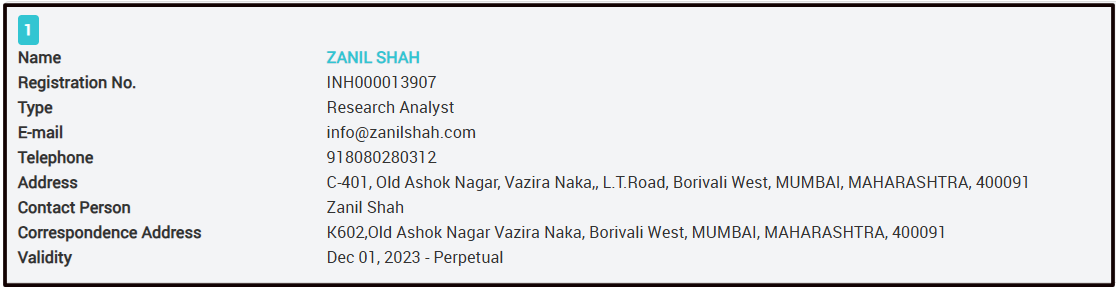
Now, what does that actually mean?
Under SEBI (Research Analysts) Regulations, a registered Research Analyst (RA) is allowed to provide research reports and investment recommendations based on analysis.
To obtain registration, the analyst must meet qualification criteria, compliance requirements, and regulatory standards laid down by SEBI.
However, it’s important to understand something very clearly:
SEBI registration does not mean guaranteed profits.
So while SEBI registration is an important regulatory requirement, investors should not confuse it with performance validation.
RA Legal Operations in India
When evaluating a SEBI-registered Research Analyst, the more important question is not whether an order exists, but whether the services operate within the legal boundaries defined by SEBI.
Under the SEBI (Research Analysts) Regulations, 2014, a registered Research Analyst (RA) is permitted to provide research reports and investment recommendations based on analysis.
However, registration comes with clearly defined compliance obligations.
An RA must maintain transparency in communication, avoid misleading advertising, disclose risks properly, and follow structured grievance redressal processes.
Marketing language, website content, and promotional material all fall within regulatory scrutiny.
In simple terms, SEBI registration allows operation, but it also imposes strict responsibility.
What a Research Analyst Is Not Allowed to Do?
Under SEBI regulations, a Research Analyst is not permitted to:
- Promise or imply guaranteed returns
- Publish misleading or exaggerated advertisements
- Present performance data in a way that creates unrealistic expectations
- Suppress risk disclosures
- Collect fees without proper transparency
- Operate without a grievance redressal mechanism
These restrictions apply not only to formal research reports but also to website content, promotional messaging, and investor-facing communication.
Zanil Shah User Review
The website displays client testimonials, some of which refer to high accuracy levels.
Even if such statements are written by users, once they are published on the official website, regulatory responsibility rests with the Research Analyst.
Quantitative claims like “90% accuracy” can influence investor perception and create expectations of consistent success.
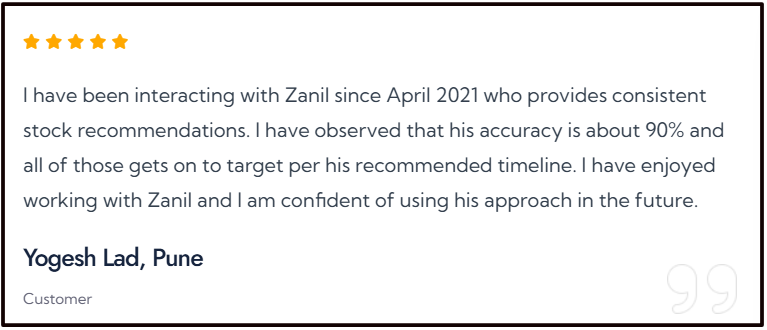
Under SEBI’s advertisement and communication standards, performance-related messaging must not be misleading or create an impression of assured outcomes.
This does not automatically establish a violation. However, such claims fall into a regulatory grey area, particularly if they are not supported by certified or formally disclosed performance data.
For investors, the distinction is important: regulatory registration and marketing presentation are separate considerations, and both deserve careful evaluation.
Which leads to the next practical question, how exactly can you report a Research Analyst if needed?
How To Report A Research Analyst?
If you believe a Research Analyst has violated regulatory norms, SEBI provides a structured grievance redressal mechanism.
Here’s how the process generally works:
1. File a Complaint on SCORES
SEBI operates an online grievance portal called SCORES (SEBI Complaints Redress System). You can register on the portal and submit your complaint by providing:
- Name of the Research Analyst
- Registration number (if available)
- Clear description of the issue
- Supporting documents
2. Attach Proper Evidence
A complaint carries more weight when supported by documentation such as:
- Payment receipts
- Email or WhatsApp communication
- Screenshots of promotional material
- Subscription agreements
- Any performance claims that influenced your decision
SEBI reviews complaints based on evidence. Without documentation, it becomes difficult to establish whether a regulatory breach occurred.
3. Follow the Resolution Process
After submission, the complaint is forwarded to the concerned Research Analyst for response. SEBI monitors the response and resolution timeline. If the issue remains unresolved, it may proceed further under regulatory review.
When filing a complaint, stay factual and precise. Avoid emotional language. Clear documentation and structured explanation improve the effectiveness of your submission.
4. File Arbitration at the Stock Exchange
If you are unsure whether your situation qualifies for reporting, it may be helpful to seek guidance before proceeding.
Need Help?
Dealing with a research analyst can feel confusing, especially when expectations and outcomes don’t match.
If you believe performance claims or service representations were unclear or misleading, it’s important to review the situation carefully before taking action.
Register with us and our team will first understand your case, then guide you on the right steps.
We help you organize documents, draft a clear complaint, and file it properly through the SEBI SCORES portal. We also guide you through the follow-up process and check the SEBI complaint status.
Conclusion
Zanil Shah presents himself as a SEBI-registered Research Analyst offering structured trading programs based on technical analysis. As per publicly available records, there are no SEBI enforcement orders against him at the time of writing.
At the same time, investors should clearly separate regulatory registration from performance expectations.
SEBI registration allows an individual to operate as a Research Analyst; it does not validate accuracy claims or guarantee trading success.
Testimonials and high-accuracy statements, even when presented as user reviews, should be viewed carefully. In financial markets, disciplined verification matters more than promotional impressions.
Before subscribing to any research service, investors should focus on transparency, documentation, and regulatory clarity, not just performance narratives.
In the end, informed decisions are always better than reactive ones.