

You place a trade, everything looks fine, and then something feels off. The order executes at a price you didn’t expect.
Your funds don’t reflect properly. You try reaching support, but the response takes time or doesn’t fully resolve your issue.
At that point, you don’t care about features or offers. You just want clarity. You want to know what went wrong and how to fix it.
This is where most investors get stuck.
Many users of SBICAP Securities report similar situations. Some face delays, some deal with confusing charges, and some simply don’t know how to escalate the issue properly.
Now here’s the thing: instead of guessing or relying on scattered reviews, you can look at actual exchange data and real complaint patterns to understand what’s really happening.
In this blog, we’ll break that down in a simple way so you can see where this broker stands and what you should do if you face a problem.
SBICAP Securities Complaints Overview
SBICAP Securities is a full-service broker backed by the SBI group.
Many investors choose it because of trust, banking integration, and the convenience of a 3-in-1 account.
On the surface, it feels like a safe and reliable option, especially for beginners and long-term investors.
But once you start using any broker, the real test begins when something doesn’t go as expected.
You might face a delay in fund updates, confusion in charges, or an issue with order execution.
At that point, brand value doesn’t solve the problem. The broker’s response does.
Because ultimately, situations like these make investors question: can you trust a stock broker?
This is exactly why complaint data matters.
Stock exchanges like NSE track complaints filed by investors every year.
This data doesn’t come from opinions or social media. Investors raise these complaints directly on the exchange when they don’t get a proper resolution from the broker.
That makes this data far more reliable than random reviews. It shows you three important things:
- How frequently users face issues
- How efficiently the broker resolves them
- How many cases escalate further
When you look at SBICAP Securities through this lens, you move from assumptions to actual patterns.
And once you see those patterns, you can make a much more informed decision.
In the next section, we’ll go through the actual complaint data and understand what it really reveals.
Exchange Complaint Data
Before you look at the numbers, understand what this data represents.
These are not random reviews. Investors file these complaints on the exchange when the broker doesn’t resolve their issue properly.
So this data reflects escalated problems, not minor inconveniences.
Even a small percentage here matters.
Now let’s look at the actual numbers for SBICAP Securities:
| Financial Year | Total Clients | No. of Complaints | % of Complaints | Resolved Complaints | % Resolved | Arbitration |
|---|---|---|---|---|---|---|
| 2022–23 | 712,846 | 289 | 0.041% | 279 | 96.54% | 4 |
| 2023–24 | 712,846 | 305 | 0.043% | 296 | 97.05% | 3 |
| 2024–25 | 824,193 | 512 | 0.062% | 512 | 100% | 1 |
| 2025–26 | 798,774 | 468 | 0.058% | 427 | — | — |
But don’t rush that conclusion.
If you look at the numbers closely, complaints increase significantly in 2024-25. They jump from around 300 to over 500.
Even in 2025-26, the number stays high compared to earlier years.
This tells you one thing clearly: issues are increasing in absolute terms.
Now look at the complaint percentage. It moves from 0.041% to 0.062%.
This may look small, but it shows a gradual upward trend. Complaints are not just increasing because of more users. They are growing at a slightly faster pace.
Resolution numbers look strong, especially in 2024-25, where they show 100% resolution.
But this doesn’t stay consistent. In 2025-26, the number of resolved complaints dropped, which means some issues remain open.
This inconsistency matters. Now let’s talk about arbitration.
The data shows a small number of arbitration cases every year. That’s a positive sign because most complaints don’t escalate to a legal level.
But here’s what most people miss: Arbitration cases do exist, and some investors have taken matters beyond basic complaints.
At the same time, detailed case files are not easily traceable publicly because exchange records are not indexed by broker name.
So you won’t always see clear, searchable case documents even though disputes happen.
What Should You Take From This?
- Complaints remain low in percentage, but they are rising in number
- Resolution is generally good, but not consistent
- Some cases escalate to arbitration, even if the count is small
This doesn’t make SBICAP Securities a bad broker. But it clearly shows that you should not rely only on brand trust.
In the next section, we’ll look at what actual users are experiencing and what patterns show up repeatedly.
SBICAP Securities User Reviews
Numbers give you one side of the story. Real user experiences show you what actually happens when you use the platform daily.
If you go through user feedback, you’ll notice a pattern.
The complaints are not random. Many users point toward similar issues- especially around app performance, trading experience, and support.
Let’s break down a few real experiences and understand what they actually mean for you.
1. App Performance and Support Issues
Before you look at the review, keep this in mind.
When a user talks about app speed and support together, it usually means the issue didn’t stop at inconvenience. It affected their ability to act in real time.
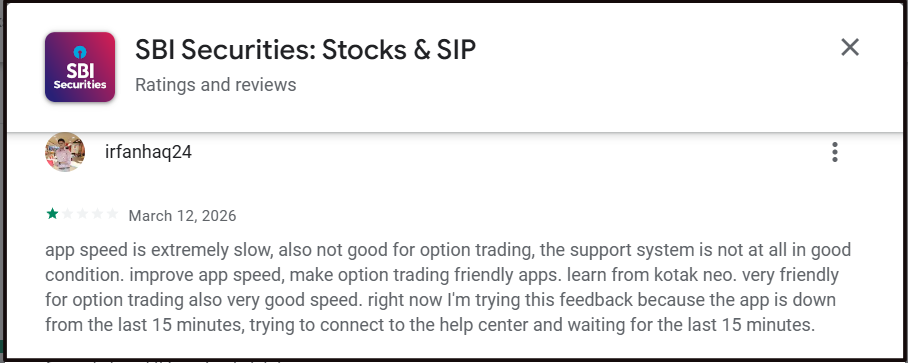
This review highlights three serious concerns:
- Extremely slow app performance
- Poor option trading experience
- Delayed or unresponsive support
The user also mentions that the app stayed down for 15 minutes while support didn’t respond.
This is not just about a “slow app.” In trading, even a few seconds matter. If the platform lags or goes down during market hours, you can miss entries or exits.
The bigger concern here is support. When the app fails, and support doesn’t respond quickly, you lose both control and clarity.
2. Confusing Interface and Poor Transparency
User frustration often increases when they cannot track their own money properly.
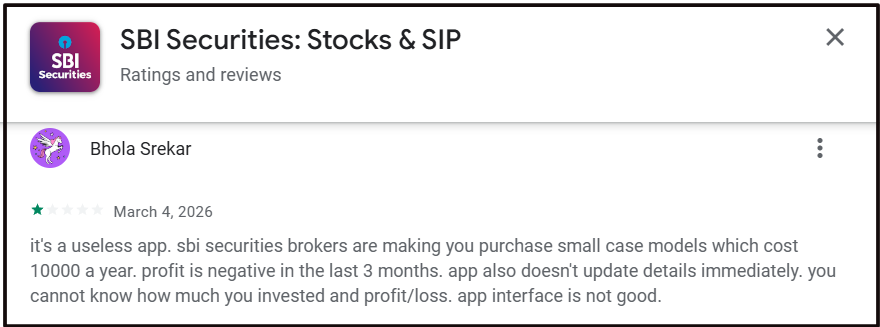
This review points toward:
- Delayed updates in investment data
- Unclear profit/loss tracking
- Forced push toward paid products like smallcase
- Overall poor interface
A trading app should give you clear, real-time visibility. If you cannot see how much you invested or what your current P&L is, decision-making becomes difficult.
The mention of paid products with negative returns also shows dissatisfaction with advisory or product recommendations.
3. Trust and Account Handling Concerns
Now this is where things become more serious.
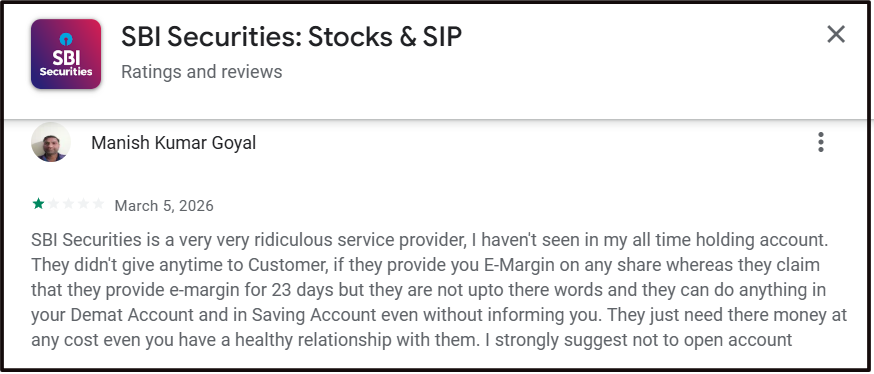
The user claims:
- Mismatch in promised e-margin duration
- Unexpected actions in the demat or bank account
- Lack of communication
Situations like this often raise concerns around SBICAP unauthorised trading, especially when users feel they are not fully informed about account activity.
Even if some parts come from misunderstanding, the core issue remains: a lack of clear communication.
And in finance, poor communication quickly turns into distrust.
4. Trading Experience and Feature Limitations
This review focuses on actual usability during trading.
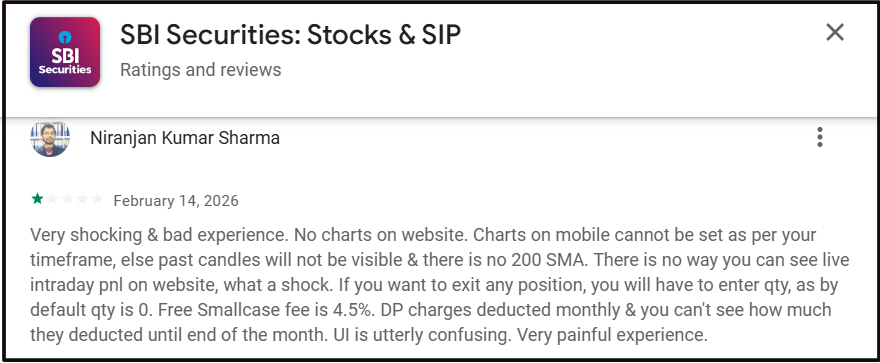
Key issues raised:
- Limited charting features
- No proper timeframe control
- No clear intraday P&L visibility
- Confusing UI
- Hidden or unclear charges
This directly affects active traders. If you rely on charts, indicators, or intraday tracking, these limitations can slow you down or lead to wrong decisions.
Even basic actions like exiting a position become inconvenient, which should never happen in a trading platform.
Many such experiences also link to concerns around SBICAP excess charges, where users feel pricing is not clearly explained.
If you look at all these experiences together, a pattern becomes clear:
- App performance and speed remain a concern
- Support does not always respond quickly
- Interface and data clarity need improvement
- Trading features feel limited for active users
- Communication gaps create trust issues
This doesn’t mean every user faces these problems. But these are repeated concerns, not isolated complaints.
And that’s what you should pay attention to. In the next section, we’ll look at when you should take these issues seriously and act on them.
When To Take Action Against Brokers?
Most investors make one mistake. They wait too long, assume the issue will fix itself, keep following up and also give the broker more time than needed.
That’s where things go wrong. You don’t need to escalate every small issue. But you should never ignore certain signals.
Many beginners even wonder, can a stockbroker steal your money, especially when they see unexpected activity.
Hence, these are the main points you need to be aware of:
1. Don’t ignore unauthorised activity
If you notice:
- Trades you didn’t place
- Positions opened or closed without your knowledge
Act immediately. Don’t wait for clarification, or don’t assume it’s a system error. Raise a complaint the same day and keep records.
2. Take delays in funding or withdrawal seriously
If your:
- Withdrawal request gets delayed
- Funds don’t reflect properly
Give it a reasonable window. But if the delay continues without clear communication, escalate. Money-related issues should never stay unclear.
3. Watch for repeated platform issues
One-time glitches happen. But if you face:
- Frequent app downtime
- Slow execution during market hours
Then it’s not a one-off issue, but it’s a pattern. And patterns need action.
4. Don’t ignore a lack of response from support
If support:
- Doesn’t respond
- Gives vague answers
- Keeps delaying resolution
That’s your signal to move beyond the broker. You should not chase basic responses.
5. Take charge when information feels unclear
If you cannot clearly understand:
- Your charges
- Your profit/loss
- Your account activity
Don’t stay passive. Confusion in financial platforms always leads to bigger problems later.
Most investors get it wrong, as they wait for the situation to become serious. Instead, you should act early.
- Small issue + quick action = easy resolution
- Small issue + delay = escalation
The moment you feel a lack of clarity, control, or response, that’s when you act. Not later.
In the next section, we’ll go step-by-step on how you can report a broker properly.
Where to Complaint Against Stock Broker?
When something goes wrong, most people either keep waiting or keep following up with the same support team.
That approach rarely works. You need a clear escalation path. Follow these steps, and move forward if you don’t get a proper resolution.
Step 1: Gather Proof
Maintain clear records of all approved trades, invested amounts, and any communication with your broker.
If any irregularities occur, gather supporting evidence such as screenshots, trade confirmations, contract notes, messages, or call recordings.
Having this documentation in place significantly strengthens your case when filing a complaint.
Step 2: Raise a Complaint with the Broker
Start with the broker’s support team.
- Use official email or support channels
- Clearly explain your issue
- Attach proof (screenshots, contract notes, transaction details)
Keep everything documented. Written proof matters more than calls.
Step 3: File a Complaint in SCORES
If you still don’t get a proper resolution, file a complaint in SEBI.
Use the SCORES (SEBI Complaint Redress System) platform.
- Register your complaint
- Submit all documents and previous communication
- Track progress
At this stage, the issue comes under regulatory supervision.
Step 4: Lodge a Complaint in SMART ODR
If the issue continues, move to the exchange-level system.
You can file your complaint through the ODR (Online Dispute Resolution) platform, which connects you to exchanges like NSE and BSE.
- Submit your complaint online
- Upload all supporting documents
- The broker has to respond within a defined timeline
This step adds structure and accountability to the process.
Step 5: Arbitration in the Share Market
If the dispute remains unresolved, you can move to arbitration. This is a formal legal mechanism handled by the exchange.
- You present your case with proof
- The broker presents their defence
- An arbitrator reviews everything and gives a decision
Arbitration decisions are binding, so this becomes the final stage.
As an Investor, remember:
- Don’t wait too long before escalating
- Follow the process step by step
- Always keep proper records
Most complaints get resolved before arbitration if you act early and stay consistent.
In the next section, we’ll look at how you can get help if you feel stuck at any stage.
Need Help?
Sometimes, even after raising complaints, things don’t move.
You follow up, wait, and still don’t get a clear resolution. This usually happens when the complaint is not structured properly or escalation doesn’t happen at the right time.
If you feel stuck, don’t keep waiting. Register with us, and we’ll help you understand your situation and guide you on the right next step so you can move forward with clarity.
Our team will also guide you in monitoring SEBI complaint status online.
Conclusion
SBICAP Securities comes with strong backing and trust, but the data and user experiences show a more balanced picture.
Complaints remain low in percentage, but they have increased over time.
Resolution looks good on paper, but it doesn’t stay consistent. User reviews highlight issues around app performance, support delays, and overall usability.
None of this makes it the worst broker. But it also means you shouldn’t rely only on brand value.
If you use this broker, stay aware. Track your trades, monitor your funds, and act quickly if something feels off.
Because in the end, your experience depends not on the brand, but on how well issues get handled when they arise.





 Add us as a preferred source on Google »

