
Shivprasad Pattiya complaints have put SEBI on high alert across Indian securities markets.
Thousands of retail investors lose their hard-earned savings to WhatsApp-based fake algo trading schemes every single day.
SEBI investigated this case thoroughly and found documented losses of nearly Rs. 4.83 crore across 54 complainants.
This blog breaks down exactly who Shivprasad Pattiya is, what SEBI found, and what you must do right now.
Who Is Shivprasad Pattiya?
Shivprasad Pattiya (PAN: CSVPP4272J) operated as part of what SEBI identifies as an “Operator Group” alongside Mr. Alkesh Narware.
Together, they ran a coordinated trading network primarily based out of Madhya Pradesh. Pattiya acted as the central figure who recruited front entities, managed a caller group, and controlled multiple trading and bank accounts.
He was not a registered investment advisor or intermediary with SEBI.
Knowing who he is sets the context, but the real picture emerges from the volume and consistency of complaints that reached SEBI.
Shivprasad Pattiya Complaint Data
SEBI received multiple Shivprasad Pattiya complaints directly through NSE’s alert system and investor grievance channels.
Here is what the complaint data tells us:
- 54 complainants filed formal complaints with SEBI and NSE.

- All 54 complainants reported receiving WhatsApp calls and messages promising guaranteed returns through “Algo-based” or “software-driven” trading.
- Complainants came from different cities and used different stockbrokers; the complaints were not isolated to one region.
- Each complainant shared their trading account login credentials after receiving these promises.
- Every complainant suffered a complete loss of the premium amount they paid.
- The total documented loss across all complainants amounts to Rs. 4,83,11,996 (approximately Rs. 4.83 crore).
- NSE, Police, and Court directions blocked Rs. 1,14,58,092 out of this amount in certain front entity accounts.
- SEBI also received alerts independently through its Out-of-the-Money (OTM) stock options surveillance system.

Many affected investors described his operation as a zero loss algo trading scam, the kind where software promises to eliminate all risk on paper but wipes out your account in practice.
These complaints triggered a full SEBI investigation, and what that investigation uncovered led directly to a formal order.
SEBI Order Against Shivprasad Pattiya
SEBI issued a Final Order on June 20, 2025, under Sections 11(1), 11(4), 11(4A), 11B(1), and 11B(2) of the SEBI Act, 1992.
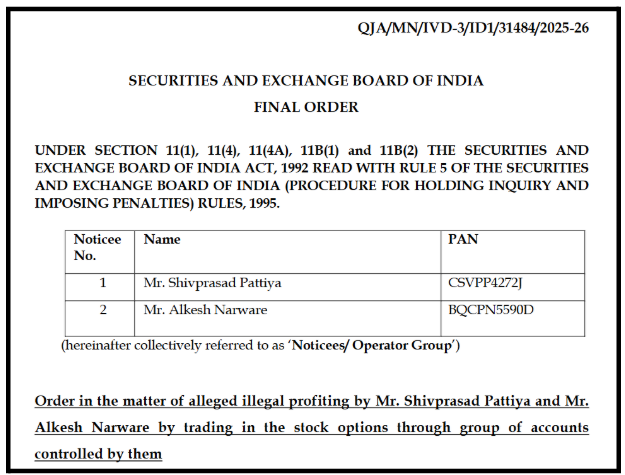 The order found the Shivprasad Pattiya complaints credible and fully substantiated by documentary evidence, call records, bank statements, and witness statements.
What Was the Case?
The case centered on an organised scheme where Pattiya and Narware ran a Caller Group that contacted investors on WhatsApp with promises of guaranteed profits through algo trading.
Once investors shared their login credentials, the Operator Group executed buy orders in deep Out-of-the-Money (OTM) stock options from the victims’ accounts.
Simultaneously, they placed matching sell orders from 28 front entity accounts they controlled. These contracts always expired worthless.
The result was a certain, complete loss for each investor and an equivalent profit flowing into front entity accounts, which Pattiya and Narware then withdrew or rerouted.
SEBI confirmed the total unlawful gain at Rs. 4,83,11,996.
With the case established, here is exactly what SEBI found Pattiya responsible for, violation by violation.
Violations by Shivprasad Pattiya
SEBI established the following specific violations, each backed by evidence on record:
Violation 1: Use of Manipulative and Deceptive Devices
Pattiya used false promises of algo-based guaranteed returns to trick investors into handing over their trading credentials.
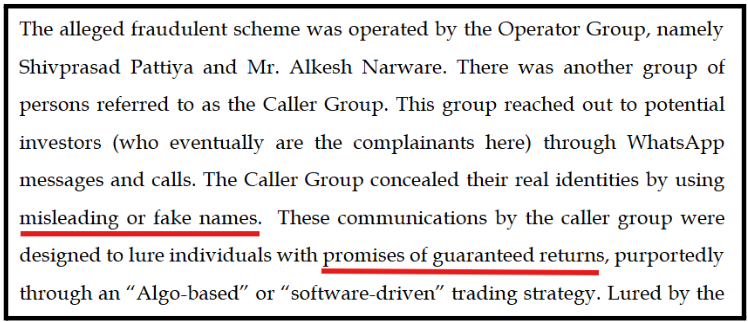 This directly violates Section 12A(a) of the SEBI Act, read with Regulation 3(b) and 3(c) of the PFUTP Regulations.
The Caller Group used fake names, fake WhatsApp identities, and rapidly deactivated SIM cards to conceal their real identities.
Violation 2: Employing a Device or Scheme to Defraud
The Operator Group designed a complete end-to-end scheme from credential capture to coordinated trade execution to profit extraction.
SEBI held that this constitutes employment of a device and scheme to defraud under Section 12A(b) of the SEBI Act and Regulation 3(c) of the PFUTP Regulations.
Violation 3: Fraudulent and Unfair Trade Practices in Securities
Pattiya and his group placed buy orders in illiquid OTM stock options from victims’ accounts at prices ranging 47% to 1350% above the Last Traded Price (LTP).
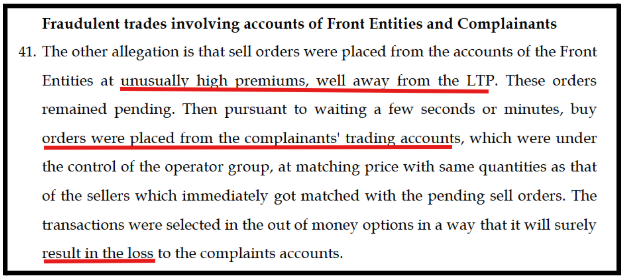
These trades had no genuine commercial purpose. SEBI held this as a clear violation of Regulation 3(a), 3(d), and Regulation 4(1) of the PFUTP Regulations.
Violation 4: Control Over Third-Party Trading Accounts Without Authorisation
Pattiya recruited 28 daily labourers as front entities. He opened trading accounts and bank accounts in their names.
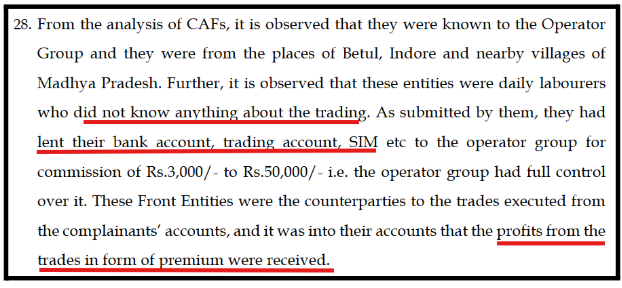
He collected their login credentials, ATM cards, blank signed cheques, and SIM cards in exchange for commissions of Rs. 3,000 to Rs. 50,000.
This gave him unauthorised operational control over all 28 accounts, violating fundamental securities market regulations.
Violation 5: Siphoning and Rerouting of Investor Funds
After profits landed in front entity accounts, Pattiya and Narware withdrew funds in cash or transferred them between front entity accounts to obscure the trail.
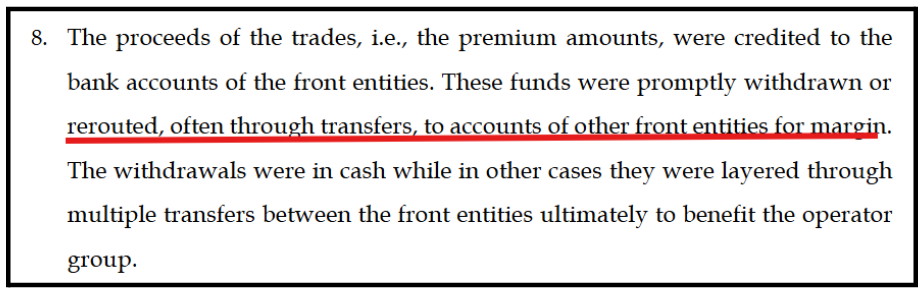
Pattiya himself admitted in his statement dated June 24, 2024, that he received funds from the front entities.
Narware admitted in his statement dated June 25, 2024, that he withdrew funds and passed them to Pattiya.
Shivprasad Pattiya SEBI Penalty
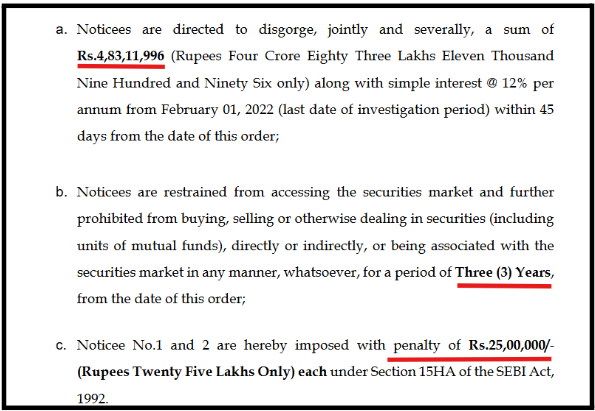
SEBI imposed the following directions on Shivprasad Pattiya and Alkesh Narware jointly and severally:
- Disgorgement of Rs. 4,83,11,996 along with simple interest at 12% per annum from February 1, 2022, payable within 45 days.
- 3-year ban from accessing the securities market, they cannot buy, sell, or deal in securities or mutual funds, directly or indirectly.
- Monetary penalty of Rs. 25,00,000 each under Section 15HA of the SEBI Act.
- Prohibition on selling assets and properties except for the purpose of complying with the disgorgement order.
The penalty reflects the gravity of what SEBI found but for investors who lost money, knowing what happened is only the first step. The next step is knowing what to watch for in future.
What Investors Should Keep in Mind?
The Shivprasad Pattiya complaints highlight patterns that every investor needs to recognise before they lose their savings.
With the increasing number of Algo Trading scams being reported across India, these warning signs are no longer rare edge cases; they are the standard playbook used by operator groups targeting retail traders on WhatsApp and Telegram every day.
1. Guaranteed Returns Are a Red Flag
No legitimate advisor, algorithm, or software guarantees profits in the stock market.
The moment someone promises “assured returns” through WhatsApp, treat it as a serious warning sign. SEBI regulations prohibit any person from making such promises.
2. Never Share Your Trading Credentials With Anyone
Your trading account login ID and password belong only to you.
Sharing them, even with someone claiming to run automated software, gives that person full control over your money. No legitimate algo trading service requires your credentials.
3. Verify Who You Are Dealing With
Always check whether an advisor is registered with SEBI before taking any investment guidance.
Unregistered individuals operating through WhatsApp groups have no accountability and no regulatory oversight.
4. Illiquid OTM Options Are Frequently Misused
Deep Out-of-the-Money options with near expiry dates carry almost no chance of profit for the buyer.
If someone pushes you to buy such contracts, especially at premiums far above the Last Traded Price, stop immediately.
5. WhatsApp Groups Are Not Investment Platforms
SEBI does not regulate WhatsApp investment groups. Anyone running a paid or unpaid investment advisory through WhatsApp without SEBI registration operates outside the law.
The Shivprasad Pattiya complaints originated entirely from WhatsApp-based solicitation.
Understanding red flags protects future investors. Recognising the scheme is important. Acting on it through the right channels, in the right sequence, is what actually leads to recovery.
What To Do In Such Cases?
If you have faced a situation similar to the Shivprasad Pattiya complaints, act immediately.
Delay reduces your chances of recovering money, especially since funds move quickly through cash withdrawals and layered transfers.
First, organise all your records. Gather payment receipts, chat screenshots, WhatsApp conversations, trade confirmations, and call recordings.
The stronger your documentation, the better your chances at every stage.
If the entity is NOT SEBI registered, like Shivprasad Pattiya follow these steps:
- Contact the Platform First: Send a formal written complaint and keep copies of all communication, including any that go unanswered.
- File a Complaint with SEBI: Since the entity is unregistered, you can directly reach out to SEBI with your supporting evidence without going through SCORES.
- File a Cyber Crime Complaint: If you suffered financial loss or were misled with fake profit claims, report it immediately on the National Cyber Crime Portal. This initiates a parallel investigation track.
- Seek Legal Advice if Needed: For significant financial losses, consulting a legal professional experienced in financial disputes can help explore recovery options.
If the entity is SEBI-registered, follow these steps:
- Contact the Platform First: Send a formal written complaint to the broker or intermediary. Ask them to flag the trades and freeze further activity. Keep copies of everything, including unanswered messages.
- File a Complaint in SCORES: Register your complaint with full details, dates, trade records, amounts, and screenshots. SEBI tracks and monitors all complaints filed here and mandates a response within 30 days.
- File a Complaint with Smart ODR: If SCORES does not resolve the matter, escalate to SEBI’s SMART ODR platform. It is faster than court proceedings and allows you to track your dispute progress online.
- Stock Market Arbitration: If your loss involves trades executed on a stock exchange, NSE or BSE arbitration gives you a structured, time-bound resolution process. Arbitration awards carry legal enforceability.
Need Help?
If you are unsure how to proceed, we can assist you in reviewing your case, organising supporting evidence, and guiding you through each step of the filing process.
Do not let uncertainty delay your action. Register with us today and get the proper support needed to resolve your issue effectively.
Conclusion
The Shivprasad Pattiya complaints resulted in a clear and documented SEBI order confirming large-scale, organised misuse of investor accounts, credential theft, and manipulated OTM options trading.
SEBI’s investigation covered 54 complainants, 28 front entities, and total investor losses of Rs. 4.83 crore. Investors who understand these patterns protect themselves.
Those who have already suffered losses have real, accessible regulatory remedies available, but acting quickly makes all the difference.