
Zero loss algo trading claims flood WhatsApp groups, Telegram channels, and social media feeds every single day.
Thousands of retail investors trust these promises and hand over their trading credentials to strangers.
SEBI has investigated multiple cases where such claims led to documented, engineered investor losses running into crores.
The increasing number of algo trading scams has made this one of the most urgent investor protection concerns in recent years.
The pattern repeats itself: fake identities, guaranteed return promises, illiquid options, and drained accounts.
This blog cuts through the noise and tells you exactly what zero loss algo trading claims really mean.
What Is Zero Loss Algo Trading?
Algo trading, short for algorithmic trading, uses computer programs to execute trades automatically based on preset rules.
Legitimate algo trading exists and operates within SEBI-regulated frameworks. It helps institutional investors and registered intermediaries execute large orders efficiently.
Zero loss algo trading, however, is a specific claim that goes far beyond what any algorithm can deliver. It promises that a software system or automated strategy will trade your account and never produce a loss.
Promoters pitch it as a passive income tool. They say the system handles everything. You simply share your credentials and watch profits grow.
That is not how any legitimate trading system works. No algorithm eliminates market risk. Markets move unpredictably.
Even the most sophisticated institutional trading systems accept losses as part of their strategy. The moment someone attaches the words “zero loss” to an algo trading pitch, they move beyond the boundaries of legitimate finance.
Can Any Algo Trading System Guarantee Zero Loss?
No. Not a single legitimate algo trading system in existence guarantees zero loss. This is not a matter of opinion; it is a mathematical and regulatory reality.
Markets operate on uncertainty. Every trade carries risk. A system that genuinely eliminated all loss would attract billions of dollars from the world’s largest hedge funds and institutions.
It would not appear in a WhatsApp group message targeting retail investors.
Furthermore, SEBI explicitly prohibits any person or entity from promising guaranteed returns to investors. A guarantee of zero loss is, by definition, a guarantee of returns.
Anyone making this promise to solicit funds or credentials from investors operates outside SEBI’s regulatory framework.
SEBI Rules For Investment Advisers
SEBI’s regulatory framework makes the following positions absolutely clear.
- SEBI-registered investment advisers cannot legally promise guaranteed or assured returns under the SEBI (Investment Advisers) Regulations, 2013.
- Anyone providing paid investment advice through WhatsApp, Telegram, or social media without SEBI registration violates the SEBI Act, 1992.
- SEBI’s PFUTP Regulations prohibit fraudulent schemes designed to mislead investors, including “zero loss” trading claims used to obtain trading credentials.
Therefore, any person or platform making zero loss algo trading claims either lacks SEBI registration, violates their registration conditions, or both.
With the legal position clear, the next step is learning to spot these schemes before they reach your trading account.
Zero Loss Trading Scam Red Flags
Recognising the warning signs early protects your capital.
Watch for every single one of these:
1. Unsolicited WhatsApp or Telegram Contact
Legitimate investment advisors and research analysts generally do not cold-message strangers with trading offers.
If someone approaches you first with claims of easy profits or exclusive trading opportunities, it should immediately raise caution.
2. “Guaranteed” or “Zero Loss” Return Claims
No trading strategy, algorithm, or advisor can legally or realistically guarantee profits in the stock market.
SEBI-registered advisors are prohibited from making assured return claims because market risk can never be eliminated.
3. Requests for Trading Account Credentials
No genuine algo trading platform requires your full trading account username, password, or OTP access.
Legitimate systems usually operate through regulated APIs with restricted permissions instead of taking complete control of your account.
4. Operations Limited Only to WhatsApp or Telegram
Credible financial service providers usually maintain official websites, office details, compliance disclosures, and SEBI registration information.
If an entire operation exists only through messaging apps or private groups, there is very little accountability or regulatory transparency.
5. Profit Screenshots Used as Proof
Profit screenshots shared on social media or messaging apps can be easily edited, manipulated, or selectively presented.
Without audited records or verified performance data, such screenshots should never be treated as reliable proof of success.
6. Pressure to Invest or Act Quickly
Scammers frequently create artificial urgency using phrases like “limited slots,” “closing tonight,” or “VIP access ending soon.”
This pressure tactic is designed to stop people from verifying claims properly or taking time to think rationally before investing.
7. Referral-Based Recruitment Models
Some zero loss algo trading schemes encourage users to recruit friends, family, or new investors in exchange for commissions.
When recruitment becomes a major source of earnings, the scheme may rely more on new member inflows than genuine trading activity.
These red flags do not exist in theory alone; SEBI has documented them in a real, investigated, and penalised case.
SEBI Order Against Zero Loss Algo Trading Claims
The Shivprasad Pattiya and Alkesh Narware case (SEBI Final Order dated June 20, 2025) documents exactly how zero loss algo trading claims operate as an engineered scheme against retail investors.
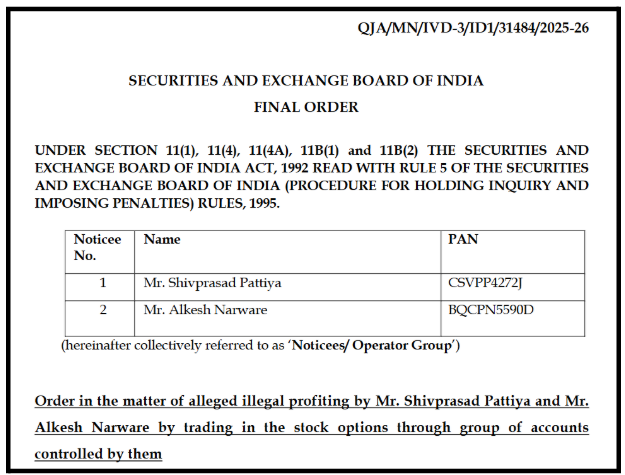
SEBI investigated trading activity between January 27, 2021 and February 1, 2022, involving 54 complainants and 28 front entities.
The total documented investor loss across all complainants reached Rs. 4,83,11,996, nearly Rs. 4.83 crore.
Violations Found
The SEBI order established the following violations under the SEBI Act and PFUTP Regulations:
- The Operator Group used fake WhatsApp identities and concealed caller identities to promise guaranteed algo trading profits and obtain investor credentials unlawfully

- The group placed coordinated buy orders in deep OTM illiquid options at inflated premiums, causing heavy investor losses.
- Profits flowing into front entity accounts were systematically withdrawn in cash or rerouted, with both Noticees admitting in statements to receiving and transferring these funds
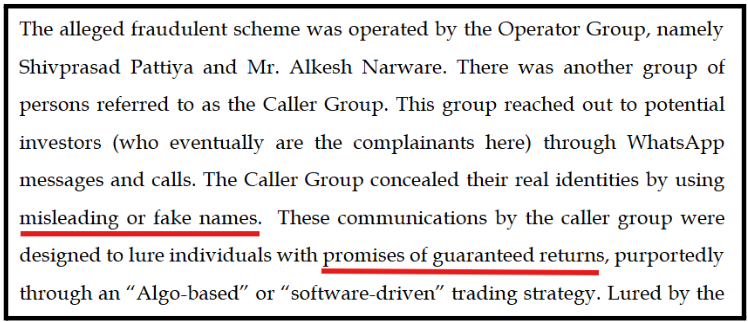
These acts violated Section 12A(a), (b), and (c) of the SEBI Act, read with Regulations 3(a), (b), (c), (d) and Regulation 4(1) of the PFUTP Regulations.
Penalty
SEBI directed disgorgement of Rs. 4,83,11,996 jointly and severally with 12% simple interest per annum from February 1, 2022.
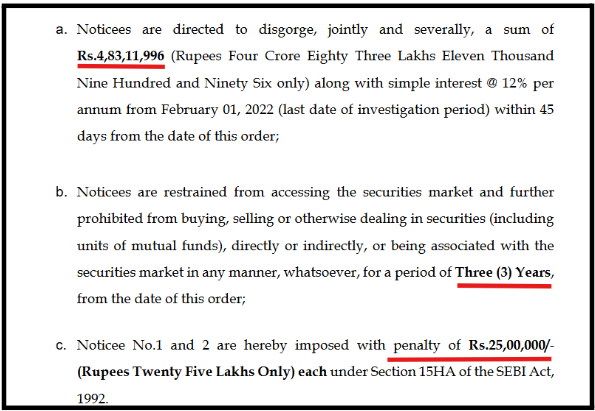
Both Noticees received a 3-year ban from accessing the securities market in any capacity. SEBI additionally imposed a monetary penalty of Rs. 25,00,000 each under Section 15HA of the SEBI Act.
SEBI also prohibited both Noticees from selling their assets and properties except for compliance with the disgorgement direction.
Knowing what a penalised scheme looks like is useful, but knowing how to check a service before you engage is what keeps your money safe.
How To Verify Whether an Algo Trading Service Is Real?
Before engaging with any algo trading service, run through this verification checklist without exception.
1. SEBI Registration Verification
Every legitimate investment advisor or research analyst must hold a valid SEBI registration number.
Always ask for the registration details and independently verify them through SEBI’s official intermediary database before making any payment.
2. Registered Business and Company Details
A credible financial service provider should have a registered office address, proper contact details, and business registration records.
Searching the entity on the Ministry of Corporate Affairs (MCA) portal can help verify whether the business actually exists legally.
3. Account Integration and Access Method
Legitimate algo trading platforms usually integrate through broker APIs with limited and controlled permissions.
If someone asks for your complete login credentials, passwords, or OTP access, it is a major warning sign and should be avoided immediately.
4. Verifiable Performance and Track Record
Real trading performance is supported through audited statements, broker reports, or independently verified records.
Screenshots shared on WhatsApp or Telegram are not reliable evidence and can easily be manipulated to create false confidence.
5. Research Analyst Registration Status
If a platform provides stock recommendations, trading calls, or investment advice, it may also require SEBI Research Analyst registration.
Always verify whether the individual or entity holds the necessary regulatory approvals before relying on their financial guidance.
If you have already engaged with a service that failed these checks and suffered losses, the next section tells you exactly what to do.
What To Do In Such Cases?
If you have already shared your credentials or suffered losses through a zero loss algo trading scheme, act immediately.
Every day of delay allows funds to move further away through cash withdrawals and layered transfers.
Step 1: Reach Out to the Entity
Contact the entity’s compliance and grievance team immediately. Report the unauthorised trades in writing.
Ask them to flag the transactions, freeze further activity on your account, and preserve all trade logs. Keep a written acknowledgement of your complaint from the broker.
Step 2: File a Complaint in SCORES
SEBI SCORES is the official investor complaint platform where you register grievances against market participants.
File your complaint with complete details, trade dates, amounts, screenshots of WhatsApp conversations, and any communication records you have.
SEBI monitors and tracks every complaint filed here and directs the concerned intermediary to respond within a defined timeline.
Step 3: Lodge a Complaint with Smart ODR
SEBI’s SMART ODR platform offers online dispute resolution through conciliation and arbitration for investor disputes with market intermediaries.
It moves faster than court proceedings and gives you a structured, tracked process.
File your dispute here with supporting documents and follow the process through to resolution.
Step 4: Share Market Arbitration
If your losses involve trades executed on NSE or BSE, exchange arbitration gives you a formal, legally enforceable resolution mechanism.
Both exchanges run investor grievance and arbitration mechanisms specifically for this purpose. Arbitration awards carry the force of a court decree and enforceable recovery rights.
Need Help?
Pursuing recovery across multiple regulatory forums while managing evidence, deadlines, and follow-ups takes time and expertise most victims do not have.
That is where we step in. Register with us today.
We work exclusively with investors who have suffered losses in securities market schemes.
Here is what we do for you:
- Case Assessment: We review your situation, identify the strongest forums for your case, and tell you honestly what recovery looks like before we begin.
- Complaint Preparation: We build your complaint from the ground up, structured & evidence-backed, whether SEBI SCORES or exchange grievance cells.
- ODR and Arbitration Representation: We handle the SMART ODR and exchange arbitration process end to end so you do not miss a step or a deadline.
- Evidence Compilation: We organise every document you have into a clean, regulator-ready file that holds up under scrutiny.
Your loss deserves a serious, organised response. We provide exactly that.
Conclusion
Zero loss algo trading claims have no basis in market reality and no standing under SEBI’s regulatory framework.
The Shivprasad Pattiya complaints filed by 54 investors document exactly how these claims function as the entry point for an engineered scheme against retail investors.
Recognise the red flags early.
Verify every service before engaging. And if you have already suffered losses, use the regulatory mechanisms available to you, starting today.