

The fact that you searched “Stock Wise IQ complaints” tells us something important: you’re being careful. Don’t stop now.
Most investors who end up in a dispute with an advisory platform will tell you the same thing, they wish they had looked this up sooner.
This blog pulls together publicly available information about Stock Wise IQ, including its SEBI registration status, real complaint patterns reported by investors, and the exact steps you need to take if something has already gone wrong.
Whether you’re researching before subscribing or dealing with an issue right now, what follows could be the most useful thing you read today.
Is Stock Wise IQ SEBI Registered or Not?
If you’ve been burned before or you’re cautious by nature, the first thing you want to know is simple: Is this platform even legal?
It’s the right question. But it’s not the only one.
This is not optional; it is a legal requirement under the SEBI (Research Analysts) Regulations, 2014.
The platform is associated with Neha Vijay Sondhi SEBI registered Research Analyst. The registration number displayed publicly is INH000018920.
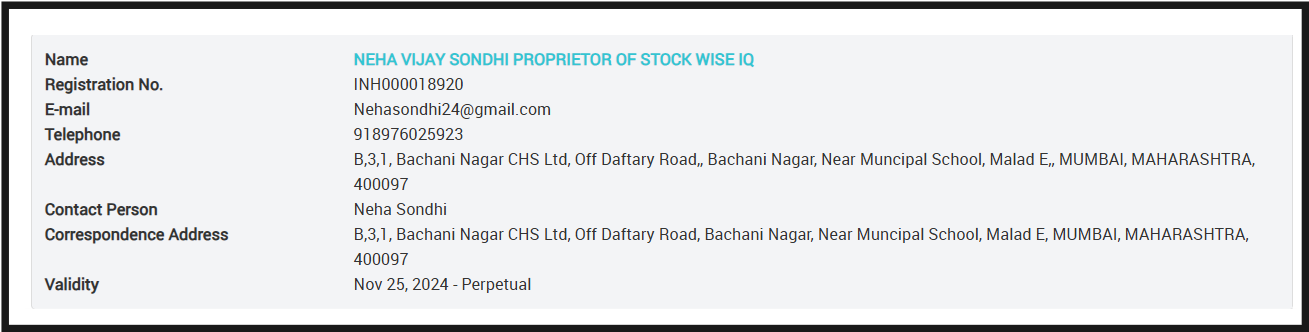
The website also contains disclosure-related sections, risk statements, grievance details, and references to SEBI investor mechanisms.
Now here’s the part that matters just as much, and that many investors learn too late.
SEBI registration is a regulatory baseline, not a quality guarantee.
It means the entity is authorised to operate within a regulated framework, but it does not mean trades will be profitable.
Moreover, it does not mean every investor experience will be positive. And it does not mean the platform is immune to legitimate complaints.
Even the most thoroughly disclosed platform can be the subject of valid investor grievances, which brings us to what investors have actually been saying.
Stock Wise IQ User Complaints
Interestingly, most people don’t search for “Stock Wise IQ complaints” before they invest.
They search after something creates doubt.
However, when money is involved, investors naturally start asking questions:
- Were the risks explained properly?
- Did I fully understand the strategy being recommended?
- Was I encouraged to increase exposure after losses?
- Were expectations created that didn’t match reality?
With that background in mind, let’s look at some of the complaint themes that investors occasionally discuss when sharing their experiences with stock advisory services.
1. Complaints Related to No Proper Risk Disclosure
One concern reportedly raised by some users relates to risk explanation during trading recommendations.
Some investors suggest that the potential downside of trades was not always explained in sufficient detail before positions were taken.
This concern becomes particularly important in high-risk segments like options trading, intraday trading, and leveraged positions.
Many new investors enter the market after seeing profit-oriented communication without fully understanding:
- Stop-loss risks.
- Capital exposure.
- Volatility.
- Possibility of rapid losses.
- Emotional pressure during drawdowns.
Stock market trading is naturally uncertain.
For first-time investors especially, this gap can be devastating. You enter a trade believing you understand the risk. You exit having discovered you didn’t.
The question to ask any advisory service before paying: “Walk me through the worst-case scenario on a typical trade.” The answer — or the reluctance to give one, will tell you a great deal.
2. Complaints Regarding Recovery Assurance
Another concern sometimes discussed by users involves “loss recovery” conversations after trading losses.
After a sequence of losing trades, some investors report being encouraged to continue, through upgraded plans, additional capital deployment, or further positions , with the suggestion that previous losses could be recovered through future trades.
Picture the psychology of that moment. You’ve already lost money, you’re anxious. Someone familiar tells you that with just a bit more commitment, you can get back to where you started.
It feels like hope. For many investors, it has led to significantly larger losses.
No Research Analyst in India can legally assure recovery of trading losses or guarantee future profits. SEBI explicitly prohibits this.
If any communication implies certainty about recovery, that is a serious warning sign regardless of which platform it comes from.
3. Complaints Related to Demo Trades
Another theme occasionally discussed in online investor conversations relates to demo-style trade examples or promotional screenshots.
Some users reportedly felt that certain showcased results looked more favourable than actual live market conditions experienced by retail traders.
This concern is not unique to one platform.
Across the broader stock market ecosystem, investors often question whether promotional trade examples fully reflect:
- Real execution conditions.
- Slippage.
- Emotional pressure.
- Failed trades.
- Practical capital requirements.
Many promotional materials across the industry naturally focus more on successful trades because those attract attention quickly.
Before any subscription decision, ask: Can you show me a period of 30 consecutive calls, including the losing ones? If that request creates discomfort, take note.
4. Complaints Related to High Quantity Trades
Imagine investing ₹50,000 but receiving recommendations that effectively expose your account to risks suitable for someone with several lakhs of capital.
When trades move against you, the financial impact can become far larger than expected.
This is why investors should always evaluate whether a recommendation matches their own risk tolerance and financial capacity.
Research analysts are not permitted to execute trades on behalf of clients or direct actual buy/sell transactions.
They also cannot customise advice to an individual’s financial situation, which is the role of a SEBI Investment Adviser, which requires a separate registration.
If you were being directed to take positions based on your specific account balance rather than generalised research, that too may have crossed a regulatory line.
Also Read: Wise Global Research reviews, What lies beyond the SEBI registration? Explore the investor reviews and concerns.
How To Complain Against Stock Wise IQ?
If you’ve recognised any of the above patterns in your own experience, here’s what to do, methodically and immediately.
The investors who achieve resolution are not necessarily the ones with the strongest grievances. They’re the ones with the best documentation and the clearest process.
Here is how to move through it:
Step 1: Approach Stock Wise IQ Directly First
Before going to SEBI, write to Stock Wise IQ’s grievance officer. Keep a record of your email or message.
Under SEBI rules, any registered intermediary must respond to your complaint within 21 days.
If they do not, or if you are unsatisfied with their response, you can escalate.
Step 2: File a Complaint with SCORES
If the issue remains unresolved, investors can file a complaint through the official SEBI SCORES platform.
SCORES is SEBI’s online investor grievance redressal mechanism.
You can:
- Register an account.
- Upload supporting documents.
- Describe the issue.
- Track complaint status online.
This creates a formal regulatory complaint trail.
Step 3: File an Issue in SMART ODR
Investors may also consider the SMART Online Dispute Resolution platform for mediation and dispute resolution support.
This mechanism helps parties attempt resolution through a structured online process.
Step 4: Arbitration in the Share Market
If the dispute still remains unresolved, investors may proceed with formal stock exchange arbitration.
An independent arbitrator reviews the evidence submitted by both sides before issuing a legally binding decision.
At this stage, organised records, payment proofs, chats, emails, and trade details become extremely important.
Need Help?
Here’s an uncomfortable truth: the majority of investor complaints that don’t achieve resolution fail not because the grievance wasn’t real, but because they weren’t prepared or presented effectively.
That’s where guidance can make a difference.
If you’re confused about what happened or unsure about your next step, register with us and we’ll help you understand the options available to you.
Conclusion
Searching for “Stock Wise IQ complaints” reflects precisely the kind of caution that protects investors from costly mistakes.
In many cases, investors simply want clarity before trusting any research or trading-related platform.
Based on publicly available information, Stock Wise IQ appears associated with a SEBI Research Analyst registration under Neha Vijay Sondhi.
For investors, the key takeaway remains simple: verify information independently, understand the risks before acting on any recommendation, maintain proper records, and raise concerns promptly if issues arise.
A well-informed investor is always in a stronger position than one who relies solely on promises or expectations.
Frequently Asked Questions:
1. Stock Wise IQ is not responding to my refund request. What should I do?
Document every attempt you’ve made to contact them, dates, channels, and what you communicated. Then escalate directly to SEBI SCORES.
A formal regulatory complaint carries far more weight than unanswered messages, and SEBI requires registered intermediaries to respond to grievances within 21 days.
2. Can trading losses alone be a valid complaint?
Markets involve risk. Complaints generally relate to communication, disclosures, service issues, or regulatory concerns rather than losses alone.
3. How long does the SCORES complaint process take?
Registered intermediaries are required to respond within 21 days of a direct complaint.
SEBI SCORES complaints typically receive initial responses within 30 days. SMART ODR mediation can resolve matters faster in many cases.
4. What should I do if I feel something is wrong with my trading?
Start by preserving all records, reviewing your documents carefully, and understanding the available grievance mechanisms before taking further action.
5. What is the biggest warning sign before subscribing to any advisory service?
Any communication that downplays risk, guarantees recovery, promises fixed returns, or pressures you to act quickly should be examined carefully before making a payment.





 Add us as a preferred source on Google »

