

Searching for “Neha Vijay Sondhi SEBI registered” before making a payment?
You’re not alone.
Many investors only start checking registration details after seeing trading advertisements, WhatsApp messages, performance screenshots, or subscription offers from Stock Wise IQ.
Before you trust any advisory service with your money, it’s important to verify the registration, understand the risks involved, and know what options are available if something goes wrong.
Who is Neha Vijay Sondhi?
Neha Vijay Sondhi is associated with a platform as a Research Analyst operating under the name “Stock Wise IQ“.
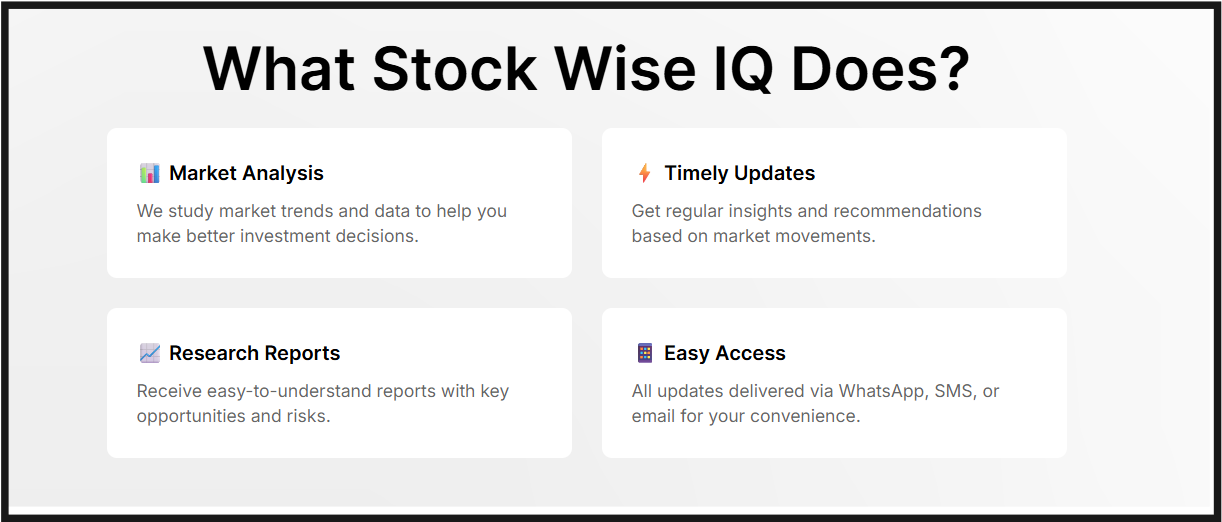
The website mentions that the platform provides:
- Market analysis and research reports
- Trading insights across equity, options, and futures
- WhatsApp and SMS-based trade updates
- Research recommendations framed as educational guidance
That framing matters legally.
The platform also mentions that recommendations are provided for educational and research purposes.
What this means in practical terms: you’re dealing with a Research Analyst service, not an Investment Adviser.
That distinction matters enormously for what the platform can and cannot legally do , and we’ll come back to that.
Why Investors Search “Neha Vijay Sondhi SEBI Registered”?
Interestingly, most investors do not search for registration details when they first discover a stock market service.
They search for something that creates uncertainty.
Sometimes they are about to pay for a subscription and want reassurance. Or sometimes, they have already subscribed and want to verify whether the person providing research recommendations is actually registered with SEBI.
The Stock Wise IQ website displays the registration number INH000018920 next to the name “Neha Sondhi | SEBI RESEARCH ANALYST.”
This type of number, beginning with INH0000, is the standard format for SEBI-registered Research Analysts. That much is consistent with what a genuine registration looks like.
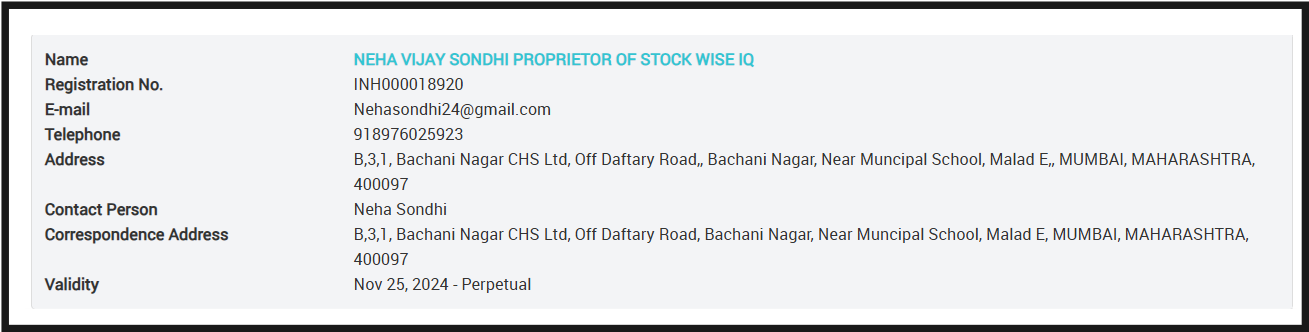
SEBI’s official Research Analyst registry currently lists 1,968 registered entities (as of May 12, 2026).
Now, and this is where most investors stop reading when they shouldn’t.
Here’s what SEBI registration actually guarantees:
It guarantees authorisation to operate within a regulated framework. Nothing more.
- It does not guarantee profitable recommendations.
- It does not guarantee ethical sales practices.
- It does not guarantee positive investor outcomes.
Registered entities across India have faced legitimate complaints, regulatory actions, and investor disputes.
Registration is the baseline, not the finish line of your verification.
Also Read: Is Afaque Ali SEBI registered, a licence real enough to clear the basic legitimacy test?
Does SEBI Registration Mean You Can Trust The Service?
Having confirmed a registration number, the smarter question becomes: Does this platform actually operate the way SEBI requires?
Stock Wise IQ’s publicly available website disclosures do include several statements that align with regulatory expectations:
- No guaranteed returns are offered.
- Clients should never share trading passwords or OTPs.
- Market investments involve risks.
- The analyst cannot execute trades on behalf of clients.
These are meaningful disclosures. Platforms that omit them are a more immediate red flag.
But here’s what experience with investor disputes teaches us: what’s written on a website and what happens in an actual sales conversation are not always the same thing.
The disclosures above exist in the fine print.
The sales pitch exists in a WhatsApp message or a phone call, and those two experiences can feel like they’re describing entirely different services.
Watch closely for these warning signs in any advisory interaction:
- Aggressive profit claims that contradict the website’s own risk disclosures.
- Pressure to upgrade packages quickly, often after initial losses.
- “Recovery” conversations that encourage larger capital deployment after losing trades.
- Heavy reliance on screenshots, “accuracy percentages,” or cherry-picked results.
- Trade quantity recommendations that seem disproportionate to your stated capital.
Any one of these should trigger a pause. More than one should trigger serious concern, and potentially a complaint.
When Can an Investor Raise a Complaint Against Stock Wise IQ?
Most investors do not start searching for how to file a complaint when their trades are making money.
Typically, doubts or problems arise when what you were promised in a sales conversation doesn’t match what happens in reality.
Instead of targeting any single platform, it is helpful to look at the most common reasons why retail investors across India find themselves needing to file a formal grievance:
1. The Risk Wasn’t Made Clear Upfront
High-risk trading strategies, like weekly options or futures (F&O), can wipe out capital incredibly fast.
An investor might feel a complaint is justified if a service heavily pushes these risky trades without giving a clear, honest warning about how quickly money could be lost.
Now, for a trader who is taking advisory services, it is important to understand that while market losses are a normal part of trading, an advisory service is supposed to make sure you fully understand the downside before you pay or take the trade, not just hide it in the fine print.
2. The “Demo Trades” Are Provided
A very common issue across the stock advisory industry is how performance is shown to the public.
The major issue here is the performance itself.
As per SEBI guidelines, RA/IA cannot show past performance publicly. In short, there are strict guidelines of SEBI around the same.
Even then, most RA to mislead traders use past performance data to induce by sharing high “accuracy percentage”, “winning screenshots”, or “demo calls”.
Such issues are clearly misleading in the eyes of SEBI.
3. Aggressive Sales Pressure to Upgrade Packages
Another frequent industry complaint involves heavy upselling tactics.
An investor might feel cheated if, right after suffering a string of losses, the sales team starts calling aggressively, pressuring them to pay for a “premium” or “VIP” package under the promise of “recovering” their lost capital.
How to Complain Against Stock Wise IQ?
If you’ve already subscribed and something has gone wrong, a refund dispute, misleading communication, unresolved grievance, here’s your structured path forward.
The investors who achieve resolution are overwhelmingly the ones who act methodically, not emotionally.
Step 1: Contact the Research Analyst Directly
Your first step should always be to raise the issue directly with the platform in writing, via email or WhatsApp message.
Keep copies of all communication. Regulators require that you attempt resolution with the entity before escalating.
If the platform ignores you or fails to respond within a reasonable period, move to the next step.
Step 2: File a Complaint in SCORES
SEBI’s official grievance platform is there to help.
Register on the portal, log in, and fill in the complaint form specifying your grievance against Stock Wise IQ.
You can upload supporting documents (PDF, up to 2MB). Under SEBI’s SCORES 2.0 framework, the concerned entity must respond within 21 calendar days.
You can track your SEBI complaint status online at any time.
Step 3: Lodge a Complaint in SMART ODR
If disputes continue, investors may also consider the SMART ODR platform for online dispute resolution.
This mechanism can help in conciliation or mediation between investors and intermediaries.





 Add us as a preferred source on Google »

