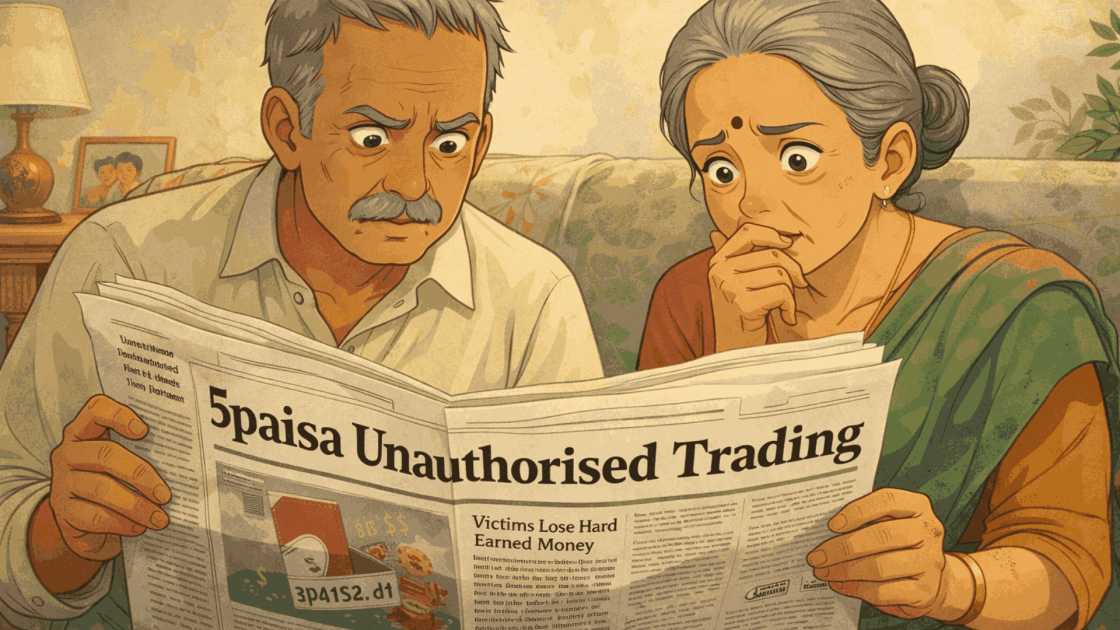
5Paisa Securities Unauthorised Trading Complaints
5paisa operates as a SEBI-registered stock broker offering trading services across equity, derivatives, currency and commodity segments.
As a large retail-focused discount broker, it receives complaints through stock exchange grievance mechanisms, just like other brokers in the market.
Before we examine the numbers, we need to clarify what “unauthorised trading” actually means.
Under the framework laid down by the Securities and Exchange Board of India, unauthorised trading refers to execution of trades without documented client consent.
Brokers must maintain proper records of client instructions – whether through call recordings, written confirmations, or digital authorisation logs.
5Paisa Complaints
Below is the complaint data for unauthorised trading (Type IV) over the past six financial years:
|
Financial Year |
Total Complaints |
Type IV (Unauthorized Trades) |
% of Complaints Under Type IV |
|
2020-21 |
148 |
7 |
4.73% |
|
2021-22 |
121 |
5 |
4.13% |
|
2022-23 |
96 |
3 |
3.13% |
|
2023-24 |
110 |
4 |
3.64% |
|
2024-25 |
138 |
2 |
1.45% |
|
2025-26 |
139 |
3 |
2.16% |
Across six financial years, Type IV complaints total 24 out of 752 overall complaints. Overall, this represents roughly 3% of all grievances recorded during this period.
However, the yearly percentages do not move in a straight line.
For example, the figure stood above 4% in 2020-21. It then declined over the next two years. Meanwhile, the percentage dropped to 1.45% in 2024-25. After that, it moved to 2.16% in 2025-26.
Overall, the numbers shift from year to year, but they still stay within a relatively narrow range.
So what does this actually tell us?
First, unauthorised trading complaints form a small part of the overall complaint mix. At the same time, the data does not show a sharp spike.
In fact, it also does not show a steady upward pattern. Instead, the percentages move within a band.
However, it is important to understand what this table represents. These numbers show complaints filed by clients with the exchange.
In other words, a complaint means a dispute was raised.
When Action can be Taken Against the Broker?
How to Report Against a Broker?
If you suspect unauthorised trading in your account, take structured action:
- Contact the broker first.
Raise a written complaint and request detailed order logs, call recordings, and proof of trade authorisation. - File a complaint with the stock exchange.
Use the official grievance portal of the exchange (NSE or BSE) where the trade was executed. - File a Complaint in SCORES.
If the broker’s reply is unsatisfactory or the matter remains unresolved, you can file a complaint with SEBI. - File an Arbitration in Stock Market.
If the dispute continues, apply for arbitration through the exchange mechanism for formal examination of evidence.
Act promptly and preserve all contract notes, SMS alerts, email confirmations, and communication records. Proper documentation strengthens your case.
Need Help?
If something in your trading account doesn’t feel right, don’t brush it aside.
Go back and check your contract notes, order book, SMS alerts, and email confirmations. Many disputes get clarity simply by matching timestamps and instructions.
If you’re still unsure whether a trade was placed with your approval, register with us.
We’ll help you review the records properly, understand what the exchange process involves, and guide you on the next steps if a formal complaint is required.
The sooner you examine the issue, the stronger your position will be.
Overall, the data provides perspective, but traders should still stay attentive.
Conclusion
Unauthorised trading is a serious allegation in the securities market. However, the numbers need context.
Over the past six financial years, Type IV complaints against 5paisa account for a small share of the overall grievances recorded by the exchanges.
The percentages move within a limited range and do not show a sustained upward trend.
At the same time, publicly available records do not show any SEBI enforcement order specifically holding the broker guilty of unauthorised trading.
However, retail traders should not look at these percentages and assume everything can be ignored, because even a small number of cases still represents a real unauthorised trading risk for investors.
Each complaint shows a real investor who believed something went wrong in their account.
For the individual trader involved, the impact is never “small.”
Therefore, traders should remain proactive. Regularly review contract notes. Check your order book and trade confirmations.
Enable SMS and email alerts so you receive immediate updates on executed trades.
In the end, complaint statistics provide one layer of information.
Your own awareness and record-keeping provide the other. By staying attentive to your account activity, you protect your capital and reduce the chances of disputes going unnoticed.