

Quick Summary
Adroit Financial Services Pvt. Ltd. was founded in 1994 by Mr. Ajay Kumar Gupta and today holds active SEBI registrations as a stock broker, depository participant, portfolio manager and research analyst. The firm operates legally across NSE, BSE, MCX and NCDEX, but its record is not spotless. SEBI has fined Adroit twice, once for misuse of NSE’s co-location servers and once for self-trades in a listed stock. This blog covers who owns and runs the firm, what its registrations actually mean, what its pricing looks like, and what its enforcement history says about how it operates.
Trying to figure out whether Adroit Financial Services is a firm you can trust with your money, or whether the person managing your account there actually has the authority you think they do, is not a simple yes or no question.
The firm has been around since 1994; it holds five separate SEBI registrations, and it also has two SEBI penalty orders sitting in the public record.
If you are researching this firm before opening an account, or you already have one and something has gone wrong, you need the full picture, not just the part of it that shows up on the homepage.
This blog walks through who owns the company, who actually runs it day-to-day, what its registrations and pricing look like, and what SEBI’s own orders say about its conduct.
Adroit Financial Services Private Limited
Adroit Financial Services Pvt. Ltd. was incorporated in April 1994 and runs its core operations out of Kaushambi, Ghaziabad, in the Delhi NCR region.
Over three decades, the firm has grown into a full-service brokerage with a presence across roughly 250 locations in India, a team of close to 1,000 professionals, and a client base of more than 50,000 investors, spanning retail traders, HNIs, corporates and institutions.
Its corporate identification number is U74899UP1994PTC042323, registered with the Registrar of Companies, and its authorised share capital stands at ₹6.5 crore with paid-up capital around ₹4.3 crore.
The firm’s service list is broad. It covers equity broking, derivatives (F&O), commodity and currency futures trading, IPO distribution, mutual funds, depository services through NSDL and CDSL, in-house research advisory, and Portfolio Management Services.
Adroit has also picked up industry recognition over the years, including the NSDL Star Performer Award in 2017 for account growth, and a BSE award in 2014-15 for being among the top performers in equity derivative volumes.
None of that history tells you whether the firm is safe for your specific situation. That depends on registration, ownership, and conduct, which is what the rest of this page covers in full.
Is Adroit Financial Services Pvt Ltd Real or Fake?
Adroit Financial Services is a real, operational, SEBI-registered entity.
It is not a shell company, and it is not an unregistered advisory running under a corporate name, which is the more common pattern behind actual investor fraud.
Here is what its active registration record looks like:
Before you take any registration number at face value, it helps to know what each one is actually meant to permit, because a firm can be legitimately registered in one category and still cause you real problems in another.
| Segment | Registration Number |
|---|---|
| Stock Broker (NSE / BSE / MCX / NCDEX) | INZ000173137 |
| Commodities Broker (MCX / NCDEX) | INZ00052535 |
| Depository Participant (NSDL / CDSL) | IN-DP-551-2021 |
| Portfolio Management Services (PMS) | INP000005349 |
| Research Analyst | INH100003084 |
The Research Analyst registration, INH100003084, shows a validity period running from May 31, 2016, on a perpetual basis, meaning it has not lapsed and has no renewal date pending as things stand.
“Real” and “safe” are not the same thing. A SEBI registration confirms the firm cleared the regulator’s net worth, infrastructure and compliance requirements to legally operate.
It says nothing about whether their app stays stable on a volatile expiry day, or whether a specific employee gave you advice that overstepped what their registration category allows.
If you are dealing specifically with their research or advisory arm and something has gone wrong there, the process for a complaint against sebi registered research analyst is different from a general broking dispute, and knowing which bucket your issue falls into changes where you should escalate first.
Also Read: Graassp Equity Research Services, zero complaints, and a table that stopped in August 2025.
Adroit Financial Services Pvt. Ltd. Owner
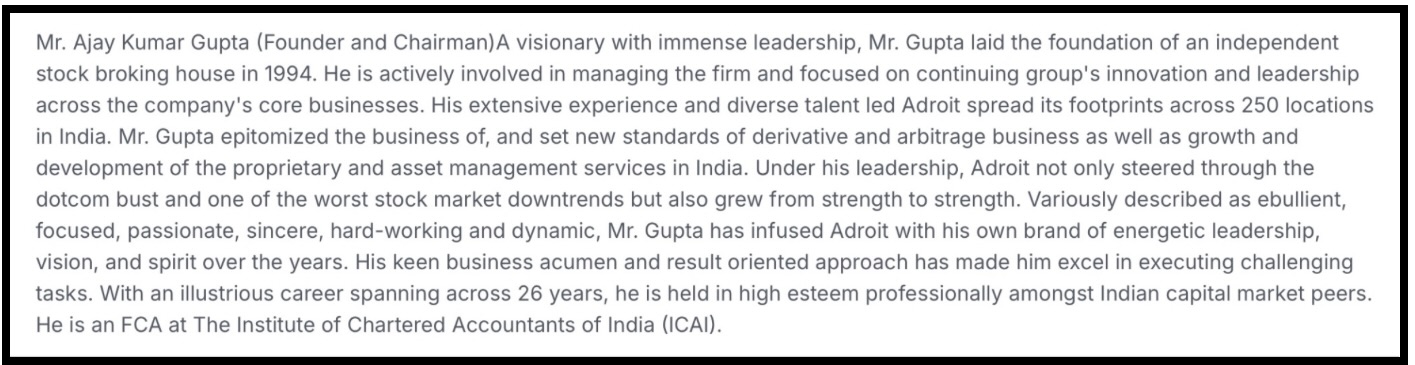
The name most closely tied to Adroit’s history is its founder and chairman, Mr. Ajay Kumar Gupta, who laid the foundation of the firm as an independent stock broking house in 1994.
Mr. Gupta is described in the firm’s own material as having been closely involved in the firm’s growth across its core businesses, particularly its derivative and arbitrage trading operations, and the buildout of its proprietary trading and asset management services.
His career in the markets spans 26 years, and he is a Fellow Chartered Accountant (FCA) with the Institute of Chartered Accountants of India (ICAI).
According to the firm’s own corporate profile, Mr. Gupta steered Adroit through the dotcom crash and multiple periods of market stress, which the firm credits as part of how it expanded to its current footprint of around 250 locations.
Ministry of Corporate Affairs records list him as a director across related entities in the group, including AKG Stock Brokers Pvt. Ltd. and Adroit Insurance Brokers Pvt. Ltd., alongside Adroit Financial Services itself.
Owning a firm and being personally SEBI registered are two different things. Mr. Gupta himself does not hold an individual SEBI registration.
The registrations listed above belong to the corporate entity, Adroit Financial Services Pvt. Ltd, which is standard structure for a firm of this size, and not itself a red flag.
Who Runs Adroit Financial Services Besides the Owner?
Day to day governance at Adroit is shared across a small management layer, largely drawn from the promoter family, alongside a designated compliance leadership role that SEBI requires every registered intermediary to maintain.
Knowing who holds which role matters if you ever need to direct a formal grievance to the right person instead of a generic support inbox.
- Mr. Ashay Gupta (Director) oversees core operations and the firm’s internal proprietary trading desks. He holds a B.Com from Sydenham College of Commerce, Mumbai, and a master’s degree from the Indian School of Business, Hyderabad.
- Mr. Ayan Gupta (Director) shares corporate directorship duties, with a focus on administrative management and automated trading frameworks.
- Mr. Mohit Sharma (CEO and Compliance Officer) is the officially designated executive responsible for exchange reporting and for handling investor grievances, which makes him the relevant point of accountability if a formal complaint escalates beyond front-line support.
Adroit Financial Services Services & Pricing
Adroit positions itself as a full-service broker, which means it is not built around a single flat discount rate the way some newer platforms are.
Publicly listed brokerage rates on third-party broker comparison platforms indicate the following approximate structure, though you should always confirm current numbers directly with the firm before opening an account, since these change over time.
- Transaction charges: roughly 0.00295% of turnover
- STT (Securities Transaction Tax): roughly 0.0126% of turnover, as per government rate
- SEBI turnover charges: roughly 0.0002% of turnover
- GST: 18% applied on brokerage plus transaction charges
- Commodity trading charges: roughly 0.03%
- Demat account opening: around ₹400, with an annual maintenance charge of roughly ₹250
- Minimum margin money: around ₹5,000
There is no listed trading account AMC on top of this.
These figures are third-party sourced, not pulled from an official Adroit rate card, so treat them as indicative rather than final, and always ask for written confirmation of current charges before you fund an account.
Adroit Financial Services SEBI Orders
A firm operating for three decades across every major exchange inevitably builds up a regulatory paper trail, and Adroit is no exception.
Two adjudication orders stand out in SEBI’s public record.
Neither order led to Adroit’s broking license being cancelled, and the firm continues to operate under all its current registrations.
That does not make the underlying conduct any less worth knowing before you trust the firm with your capital.
1. The NSE Co-Location Matter (February 2022)
SEBI’s investigation covered the period 2012 to 2014, during which Adroit was found to have been routinely logging into NSE’s secondary Tick-By-Tick (TBT) data servers, across its cash, currency and F&O segments, without a legitimate operational reason.
Under exchange rules, that secondary server exists strictly as an emergency backup.
Connecting to it on a routine basis, which NSE had specifically told Adroit to stop doing, hands a trading desk a real speed advantage over retail clients stuck on standard data feeds.
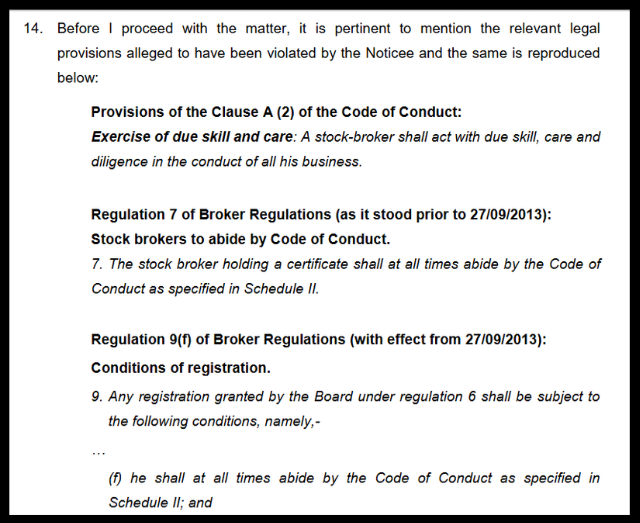
SEBI’s order found Adroit in breach of Clause A(2) of the Code of Conduct (the requirement to exercise due skill, care and diligence), Regulation 7 of the Broker Regulations as they stood before September 27, 2013, and Regulation 9(f) of those regulations, which conditions a broker’s registration on abiding by the Code of Conduct at all times.
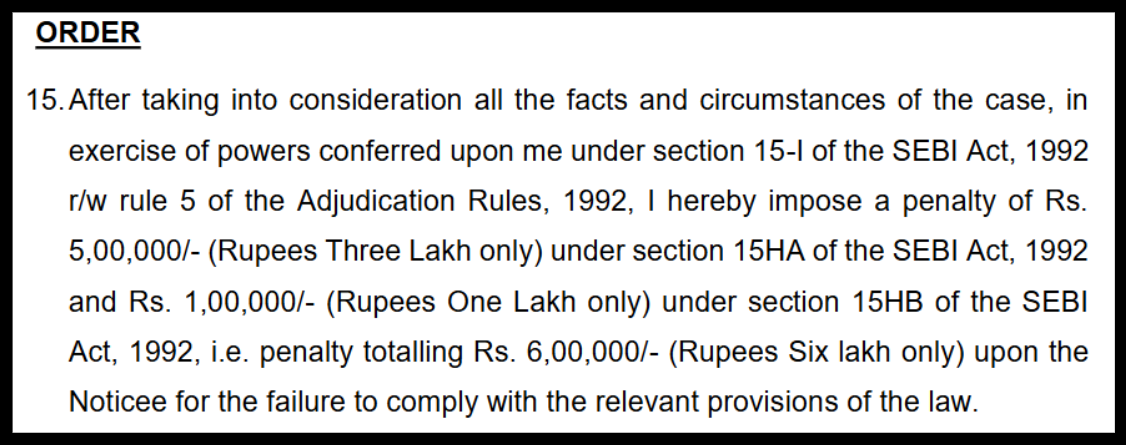
Acting under Section 15-I of the SEBI Act, 1992, read with Rule 5 of the Adjudication Rules, 1992, SEBI imposed a penalty of ₹5,00,000 under Section 15HA and a further ₹1,00,000 under Section 15HB, totalling ₹6,00,000.
2. The Byke Hospitality and BGIL Matter (October 2020)
In October 2020, SEBI passed a separate order against Adroit tied to trading irregularities around The Byke Hospitality Ltd, following an investigation into unusual trading patterns in the stock.
This was not an isolated finding.
An earlier, related case involving Bharatiya Global Infomedia Ltd (BGIL) is where the more detailed conduct emerged: SEBI found that Adroit had executed self-trades in BGIL shares on the stock’s listing day on behalf of a client, meaning matching buy and sell orders processed under the same account, which creates an artificial impression of trading volume.
Adroit’s management tried to frame this as an acceptable trading strategy.
SEBI rejected that explanation outright, noting that tolerating self-trades sends the wrong signal about market discipline, and imposed a penalty of ₹5,00,000, directing the firm to overhaul its internal filters to prevent this category of trade going forward.
Not sure whether an issue you’re facing with Adroit, or any SEBI-registered firm, is something you can push back on formally?
We will review what happened, map it against the exact SEBI regulation it may have breached, and help you build a complaint that names the right violation instead of a vague grievance.
Where to Complain Against Adroit Financial Services?
If you’re looking for the actual complaint numbers and the specific issues other users have run into, that ground is already covered in full on our dedicated Adroit Financial Services complaints page, disclosure data and all seven documented reviews included.
What follows here is just the filing route itself.
Most of what gets written about SEBI complaints online assumes a single Research Analyst registration. Adroit doesn’t fit that mould.
The firm carries five separate licences, and which one your specific issue falls under changes where your complaint actually needs to go.
A research-tip dispute follows the RA framework, covered in full in our guide on complaint against SEBI registered research analyst.
A trade execution failure, a locked account, or a fund withdrawal delay is a broking-side issue instead. Those get handled directly through the exchange, NSE or BSE, not the RA complaint channel.
Regardless of which registration applies, filing a SEBI SCORES complaint remains the correct starting point in every case.
If that doesn’t resolve things, the SMART ODR portal offers structured mediation as the next stage.
Should mediation also fail, share market arbitration is the final, binding step, producing a legally enforceable decision.
Conclusion
Adroit Financial Services is a genuine, three-decade-old, multi-segment SEBI-registered brokerage, founded and still closely overseen by Mr. Ajay Kumar Gupta, with a management layer that includes Ashay Gupta, Ayan Gupta and CEO Mohit Sharma.
It is also a firm with two confirmed SEBI adjudication orders on its record, totalling ₹11 lakh in penalties across the co-location and self-trade matters, which is a fact any prospective or existing client has a right to weigh before deciding how much trust to extend.
Being registered is not the same as being risk-free, and a long operating history is not the same as a clean one.
Verify the registration number relevant to your specific service, read the regulatory orders in full rather than a summary, and use the escalation channels available to you if something goes wrong.
Report. Recover. Stay Fraud Free.
Yes. It holds active registrations as a stock broker (INZ000173137), depository participant (IN-DP-551-2021), portfolio manager (INP000005349), and research analyst (INH100003084), covering NSE, BSE, MCX and NCDEX. Mr. Ajay Kumar Gupta founded the firm in 1994 and remains its Chairman. He is an FCA with ICAI and is not individually SEBI registered; the corporate entity holds all licenses. It is a real, operational company with a valid CIN and active SEBI registrations, not a shell entity. It does carry two SEBI penalty orders, which is a factor to weigh, not evidence of fraud. Mr. Mohit Sharma holds the role of CEO and is also the designated Compliance Officer responsible for exchange reporting and addressing investor grievances at the firm. Yes, twice. A ₹6 lakh penalty in February 2022 over misuse of NSE's co-location data servers, and a ₹5 lakh penalty tied to self-trades in BGIL shares, examined alongside the Byke Hospitality matter in October 2020. Start with their internal grievance desk, then escalate through a SEBI SCORES complaint if unresolved. For monetary disputes, SMART ODR offers a faster mediated route before formal exchange arbitration.Frequently Asked Questions





 Add us as a preferred source on Google »

