

Quick Summary
An AI voice cloning scam copies the voice, and sometimes the face, of someone you know, then asks for urgent money. A viral reel shows Guddu getting a video call from “Daddu” who wants ₹2 lakh. Real Indian cases follow the same pattern, from a ₹40,000 loss in Kozhikode in 2023 to a reported ₹50 lakh loss in Mumbai in October 2026. This post explains how the scam works, how to detect a fake AI voice, and what to do if you have already paid.
Picture this. Your phone rings, and it is your grandfather’s voice.
He sounds scared. He needs ₹2 lakh right now.
Would you stop and check, or would you just send it?
That is the moment Guddu faces in a viral awareness reel, and a very similar moment has cost real families in India lakhs of rupees.
Here is how the AI voice cloning scam works, and how you can tell a fake voice from the real one.
AI Voice Scam
An AI voice scam starts with a few seconds of someone’s voice.
Scammers take it from a social media clip or a voice message.
Cloning software then copies that voice. One report says the tools need only a few seconds of audio.
The caller then invents an emergency.
Experts list robbery, a car crash, a lost phone or wallet, and money needed during overseas travel as the stories that work best.
The money is usually asked for by UPI or bank transfer, and it is asked for quickly.

Some scammers add a face too.
In a Kerala case, the victim even made a WhatsApp video call to check, and saw his colleague’s face and heard his voice. Police said the criminals had faked both.
A UC Berkeley researcher quoted by Scroll explains why this works.
Scammers rely on panic and emotional distress to cloud your judgement.
Voice cloning is only one branch of the problem.
Deepfake videos of public figures and fake chatbots use the same idea, which is making something fake feel familiar, and together they make up the wider world of AI scams in India.
The Guddu Reel: What Daddu’s Video Call Shows?
This section describes the reel that started the conversation. It also points out what the reel gets right and where real life is harder.
A popular awareness reel from ScamShala follows a character called Guddu.
He gets a video call from his grandfather, Daddu, who asks him to transfer ₹2 lakh urgently.
The face looks like Daddu and the voice sounds like him.
Then Guddu realises that both have been created with AI face and voice cloning.
The reel teaches four warning signs.
- Inconsistent lip sync and audio, where the mouth and the words do not match
- Unnatural facial movements
- Strange behaviour from someone you know well
- An unexpected, urgent demand for money on a video or voice call
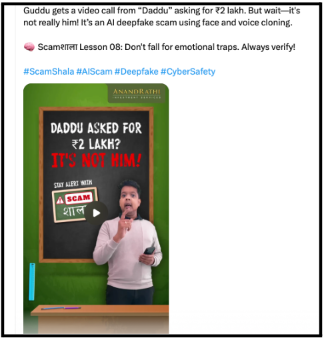
The reel gets one thing very right. The money demand is urgent, and urgency is the scammer’s best tool.
It also makes one thing look easier than it is. Guddu had time to look closely.
In the Kozhikode case below, the victim video-called to check and still saw a convincing face.
In the Noida case, the mother noticed that the caller said “mummy” instead of “mom”, and she still paid.
Spotting the fake is hard when you are frightened. That is why the checks later in this post matter more than a sharp eye.
AI Voice Cloning Scam Cases in India
These are the cases I could confirm from news reports and an incident database, with dates where the reports give them.
Treat the Mumbai case as alleged, because police are still examining it.
1. Kozhikode Deepfake Video Call Scam (July 2023)
This is the best-documented case, because the police side was reported too.
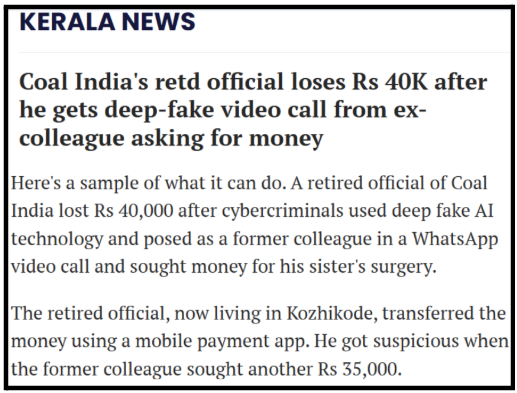
A retired Coal India official in Kozhikode got a call on 9 July 2023 from a new number.
The caller said he was a former colleague, and he asked for money for his sister’s surgery.
To check, the victim made a WhatsApp video call.
He saw the colleague’s face, heard his voice, and paid ₹40,000 through a mobile payment app.
Then the caller asked for another ₹35,000.
That second request made him suspicious, so he called the colleague on the number saved in his phone. The colleague said he had never called.
Police had the receiving account frozen on 11 July.
By then, the money had moved on to a trading company in Panaji, Goa.
A case was registered under IPC section 420 and IT Act sections 66C and 66D, and a team went to Goa on 24 July.
No recovery had been confirmed when the case was reported.
2. Lucknow AI Voice Deepfake Fraud (December 2023)
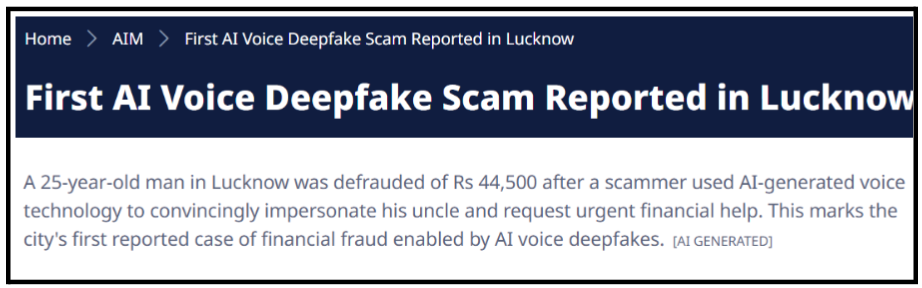
A 25-year-old in Lucknow lost ₹44,500 after a caller imitated his uncle’s voice and asked for urgent help.
Some outlets reported ₹45,000.
The OECD incident database calls it the city’s first reported financial fraud enabled by AI voice deepfakes.
3. Noida Mother and the Cloned Voice of Her Son
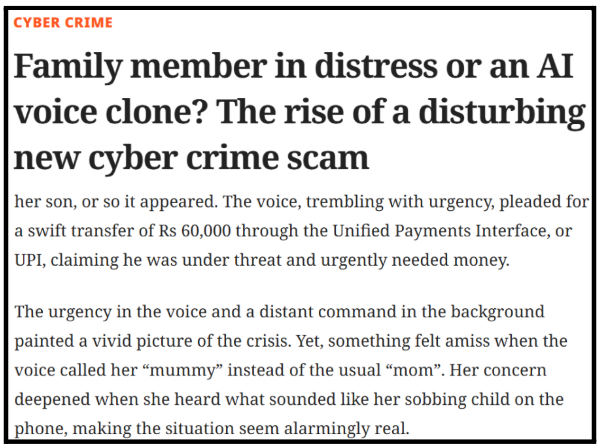
A woman in Noida heard what sounded like her son. He was distressed and said he was under threat.
She sent ₹60,000 by UPI. She had noticed that the caller said “mummy” instead of “mom”, yet she paid anyway.
Her son had never made the call.
Scroll reported this case but gave no date.
4. Mumbai Senior Citizen and the ₹50 Lakh Allegation (October 2026)
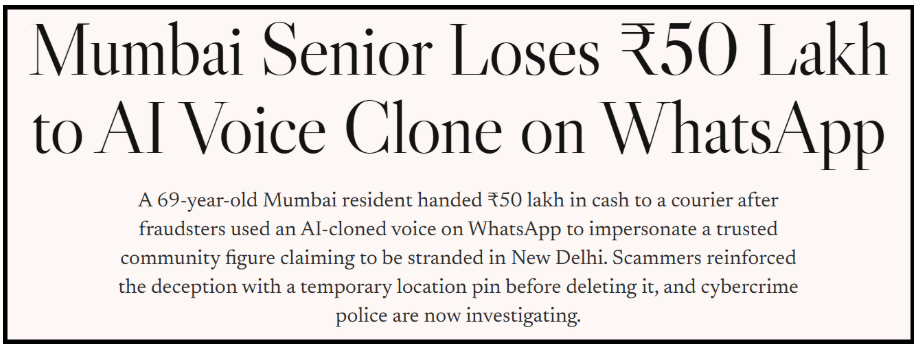
The420.in reported on 15 October 2026 that a 69 year old in Mumbai lost ₹50 lakh in cash in an alleged AI voice cloning scam.
The call came on WhatsApp from an unknown number that showed the profile photo of a respected community figure.
The voice sounded like the real person, and police suspect it was AI-cloned.
The caller claimed to be stranded in New Delhi and asked for a ₹50 lakh loan.
The victim raised the money with a friend, and a courier collected the cash in Delhi.
The scammers’ numbers became unreachable soon after, and the real person said he had never made the call.
Police are examining call records and device data.
Everything here stays alleged until the investigation ends.
5. Other Reported AI Voice Scam Cases
A report published on 2 September 2026, citing Analytics Insight, describes a matrimonial scam in Maharashtra.
The scammers built a relationship over weeks, then used a cloned trusted voice in a fake emergency, and the man sent ₹11.8 lakh.
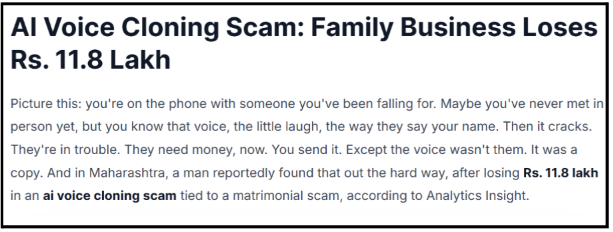
The report gives no incident date.
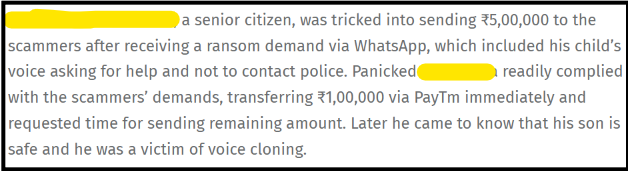
CyberMithra’s page on voice cloning fraud describes a senior citizen who sent ₹5 lakh after a WhatsApp ransom demand that carried a cloned voice of his child.
The child was safe. That page gives no date either.
How Common Is an AI Voice Scam in India?
Survey numbers help show the scale, though they come with limits.
They are from 2023; they come from a security company, and the reports do not share sample sizes. Read them as a signal, not an exact count.
A McAfee survey, as reported by Media India, found that 83% of Indian victims of AI voice scams lost money, and nearly half lost more than ₹50,000.
The same report says 69% of Indian respondents could not confidently tell a cloned voice from a real one, and 47% had experienced such a scam or knew someone who had.
Scroll reports other McAfee figures. 66% of Indian respondents said they would likely respond to a call asking for urgent money.
Of those, 46% cited a parent, 34% a spouse and 12% a child.
The stories that felt most convincing were robbery (70%), a car crash (69%), a lost phone or wallet (65%) and overseas travel funds (62%).
Scroll also notes that 86% of Indians share voice data online or in voice messages at least once a week, and that McAfee says a clone can be about 85% accurate even when a beginner makes it.
It cites Delhi cybercrime cases at 685 in 2022, up from 345 in 2021 and 166 in 2020, attributed to the National Crime Records Bureau.
Did a call in a loved one’s voice cost you money?
Then the next step is to register a cyber crime complaint with the right details, and to speak with people who handle these cases every day. Register with us and share what happened.
How to Detect Fake AI Voice?
No single trick catches every clone.
This section combines the signs worth noticing with checks that still work when the voice sounds perfect.
Signs a Voice or Video Call May Be Fake
These signs come from the reel and from the reports I read. Use them as clues, and never as proof either way.
- Blurry video, or a video that loops or freezes
- Inconsistent lip sync, where the mouth and the words do not match
- Unnatural pauses or robotic speech
- Odd facial movementsor strange behaviour from someone you know well
- A small slip in how they speak, like the Noida caller who said “mummy” instead of “mom”
The biggest sign has nothing to do with sound or video. It is an urgent request for money that you did not expect.
A second payment request is another warning.
In the Kozhikode case, it was the moment the victim started to doubt.
A new number claiming to be someone you know deserves a pause.
Take a minute to check if a phone number is a scam, and look at the caller ID before you answer any questions.
Do not rely on glitches alone. A good clone may have none, and fear makes everyone a worse detective.
Checks That Work Even When the Voice Sounds Perfect
These steps do not depend on your ear. They take a minute or two, and each one beats a clone.
- Hang up and call back on the number already saved in your phone, not the one that called you.
- Ask a question only the real person would know, such as a family detail that never appears online.
- Use a family code word that relatives agree on in advance, for real emergencies.
- Ask the caller to hang up so you can verify. A real relative will understand, though this is hard to do under pressure.
- Slow down. Scammers need you to decide in minutes, so take your time.
- Message another family member to confirm the story before you send anything.
How to Protect Your Voice From Being Cloned?
A clone needs a voice sample, so the safest habit is to leave fewer samples in public view.
Keep your social media profiles private, and think before you post long videos or voice notes where your voice is clear.
Be careful with apps that promise to change or copy voices.
Some fake AI apps claim to imitate celebrity voices, and they can record yours without asking, which is one more way a clean voice sample leaves your phone.
It also helps to talk about this at home. A code word only works if your parents and grandparents know it exists.
What to Do If You Paid in an AI Voice Cloning Scam?
If you have already sent money, the first hour matters most. This section lists the steps in the order we would take them.
- Call the cyber fraud helpline number at once, or file a report at the cybercrime portal. Both routes are named on the CyberMithra page.
- Call your bank and ask it to freeze the funds. In the Kozhikode case, the account was frozen two days after the payment, and the money had already moved on.
- Tell your UPI app and your bank together if the money went out by UPI, and keep the transaction ID ready when you report UPI frauds.
- Save the evidence. Keep screenshots of the call log, the number, the chats, and every payment receipt. If cash was handed over, note the courier and the place.
- Change passwords and PINs for any account you may have exposed. If you shared Aadhaar details, lock your Aadhaar through the UIDAI website.
- Warn your family, so the same voice does not call the next relative.
After the first hour, a longer checklist on what to do if online fraud happens helps you catch anything you missed.
Conclusion
The Guddu reel ends well because Guddu stops and checks. That is the whole lesson.
An AI voice cloning scam works only when you act before you verify.
A voice, or even a face, is no longer proof of who is calling.
A saved number, a private question, and a family code word are proof.
Agree on the code word with your family this week, and call 1930 within the hour if you ever pay by mistake.
Report. Recover. Stay Fraud Free.
Frequently Asked Questions
Scammers copy a person's voice from a short audio clip, then call family or friends with a fake emergency and ask for urgent money. Some also fake the face on a video call.
Yes. Reports say the tools need only a few seconds of audio from social media or voice messages. McAfee, as cited by Scroll, says even a beginner can make a clone that is about 85% accurate.
Hang up and call back on their saved number, and ask a question only they could answer. A family code word settles it even faster.
The reel is an awareness story, not a news report. Its scenario matches real cases such as Kozhikode in 2023 and the alleged Mumbai case in 2026.



 Add us as a preferred source on Google »