
Quick Summary
KreditBee impersonation scams use the name of a well known loan app to trick people. Reports describe fake callers who offer a big loan, push you into taking a small real one and ask you to send the money on as a fee. Others describe a lookalike app called Kreditbe and collection messages for loans people never took. This guide shows how each version works, what users reported, the red flags to watch for and how to report it.
Your phone rings, and a polite voice says you have been pre-approved for a ₹5 lakh loan from KreditBee.
Or you have never opened the app at all, and a stranger is suddenly texting you about a repayment.
Both stories show up in reports of KreditBee impersonation scams, and they work because the real app is so widely known.
The details change from case to case, but the pattern stays the same: a borrowed name, a lot of pressure, and a request for money or documents.
Let us walk through how it works, what users have reported, and what you can do about it.
KreditBee Details
KreditBee is a real, widely used instant loan app. That is exactly why scammers like it.
Most people have at least heard the name, so a call that begins with “I am calling from KreditBee” does not sound strange.
The people in the reports below are not KreditBee.
They borrow its name, a near-identical spelling, and the language of quick loans, so a stranger believes the offer is genuine.
Treat any app, caller, or message that mentions KreditBee as unverified until you check it inside the official app.
What KreditBee Impersonation Looks Like
The reports describe three different tricks. It helps to keep them apart, because the right response is different for each.
- A fake representative on the phone. The caller offers a large loan and walks you through KYC, but the real aim is to get money out of you.
- A lookalike app. An app with a name one letter away from the real one, built to collect your details and pressure you for repayments.
- Collection messages for a loan you never took. Someone claims you owe money and threatens a visit, a notice, or a call to your family.
KreditBee Lending App Ban Lifted: What the 2023 Report Said
This is a short background note, because some people mix it up with fraud.
It was a government blocking story, and it is not a scam report about KreditBee.
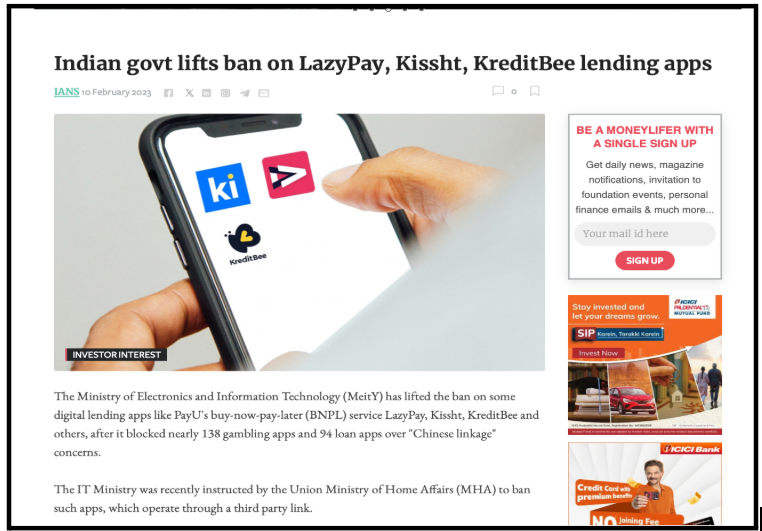
On 10 February 2023, MoneyLife reported that the Ministry of Electronics and Information Technology had lifted its block on some digital lending apps, KreditBee among them.
The ministry had earlier blocked nearly 138 betting apps and 94 loan apps over concerns about Chinese links.
The report said the lending apps described the domain Aptoide, which appeared in the ministry’s list, as a clear case of impersonation with no connection to them.
In other words, even a blocking list can carry a lookalike.
The same report raised wider concerns about digital lending apps trapping vulnerable borrowers through very high interest rates.
It did not show that KreditBee itself charged those rates or took part in such practices.
How KreditBee Impersonation Scams Work
Most reports follow the same four steps. This section walks through them in order, so you can spot the moment the story turns.
1. The Call That Offers a Large Loan
It starts with a call from someone who says they are a KreditBee representative.
In one reported case, the offer was a loan of ₹5 lakh.
The caller sounds helpful and guides you through KYC over the phone.
This is the point where you are being led, not asked.
2. A Real Loan Taken Out in Your Name
Here is the twist that surprises people.
According to a Reddit post, the caller did not give a ₹5 lakh loan at all.
Instead, the victim was guided to apply for a real loan of ₹24,000 on the genuine KreditBee app.
That detail matters. The app was real, and the loan was real, so the victim believed everything was above board.
3. The Request to Send the Money On
Once the ₹24,000 landed in the bank account, the poster said the scammer called it a temporary amount and asked for it to be sent to a UPI ID as a “processing fee”.
The demands did not stop there.
The poster wrote that the scammer then asked for more under labels such as “health insurance fees” and “extra charges”, until about ₹53,000 had gone out in five UPI transfers.
4. The Loan Stays in Your Name
The worst part is what is left afterwards.
The money is gone, but the loan is still there, with a repayment date attached.
This is why online personal loan frauds in India hurt twice.
You lose the fee you paid, and you may still be chased for a loan you never really wanted.
Lookalike Apps, Fake Helplines and Collection Messages
Not every case involves a phone call. This section covers the fake apps, fake helplines and threatening messages that use the KreditBee name.
The One Letter Name Trick
An Al Jazeera report from December 2023 described an illegal loan app called “Kreditbe”.
The name differs from the real spelling by a single letter.
Illegal apps often pick names close to trusted brands so that they look genuine.
Experts quoted in coverage of such apps say they also stuff their names with words such as “easy”, “loan”, “Aadhar” and “emi”, so they show up in searches.
Ads, Rebranding and Foreign Numbers
The research behind this article lists a few more habits.
Such apps are said to advertise on big platforms, including Facebook and Google AdSense, and to return under new names after a ban or a wave of complaints.
It also notes that many scammers use virtual numbers from neighbouring countries such as Bangladesh, Pakistan and Nepal, which makes them hard to track.
One loan comparison site warns that fake helplines are common for lending app brands.
So a number that comes from an ad, a search result, or a stranger is not proof of anything.
If a number looks odd, learn how to check if a phone number is scam before you call it back or reply.
Collection Messages for Loans You Never Took
The third version needs no app and no offer.
Someone just texts you that a collection agent is on the way.
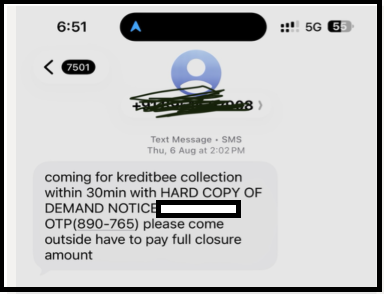
One screenshot shows a message saying a person is “coming for kreditbee collection within 30min” with a hard copy of a demand notice, and asks the reader to come outside and pay a full closure amount.
It also quotes an OTP in the text.
The screenshot does not show who sent it, or whether the receiver ever had a loan.
So treat it as an example of the pressure style, not as proof of anything about a particular company.
What Users Have Reported About KreditBee Impersonation
These are summaries of public posts, written in our own words.
We credit every claim to the person who wrote it, and none of it has been independently verified.
The posts also describe different problems, so we have kept them in separate sections.
They do not show that KreditBee or its staff did anything wrong.
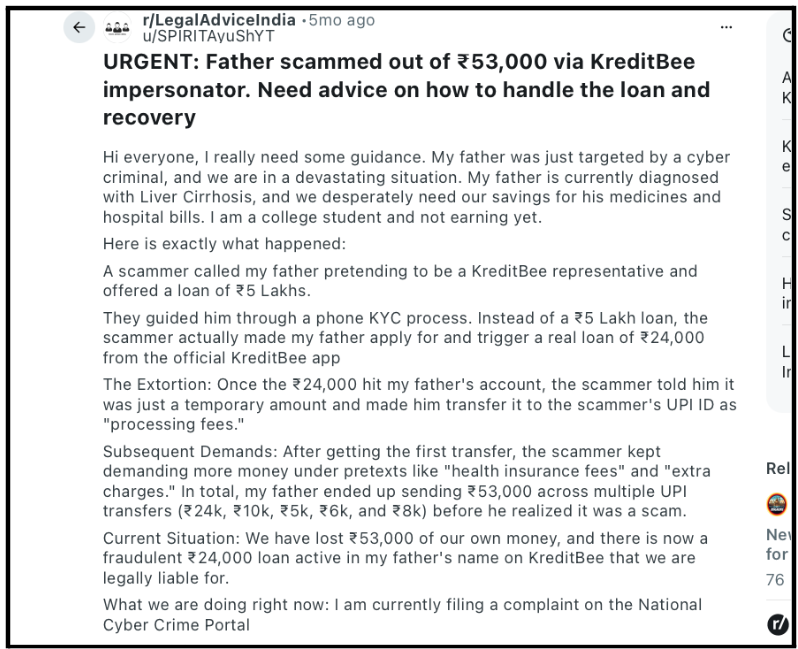
1. A Reddit Post on a ₹53,000 Loss
This post appeared on r/LegalAdviceIndia.
The poster, a student, wrote that a caller pretending to be a KreditBee representative offered their father a ₹5 lakh loan.
They described the steps already covered above: a phone KYC process, a real loan of ₹24,000 on the official app, and five UPI transfers of ₹24,000, ₹10,000, ₹5,000, ₹6,000, and ₹8,000.
The poster said they were filing a complaint on the National Cyber Crime Portal.
They asked how to dispute the loan without harming a CIBIL score, and how to protect the family from recovery pressure.
2. A LinkedIn Post on a Loan Against a PAN
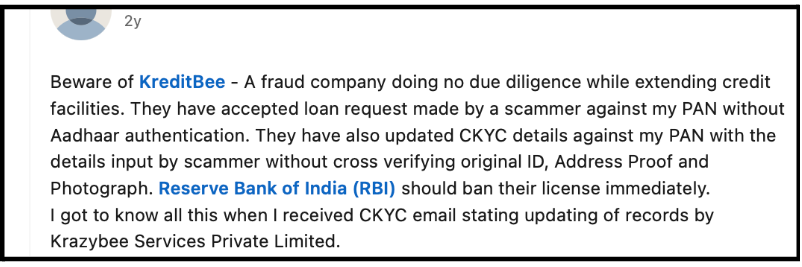
This poster wrote that a loan request was accepted against their PAN, which they said they had not applied for.
They said the loan application and their CKYC record carried details entered by someone else.
They said they found out through a CKYC email and planned to complain to the RBI.
We are only reporting what the poster said, and the post does not show how the loan was processed.
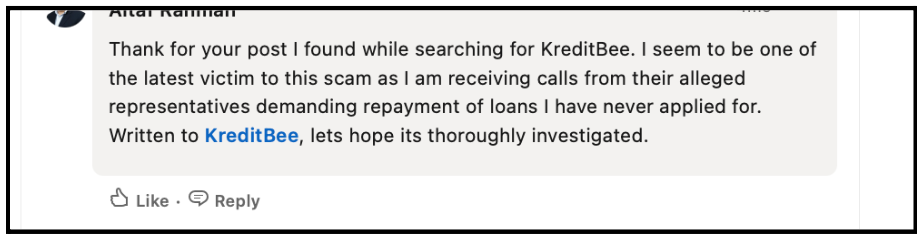
Another LinkedIn user commented, in a post about KreditBee, that they were getting calls from alleged representatives asking for repayment of loans they had never applied for.
They said they had written to KreditBee.
3. A Reddit Post on Aggressive Recovery Calls
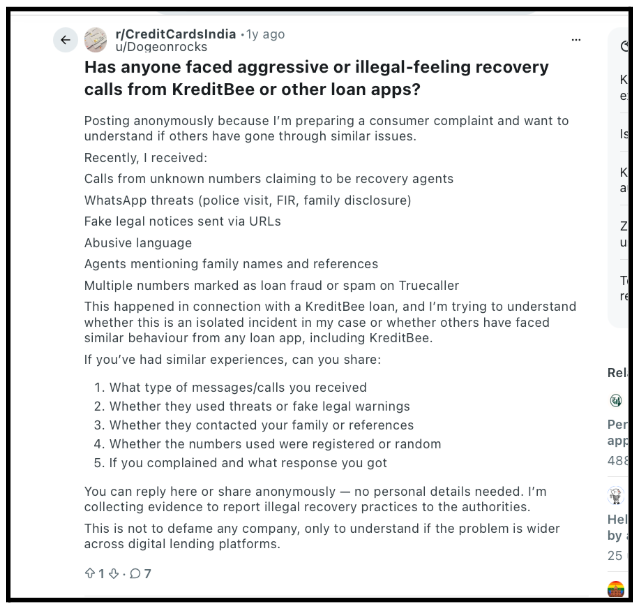
This post appeared on r/CreditCardsIndia.
The poster said they were collecting evidence for a consumer complaint, and listed what they had received in connection with a loan they linked to KreditBee.
The list included calls from unknown numbers claiming to be recovery agents, WhatsApp threats of a police visit, an FIR, telling family, fake legal notices sent as links, and abusive language.
They also said several of the numbers were marked as loan fraud or spam on Truecaller.
This is a different problem from impersonation, so please read it separately.
The poster did not say who was behind the calls, only that the callers claimed to be recovery agents, and we cannot tell whether they had any link to a lender.
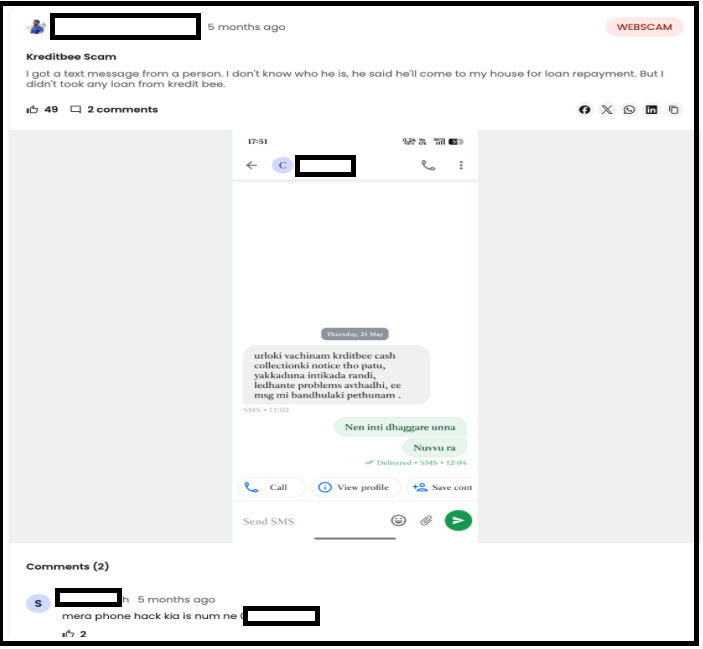
4. A Text Message Report on Webscam
The last report is a short post on a scam reporting site.
The user wrote that they got a text from a stranger who said he would come to their house for loan repayment, even though they said they had never taken a loan from KreditBee.
The screenshot shows a message in Telugu about a cash collection notice.
We cannot confirm who sent it, and the post does not say anything beyond what the user wrote.
A Real Case: The Kreditbe Loan App
This section covers the best documented story in the research.
It comes from a published news report, so it is about one real person’s experience with a lookalike app.
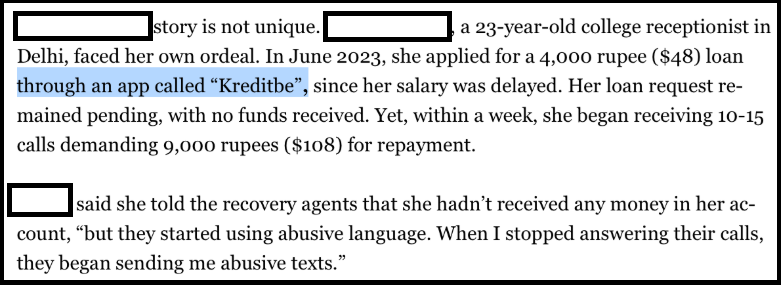
Al Jazeera published a report on 25 December 2023 about illegal loan apps in India.
It described a 23-year-old college receptionist in Delhi who applied in June 2023 for a ₹4,000 loan through an app called “Kreditbe”, because her salary was delayed.
The loan stayed pending, and no money reached her.
Even so, within a week she began getting 10 to 15 calls demanding ₹9,000.
When she said she had received nothing, the agents reportedly turned abusive, and then sent abusive texts when she stopped answering.
The report says manipulated images of her and her family were later sent to her colleagues, and that she lost her job after a request to resign.
Al Jazeera also said it could find no information about the company behind Kreditbe.
The lesson is not about one name.
A lookalike app can hurt you even when it never sends a rupee, so check the exact app name and the developer before you share a single document.
Red Flags of a Fake KreditBee Call or App
These are the warning signs that appear again and again in the reports.
This section turns them into a quick checklist you can run in your head during a call.
- “You are pre-approved for a very large loan.”A big offer from a stranger, with KYC done over the phone, is how the story begins.
- “Send the money on; it is only a temporary amount.”A genuine lender does not need you to pass a disbursed loan to a personal UPI ID.
- “Pay an insurance fee or extra charge to continue.”New fees that appear after each payment are a sign of a scam.
- An app name that is one letter off. Compare the spelling and the developer name on the official listing.
- A caller or message that reached you first. If you did not apply, be careful with the person who contacted you.
- Pressure and short deadlines. Messages such as “within 30 minutes” are meant to stop you from checking.
- An OTP quoted in a message. Never share an OTP with anyone who says they are collecting or approving a loan.
- Threats to your family or colleagues. Threats in messages, notices, or edited pictures are a reason to report, not to pay.
Did someone ask you to send on money from a KreditBee loan, or are you being chased for a loan you never took?
A complaint with the right documents works best when it goes in early, so file it on the cyber crime portal as soon as you can. If you want help sorting your papers and deciding the next steps, Register with us.
What To Do If You Have Been Targeted?
The first few hours matter, because money moves fast between accounts. This section gives you an order to follow.
Most victims lose precious time working out what to do if online fraud happens, so start at step one and keep going.
- Stop paying and stop sharing. Do not send more money, documents, or OTPs, even if the caller threatens a visit or a notice.
- Call your bank. Ask to block UPI or card access linked to the payments, and report UPI frauds to the bank in the same call, since the first few hours decide how much can be traced.
- Save the evidence. Keep call numbers, chats, UPI IDs, receipts, the loan screens in the app, and every message.
- Report. Call the national cybercrime helpline as soon as you notice, then file online on the cybercrime portal.
- Tell the lender in writing. Use the support option inside the official app, not a number from an ad, and keep a copy of what you send.
- Watch your credit record. If a loan appeared that you did not take, check your credit report for entries that are not yours.
Loan Taken in Your Name Without Consent: What to Do
Do not ignore it, and do not pay a collector who contacts you out of the blue.
Ask the lender in writing for the application details and tell them the loan is not yours.
Keep the lender’s reply and note every call you receive.
Then file a complaint against loan frauds with your bank statements and the loan screens attached.
If the lender does not respond, the RBI’s complaint system is the next place to go.
Conclusion
KreditBee impersonation scams lean on a name people trust.
Some callers use the real app to put a loan in your name, others use a lookalike app, and some just send threatening messages about a loan you never took.
The reports we looked at come from Reddit, LinkedIn, a scam reporting site, and one published news story.
They are accounts, not findings, and none of them shows that KreditBee itself did anything wrong.
The safest habit is simple.
Never pay anything to unlock a loan, never send disbursed money to a personal UPI ID, and check every offer inside the official app.
If you have already paid, report it without waiting.
Report. Recover. Stay Fraud Free.
Frequently Asked Questions
You cannot tell from the call alone. Reports describe fake callers who use the KreditBee name, so hang up and check any offer inside the official app before you share documents.
Tell the lender in writing, save every message and call, and report it on 1930 and the cyber crime portal. Check your credit report for entries that are not yours.
No. Al Jazeera described "Kreditbe" as an illegal loan app whose name is one letter away from the real one. Always compare the exact spelling and the developer name.
No, not to someone who contacts you first or who sends you a message with an OTP. Verify the loan inside the official app, and pay only through its own payment options.
File on the cyber crime portal and write to the lender through the official app. Keep your chats, UPI IDs and receipts ready.



 Add us as a preferred source on Google »