
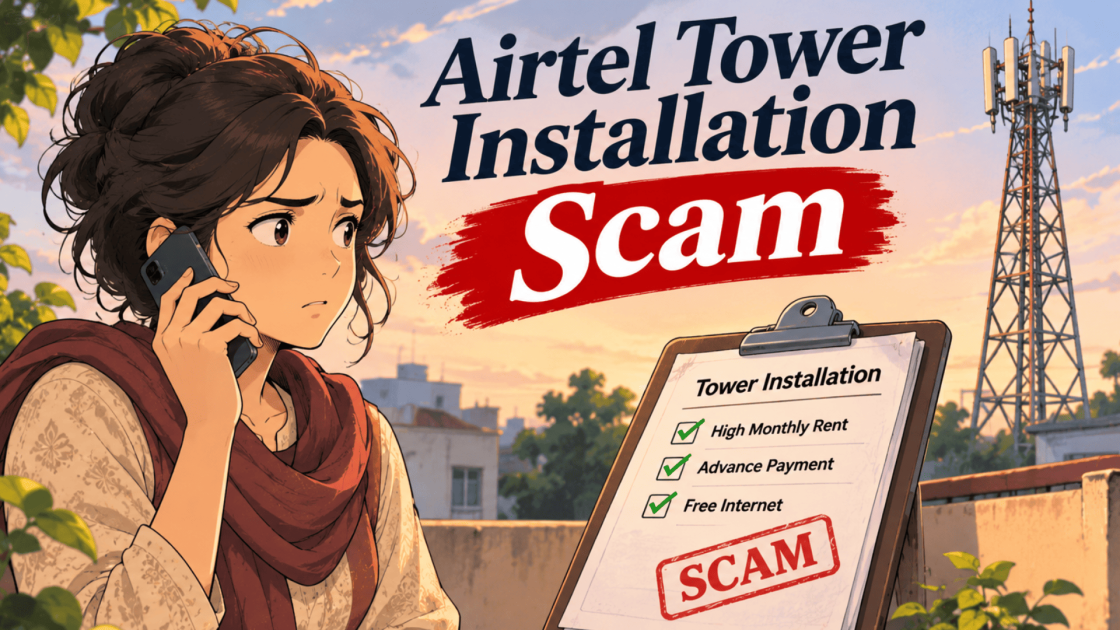
Quick Summary
Landowners across India are reporting calls and messages that claim their rooftop or vacant land has been chosen for an Airtel mobile tower. The offers promise high monthly rent and a large advance. Reported victims were then asked for registration, processing or approval fees, and for ID and property documents. This page explains how the Airtel tower installation scam works, the documents and charges involved, reported cases and what to do next.
A caller says your rooftop is perfect for a 5G tower. The rent sounds life-changing.
Then comes a small fee to “start the paperwork”, and then another.
Many property owners have reported this pattern, and the offers were made in the name of a trusted company.
This post explains the Airtel tower installation scam using public advisories and cases shared online.
Read it before you share a single document or rupee.
What Is the Airtel Tower Installation Scam?
It is a type of property rental fraud.
Scammers claim to represent Bharti Airtel or other telecom operators and tell landowners that their property has been shortlisted for a 4G or 5G mobile tower.
They promise a high monthly rent and a sign-up bonus, and then ask for payments such as registration, government approval, or installation charges.
Once the money is sent, the reported pattern is that they disappear without installing any tower.
This is a classic impersonation scam, where a trusted brand is borrowed so the offer looks official.
Does Airtel Really Call Landowners to Install Towers?
This is what every landowner wants to know after the first call.
Here is what the industry itself has said.
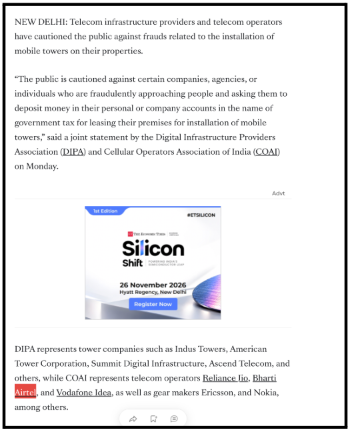
A joint statement by the Digital Infrastructure Providers Association and the Cellular Operators Association of India cautioned the public against people asking them to deposit money in personal or company accounts in the name of government tax for leasing premises for mobile towers.
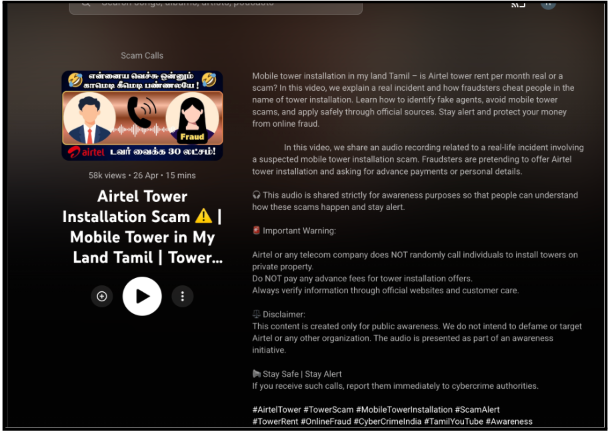
An awareness video also states that Airtel does not randomly call individuals to install towers, and that no advance fees should be paid.
People on a question-and-answer site say genuine companies handle permissions themselves and do not ask landowners for upfront money.
So any tower offer that asks you to pay first should be checked through the operator’s official channels.
Also Read: Fake profiles and AI-generated deepfake videos have been reported using the Delta name to pull investors into chat groups, a trick we explained in our Delta exchange impersonation scam guide.
How Does the Airtel Tower Installation Scam Work?
Reports follow a fairly steady pattern. Here is the order in which it is described to unfold.
- The approach. Landowners are contacted by phone, email, WhatsApp, or social media by someone claiming to represent Airtel or a telecom infrastructure company.
The first contact is usually a call, so it helps to know how to check if a phone number is scam before you reply. - The attractive offer. The property is said to be “shortlisted” for a 4G or 5G tower, with high monthly rent, a large advance, and extras such as free internet or a caretaker’s salary.
- Official-looking documents. Approval letters, agreements, and affidavits arrive carrying company, TRAI, or government names and logos.
- ID and property documents are requested. Owners may be asked for PAN, address proof, land records, property photos and bank passbook pages.
- Fees, then silence. Registration, processing, licence or approval fees are demanded.
Complainants say more charges follow, and then the callers stop responding.
The fees may be described as refundable or as deductible from the first rent.
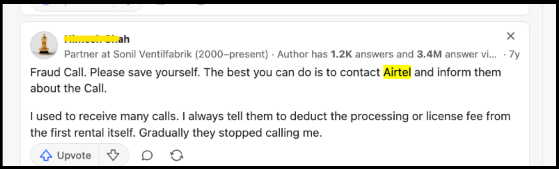
One respondent on a question and answer site said the callers stopped contacting them after they suggested deducting the fees from the first rent.
Offers and Charges Reported by Property Owners
The figures differ from one case to another.
The table below lists what was reported in the research, so you can compare it with any offer you receive.
| What was promised or asked | Reported figure | Where it was reported |
| Monthly rent | ₹25,000 to ₹50,000 | General reports and an awareness video |
| Upfront payment | ₹15 lakh under a 20-year agreement | An awareness video |
| Caretaker salary | ₹15,000 a month | An awareness video |
| Registration fee | ₹2,500 “refundable” | A LinkedIn post |
| Processing fee | ₹30,000 to ₹35,000 | An awareness video |
| Other benefits | Free internet for 20 years | An awareness video |
These are reported claims and not confirmed offers from any company.
Any figure that arrives with a fee request is a red flag, whatever the amount.
Also Read: One forum poster warned that a site with a similar-sounding name had team members who could not be found online and a withdrawal step where the transaction ID did not match, as shared in our Galaxy digital fraud guide.
Fake Documents: What Complainants and Reviewers Point Out
The paperwork is built to look official.
This section lists what people noticed when they checked these documents.
In an awareness video, the presenter said documents carrying Airtel, TRAI, and Ministry of Communications names had edited registration numbers, names, and QR codes.
He also questioned the signatures and government stamps.
Other documents reportedly had inconsistent logos, copied signatures, and project schedules with suspicious dates.
One shared letter claimed approval from local land revenue officials and the Department of Telecom, and asked for a “refundable” approval charge of ₹2,500.
Logos, stamps, QR codes, and stamp paper do not prove an offer is genuine.
Reported Airtel Tower Installation Scam Cases
These are complaints and accounts shared publicly. They are allegations by the posters and presenters, and names are left out on purpose.
1. A ₹2,500 “Refundable” Fee After an Affidavit
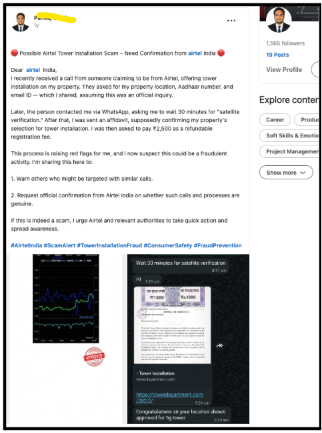
A LinkedIn user said a caller claiming to represent Airtel offered a tower installation on their property.
The caller collected the property location, Aadhaar number, and email ID.
Later, on WhatsApp, the user was asked to wait 30 minutes for “satellite verification”.
An affidavit then arrived, claiming the property had been selected.
The user was then asked for a ₹2,500 refundable registration fee.
They suspected fraud, asked Airtel for confirmation, and warned others.
2. A ₹15 Lakh Offer Followed by ₹30,000 to ₹35,000 in Fees
An awareness video discussed a property owner who was offered ₹15 lakh under a 20-year agreement, ₹25,000 monthly rent, a ₹15,000 caretaker salary, and free internet.
The documents sent to the owner carried Airtel, TRAI and Ministry of Communications logos.
The presenter said they looked forged.
The video says the owner was then asked for ₹30,000 to ₹35,000 in processing fees, along with PAN, address proof, land papers and bank passbook pages.
The presenter said an email was sent to Airtel asking it to verify the documents.
3. What Question Site Users and Video Viewers Say
On a question and answer site, several users described similar calls as fraud.
They said callers demand processing or licence fees and vanish once the money is paid.
Under the video, viewers said the same thing had happened to them.
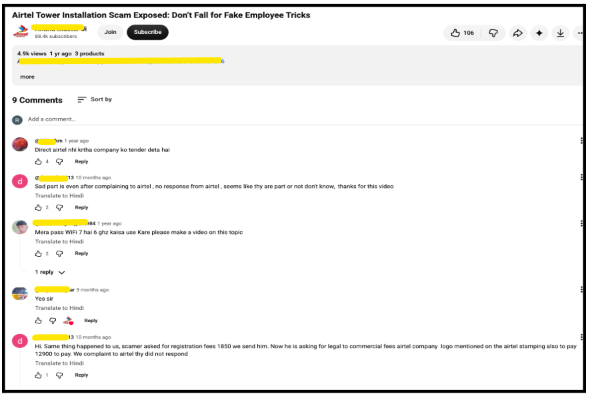
One said the callers first asked for a registration fee and then for a much larger charge.
These are personal claims, so treat them as reports and not proof.
Paid fees for a mobile tower offer and unsure where to start?
Reported losses range from a few thousand to tens of thousands of rupees. Our team reviews cyber fraud cases of ₹30,000 and above, and a clear record of payments helps a lot. If your loss is in that range, Register with us and we will go through your case with you.
How to Stay Safe From Fake Tower Installation Offers?
A few checks can stop this trick early. This section lists them in plain steps.
- Never pay to receive rent. Registration, processing, licence, or approval fees are the core warning sign.
- Verify through official channels. Contact the operator using details from its own website, not the number or email the caller gives you.
- Hold back your documents. Do not send Aadhaar, PAN, land records, or bank passbook pages to an unverified caller.
- Do not trust paperwork. Logos, stamp papers, QR codes and “approved” seals prove nothing by themselves.
- Ignore pressure. Short deadlines such as “wait 30 minutes for verification” are built to rush you.
Fake rental income pitches are one of many scams in real estate that target property owners as well as buyers.
Also Read: Brand-name goods at around 70% off reportedly arrive as cheap plastic items, counterfeits, or nothing at all, as reported in our Shopify scam guide.
What to Do If You Paid or Shared Your Documents?
If you have already paid or sent documents, act quickly and calmly.
This section gives the order to follow.
- Stop all payments. Do not pay any registration, processing, or approval fee, however official the letter looks.
- Save the evidence. Keep call records, WhatsApp chats, documents received, payment receipts, and transaction IDs.
- Call straight away. This is the national cyber fraud helpline, and early reports give banks more time to act.
- Inform your bank. Share the transfer details, and ask it to watch your account if you shared passbook pages.
- File a complaint online. Use the national cybercrime portal and submit your evidence, as explained in our guide how to file complaint in cyber crime.
- Watch for misuse of your ID. If you shared Aadhaar or PAN copies, keep an eye on loans or accounts opened in your name.
No one can promise that money will come back. Quick reporting only gives you the best chance of the right agencies acting.
Disclaimer: This page describes fraudsters who use the Airtel name. Bharti Airtel and other telecom operators are not accused of any wrongdoing, and this post relies on public reports and advisories.
Conclusion
Bharti Airtel and other operators are real companies, and industry bodies have warned about fake tower offers made in their names.
The callers are the problem.
A genuine offer does not ask you to pay before you earn.
If you are asked to keep paying, stop, save your proof, and report it.
Report. Recover. Stay Fraud Free.
Frequently Asked Questions
People have reported such calls and documents in public posts, videos and industry advisories. The offers use the Airtel name, but Airtel is not accused of the fraud.
Public advisories and respondents say genuine operators and tower companies do not ask landowners for upfront payments. Verify any offer through the operator's official channels.
Look for edited registration numbers, inconsistent logos, copied signatures and odd dates. A logo or stamp alone does not prove the letter is genuine.
Stop paying, save your evidence, call helpline, inform your bank and file a complaint on the cyber crime portal.
No one can promise it. Reporting quickly gives banks and agencies the best chance to act.



 Add us as a preferred source on Google »