

Quick Summary
On July 24, 2026, SEBI passed its final order in the Axis Mutual Fund front running case, and it held all 21 people and entities involved responsible. At the centre was Viresh Joshi, the fund’s chief dealer, who leaked details of Axis Mutual Fund’s impending trades to a Dubai based operator. That operator placed trades ahead of the fund through a web of borrowed accounts, and the profits, around ₹30.56 crore, flowed back to Joshi in cash and through a Dubai shell company. SEBI banned the group from the market for three to seven years, ordered the ₹30.56 crore disgorged with 12 percent interest, and imposed ₹7.40 crore in penalties. This is how the scheme worked, and how it came undone.
If you hold a mutual fund, and crores of Indians do, this case is closer to your money than almost any broker dispute.
Axis Mutual Fund managed around ₹2,48,000 crore across roughly 1.28 crore investor accounts at the time.
When a fund that size decides to buy a stock, the order is so large it moves the price up as it executes. That price movement is supposed to be a cost the fund absorbs on your behalf, and good dealers work to keep it small.
Front running turns that cost into someone’s private profit.
If a person knows the fund is about to buy, they buy first, wait for the fund’s own buying to lift the price, then sell into that rise.
The gain they pocket is quality that should have gone to the fund, and therefore to you, the unitholder.
So this is not a victimless white collar puzzle.
It is a skim taken off the top of an ordinary investor’s returns, one trade at a time.
This case takes that same front-running strategy, but executes it directly from inside a fund’s own dealing desk.
Viresh Joshi’s Role in the Axis Mutual Fund Front-Running Scandal
Viresh Joshi was not a junior.
He had headed the Axis Mutual Fund dealing desk for about 13 years, which meant that every large order the fund intended to place passed in front of him before it hit the market.
Stock name, quantity, timing. He saw it first.
That position is one of the most sensitive in any fund, precisely because the information is worth so much to anyone who gets it early.
The COVID era added two more ingredients: he was often working from home, away from the controlled floor, and he was using an undisclosed mobile phone.
What he did with that access was build a pipe to carry the information out, and a network to trade on it without his name appearing anywhere.
How the Axis Mutual Fund Front-Running Scheme Was Executed?
The structure had a deliberate shape, designed so that no single link could give away the whole.
Joshi asked two associates, Sumit Desai and Pranav Vora, to arrange demat and trading accounts he could use without being connected to them.
They procured accounts from two broking groups, one linked to Nishil Marfatia and one to Suresh Jajoo, along with the broker trading terminals those accounts ran on.
The trades themselves were placed by Prijesh Kurani, sitting in Dubai.
He logged into the Indian brokers’ terminals remotely, using screen sharing software installed on the machines, and executed the front running trades the moment Joshi signalled.
He also traded through his own family’s accounts.
The signalling was the clever part.
Joshi passed his tip-offs over Apple FaceTime and BOTIM, a Middle East messaging app, deliberately staying off SMS and WhatsApp where a trail would be easy to pull.
The profits came home through Angadias, the informal cash couriers of Gujarat and Maharashtra, and through a company set up in Dubai.
Over seven months, from September 2021 to March 2022, the group ran 1,083 front-running trades, 828 in equity and 255 in derivatives, for a total unlawful gain of ₹30,55,89,668.
Now here is the part worth reading closely, because it is where the whole thing fell apart.
How SEBI Used the Code Name ‘Jadugar’ to Trace Viresh Joshi?
Prijesh Kurani’s phone, once SEBI seized it, was full of references to someone called Jadugar, Hindi for magician.
Jadugar was the person at whose signal the trades were placed.
Everyone in the network used the name. Nobody wrote down who he was.
SEBI worked it out four separate ways, and any one of them would have been persuasive.
A message from Joshi’s own brother, sent on 2 February 2022, read “Today jadugar birthday.” Viresh Joshi’s date of birth, on his KYC record, is 2 February 1974.
A chat from November 2021 mentioned that Jadugar’s brother and father were flying to Dubai on 10 December to form a company.
Airline records confirmed that Joshi’s brother and father flew from Mumbai to Sharjah on exactly that date.
The contact detail on the flight booking was Prijesh Kurani’s own email.
Sumit Desai and Pranav Vora both named Joshi in their statements.
And a video clip on Kurani’s phone described a particular cover-up letter as having been prepared by Jadugar.
A code name meant to make the magician untraceable became the single thread that tied him to every part of the network.
The ‘Asdfg’ Burner Phone: How Mobile Location Data Trapped Viresh Joshi?
There was a second code name, and it unravelled the same way.
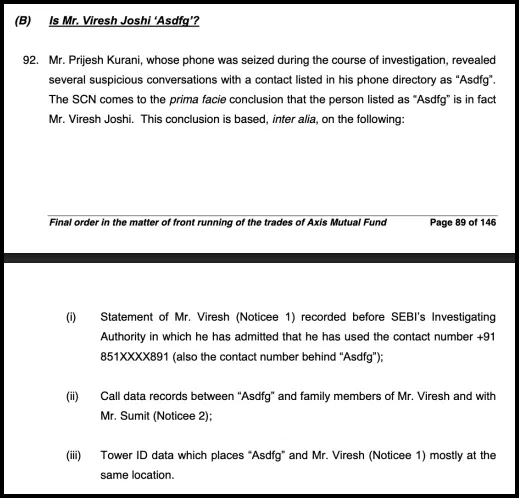
Kurani’s phone held a contact saved as Asdfg, the first five letters on a keyboard, chosen to mean nothing. It was a phone number, and Joshi admitted twice on oath that the number was his.
The call records showed that Asdfg spoke to Joshi’s brother, to Sumit Desai and to Prijesh Kurani, 28 calls totalling nearly five hours across the investigation period.
And when SEBI mapped where the phone was when it made those calls, the tower location came back to a single set of coordinates: Axis House, Worli, the fund’s own office.
On 37 separate dates, the Asdfg phone and Joshi’s declared personal number pinged the same tower. They mismatched on only four.
Joshi argued the number had been used on a device whose hardware ID did not match either phone seized from him.
SEBI traced the hardware IDs and found Asdfg had run on three different handsets in a single year, an Oppo and two iPhones.
Moving one SIM between burner phones is a standard move in financial fraud, and it did not help him.
Caught in Real Time: How SEBI Matched Viresh Joshi’s Trades?
The most damning evidence was not a code name at all. It was Joshi visibly setting up a trade in real time.
On 2 December 2021, Joshi was in a Bloomberg chat with a broker, negotiating a large block of Gland Pharma.
Over several minutes, he settled a price and a quantity, then typed “Wait 5 min more,” and finally “Go ahead.”
One of the front running accounts, in the name of Bhavin Shah, began buying Gland Pharma three seconds before Joshi typed “Go ahead,” at the exact quantity and price he had just negotiated.
Minutes later, Axis Mutual Fund’s own order went through, with that same front running account as the counterparty selling into it.
The pattern repeated on other stocks.
On ABB India, front running accounts bought where Joshi set the floor price and sold at the higher level he was simultaneously arranging for the fund.
He never disputed these facts.
How Device IDs and Dubai IP Addresses Exposed the Entire Network?
Then there is the forensic evidence, which is the reason the whole network went down together rather than one by one.
When SEBI examined the devices behind the trades, it found the same physical machine identifier appearing across accounts belonging to three supposedly unrelated families, the Kuranis, the Marfatia group and the Jajoo group.
One device was placing trades for all of them. A brokerage even captured the operator’s laptop names, which read “Prijesh” and “Bindesh.”
And the accounts of one Dubai entity, Visa Capital Partners, traded from the same Dubai internet addresses as Kurani’s family, despite there being no evidence any of the Indian account holders had ever set foot in Dubai.
Three families, one machine, one city.
The mule account structure was designed to make each strand look independent. The forensics showed they were all being pulled by the same hand.
Broken Email Addresses and Misdirection: Inside the Fake Whistleblower Plot
One detail shows how far the group went to protect the scheme, and it is worth telling because it backfired completely.
On 19 January 2022, an email landed in Joshi’s official Axis inbox, apparently from Bhavin Shah, accusing Joshi of misusing Shah’s account from a Dubai address.
On its face, it looked like a whistleblower blowing the lid off.
It was the opposite. Every regulator email address it was copied to was deliberately misspelled, “chairma.n” instead of “chairman,” so that not one of them would actually arrive.
The only correct address on the email was Joshi’s own. It was never meant to reach anyone. It was a warning shot, staged to look like a disclosure.
Joshi then, by his own admission, drafted a denial letter for Shah to send in response, and reused the same broken regulator addresses so that the “clarification” would also vanish into nowhere.
A genuine whistleblower complaint did reach SEBI that same day, from someone else.
That is what started the investigation.
Why SEBI Rejected Viresh Joshi’s Defence on Confessions and Live Orders?
Faced with the evidence, Joshi’s main defence was that his confessions had been extracted under duress. SEBI took the claim apart on its own logic.
He had signed each statement above a printed declaration that it was voluntary.
He first alleged coercion a full year after the last statement. His supporting police complaint carried a receiving stamp dated after the interim order, contradicting the date on the complaint itself, a gap he never explained.
And most tellingly, he claimed that his first statement, taken during a surprise raid at his home, was voluntary, while later statements taken calmly in an office were coerced.
SEBI pointed out the obvious: if pressure were the issue, a person is most vulnerable during an unannounced search, not months later in a meeting room. The claim was rejected.
His argument that the residual leg of a fund order is not really secret information failed too, and the reasoning matters for future cases.
SEBI held that as long as a fund’s large order is still being executed, the part not yet filled remains non-public information.
The wider market sees only what has traded.
The front runner knows what is still coming. An order stays live and exploitable until the last share is bought.
What Was SEBI’s Final Order Against Viresh Joshi and Axis Mutual Fund?
The directions went into effect immediately.
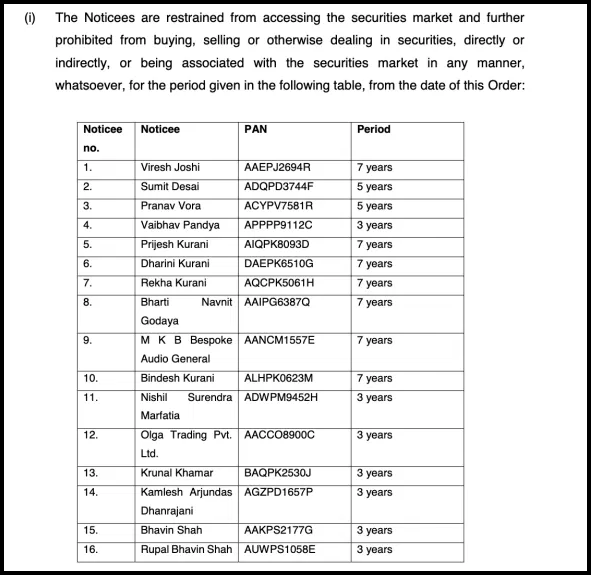
Market bans ranged from three to seven years, with Viresh Joshi, Prijesh Kurani, and the core Kurani family accounts receiving the maximum seven-year ban.
The arrangers, Sumit Desai and Pranav Vora, were barred for five years, while the remaining account holders and terminal lenders received three-year bans.
Because time already served under the 2023 interim order counts toward these bans, those in the three-year group have essentially served their time.
Financially, SEBI officially converted the ₹30.56 crore already impounded into a disgorgement penalty, transferring it to its Investor Protection and Education Fund along with a 12% annual interest charge starting from the end of the investigation period.
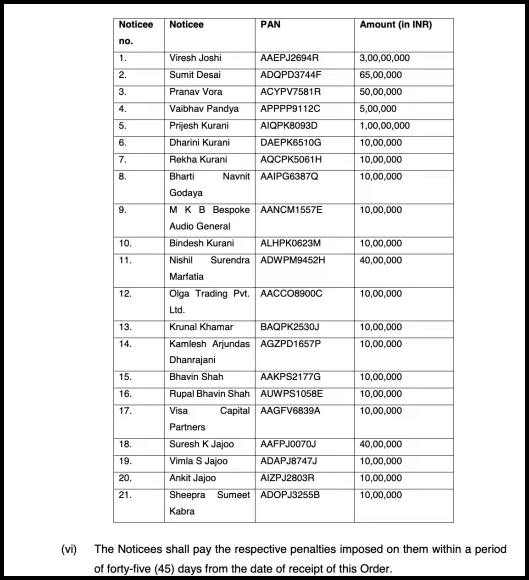
On top of that, SEBI imposed ₹7.40 crore in total penalties across 21 entities.
The heaviest fines landed on the main culprits, ₹3 crore on Joshi and ₹1 crore on Kurani, with significant fines also given to the arrangers and the two broker directors who handed over trading terminals.
SEBI noted that the brokers bore greater responsibility than typical account lenders, as a registered broker giving away access to its trading terminals directly violates the trust placed in them by regulatory rules.
Key Takeaways From the Axis Mutual Fund Front-Running Scandal
Two things are worth carrying away from this case.
The first is reassurance. A scheme built by professionals, using offshore execution, burner phones, code names, cash couriers and a shell company, still collapsed.
It collapsed because a machine identifier does not lie, a phone tower records where you stood, and a brother’s birthday message matches a KYC form.
The very tricks meant to hide the network, the code names Jadugar and Asdfg, became the threads that tied it together.
The second is a quieter warning about the accounts in the story.
Several people insisted they had only lent their demat accounts and knew nothing. SEBI did not accept it.
Under the rules, once you hand effective control of your account to someone else, especially with no proper authorisation on paper, you become part of whatever runs through it.
Lending your trading account to a friend with a clever scheme is not a favour.
It is a way to end up named in an order like this one.
Conclusion
SEBI’s final order in the Axis Mutual Fund matter closes a case that ran for more than three years, and it lands hard: bans of up to seven years, ₹30.56 crore disgorged with interest, and ₹7.40 crore in penalties across 21 parties.
Strip away the offshore detail, and it is a simple betrayal.
A man trusted to protect a fund’s trades sold them, and the cost came quietly out of the returns of more than a crore ordinary investors who never knew his name.
They know it now. So does every dealing desk in the country.
Report. Recover. Stay Fraud Free.
Frequently Asked Questions
As chief dealer at Axis Mutual Fund, Viresh Joshi had advance sight of the fund's large impending trades. SEBI found he leaked that information to a Dubai based operator, Prijesh Kurani, who traded ahead of the fund through a network of borrowed accounts, with the profits routed back to Joshi in cash and through a Dubai company.
SEBI quantified the unlawful gains at ₹30,55,89,668 across 1,083 trades between September 2021 and March 2022. It ordered that amount disgorged with 12 percent interest, and imposed additional penalties totalling ₹7.40 crore.
When a fund's large order is front run, someone captures the price movement the order creates, which is value that should have stayed with the fund. Since the fund's units are owned by ordinary investors, that skimmed value ultimately comes out of unitholders' returns, invisibly and one trade at a time.
Through four independent proofs, including a birthday message from Joshi's brother matching Joshi's KYC date of birth, flight records confirming Joshi's family flew to Dubai on a date discussed in the chats, statements from two associates naming him, and a video clip attributing a cover up letter to Jadugar.
Yes. SEBI held that lending effective control of your account to another person, particularly without proper written authorisation, makes you part of any manipulative scheme run through it. Several account holders in this case raised that defence and all were held liable.




 Add us as a preferred source on Google »

