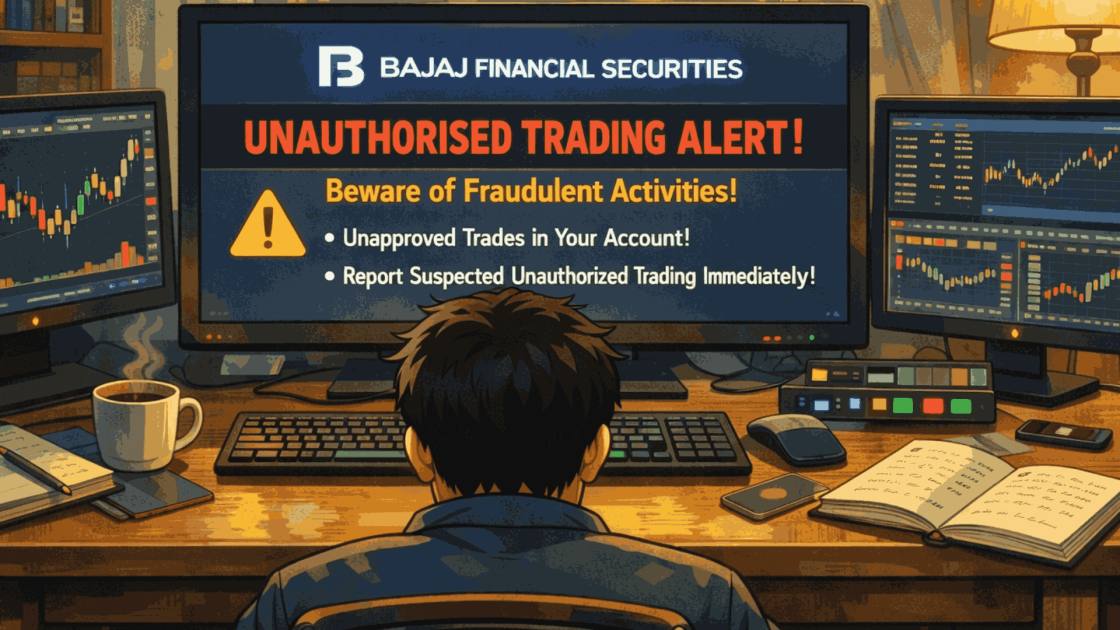
When investors search for “Bajaj Financial Securities unauthorised trading”, they are usually trying to understand whether traders have ever raised such concerns about the broker.
Questions like these often arise when investors come across complaint data published by stock exchanges or discussions from other traders.
Unauthorised trading occurs when a broker executes trades in an investor’s account without the investor’s approval or proper authorization.
SEBI requires brokers to maintain clear order records, trade confirmations, and communication logs that show how they placed each transaction.
To understand this issue better, it helps to look at the investor complaint data related to Bajaj Financial Securities and examine what it reveals about unauthorised trading concerns raised over the years.
Bajaj Financial Securities Unauthorised Trading Complaints
Bajaj Financial Securities Limited (BFSL) operates as the stock broking arm of the Bajaj Finserv group. The broker offers trading and investment services across equity, derivatives, currency, mutual funds, and IPOs.
Like other SEBI-registered brokers in India, Bajaj Financial Securities functions under the regulatory framework set by the exchanges and the Securities and Exchange Board of India (SEBI).
As the number of retail investors in the market has grown over the years, so have investor complaints recorded on exchange platforms.
These complaints can relate to several issues; delayed payouts, margin disputes, platform glitches, or concerns about trades executed in a client’s account.
One category that often attracts investors’ attention is unauthorized trading.
In simple terms, unauthorised trading occurs when a broker executes trades in a client’s account without the client’s consent or proper authorization.
Sometimes this happens when a dealer places trades without clear instructions. In other situations, disputes arise when investors believe a broker or relationship manager executed trades that they never approved.
To understand whether investors have raised such concerns in relation to Bajaj Financial Securities, it is helpful to examine the investor complaint data published by the National Stock Exchange (NSE).
| Financial Year | Total Complaints | Type IV (Unauthorised Trades) | % of Complaints Under Type IV |
|---|---|---|---|
| 2020–21 | 18 | 2 | 11.11% |
| 2021–22 | 26 | 2 | 7.69% |
| 2022–23 | 34 | 1 | 2.94% |
| 2023–24 | 48 | 2 | 4.17% |
| 2024–25 | 55 | 1 | 1.82% |
| 2025–26 | 67 | 2 | 2.99% |
In NSE’s complaint classification system, Type IV complaints generally involve disputes where investors claim that brokers executed trades without proper authorization.
Looking at the table, one trend becomes immediately visible. The total number of complaints has gradually increased over the years, rising from 18 complaints in 2020–21 to 67 complaints in 2025–26.
This increase does not necessarily mean misconduct. Often, it reflects the growth in the broker’s customer base or higher trading participation among retail investors.
However, when we focus specifically on Type IV complaints, the numbers remain relatively small. Across six years, only a handful of complaints fall into this category each year.
At first glance, the percentage may appear minor. In some years it remains below 5 percent of the total complaints recorded.
Because of this, many traders might quickly dismiss the numbers as insignificant.
But retail investors should be careful about overlooking small percentages in matters related to unauthorised trading.
Even a single unauthorised trade can expose an investor to substantial losses, especially in segments like derivatives where positions can be large and highly leveraged.
Unlike routine operational complaints, disputes related to trade authorization can directly affect the investor’s capital.
Another reason these complaints deserve attention is that many investors only discover questionable trades after reviewing their account statements or contract notes later.
By that time, the financial impact may already have occurred.
This is why regulators insist that brokers maintain detailed records of every order placed.
Impact of Complaint Data on Investors
Exchanges rely on these records to determine whether a trade was actually authorized by the client or executed without proper consent.
For retail traders, the takeaway is simple.
Investors should not treat complaint data as proof of wrongdoing, but they can use it as an indicator of the types of issues traders have raised in the past.
Paying attention to such patterns helps traders stay alert and monitor their own accounts more carefully.
In practice, investors can protect themselves by regularly checking order confirmations, trade alerts, contract notes, and account statements.
These records help traders quickly identify whether a trade appearing in their account matches the instructions they actually gave.
Understanding the complaint data in this context allows investors to look beyond just the percentages and focus on the broader question – how vigilant they should remain when monitoring activity in their trading accounts.
When Can Action Be Taken Against a Broker?
Unauthorised trading is taken seriously in the securities market. However, regulatory action does not happen automatically every time a complaint is filed.
Exchanges and regulators examine the facts carefully before deciding whether a broker has actually violated the rules.
In most cases, the key question regulators try to answer is simple: did the client authorize the trade or not?
To determine this, exchanges rely on different types of records that brokers are required to maintain.
1. Order Logs and Digital Records
For trades placed through online platforms, brokers must maintain internet order logs.
These logs record important details such as the time of the order, the system used, and other technical information linked to the transaction.
When a dispute arises, exchanges check these logs to confirm whether the client placed the order through the trading platform.
2. Call Recordings for Dealer-Assisted Trades
In many cases, investors place trades through dealers or relationship managers instead of directly using the trading platform.
In such situations, SEBI regulations require brokers to maintain recorded phone conversations where the client gives the trading instruction.
These recordings act as evidence that the order was actually authorized.
If a broker cannot produce call recordings in a dealer-assisted trade dispute, it may become difficult to prove that the client approved the transaction.
3. Contract Notes and Trade Confirmations
After every trade, brokers must send contract notes and confirmation messages to the client. These notifications usually reach investors through email or SMS.
Exchanges review these documents to verify that the client received timely information and that the trade details matched the client’s order.
4. Exchange Arbitration and Regulatory Action
If the evidence shows that the broker executed trades without proper authorization, the exchange may refer the dispute to arbitration.
During arbitration, an independent panel reviews the evidence submitted by both the investor and the broker.
f the panel concludes that the broker failed to follow the required safeguards, the exchange may direct the broker to provide compensation or face disciplinary action.
At the same time, it is also important to remember that not every complaint leads to regulatory penalties.
Some disputes arise because of misunderstandings related to order placement, margin trading, or overlooked trade confirmations.
This is why exchanges examine records carefully before determining whether unauthorised trading actually occurred.
How To File a Complaint Against a Stock Broker?
If an investor believes that trades were executed in their account without proper authorization, it is important to act quickly.
The securities market has a structured complaint mechanism that allows investors to raise concerns and seek resolution.
Most disputes related to unauthorised trading follow a step-by-step escalation process.
Step 1: Contact the Broker First
The first step is to raise the issue directly with the broker’s customer support or grievance redressal team.
Investors should clearly explain the problem and provide relevant details such as the trade date, order number, and contract note.
In many cases, brokers review their internal records to determine whether the client placed the order through the trading platform, a dealer, or another authorized channel.
Step 2: File a Complaint with the Stock Exchange
If the broker does not resolve the issue satisfactorily, the investor can file a complaint in NSE where the broker holds registration.
Both NSE and BSE provide investor grievance mechanisms where traders can submit complaints online.
At this stage, the exchange may ask the broker to provide supporting documents such as order logs, communication records, or call recordings.
Step 3: Escalate the Complaint Through SCORES
If the matter remains unresolved, investors can file a complaint with SEBI.
This system allows investors to register grievances against SEBI-regulated entities, including stock brokers.
Once a complaint is filed on SCORES, SEBI forwards it to the concerned broker and monitors the response process.
Step 4: Exchange Arbitration
When disputes still remain unresolved, the matter may move to arbitration with the relevant Stock Exchange.
In arbitration, an independent panel examines the evidence provided by both the investor and the broker.
If the panel finds that the broker failed to follow regulatory safeguards or executed trades without proper authorization, it may direct the broker to compensate the investor or impose other regulatory consequences.
Because the outcome of such cases often depends on documentation and evidence, investors should preserve important records such as contract notes, trade alerts, and communication with the broker.
Understanding this complaint process helps investors respond quickly if they ever notice suspicious activity in their trading accounts.
Need Help?
Unauthorised trading disputes can feel confusing, especially for investors who are not familiar with the complaint and arbitration process.
If you believe someone executed trades in your account without proper authorization, seek the right guidance to handle the process more easily.
Here is how support can help in such situations:
- Review trading records such as order logs, contract notes, trade confirmations, and account statements to understand how the broker executed the trades.
- Examine communication history between the investor and the broker, including emails, messages, or dealer calls, to identify whether clear authorization existed.
- Guide investors through the complaint process, including raising a grievance with the broker, approaching the stock exchange, and filing a complaint on the SEBI SCORES platform.
- Assist in preparing documentation required for exchange arbitration if the dispute escalates.
- Help investors understand their rights and the regulatory safeguards available in cases of suspected unauthorised trading.
- Monitoring the complaint status at SEBI.
If you are facing a similar issue and are unsure about the next steps, you can register with us for assistance. Our team can review your case and help you understand how to proceed with the complaint process.
Conclusion
Unauthorised trading complaints often raise serious concerns because investors claim that brokers executed trades in their accounts without their approval.
While the NSE data related to Bajaj Financial Securities shows that such complaints form a small percentage of total grievances, retail traders should still pay attention to them.
At the same time, complaint data alone does not prove wrongdoing.
Exchanges examine order logs, call recordings, and trade confirmations to determine whether a trade was unauthorised.
For investors, the key takeaway is simple: regularly review trade alerts, contract notes, and account statements.
When traders understand how the complaint process works, they can respond quickly if any unusual activity appears in their accounts.