
Quick Summary
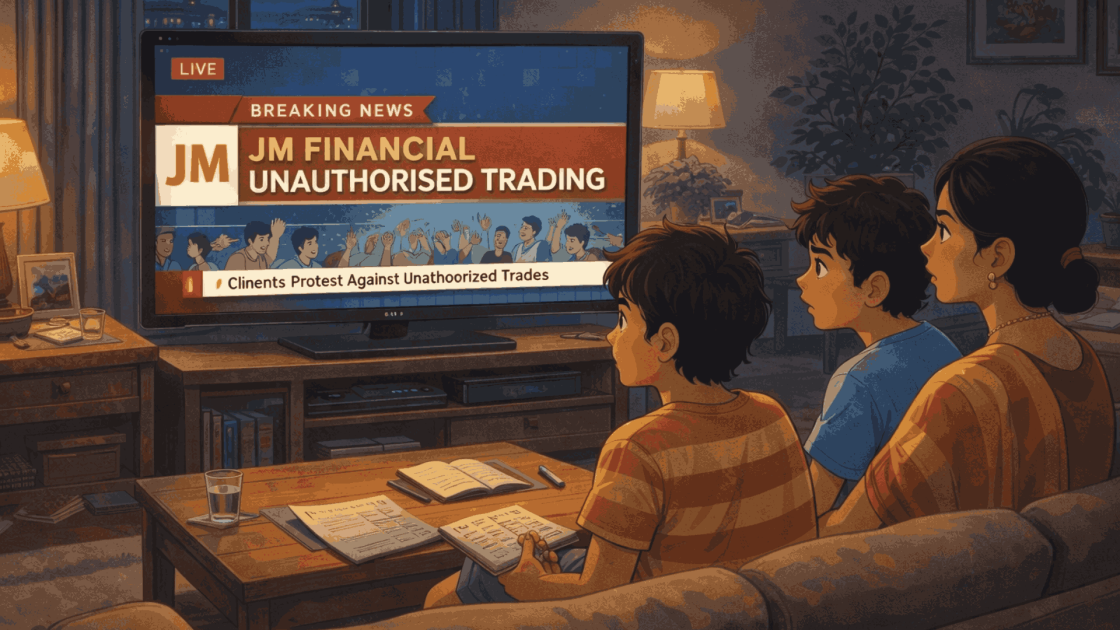
JM Financial unauthorised trading complaints, filed under NSE’s Type IV category, have grown from 2 to 33 a year since 2021-22, now roughly a quarter of all complaints against the broker. SEBI requires brokers to hold verifiable, timestamped proof of your instructions before placing any trade. A phone call alone does not qualify. This blog breaks down the yearly Type IV numbers, explains what counts as valid authorisation, and shows you what to collect before you file a JM Financial unauthorised trading complaint.
JM Financial unauthorised trading complaints have climbed from 2 cases in 2021-22 to 33 in 2025-26, and they now make up a bigger share of all complaints against the broker than they did five years ago.
If a trade shows up in your account that you never placed, that shift matters to you directly.
This blog uses NSE’s own complaint-type data for JM Financial Services Limited to show how big this problem actually is, what SEBI requires as proof of authorisation, and the exact evidence that makes or breaks a claim.
What Counts as JM Financial Unauthorised Trading?
Unauthorised trading is simple to define even when it is hard to prove.
It means a trade was executed in your account without your permission, or without a record the broker can produce if asked.
SEBI requires every broker to maintain verifiable proof of client instructions. That can be a recorded call, a written email, an authenticated online order, or a signed instruction.
A verbal conversation with no recording, or a WhatsApp message the broker cannot produce later, does not meet that bar on its own.
If your relationship manager says a trade was “discussed on call” but cannot produce the call recording with a timestamp, the burden of proof has not actually been met.
How Many JM Financial Unauthorised Trading Complaints Are There?
NSE’s own complaint records are public and broken down by broker and by complaint type every year.
Here is the exact Type IV trend for JM Financial Services Limited since 2021.
| Year | Total Complaints | Type IV (Unauthorised Trading) | % of Total |
|---|---|---|---|
| 2021-22 | 15 | 2 | 13.3% |
| 2022-23 | 14 | 1 | 7.1% |
| 2023-24 | 25 | 5 | 20.0% |
| 2024-25 | 130 | 27 | 20.8% |
| 2025-26 | 140 | 33 | 23.6% |
The share has nearly doubled, from 13.3% of all complaints in 2021-22 to 23.6% in 2025-26.
That means unauthorised trading is not a shrinking category as the broker’s overall complaint volume has grown. It is growing faster than the total.
2026-27 note: the current year’s data runs only through 31 August 2026 and shows 4 Type IV complaints out of 22 total so far, an 18.2% share. This is a partial-year figure.
What Evidence Do You Need for a JM Financial Trades Without Permission Claim?
Before you write your complaint, gather the specific documents that actually carry weight with SEBI and the exchange.
A vague complaint with no dates gets deprioritised. A specific one with a timeline gets taken seriously.
- Contract notes for the disputed trade: these show the exact time the order was placed and executed.
- Your own order history: log into your account and check whether the order shows as placed by you or through a dealer terminal.
- Any call recordings or written instructions you actually gave: even if they do not cover this specific trade, they establish your normal pattern of authorisation.
- The date you first noticed the trade: SEBI’s timelines run from when a dispute is raised, not from when the trade happened.
- Screenshots of your ledger before and after the trade: this shows the financial impact clearly.
Once you have these together, the goal is to show a clear gap between what you actually authorised and what the broker executed.
Found a trade in your JM Financial account you never placed?
Our team will review your contract notes and order history, map the exact authorisation gap, and draft a complaint built around the evidence SEBI actually looks for.
Has JM Financial Faced Arbitration Over a Disputed Trade?
Yes. In a case decided in October 2022, an NSE arbitrator ruled against JM Financial over a disputed close-out on a UPL put option, awarding the investor ₹1,47,065.
That case was not filed under Type IV specifically, but it shows the same underlying principle courts apply to unauthorised trading disputes too. A broker’s internal decision does not override what SEBI’s own rules require.
The full case details, including the arbitration matter number and the arbitrator’s reasoning, are covered on our JM Financial complaints page.
What Are the Red Flags of Unauthorised Trading in Your Account?
Most unauthorised trading by stock broker does not announce itself. It shows up as small, easy-to-miss patterns before it becomes a large loss.
Watch for these signs in your JM Financial account statements.
- Trades you do not recognise in your contract notes, even small ones, since these often precede larger unauthorised activity.
- F&O positions opening without a call or written confirmation from you.
- Your RM referencing a “standing instruction” you never actually gave in writing.
- Frequent trades that generate brokerage but do not match your stated investment goals. If this pattern feels familiar, our page on JM Financial excess charges explains how churning and unauthorised trading often overlap.
- A pattern of trades placed right before market volatility, when you were unlikely to be watching closely.
How Do You Report JM Financial Unauthorised Trading?
Once you have your evidence organised, act quickly. SEBI’s timelines for disputing a trade are shorter than most investors expect.
Start with a written complaint to JM Financial’s compliance officer, naming the exact trade, date, and the authorisation gap you found.
- If the broker’s response does not resolve things, escalate through the SEBI SCORES portal, attaching your evidence directly.
- Should that not resolve the matter, the SMART ODR login offers structured mediation as the next stage.
- If mediation still doesn’t settle things, share market arbitration is the final, binding step.
Our full walkthrough on SEBI complaint against broker covers the documents and language that gets a complaint taken seriously.
Conclusion
Unauthorised trading complaints against JM Financial have grown faster than the broker’s overall complaint volume for three straight years, and the share keeps climbing.
If a trade shows up in your account that you did not place, the burden of proof is on the broker, not on you, but only if you document the gap clearly and quickly.
Save your contract notes, check your order history for the disputed trade, and do not accept a verbal explanation as a substitute for a written one.
Report. Recover. Stay Fraud Free.
Frequently Asked Questions
Type IV complaints have grown from 2 in 2021-22 to 33 in 2025-26, now making up about a quarter of all complaints NSE records against the broker.
SEBI requires verifiable, timestamped proof of client instructions such as a recorded call, written email, or authenticated online order, not a verbal conversation alone.
Act within 15 days of noticing the trade where possible. Evidence such as call recordings and system logs can become harder to retrieve the longer you wait.
Not without a verifiable, timestamped record of that specific instruction. A phone call with no recording does not meet SEBI's documentation standard on its own.
Download the contract note for that trade immediately, check your order history, and send a written complaint to the broker's compliance officer the same week.



 Add us as a preferred source on Google »

