

Quick Summary
JM Financial complaints rose from 15 in 2021-22 to 140 in 2025-26 on NSE data, with service issues and unauthorised trading making up most cases. One 2022-23 arbitration case ended in a ₹1,47,065 award against the broker. App related grievances fall mostly under service complaints rather than a separate category. This blog breaks down the yearly numbers by complaint type, explains what counts as an unauthorised trade, and shows you the exact route to file your own JM Financial complaint.
JM Financial complaints on NSE’s own records have jumped from 15 in 2021-22 to 140 in 2025-26, a ninefold rise in five years.
If you already have an open case, you know how long that number can feel when nobody at the broker is answering you.
This blog uses the raw NSE Report 1A, 1B, and 1C data for JM Financial Services Limited, not a summarised version, to show exactly what investors are complaining about.
It also covers the JM Pro and Blink Trade app issues that used to have their own page here, one real arbitration award against the broker, and the escalation path that actually worked.
How Many JM Financial Complaints Has NSE Recorded Since 2021?
Before you file anything, it helps to see the actual trend instead of a single headline number.
NSE publishes this data broker by broker every year, and JM Financial Services Limited’s own record looks like this.
| Year | Active Clients | Complaints Received | % of Active Clients | Resolved | Arbitration Filed | Decided in Investor’s Favour |
|---|---|---|---|---|---|---|
| 2021-22 | 57,737 | 15 | 0.02% | 11 | 0 | 0 |
| 2022-23 | 64,332 | 14 | 0.02% | 10 | 1 | 1 |
| 2023-24 | 96,425 | 25 | 0.03% | 25 | 1 | 1 |
| 2024-25 | 1,21,619 | 130 | 0.11% | 130 | 0 | 0 |
| 2025-26 | 1,14,629 | 140 | 0.12% | 140 | 0 | 0 |
The client base grew roughly two times over this period. Complaints grew closer to nine times.
That gap is the number worth paying attention to, not the raw complaint count on its own.
A separate entity called JM Financial Securities Pvt. Ltd. shows up in the same filings with one complaint a year in some years.
That is a different legal entity from JM Financial Services Limited and is not included in the numbers above.
2026-27 note: the data for the current year only runs through 31 August 2026 and shows 22 complaints against 1,13,671 active clients so far, with 18 resolved and 4 pending.
This is a partial-year figure, not a full annual number.
What Types of JM Financial Complaints Do Investors File Most?
Every complaint gets sorted into a fixed set of categories, and knowing which one yours falls under changes how you should word your own complaint.
Here is what those categories mean, and how JM Financial’s complaints have split across them since 2021.
- Type I: Non-receipt or delay in payment
- Type II: Non-receipt or delay in securities
- Type III: Non-receipt of contract notes or account statements
- Type IV: Unauthorised trades or misappropriation
- Type V: Service-related complaints
- Type VI: Closing out or squaring up disputes
- Type VIII: Charges-related complaints
- Type IX: Others
| Year | Type I | Type II | Type III | Type IV | Type V | Type VI | Type VIII | Type IX | Total |
|---|---|---|---|---|---|---|---|---|---|
| 2021-22 | 1 | 0 | 0 | 2 | 4 | 0 | 0 | 8 | 15 |
| 2022-23 | 0 | 0 | 0 | 1 | 4 | 0 | 1 | 4 | 14 |
| 2023-24 | 1 | 0 | 0 | 5 | 13 | 0 | 0 | 6 | 25 |
| 2024-25 | 15 | 2 | 4 | 27 | 65 | 3 | 1 | 12 | 130 |
| 2025-26 | 3 | 2 | 5 | 33 | 71 | 2 | 0 | 24 | 140 |
*4 complaints in 2022-23 carry no type code in the exchange’s own record.
**2024-25 also includes 1 Type VII complaint, a portfolio management services dispute.
Two things stand out here. Service-related complaints, Type V, are consistently the largest single category every year.
JM Financial unauthorised trading complaints, Type IV, have grown from 2 to 33 over five years.
This is also the category JM Financial excess charges and churning disputes usually get folded into when they involve trades placed without your consent.
If your issue is about a charge you did not expect rather than a trade you did not authorise, Type VIII is the more accurate category to reference in your own complaint.
Is JM Financial App Not Working a Common Complaint?
JM Financial runs two retail apps, JM Pro and Blink Trade, on Android and iOS. Neither shows up as its own complaint category on NSE’s records, since technical glitches and app failures usually get logged under Type V, service-related, the closest fit in the fixed classification.
That said, real users have reported specific problems worth knowing about before you rely on either app during market hours. Here is what each one actually involved.
1. Market Depth Freezing and Stale Order Data
A user reviewing the app reported market depth freezing mid-session, meaning live bid and ask quotes stopped updating while a position was still open.
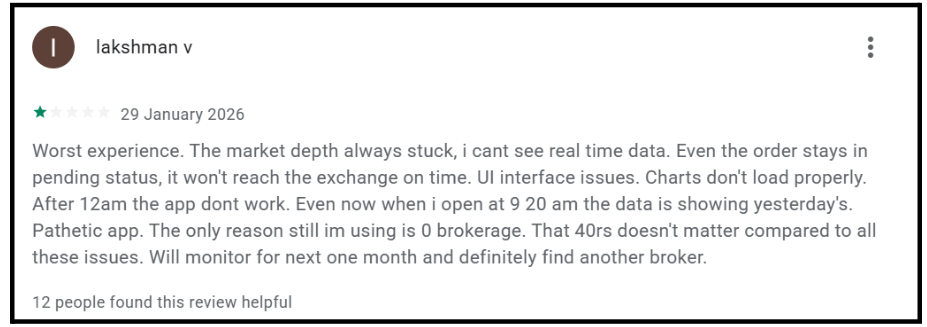
Real-time data failed to load, and orders placed during this window sat in pending status without actually reaching the exchange.
This is a serious gap for anyone trading intraday, since a stuck order gives no confirmation either way, leaving the investor unsure whether to place a fresh order and risk a duplicate, or wait and risk missing the move entirely.
The app reportedly carried this stale data forward into the next trading session after midnight, rather than refreshing on its own.
That means the problem did not resolve itself overnight, and a user opening the app the next morning could have seen outdated prices before placing a new trade.
2. A Security Warning Triggered by the JM Pro Install
A separate review from April 2026 flagged something more concerning than a performance glitch.
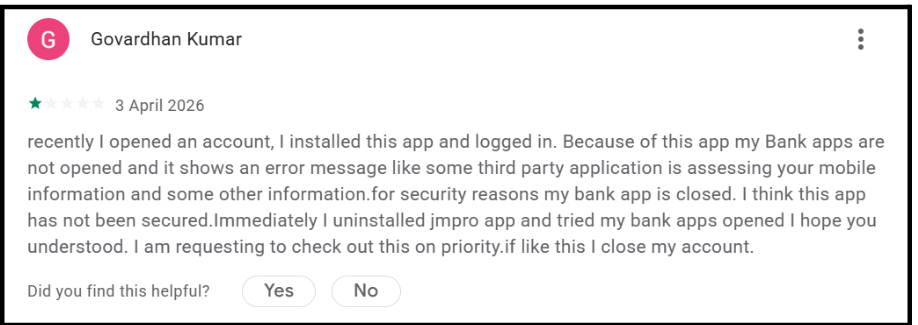
Installing JM Pro reportedly triggered a warning from the user’s own banking apps, citing a third-party application accessing device information.
This is a different category of problem entirely. A frozen screen costs you a trade.
A flagged permission on a trading app touches your financial data more broadly, especially since JM Pro would typically have access to personal and transaction details on the same device.
The user’s response was to uninstall JM Pro, after which the banking app warnings reportedly stopped.
That sequence, warning appears after install and disappears after uninstall, is the kind of detail worth noting if you use both a banking app and JM Pro on the same phone.
3. Repeated Downtime With No Fix After Follow-Up
A January 2026 review described a third kind of problem, plain unavailability during trading hours, and this one stood out for a different reason.
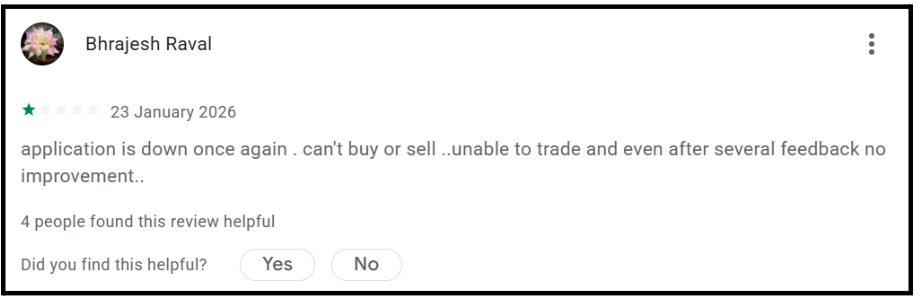
It was not a one-time outage.
The reviewer described raising the issue with the broker more than once and getting no visible resolution after multiple rounds of feedback.
For an investor, repeated downtime during market hours is not just an inconvenience; it is a window where you cannot exit or adjust a position no matter how urgently you need to.
4. Support That Went Silent on a Ledger Dispute
A March 2025 review, from an investor who had used Blink Trade under its earlier name JMFS First, described a different failure altogether, not the app itself, but what happened after something went wrong on it.
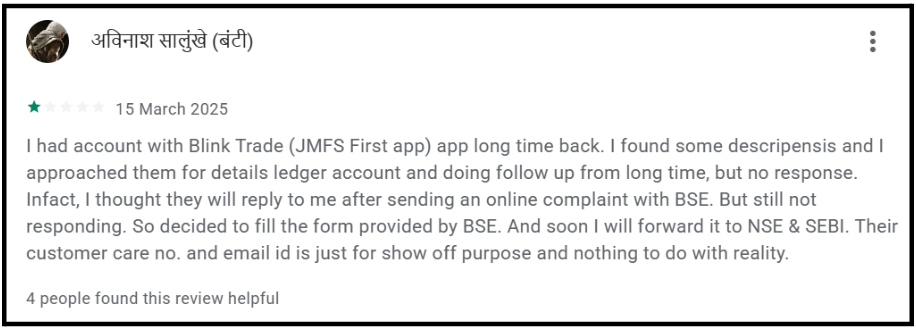
The user reported ledger discrepancies and raised them with JM Financial multiple times. According to the review, none of those attempts got a response.
The investor then escalated by filing a formal complaint directly with BSE. Even that, according to the review, went unanswered.
This is the pattern worth flagging separately from the technical issues above, a broker not responding internally is one problem, but an unresolved complaint at the exchange level is a step further, since BSE’s own grievance process exists specifically to force a response when the broker will not give one.
No major news coverage or viral social posts about JM Financial app outages have surfaced in the last two to three years beyond these individual reviews, so this is not the kind of large-scale, well-documented pattern seen with some other brokers.
SEBI does require brokers to report any major technical glitch to the exchange within two hours and to maintain a backup disaster recovery site in a different city.
If the app fails you during a live session and causes a loss, that failure is still reportable on the same terms as any other service complaint.
JM Financial Arbitration Case
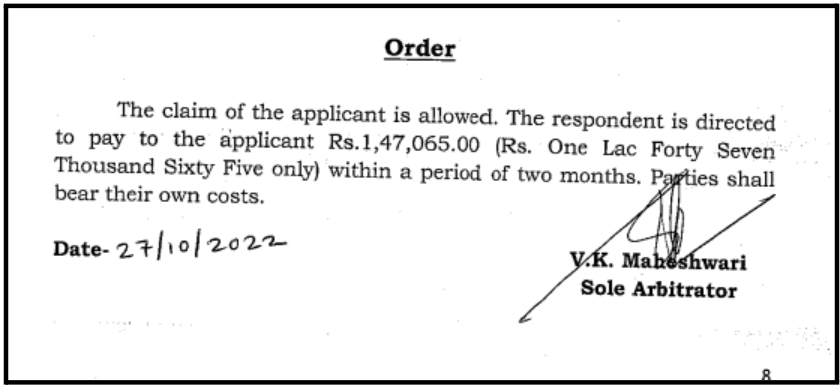
According to Arbitration Matter No. NSEDRO/0000671/22-23/ISC/IGRP/ARB, decided on October 27, 2022, Sole Arbitrator V.K. Maheshwari directed JM Financial Services Limited to pay ₹1,47,065 to an investor within two months.
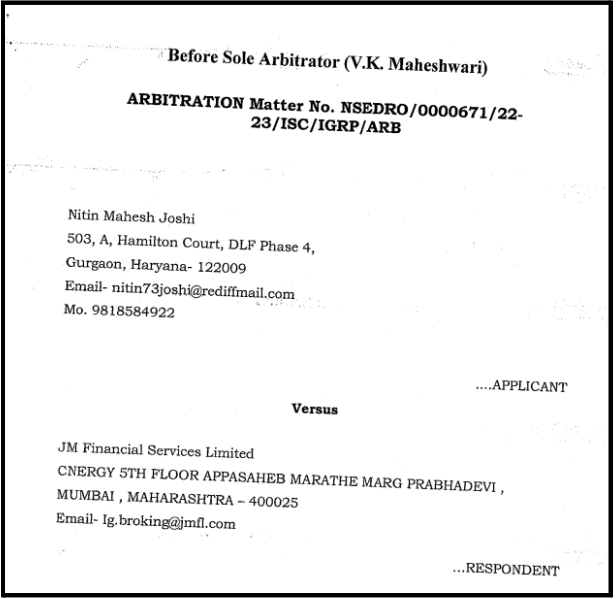
Case Background
The applicant, Nitin Joshi, purchased 1,300 shares of UPL through a Put Option at a strike price of ₹720 per share, paying a premium of ₹7,750.
When the shares could not be delivered due to an “internal shortage” at the broker’s end, JM Financial closed out the transaction at an auction price of ₹665.45 per share (plus an additional 3%).
The applicant argued that the settlement price should be calculated at 20% above the closing price as per SEBI’s 1996 circular, not the broker’s internal policy.
Penalty/Award
The Arbitrator ruled in favor of the applicant. JM Financial Services Ltd. was directed to pay ₹1,47,065 within two months.
Lessons for Investors
- A broker’s internal policy cannot override SEBI circulars when determining close-out prices.
- If a delivery fails due to the broker’s internal shortage (not your fault), you may be entitled to a higher settlement price (e.g., 20% above the closing price).
- Do not accept a broker’s explanation at face value; verify the applicable SEBI guidelines yourself.
- Changing your claimed loss amount during negotiations does not automatically invalidate your arbitration case.
- Arbitration awards from other cases are not binding, but SEBI circulars and higher court judgments carry legal weight.
These actions are not isolated incidents. Taken together, they reveal a pattern of governance failures across multiple entities within the JM Financial Group, in fund management, investment banking, broking, and pricing practices.
When Should You Take Action Against JM Financial?
Not every rough patch with a broker needs a formal complaint. But certain situations should not wait.
Here are the specific triggers worth acting on immediately rather than waiting to see if the problem resolves itself.
- Trades you never approved: if a position appears in your account that you did not authorise in writing, evidence gets harder to retrieve the longer you wait.
- A close out price that looks off: as the arbitration case above shows, brokers do not always apply the correct SEBI formula on their own.
- Charges you cannot match to a contract note: every deduction on your ledger deserves a specific written explanation, not a general one.
- An RM who stops responding after your account is funded: this is a pattern worth documenting from the first missed call, not the fifth. Our page on JM Financial account handling covers exactly what counts as a violation here.
- An app failure during a live position: save the screenshot and timestamp immediately, since this evidence disappears fast.
How Do You File a Complaint Against JM Financial?
Once you have your evidence together, the escalation path is fixed by SEBI and the exchanges, not by the broker.
Start with a written complaint to JM Financial’s compliance officer, not your relationship manager, and keep a dated copy of everything you send.
If the broker does not resolve things on its own, here is the exact sequence to follow next.
- File through the SEBI SCORES portal, with your evidence attached, once the broker’s own response is unsatisfactory.
- Track and respond through your SMART ODR login if the dispute moves to online conciliation or mediation.
- Move to arbitration in stock market if the dispute is still not resolved after that, the step that produced the ₹1,47,065 award covered above.
If you want to know the full process end to end, check our guide on SEBI complaint against broker.
Conclusion
JM Financial’s complaint numbers have grown faster than its client base for five straight years, and the data behind that trend is now public and traceable.
Whether your issue is a trade you never placed, a charge you cannot explain, or an app that failed you at the wrong moment, there is a documented path that has already worked for at least one investor in a decided arbitration case.
Keep your evidence dated, know which complaint category your issue actually falls under, and do not wait for the broker to fix it on its own.
Report. Recover. Stay Fraud Free.
Across 2021-22 through 2025-26, records show 324 complaints against JM Financial Services Limited, rising from 15 to 140 a year over that period. Service related complaints, Type V, form the largest category every year on record, followed by unauthorised trading complaints under Type IV. Yes. In a 2022-23 case, an arbitrator directed JM Financial to pay ₹1,47,065 to an investor after a disputed close out price on a UPL put option. Individual reviews describe freezing, stale data and one security concern with JM Pro, but there is no separate complaint category for app issues and no large scale news coverage of outages in the last two to three years. Start in writing with JM Financial's compliance officer, then escalate to SCORES if you do not get a satisfactory response within the broker's stated timeline.Frequently Asked Questions



 Add us as a preferred source on Google »

