

Quick Summary
Aditya Birla Money complaints rose from 39 in 2022-23 to 81 in 2025-26 on NSE data, while active clients fell from 97,953 to 68,189 in the last year alone. Unauthorised trading is the fastest growing type, up from 11 to 28 complaints. SEBI also fined the broker ₹1.02 crore. Fourteen dated client reviews describe payout shortfalls, charge disputes and trades clients never placed. This guide covers the yearly numbers, excess brokerage, a summary of the SEBI order and the steps to report a problem.
Picture this: your ₹3 lakh payout request is processed, but only ₹2.93 lakh reaches your bank. You call customer care, and they say you drew from a “spare balance.”
Your money is short, the explanation makes no sense, and nobody is solving anything. This is a real Aditya Birla Money complaint, posted as a Google Play review in December 2025.
It is not the only one. SEBI’s inspection findings, exchange data, and a ₹1.02 crore penalty order all point to a pattern.
That raises a question many investors hesitate to ask: can a stockbroker steal your money, or do such cases come from deeper problems in how brokers operate?
If you know your rights and follow the correct steps, your chances of recovery improve a lot.
Aditya Birla Money Limited
Aditya Birla Money Limited (ABML) is the financial services arm of the Aditya Birla Capital Group.
It was incorporated in 1995 and is listed on both BSE and NSE. Three SEBI registrations define what it does.
- Stock Broker: SEBI Registration No. INZ000172636, with memberships across NSE, BSE, MCX and NCDEX. This is the capacity in which most retail clients deal with ABML.
- Research Analyst (RA): Registration No. INH000002145. ABML also holds an Investment Adviser registration under INA000009214.
- Portfolio Management Services (PMS): Registration No. INP000003757, offered to eligible clients above the minimum portfolio thresholds SEBI prescribes.
How Many Aditya Birla Money Complaints Does NSE Record?
NSE publishes investor complaint data broker by broker every year. We pulled the Aditya Birla Money rows from those reports.
Each row below is one financial year, running April to March. It shows how many active clients the broker had, how many complaints came in, and how many were closed by year-end.
The percentage column is the number that matters most.
It tells you how often a client files a complaint, regardless of how big the broker is.
| Year | Active Clients | Complaints | % of Clients | Resolved | % Resolved | Pending or Arbitration |
|---|---|---|---|---|---|---|
| 2021-22 | 68,292 | 58 | 0.085% | 52 | 89.7% | 6 |
| 2022-23 | 65,993 | 39 | 0.059% | 38 | 97.4% | 1 |
| 2023-24 | 80,479 | 47 | 0.058% | 46 | 97.9% | 1 |
| 2024-25 | 97,953 | 65 | 0.066% | 65 | 100% | 0 |
| 2025-26 | 68,189 | 81 | 0.119% | 81 | 100% | 0 |
The 2022-23 arbitration was filed on 24 November 2022.
For 2026-27, NSE’s data so far covers 28 complaints, with 15 resolved and 13 still open.
That is a partial year, so I would not read a trend into it yet.
At first glance, the numbers look contained. They are not, and the next three sections show why.
Are Complaints Rising While the Client Base Shrinks?
Yes. Active clients dropped from 97,953 in 2024-25 to 68,189 in 2025-26, a decline of about 30%.
Over the same year, complaints rose from 65 to 81.
A smaller client base generating more complaints is an unfavourable signal for any investor weighing this broker. The rate per client is now about twice its 2022-23 level.
Are Complaints Getting Resolved?
On NSE’s year-end data, almost all of them are. Resolution was between 97% and 100% in the last four full years.
That is good for the clients concerned. It also means the issues keep appearing even though they eventually get closed.
The rise in complaint percentage, despite high resolution, suggests the underlying causes are still there.
Which Types of Aditya Birla Money Complaints Are Rising?
NSE sorts every complaint into a fixed type, and the type tells you where a problem sits.
Type I is delay in payment, and Type II is delay in securities.
Type IV is unauthorised trading, Type V is service-related, and Type IX is others.
| Year | Type I | Type IV | Type V | Type IX | Other or Untyped | Total |
|---|---|---|---|---|---|---|
| 2021-22 | 7 | 11 | 20 | 20 | 0 | 58 |
| 2022-23 | 2 | 11 | 7 | 8 | 11 | 39 |
| 2023-24 | 5 | 11 | 26 | 5 | 0 | 47 |
| 2024-25 | 5 | 18 | 23 | 13 | 6 | 65 |
| 2025-26 | 6 | 28 | 27 | 17 | 3 | 81 |
In 2024-25, the six “other” cases are 3 Type VI and 3 Type VIII. In 2025-26, they are 2 Type II and 1 Type VII. In 2022-23, 11 complaints carry no type code in NSE’s own record.
Type IV went from 11 to 28 in three years. It is now 35% of all complaints, up from 28% in 2024-25.
The Investor Grievance Redressal Committee (IGRC) at NSE and BSE is the first formal hearing beyond the broker.
Is Unauthorised Trading the Real Problem at Aditya Birla Money?
On the numbers, it is the category growing fastest. It is also the one where the broker has the most to prove.
A trade you did not place is the broker’s burden to explain. It needs a recorded instruction, a logged order, or a signed mandate.
A phone call with no recording does not meet that standard.
If this is your problem, our page on unauthorised trading in India explains what counts as proof and what to collect first.
Aditya Birla Money Excess Charges
No. NSE has no separate excess charges category, so any figure that claims to count them is an estimate.
Excess brokerage, wrong charges, and similar disputes get filed under Type V, service-related. The 27 Type V cases in 2025-26 are the nearest official count.
Type VIII exists too, but NSE defines it as IPO related. It should not be read as a charges category.
That is why this page has no “around X” excess-charges table. Only the type totals above come from NSE.
SEBI’s own order did find late pay-in fees on F&O positions charged without documented consent. That is a charges dispute in its own right.
What Does Brokerage Churning Look Like?
When a broker buys and sells stocks in your account excessively, the aim is not to grow your wealth. It is to earn more commission at your expense.
This is what we formally call churning in share market.
Every trade costs you brokerage, GST, STT and exchange fees, whether or not it makes money.
Compare those costs across a quarter against your net result. If fees eat most of your gains, that ratio is your evidence.
What Did SEBI Find Against Aditya Birla Money?
SEBI Adjudication Order No. Order/KS/AE/2021-22/13679 imposed a total penalty of ₹1.02 crore on ABML. It followed inspections by SEBI, the stock exchanges and the depositories.
The findings included trades executed without prior client approval, PMS offered without a written agreement, and misleading profit and loss statements.
SEBI also found late pay-in fees charged without consent and inactive client funds left unsettled.
The penalty came under Section 15HA (₹75 lakh), Section 15HB (₹25 lakh) and Section 23D of the SCRA (₹2 lakh).
ABML had 45 days from the order to pay, and SEBI noted that some violations were repetitive.
It shows how trading authority can be misused when controls are weak. Review your trades, statements, and charges regularly.
We have broken down every violation, with what each one means for a client, in our guide: Aditya Birla Money review.
Aditya Birla Money User Reviews
User reviews highlight recurring concerns about fund handling, platform reliability, and customer support.
So what are clients actually writing about? We went through fourteen reviews, each one shown with its screenshot.
1. Ravikumar G, 25 December 2025: Payout Shortfall and Unexplained Deduction
He opted for a payout of ₹3,00,000. Only about ₹2,93,000 reached his bank, a shortfall of roughly ₹6,000.
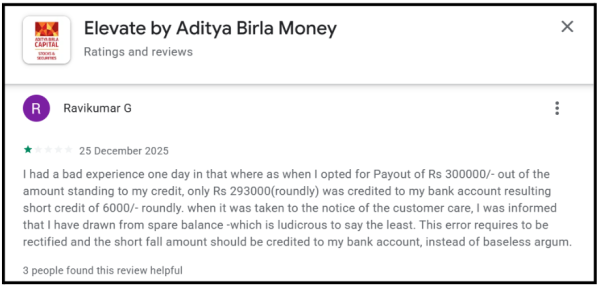
When he raised it, customer care said he had drawn from a “spare balance.”
He calls that explanation baseless and wants the amount credited.
An unexplained fund deduction is among the most serious Aditya Birla Money complaints, as it affects capital directly. Ask for the ledger entry behind every deduction.
2. Manoj Kumar, 7 April 2026: A Trade He Never Executed
His review is short. A trade he says he did not execute is reflected in his account.
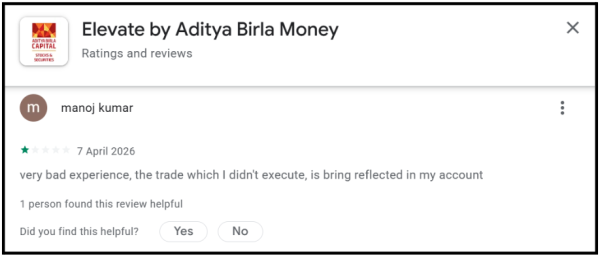
This is the kind of alleged unauthorised trade that SEBI’s inspection highlighted in its adjudication order.
Check the order history first.
It shows whether the order came from his own login or from a dealer terminal.
3. Raja Sudhakar, 10 December 2025: Stocks He Cannot Sell
Four months earlier, he bought stocks worth ₹5,000. He says he still cannot sell them.
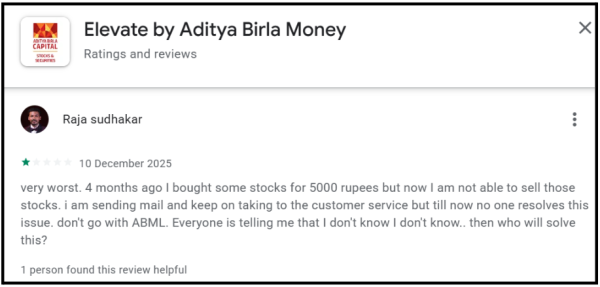
Despite repeated emails and calls to customer service, he says nothing has been resolved.
The replies, he says, amount to “I don’t know.”
The amount is small, but the pattern is not. A four-month sell block is a service failure, and every dated email is evidence.
4. Vasant G Patel, 30 January 2026: High Charges and an Unkept Promise
He calls delivery brokerage of half a percent very high and says MTF interest is high too. He also reports no branch support.
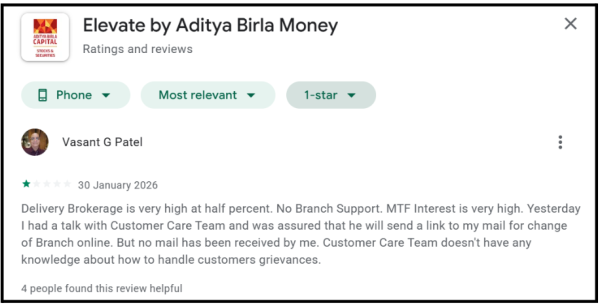
Customer care promised to email a link to change his branch online, but he says it never arrived.
Check the rate on your own contract note against what you agreed.
Save the promise too, since a documented broken promise carries weight with regulators.
5. Chetan Prakash Sancheti, 17 May 2025: Login, OTP and Cash Out Trouble
He calls it a poor app, with login and OTP issues. He says he cannot see the portfolio properly.
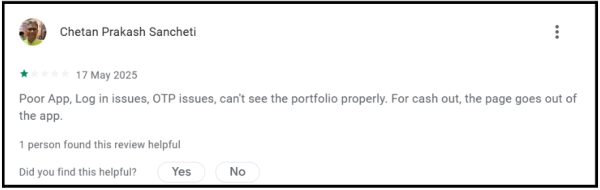
When he tries to cash out, he says the page goes out of the app.
If a cash out fails, screenshot the screen with the time on it. Then note the request against your ledger, so you can show whether the money moved.
If the app keeps failing you during market hours, our guide on Aditya Birla Money app not working covers those failures separately.
6. SN Singh, 6 October 2025: Figures That Do Not Match
He says the app is not giving proper figures during trading time and is not available after trading hours.
He says the data does not match the actuals and calls it misleading.
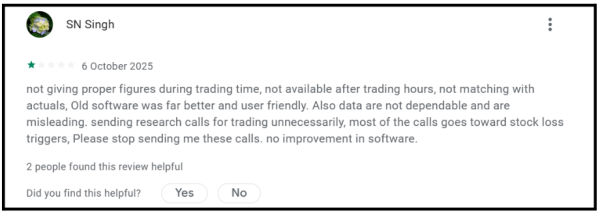
He also says the old software was far better, and that the research calls he receives mostly go toward stop-loss triggers.
If you act on a figure that later proves wrong, save a screenshot with the timestamp.
If calls are pushing you to trade, ask in writing who is calling and under which registration.
7. Vaibhav Goel, 25 December 2025: A Withdrawal That Took 15 Tries
He calls the app very buggy. He says withdrawing his money took about 15 tries over around 2 months.
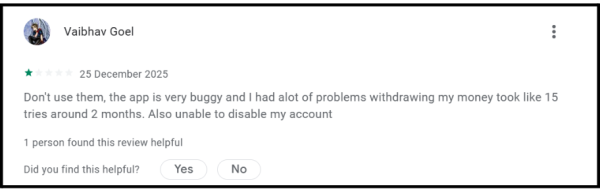
He also says he was unable to disable his account.
If you retry a withdrawal many times, keep a log with dates and the reference of each attempt.
That log is your evidence of how long it really took.
8. Amarendu Bharat, 4 November 2025: A Mutual Fund He Cannot Redeem
He says he cannot redeem his mutual fund despite trying many times.
He adds that it seems to him to be a fraudulent application, because new money is welcome but he cannot withdraw.
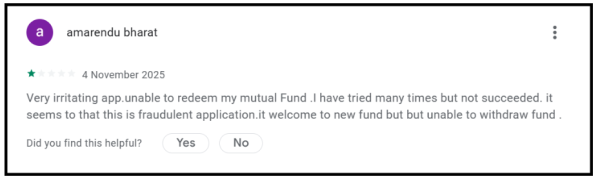
That is his own view, not a finding. What matters for a complaint is the facts: the redemption order, its date and its status.
Note the reference number of each redemption attempt, and write to the broker with them.
9. R J, 19 July 2025: An Account That Will Not Open
His review is one line. He says that even after the journey is completed online, his user ID shows as invalid.
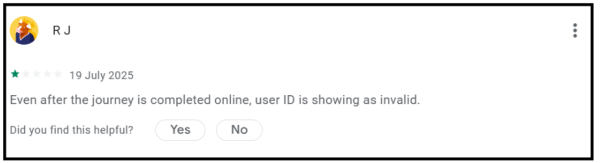
Account opening is where a client can lose days before trading anything.
Keep your application reference and the invalid-ID screen, and write to the broker with both.
The next five reviews are older and come from a review site. Each carries the date it was posted.
10. Tripti, 8 June 2022: Wrong Paperwork at Account Opening
She says staff gave wrong information when she opened her account, including a wrong POA format. She says she lost a month of trading and suffered losses.
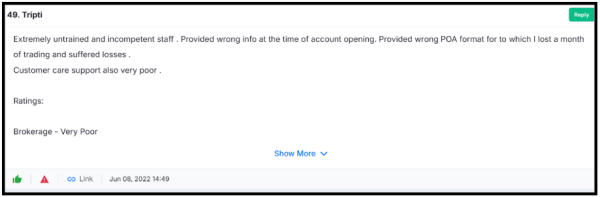
She also calls customer care very poor and rates brokerage Very Poor. Part of her review is cut off in the screenshot.
Keep the account-opening paperwork and date it. A complaint should name the exact document that was wrong.
11. Rohit, 19 May 2023: Passed Between Departments
He says he has been stuck with the service for 5 years.
He says customer service staff have no knowledge, and that calls are transferred between the security and equity departments.
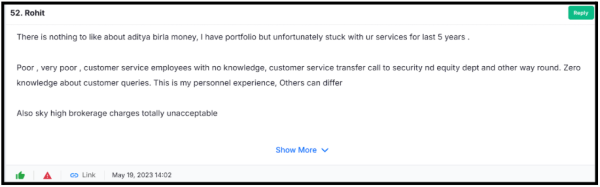
He also calls the brokerage charges sky-high. He adds that this is his personal experience and others can differ.
Note the date and time of each call and who you spoke to. A written complaint beats a phone call that gets transferred.
12. R. Pathak, 9 October 2023: Charges With No Clear Rate
He says charges vary from ₹20 per trade to 0.5% to 2.5%, and that repeated emails got no clarity.
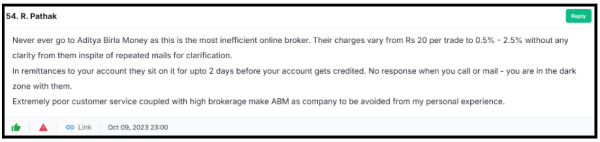
He also says remittances take up to 2 days to be credited, and that there is no response when he calls or mails.
Ask in writing for the brokerage schedule that applies to your account. Compare it with each contract note.
13. Raja, 19 August 2016: High “Other Charges”
He says the broker charged high brokerage in the form of “other charges”. He bought stocks worth ₹61 and says the total to be paid stood at ₹118.
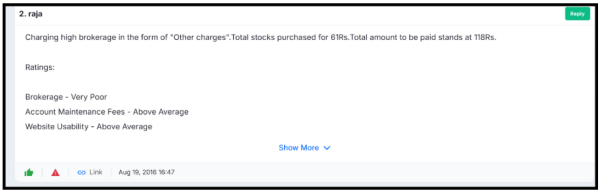
He rated brokerage Very Poor, but account maintenance fees and website usability Above Average. Part of his review is cut off.
This review is a decade old, so it shows how long charge concerns have been raised.
It says little about today’s rates.
14. Vijay K Roy, 27 November 2016: Misleading Advertisement
His review is brief. He says the broker is giving a misleading advertisement.
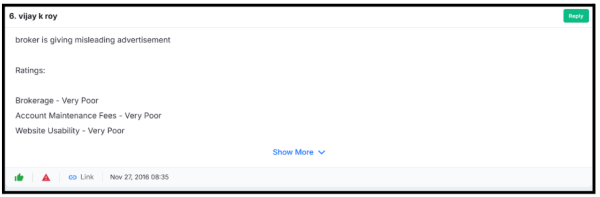
He rated brokerage, account maintenance fees, and website usability all Very Poor. Part of his review is cut off.
Like the one above, it is ten years old.
Read it as history, and check any offer against what you are actually charged.
When Should You Take Action Against a Financial Service Provider?
If something feels off in your account, act immediately and document everything. Most issues escalate quietly if you wait.
Know who you are dealing with first. RAs can only provide advice, not execute trades or manage funds.
PMS providers must operate under a formal agreement before handling any portfolio.
If your portfolio manager has made discretionary trades or charged fees without documentation, learning how to file a complaint against portfolio managers online is the first step.
The regulatory boundaries to keep in mind:
- RAs cannot execute trades or accept funds for trading purposes.
- RAs cannot guarantee returns or go beyond SEBI’s fee limits.
- PMS without a signed agreement is a direct regulatory violation.
Brokers handle your trades and funds directly, so any discrepancy is financially immediate.
Act when you see any of these:
- Frequent buying and selling without a clear strategy or your consent.
- Charges or fees higher than what was agreed or expected.
- Unauthorised trades or changes in your portfolio need a written complaint within 24 hours.
- A fund shortfall after a payout request must be raised formally the same day.
- Margin (MTF or F&O) positions without consent shift the burden of proof to the broker.
- An app failure that stops you from exiting a trade is a valid, documentable grievance.
- A P&L mismatch with the ledger suggests misreporting and must not be ignored.
- Delayed or unsatisfactory responses to your complaints.
Another key moment is when communication turns unclear, or your concerns are repeatedly overlooked. A lack of transparency often signals deeper issues.
If customer care does not resolve the matter within 30 days, escalate formally through SEBI or the exchange.
Delays weaken your position, so act with records, not assumptions.
How To File a Complaint Against Aditya Birla Money?
If you relate to people who feel personally hurt by churning or a fund shortfall, it is not too late.
Acting quickly with proper documentation improves your chances of resolution and recovery.
Here is how a complaint to SEBI against stock broker is built, step by step:
Step 1: Collect Proof
Take screenshots, save transaction details, record all calls from the broker, and save your contract notes.
A comprehensive record makes your complaint verifiable. It also helps authorities review the issue faster and act on clear evidence.
Step 2: Write to Aditya Birla Money Directly
Send your complaint by email, with your client ID, the trade or transaction date, the disputed amount, and the resolution you want.
The broker must respond within 30 days. Clear evidence also makes a quick, satisfactory reply more likely.
If the response is unsatisfactory or absent, go to the next step.
Step 3: File a Complaint in SCORES
If the broker does not resolve the issue within a reasonable time, raise it with SEBI. Our guide to SEBI complaint SCORES shows each field.
SCORES makes your complaint official, and the broker has to reply on the record.
You can also track the SEBI complaint status online throughout.
That paper trail lets the regulator monitor the resolution and act if needed.
Step 4: Report the Complaint to the Exchange
If you are not satisfied with the broker’s reply, escalate to the exchange’s investor grievance cell.
The exchange reviews it and may guide it toward further dispute resolution.
You can follow a case on the BSE complaint status page if the broker is also a BSE member.
Keep your records in order, because they decide how well you present the case at this stage.
Step 5: File in SMART ODR
If the matter becomes a formal dispute, this is how to file complaint in SMART ODR, the online dispute resolution platform.
It gives your concerns a structured, transparent route when earlier attempts have not worked.
An independent arbitrator can then review your case and the evidence from both sides.
Step 6: Go to Arbitration
If it is still unresolved, you can proceed with arbitration in stock market disputes through the relevant exchange.
An independent arbitrator examines the case and the evidence submitted by both sides.
Based on that review, the arbitrator issues a final, binding decision. NSE records one arbitration filed against ABML in 2022-23.
Have an unresolved complaint against Aditya Birla Money, or against any other broker?
Our team will review your ledger and contract notes, then file the complaint at the right place, from the broker to SCORES to SMART ODR.
Register with us for a free consultation.
Conclusion
Aditya Birla Money Limited is a SEBI-registered stock broker (INZ000172636), Research Analyst (INH000002145) and portfolio manager (INP000003757), with over two decades of market presence under Aditya Birla Capital.
Legitimacy and reliability are not the same thing.
The data demands attention. Complaints have doubled in three years, Type IV unauthorised trading has risen from 11 to 28, and the complaint rate per client has doubled, even as active clients fell by about 30%.
SEBI’s order found unauthorised trading, misleading profit statements, PMS without mandatory agreements, and unsettled inactive client funds.
Most complaints do get resolved, but the recurring issues show the need for clearer pricing and stronger oversight.
Document everything, review your statements regularly, question any unusual trade or charge, and know where to escalate if your money is at risk.
Report. Recover. Stay Fraud Free.
NSE shows 58 in 2021-22, 39 in 2022-23, 47 in 2023-24, 65 in 2024-25 and 81 in 2025-26. That is the highest in five years. No. Excess brokerage disputes are filed under Type V, service related. Type VIII is IPO related, not charges. SEBI imposed a total of ₹1.02 crore: ₹75 lakh under Section 15HA, ₹25 lakh under Section 15HB and ₹2 lakh under Section 23D of the SCRA. Download the contract note, check the order history and write to the broker with the exact trade and date. Escalate to SCORES if the reply is unsatisfactory. Allow up to about 30 days for a written reply. If it is late or unclear, move to SCORES with your evidence attached.Frequently Asked Questions



 Add us as a preferred source on Google »

