

Quick Summary
Aditya Birla Money review: SEBI’s October 2021 order imposed a ₹1.02 crore penalty after finding ten violations, including unauthorised trading, misleading profit statements and client securities moved to the firm’s own accounts. NSE records 81 complaints in 2025-26 against 68,189 active clients, and unauthorised trading is its fastest growing type. Fourteen dated client reviews describe payout delays, unclear charges and app trouble, each with its date. This guide explains the order in plain words and what to check before you open an account.
Ever signed up with a broker just because you trusted the big brand name on the door?
Behind that famous Aditya Birla label, SEBI’s inspectors found a very different story when they opened the books.
From surprise charges to serious regulatory penalties, big names don’t always mean safe trades.
Let’s break down what’s really happening behind the scenes and what real clients are experiencing today.
Aditya Birla Money Limited
Aditya Birla Money Limited is a stockbroking and wealth management firm under the Aditya Birla Capital umbrella.
It has been operating since 1995. It offers trading in equities, derivatives, commodities, and mutual funds, and it is registered with SEBI as a full-service broker.
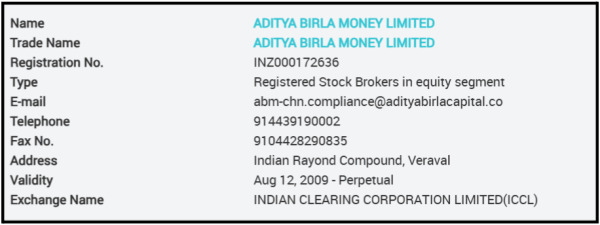
According to its official website, it serves over 6 lakh clients across India and provides comprehensive financial solutions.
NSE’s own active-client figure for 2025-26 is 68,189. The two numbers count different things, so do not compare them directly.
It works as a traditional full-service brokerage house, with both online and offline trading services. Clients reach it through a digital platform and a physical branch network.
Key services include:
- Trading platforms: the Elevate mobile app, a web-based trading terminal, and offline branch access, for equity, derivatives, commodities, currency, and mutual fund investments.
- Advisory services: research reports, market insights, portfolio management services and dedicated relationship managers for premium accounts.
- Account types: regular trading accounts, margin trading facilities, IPO applications and systematic investment plans.
The firm charges higher brokerage than discount brokers, but promises personalised support and comprehensive research.
However, user experiences suggest a significant gap between the services promised and the services delivered.
Also Read: Adroit Financial Services Private Limited, five licences, verified one by one on SEBI’s own portal.
SEBI Order Against Aditya Birla Money
Every order like this starts with someone going through the books. Here, SEBI, the stock exchanges and the depositories all inspected ABML.
What they found went to an adjudicating officer, who passed an order on 4 October 2021 (Order/KS/AE/2021-22/13679).

The order runs to 258 pages and ends with a penalty of ₹1.02 crore under the SEBI Act and the SCRA.
SEBI listed the following violations. Let us take them one at a time.
1. Trades Placed First, Approved Later
Normally you tell your broker what to buy, and the broker does it. SEBI found the order of events was sometimes the other way round.
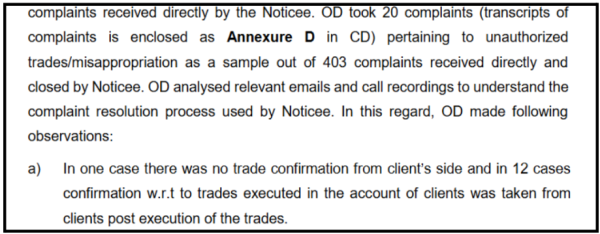
The firm traded in client accounts, and confirmation was taken only after the trades were done.
Clients mostly sat back while the firm made the decisions.
That is how a PMS works, but a PMS needs a written agreement, and here there was none.
In effect, retail clients were being treated as PMS clients on paper they never signed.
2. Retail Clients on a PMS-Only System
Some terminals are meant only for portfolio management business. They are not built for ordinary retail clients.
SEBI found that trades for 46 retail clients were running through them.
It is like sending two kinds of customers through the same door.
The firm’s systems were not keeping the two businesses apart.
3. Profit Statements That Did Not Match Reality
A statement is supposed to tell you where you stand. SEBI found ABML shared statements showing smaller losses, or even profits that were not real.
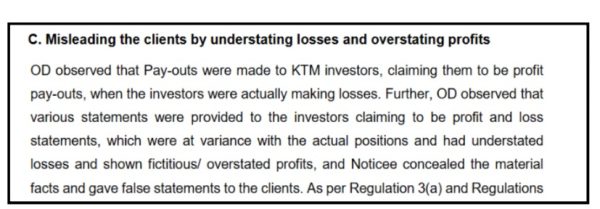
Profit payouts were also made during periods when clients were in loss.
If a statement looks better than the truth, you lose the chance to act early.
SEBI linked this to fraud and unfair trade practice rules.
4. Losses Hidden Behind Option Premiums
When a client’s account goes into debit, someone has to cover it. SEBI found the firm was using premiums from options it sold to cover those debit balances.
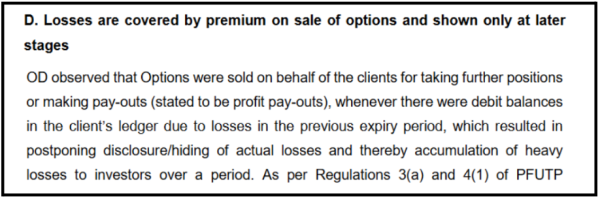
The effect was to push the loss out of sight for a while. The client saw a calm statement while the real loss sat underneath.
Over time, the hidden damage kept building up in client accounts.
5. Late Fees Nobody Agreed To
If you owe money on an F&O position, a late fee can apply. That is normal, as long as you agreed to it.
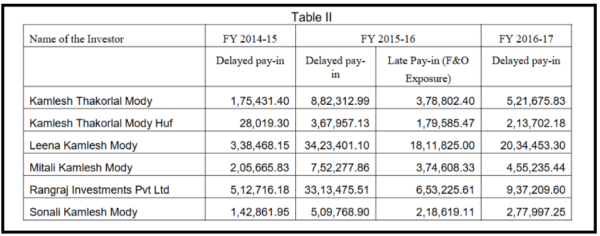
SEBI found ABML charged late pay-in fees without clear, documented consent. The charges also went beyond the agreed annual interest rates.
Some were even levied on trades the firm itself had started.
6. Money Left Sitting in Inactive Accounts
Not every client trades every month. When an account goes quiet, the money in it still belongs to the client.
SEBI found that funds in inactive accounts were not settled on time. The unsettled amount was about ₹64 lakh, which is ₹63.94 lakh in the sample SEBI checked.
SEBI rules require periodic settlement.
Delay can leave clients unable to reach their own money, and leave quiet accounts open to misuse.
7. Paperwork Left Hanging
CKYC is the central KYC record that saves you from repeating your paperwork across financial firms. It has to be uploaded on time.
SEBI sampled eight clients. All 8 of 8 had delayed CKYC entries.
It is a small sample, but a complete failure inside it.
8. A Complaint Channel That Did Not Exist
When something goes wrong, the first thing you need is somewhere to send it.
SEBI found ABML had no dedicated grievance email. It used general email IDs for complaints.
A client with a problem had no clear, official door to knock on.
9. Alerts That Were Switched Off
SMS alerts are your early warning. They tell you when something moves in your demat account.
SEBI found alerts were not enabled for depository accounts. Power of attorney was also activated without the clients’ mobile numbers.
Without an alert, you might not learn of a transaction until long after it happens.
10. Client Shares Moved to the Firm’s Own Account
This is the one that stopped the inspectors. Client securities were moved out of client demat accounts into the firm’s own proprietary accounts.
The order puts it at ₹5.41 lakh across 160 instances.
Client shares are held for the client. Moving them to the firm’s own account without proper authorisation raises serious concerns about misuse of client assets.
What Did SEBI Charge for All of This?
The penalty was split across three provisions of law. Each covers a different kind of failing.
Here is how the ₹1.02 crore breaks down.
| Violation Category | Legal Provision | Penalty |
|---|---|---|
| Fraudulent and unfair trade practices | Section 15HA, SEBI Act, 1992 | ₹75,00,000 |
| General contraventions | Section 15HB, SEBI Act, 1992 | ₹25,00,000 |
| Failure to segregate client securities | Section 23D, SCRA, 1956 | ₹2,00,000 |
| Total | ₹1,02,00,000 |
ABML had 45 days from the order to pay.

SEBI also noted that certain violations were repetitive, which means the firm had chances to fix them and did not.
Did something in your Aditya Birla Money account stop adding up?
Our team reviews your ledger and contract notes, then files the complaint at the right place, from the broker to SCORES to SMART ODR.
Register with us for a free consultation.
What Should Investors Learn From the Order?
An order like this is not only about one firm. It shows how trading authority can be misused when controls are weak.
Here is what to take from it:
- Trades executed without your instruction are not a misunderstanding. SEBI treated them as a violation.
- Portfolio-style management for retail clients without a written agreement is a specific breach, not just poor service.
- A statement that shows profit while you are in loss can be an unfair trade practice under SEBI law.
- Unsettled funds in a quiet account leave it open to unauthorised transactions.
- SEBI called the violations “repetitive”, so the broker had chances to correct them.
- Brokers must trade only on clear authorisation, must not mislead clients and need strong internal controls.
- SEBI can impose large penalties, so review your trades, statements and charges regularly.
What Do the NSE Numbers Say Now?
The order is the past. The exchange data shows how things look today.
It is the one place where you can compare this broker year by year, using figures the exchange itself publishes.
NSE records 81 complaints in 2025-26, against 68,189 active clients. That is 0.119% of clients, up from 39 complaints in 2022-23.
Unauthorised trading, Type IV, rose from 11 to 28 over those three years. It is now about 35% of all complaints.
NSE has no separate category for charges. Disputes about them mostly sit under Type V, service-related, so for charge disputes.
What Kinds of Trouble Do Aditya Birla Money Clients Report?
Numbers tell you how many complaints there are. They do not tell you what the trouble feels like from the other side of the screen.
Client complaints about a broker tend to fall into a few types. Knowing the type helps you spot a problem early and know what to document.
Here are the five you are most likely to meet:
- Charges that are hard to pin down. This is when the brokerage or fees on your contract note do not match what you understood you would pay. Keep the rates you agreed to, so you can compare every line.
- Support that passes the problem along. Here you ask a question and are handed from one department to another, with nobody owning the answer. Write down who you spoke to, and ask for the reply in writing.
- Money that is slow to move. This covers payouts that arrive short, withdrawals that drag, and holdings you cannot sell. Note the request date and the date the money actually arrives.
- Apps and accounts that do not work. Login or OTP trouble, wrong figures on screen, or an account that will not activate after onboarding all sit here. Screenshot the screen with the time showing.
- Marketing that does not match the service. This is when what you were told before signing up is not what you get afterwards. Save the offer, the advertisement, or the message that made you sign up.
If you want to see how these types show up in real clients’ own words, check each review with its screenshot in our guide: Aditya Birla Money complaints page.
What Should You Check Before Opening an Account?
You can learn a lot from the order and the reviews without losing a rupee.
Each check below maps to something SEBI or a client has flagged.
- Ask for the brokerage schedule in writing. Compare every contract note against it.
- Know what any POA allows. Keep a copy, and do not sign a blanket authority you do not understand.
- Turn on SMS and email alerts for trading and demat. SEBI found alerts were not enabled for ABML’s depository accounts.
- Keep your own record of every payout request. Note the request date and the day the money arrives.
- Find the grievance email before you need it. SEBI found there was none dedicated at the time.
Some reviewers describe the app failing at the worst moment
. If that worries you, our guide on Aditya Birla Money app not working looks at it on its own.
How an Aditya Birla Money Complaint Moves: Broker, SEBI, Exchange, Arbitration
A complaint is a piece of paper that moves from desk to desk.
What matters is who sits at each one.
Here are the four desks in order, with what each one can do for you.
1. The Broker’s Own Desk
This is where a complaint should start.
The broker gets the first chance to fix it, and your letter becomes the first line of your record.
Our guide on how to file complaint against stock broker shows what to put in it.
2. SEBI’s Desk
SEBI sits above the broker. A complaint here is recorded officially, and the broker has to answer on the record.
Our walkthrough of SEBI complaint SCORES covers each field.
3. The Exchange’s Desk
The exchange is where a broker’s membership lives.
It runs its own investor grievance cell, and it keeps the data you saw earlier.
Our page on Stock Exchange Complaints explains how to use it.
4. The Arbitrator’s Desk
The last desk takes no side. An independent arbitrator reads the evidence from both parties.
For arbitration in stock market disputes, this is where the case ends, with a final decision.
How We Help With a Broker Complaint?
Dealing with an unresponsive broker while your money is at stake is exhausting.
We take you through it in five steps, so you are not working it out alone.
- Consultation: we understand what happened and what you want back.
- Documentation: we organise your contract notes, ledger, and messages into evidence.
- Escalation: we file at the right place, in the right order.
- Advisory: we guide you through the replies and the deadlines.
- Advanced recourse: if needed, we take the dispute further to arbitration.
Conclusion
Aditya Birla Money has strong corporate backing and a proper SEBI registration. That is a fact, and so is the 2021 order against it.
SEBI found unauthorised trading, misleading profit statements, and client securities moved to the firm’s own accounts. NSE data shows complaints and the Type IV share rising since.
Client reviews repeat the same themes across years, from charges and support to payouts and the app. There is a gap between the brand and the service people describe.
Document every interaction, switch on your alerts, and write down every payout request.
Report. Recover. Stay Fraud Free.
SEBI’s October 2021 order found ten violations, including unauthorised trading, misleading profit statements, PMS without agreements and client securities moved to proprietary accounts. It imposed a ₹1.02 crore penalty. Yes. It is registered as a full-service stock broker and holds research analyst, investment adviser and PMS registrations as well. NSE records 81 complaints in 2025-26 against 68,189 active clients. Unauthorised trading, Type IV, is the fastest growing type, up from 11 to 28 in three years. Each is one client’s account, not a finding. We date every review, and the older ones, including two from 2016, should be read as history. Ask in writing for the ledger entry behind every deduction. If the reply is unsatisfactory, escalate to SCORES with your records attached.Frequently Asked Questions





 Add us as a preferred source on Google »