

Quick Summary
Priya Rathore (name changed) trusted a name she found on Instagram. She ended up paying more in brokerage than she ever lost to the market itself that single fact became the strongest evidence in her case. A firm registered only as a Research Analyst gave her personal trade instructions, hid a broker referral commission, and ran her account through three different advisors. Her initial claim totaled ₹4,55,768: ₹4,25,768 in trading losses plus ₹30,000 in fees. The case moved through a legal notice followed by structured negotiation and out-of-court settlement talks, closing with a final recovery of ₹3,40,000.
Priya Rathore (name changed) came across promotional content from a firm registered with SEBI as a Research Analyst. A junior relationship manager reached out within days and introduced her to a “Senior RM.”
She was told to open a demat account through a specific referral link. No KYC form was filled, no written agreement was signed, and no invoice was ever raised for the fees she paid.
The Promise That Started It All
The senior advisor’s opening line set the tone for everything that followed. “I am senior, I will recover your loss,” she was told on her very first call with this new handler.
Messages in Hindi and English followed almost daily. Lines like “tension nhi lo, sab cover ho jayega” gave her false comfort. Daily profit targets of one and a half lakh rupees made the promises feel concrete.
No genuine adviser quotes a daily profit number. A promise like that is not encouragement. It is a guarantee dressed up as motivation, and SEBI rules treat it as a violation.
Personal Trade Calls From A Firm With No Licence To Give Them
A Research Analyst can publish research for everyone. A Research Analyst cannot tell one specific client to buy one specific option at one specific price. That function belongs only to a licensed Investment Adviser.
Priya received exact instructions daily. Buy this strike, hold this target, exit at this stop loss, and send a screenshot to confirm the trade was placed. This was personal advisory, not research.
The firm had no Investment Adviser licence. Every instruction sent to her phone was, on its own, a regulatory violation under the rules that govern research analysts in India.
Three Advisors, Three Rounds Of Fresh Losses
When one advisor’s trades started losing money, Priya was quietly moved to another one. Each new handler was introduced as more senior and more capable than the last.
This is a manipulation pattern we see often. Every switch reset her hope. Every switch also meant a fresh round of trades, fresh churn, and fresh losses on an account that never had room to absorb them.
By the time a third, unnamed “Manager” took over her account, she had already lost close to a lakh through the first two handlers alone.
What Our Team Did: The Recovery Strategy
The chat evidence in this case was extensive, but scattered across weeks of WhatsApp messages in two languages. Our first task was to organise it into a clean, dated, chronological record.
Step One: We Mapped Every Instruction To A Regulation
Every buy call, every target, every stop loss message was matched against the specific SEBI rule it broke. This turned informal chat screenshots into a structured legal filing.
Step Two: We Pulled The Brokerage Numbers
We requested the account statement directly from the broker. The numbers told their own story once we laid them side by side with her actual trading result.
Her realised trading loss stood at ₹8,068 for the entire period. Her brokerage charges for the same period stood at ₹4,17,699. This gap is what exposed the churning.
An account that size does not generate that much brokerage through normal trading. It generates it when someone on the other end is placing trades to earn commission, not to help the client profit.
Step Three: We Traced The Referral Link
The demat account was opened through a referral link the firm itself provided. That link earned the firm a commission from the broker every time it was used, and every time it generated trading volume.
This conflict was never disclosed to our client. We built this into the complaint as a standalone violation, separate from the churning and separate from the licensing breach.
Step Four: We Sent A Detailed Legal Notice
Our notice to the firm laid out five distinct violations with dates, message excerpts, and the exact circular sections each one breached. We demanded full restitution within a defined timeline.
Anyone facing personal trade calls from a firm that only holds a research licence can file a complaint against a SEBI registered research analyst the same way we did here.
Step Five: We Held The Line Through Negotiation
The firm’s first response tried to minimise the churning as normal trading activity. We countered with the brokerage-to-capital ratio and the referral link evidence, both of which are difficult to explain away.
Recovery Amount And Final Outcome
Our client’s total claim stood at ₹4,55,768, covering both her trading losses and the fees she paid without ever receiving an invoice.
After sustained negotiation backed by documented evidence, the matter settled at a recovery of ₹3,40,000. This covered the bulk of her losses and closed a case that had dragged on for months of stress.
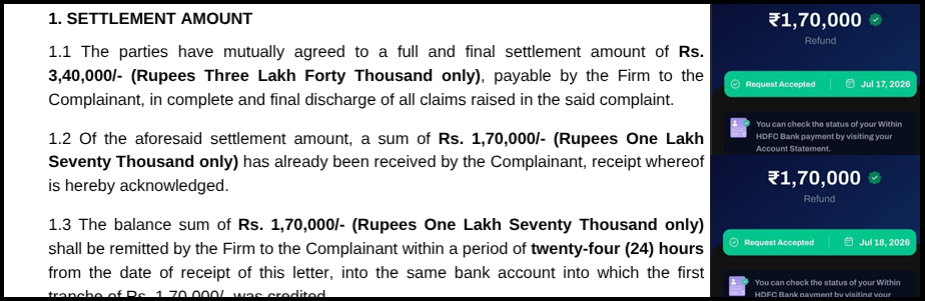
She walked away with her funds and, just as important, with clarity on exactly how the scheme had worked against her from day one.
Paying More Than You Ever Lost To The Market? We Can Help
Every switch resets your hope and starts a fresh round of losses. Our team traces your bill against actual trading loss, uncovers hidden referral commissions, and builds the case through a formal notice and structured negotiation until it’s resolved. Register with us.
Report. Recover. Stay Fraud Free.
Frequently Asked Questions
No. A Research Analyst can only publish research for a general audience. Personal trade instructions require a separate Investment Adviser licence.
Churning is excessive buying and selling that generates high brokerage without matching benefit to the client. Comparing brokerage paid against actual trading loss is a strong way to spot it.
No, but hiding it from the client while directing their trading activity creates an undisclosed conflict of interest, which is a violation under SEBI rules.
Yes. SEBI rules require a written service agreement, KYC documentation, and risk profiling before any advisory relationship begins. If that agreement was never given to you, you can raise this directly through a SEBI SCORES complaint.
Save every chat message, download your full account statement, and reach out to our team before deleting anything.




 Add us as a preferred source on Google »

