
Quick Summary
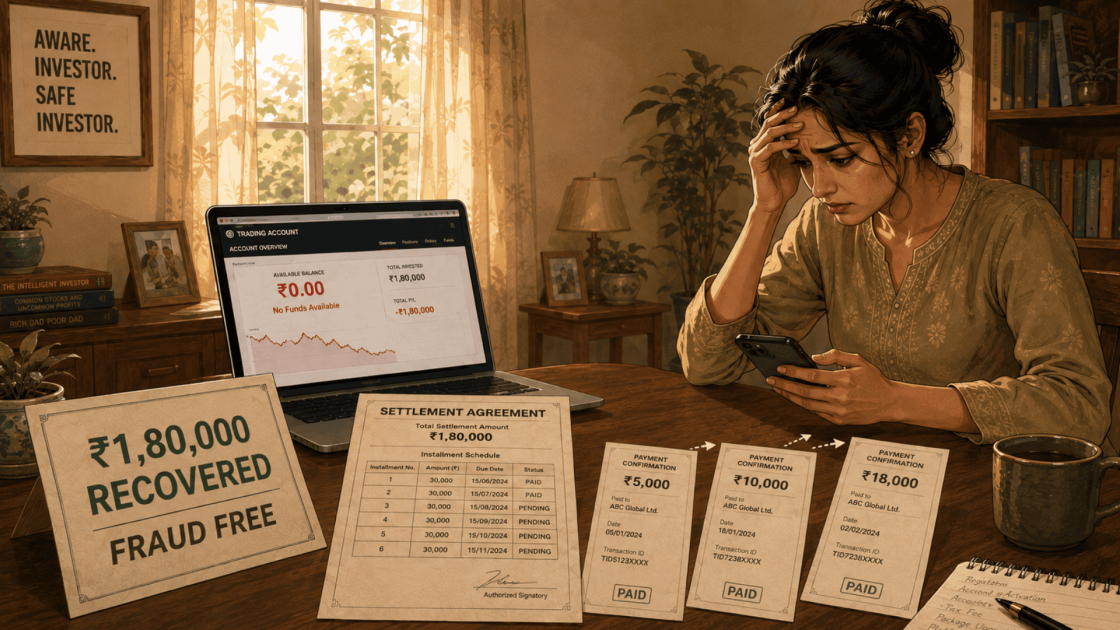
What Ritu (name changed) total claimed reached ₹3,29,000: ₹1,79,000 pulled out in fees, plus ₹1,50,000 lost in trading. Nothing about it looked alarming at first. Five thousand rupees one time, ten thousand the next, each payment small enough to pass without notice. It was only once every transaction was placed side by side that the pattern of extraction became unmistakable. The firm behind it, registered with SEBI as a Research Analyst, had gained access to the client’s login credentials and used that access to push five separate rounds of escalating fee demands. When she finally refused to pay further, her account was wiped clean. A formal legal notice followed, taking the matter to Smart ODR, where it was resolved with a settlement of ₹1,80,000, released in structured installments.
Ritu Singh (name changed) was already nursing losses from earlier trading when a firm registered with SEBI as a Research Analyst called her out of nowhere. They cited their SEBI registration repeatedly as proof of legitimacy.
She was told her losses would be covered if she let their team manage her account directly. Trusting the registration claim, she shared her trading login credentials with them.
No discretionary account agreement was ever signed. No written consent form for credential sharing existed. What followed was months of trades placed on her account without her knowledge until evening statements arrived.
A Fee Ladder Built On Five Separate Pretexts
The first payment was five thousand rupees, framed as a simple registration charge. It came with the only invoice our client would ever receive from this firm.
The second round followed almost immediately. A “senior analyst” first quoted a fee of ninety thousand rupees, then offered a smaller test amount instead, pressuring our client into paying ten thousand five hundred rupees.
A third demand arrived days later. Ritu was told a call had been taken from another city and she now owed eighteen thousand rupees for it. No invoice was issued for this either.
When one trade finally showed a small profit, twelve thousand rupees was extracted as a profit-sharing fee. Every gain was followed by a fee large enough to erase it.
By the time a senior figure at the firm called offering a special recovery package for a further sixty thousand rupees, our client had already paid close to ninety thousand without a single written agreement in hand.
Refusal Met With Retaliation
Ritu refused the additional sixty thousand rupee demand. She pointed out that she had already paid for services that had produced no results.
Within days, two trades were executed on her account that wiped out her remaining capital entirely. Communication from the firm stopped soon after. Her account had gone from full capital to zero in about thirty trading days.
Anyone facing repeated, undocumented fee demands from a firm claiming SEBI status can file a SEBI SCORES complaint using the same payment trail our team compiled here.
What Our Team Did To Make The Recovery Possible
Five separate fee demands, most with no invoice at all, made this a documentation heavy case. Our first task was reconstructing a complete, dated record of every rupee that left our client’s account.
Step One: We Reconstructed The Full Payment Trail
Google Pay records, credit card statements, and the single available invoice were pulled together into one chronological ledger. This showed the escalation pattern clearly for the first time.
Step Two: We Isolated The Credential Sharing As A Standalone Breach
Handling a client’s account requires a signed, written agreement. None existed here. We built this absence into its own violation, separate from the fee extraction and the unsuitable trading.
Step Three: We Mapped The Trading Pattern Against SEBI Standards
No stop loss levels, no pre trade confirmations, and a complete capital wipeout in about a month painted a clear picture. We matched each gap to the specific standard it violated.
Step Four: We Sent A Detailed Legal Notice With A Firm Deadline
Our notice laid out five distinct categories of violation, from the false registration claims to the retaliatory account wipeout. We gave the firm five business days to respond in good faith.
Step Five: We Escalated To Smart ODR
The response we received did not address the core violations. We moved the dispute to Smart ODR, where the payment trail and the absence of any written agreement carried significant weight.
Once a notice has already gone unanswered, escalating through the Smart ODR complaint portal is often the fastest route to a structured resolution.
Total Recovered Amount and Final Outcome
Our client’s total claim stood at ₹3,29,000, covering every fee extracted across five rounds and the full trading loss that followed the account takeover.
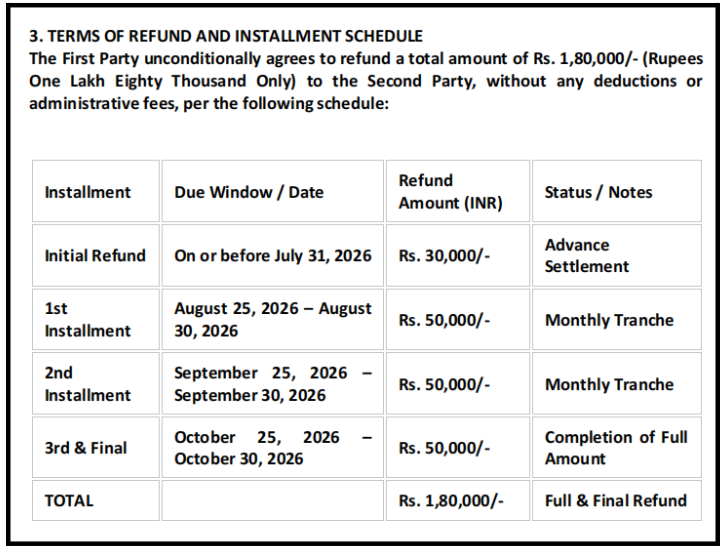
The matter settled at Smart ODR for a total of ₹1,80,000, structured across four payments rather than a single lump sum. The first installment of ₹30,000 has already been paid in full.
Three further installments of ₹50,000 each are scheduled through October 2026, bringing the settlement to full and final closure. Our team continues to track each payment against the agreed schedule.
Facing Endless Fee Demands With Nothing In Writing? We Can Help
Unwritten fees rarely stop at one. Our team reconstructs the full payment trail, treats every undocumented demand as evidence, and escalates through SEBI SCORES, Smart ODR and arbitration when required. Register with us.
Conclusion
If you have ever paid one fee after another without a single written agreement to show for it, that pattern has a name and a remedy. Reach out before the next demand arrives.
Report. Recover. Stay Fraud Free.
Frequently Asked Questions
No. A Research Analyst is not authorised to handle your account without a signed, written agreement. Sharing your login should never be treated as standard practice.
Escalating fee demands with new pretexts each time are a recognised extraction pattern. Genuine advisory fees are disclosed upfront, not revealed in stages.
Payment app records and bank statements can substitute for missing invoices. What matters is a clear, dated trail connecting each payment to the firm.
Yes. Structured settlements across a few months are common and enforceable once agreed through a formal process like Smart ODR.
Preserve every trade confirmation and account statement from that period immediately. This timing is often the strongest evidence of retaliation.





 Add us as a preferred source on Google »

