

Quick Summary
BlackAce Research holds a 4.6-star Google rating across roughly 300 reviews, and its own SEBI-mandated complaint disclosure shows 17 complaints across two years, all marked resolved. Beneath that clean surface, seven detailed reviews describe a repeating pattern, guaranteed return promises, unauthorized WhatsApp contact, profit-sharing arrangements, directed trade sizes, and support going silent right after a loss. None of this is proven wrongdoing on its own, but the specificity and repetition across separate, unconnected reviewers is worth reading in full before you subscribe.
A 4.6-star rating and a detailed fraud allegation can sit on the exact same page.
That’s genuinely the case with BlackAce Research reviews on Google, glowing praise sitting right next to dated, specific accounts of loss and silence.
This page goes through seven of those reviews individually, checks each one against what a SEBI-registered Research Analyst is actually allowed to do, and lays out what to do if your own experience matches any of them.
BlackAce Research Reviews Complaints
BlackAce Research shows close to 300 Google reviews, most of them short, a line or two of praise with no real detail behind them.
The one-star reviews read completely differently.
They’re longer, dated, and specific, naming exact amounts, exact timelines, and a clear sequence of events.
Seven of them stand out enough to go through individually, since generic complaints don’t tell you much, but detailed, specific ones do.
1. A ₹3 Lakh WhatsApp Loss and a “Major Cyber Scam” Warning
A reviewer named Anwar P posted this account twice on Google, once roughly nine months ago and again three months later, both times under the same title, “Urgent Public Warning: Black Ace Research company – A Major Cyber Scam.”
He describes being approached through WhatsApp by a group calling itself Black Ace Research, promised high returns on trading, and says he lost over ₹3 lakh through what he calls manipulative and threatening tactics.
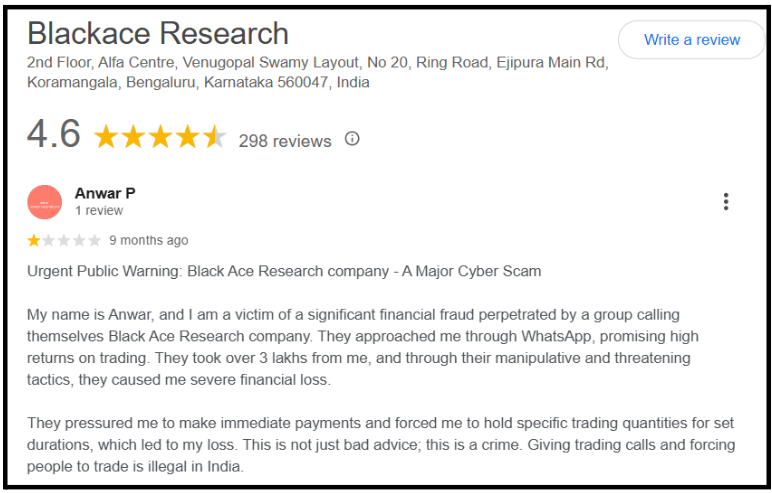
He states he was pressured into immediate payments and forced to hold specific trade quantities for set durations.
This account raises two separate, checkable concerns.
First, BlackAce Research’s own website tells clients to follow calls only through its official Telegram channel, which raises a real question about who Anwar was actually in contact with over WhatsApp.
Second, being pressured to hold a specific trade size or duration edges directly into directing a trade, something a Research Analyst licence doesn’t cover, since an RA can only publish a recommendation, not instruct execution.
2. Allegations of AI-Generated Reviews and No Real Analysis Team
A reviewer named V. Sampath Kumar, a Google Local Guide with 649 reviews and 425 photos to his name, posted a detailed warning specifically about the review section itself.
He alleges that many of the positive reviews on the page are AI-generated and fake, and states the firm has no real analysis team behind its calls.
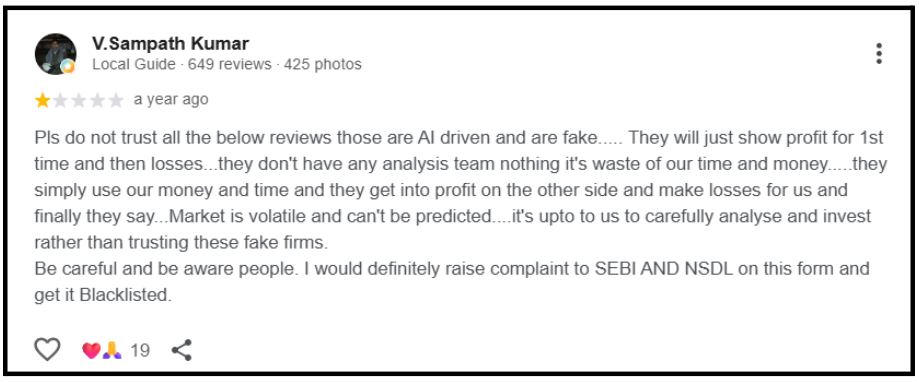
He describes a pattern of an initial profit followed by losses, and says that when a trade goes wrong, the firm attributes it to normal market volatility rather than taking responsibility for the recommendation itself.
He states he plans to raise a complaint with SEBI and NSDL.
If accurate, this kind of practice would sit against SEBI’s Advertisement Code, which requires investment-related communications, including testimonials and public-facing claims, to be fair and not misleading.
A reviewer with this much platform history (649 reviews) lends some weight to the specificity of the claim, though it remains one account, not independently verified beyond what’s stated here.
3. A Profitable Trade, Then a ₹52,000 Loss and Silence
A reviewer named Chandramohan Godara describes a ten-day trade that made ₹60,000 in profit, out of which the firm reportedly kept ₹30,000.
A Research Analyst cannot legally charge a share of a client’s trading profits. Fees have to be fixed and disclosed upfront, capped at ₹1.51 lakh a year per family, not a percentage of what a client earns.
He goes on to describe a subsequent loss of ₹52,000 in a single day, after which he says the firm stopped answering his calls entirely.
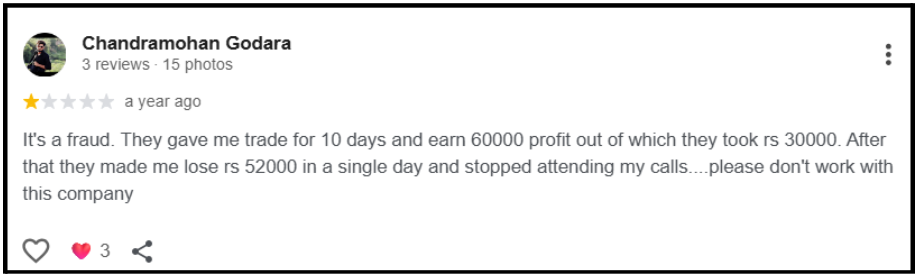
Two separate issues sit inside this one account. The profit-sharing arrangement itself is a direct compliance concern, since it’s a fee structure explicitly prohibited for Research Analysts.
The described silence immediately after a loss is a conduct pattern that shows up again in several of the reviews below.
4. Capital Reduced to Zero, With a Screenshot Attached
A reviewer named Vipul Kumar Bansal posted a short, blunt review alongside a screenshot of his own trading account.
He describes his capital as reduced to zero, calls the experience “totally fraud,” and states he paid ₹60,000 in fees. The attached screenshot shows a live trading account with a Total P&L of negative ₹73,464.
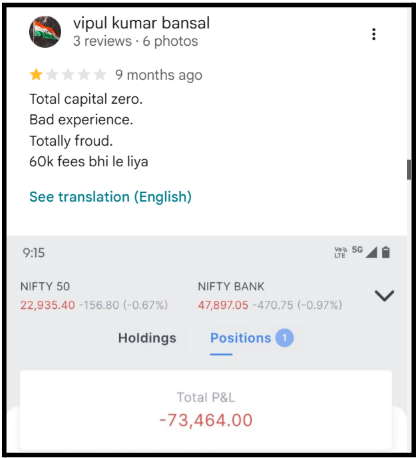
This is one of the more concrete pieces of evidence in this set, since it pairs a written complaint with an actual account screenshot showing the loss figure directly, rather than relying on the reviewer’s own stated number alone.
5. “They Only Recover Their Huge Fees Earlier”
A reviewer named Chetan Salunke, a Google Local Guide with 21 reviews and 18 photos, describes a specific pattern he says he observed.
He states that the firm collects its fees upfront and then works to reduce a client’s capital to zero afterward, and warns others to stay away from “tips guys,” calling the experience a “genuine scam.”
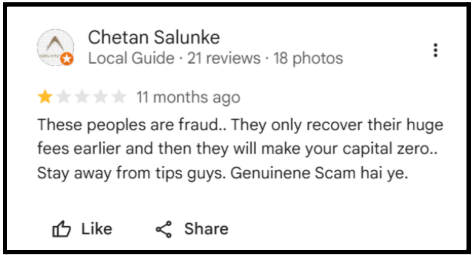
This account echoes the same sequence described by Chandramohan Godara above: fees paid first, followed by losses, though Chetan’s review frames it as a deliberate pattern rather than a single bad trade.
6. No Risk Management, No Stop Loss
A reviewer named Abhiraj Kaushik describes his account being emptied, and specifically states there was no stop loss and no risk management applied to his trades.
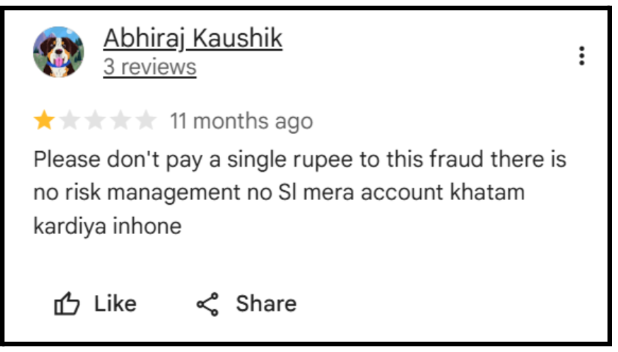
Under SEBI’s regulations, every recommendation a Research Analyst issues needs a real, documented basis, and standard trading practice includes defined risk parameters.
A reviewer specifically flagging the absence of any stop loss or risk management is describing a conduct issue distinct from the profit-sharing and contact-channel concerns raised in the reviews above.
7. “Genuinely No Analysis, No Stop Loss, No Risk Management”
A reviewer named Aarti Shinde, writing in Hindi, warns others directly not to hand over their capital, stating plainly that the firm has no analysis, no stop loss, and no risk management, and advises people to do their own research instead of relying on the firm’s calls.
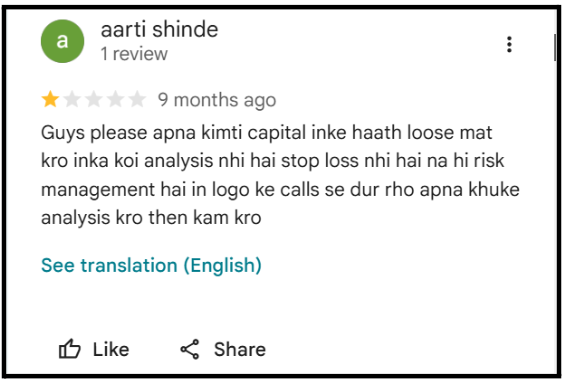
This is the third separate reviewer, alongside Abhiraj Kaushik and V. Sampath Kumar, to specifically flag the absence of genuine research or risk management behind the calls being issued, rather than describing a financial loss alone.
Also Read: Eqwires Reviews, where six documented accounts describe the same missing stop-loss discipline, and a formal SEBI penalty followed.
What Does BlackAce Research’s Own Complaint Data Show?
BlackAce Research publishes an annual complaint disposal table, as SEBI requires of every registered Research Analyst.
| Year | Carried Forward | Received | Resolved | Total Pending |
|---|---|---|---|---|
| 2024-2025 | 0 | 12 | 12 | 0 |
| 2025-2026 | 0 | 5 | 5 | 0 |
Seventeen complaints across two full years, every single one marked resolved, nothing pending. On paper, that’s about as clean a record as a registered firm can show.
Twelve complaints in a single year is still worth noting as a real, non-trivial number, even resolved.
Set that clean table next to the seven accounts above, and the numbers stop telling the same story. A complaint left as a Google review doesn’t feed into this official table at all; only a complaint filed through SEBI SCORES does.
That gap is exactly why a clean complaint table on its own doesn’t tell you the whole picture.
For the complete company profile, its services, and its registration details, our page about BlackAce Research covers the full background.
Recognise any of this from your own experience with BlackAce Research?
Tell us what happened, when, and what you have to show for it. We’ll help you understand whether it’s worth formally documenting.
How Can You Protect Yourself From the Same Situation?
Every review above starts the same way: a call, a promise, and trust given a little too quickly.
Reading through seven accounts like these naturally raises one question: what would have actually stopped this?
A few checks before you subscribe can keep you from ending up in the same position.
- Treat any contact outside BlackAce Research’s declared channels as suspicious. The firm’s own site directs clients to its official Telegram channel specifically, not WhatsApp.
- No SEBI-registered Research Analyst can promise a fixed or assured return, under any framing. If a call opens with a guarantee, that alone is worth treating as a warning sign.
- Keep control of your own trades. Deciding your own position size is entirely your call. No RA is licensed to direct how much you hold or for how long.
- Never agree to pay a share of your profits. Only the disclosed, fixed subscription fee is legal for a Research Analyst to charge.
None of this guarantees a good outcome, since the market itself carries its own separate risk. But it keeps you out of situations that have nothing to do with market risk at all.
Also Read: Ajcon Global Services Limited Reviews tells about a review on how there was no support website to fall on.
What Should You Do If You’ve Already Faced Losses?
If your own experience already matches what’s described above, gathering your evidence and raising it formally is the practical next step.
Before anything else, check SEBI registered company status yourself, directly on SEBI’s own portal, confirming the registration number matches what BlackAce Research states, rather than taking any claim at face value.
A structured, four-stage complaint process exists specifically for situations like this. The first formal step outside the firm itself is to file complaint in SCORES, SEBI’s official grievance platform.
If that stage doesn’t resolve things and your dispute involves a specific financial amount, the SMART ODR login page offers a faster, structured mediation route.
And when nothing earlier resolves it, arbitration in share market disputes is the final stage that ends in a binding decision.
The complete step-by-step route, exactly what to gather and how each stage works, is walked through in full in our guide on how to complain against BlackAce Research.
Disclaimer: The reviews referenced on this page are publicly available comments shared by users on independent platforms, not verified or endorsed by us. No regulatory body has taken any action against BlackAce Research, and this page is shared for informational purposes only to help you make an informed decision.
Conclusion
BlackAce Research’s official complaint table shows seventeen complaints across two years, all resolved.
Its public reviews tell a more complicated story: guaranteed-return promises, unauthorized contact channels, an alleged profit cut, no stop loss or risk management, and silence after losses, described independently across seven separate reviewers.
None of it is proven wrongdoing on its own, but the consistency across unconnected accounts is worth taking seriously.
If your own experience matches any of it, document it now, while the messages and screenshots are still there.
Report. Recover. Stay Fraud Free.
Not entirely on its own, it only reflects complaints filed through SEBI's formal channel, not the ones left as public reviews on Google. No, a SEBI-registered Research Analyst cannot promise any assured or fixed return, under any name or framing. No, Research Analysts can only charge a fixed, disclosed fee, capped at ₹1.51 lakh a year per family, never a share of trading profits. Multiple reviewers have raised the question directly, including one alleging AI-generated fake reviews. This isn't independently confirmed, but it's a claim worth being aware of alongside the rating itself.Frequently Asked Questions





 Add us as a preferred source on Google »

