

Quick Summary
Eqwires reviews describe a consistent pattern: large losses tied to poor stop-loss management, constantly changing relationship managers, and pressure to keep investing in a losing position. Four separate, individually documented accounts are covered in full below, including one cited directly inside SEBI’s own adjudication order. SEBI has separately confirmed the firm marketed itself beyond its actual licence and used fabricated testimonials, resulting in real financial penalties. This page covers every documented account, what SEBI found, and the exact steps to recover your money if your experience matches.
A ₹7 lakh loss. A three-year subscription that shrank from ₹8 lakh to ₹2 lakh.
A client who handed over her account password for nine months. These aren’t rumors; they’re documented accounts, and Eqwires reviews keep circling back to the same handful of patterns no matter which platform you check.
Here’s what real users actually reported, and whether the regulator’s own findings back any of it up.
Eqwires Research Analyst Reviews
It happens to the best of us. You’re looking for a way to grow your money, and suddenly you’re getting calls promising “sure-shot” profits and “guaranteed” returns.
If you’ve been reading Eqwires research analyst reviews across different platforms, four separate, individually documented accounts tell a consistent story, laid out below.
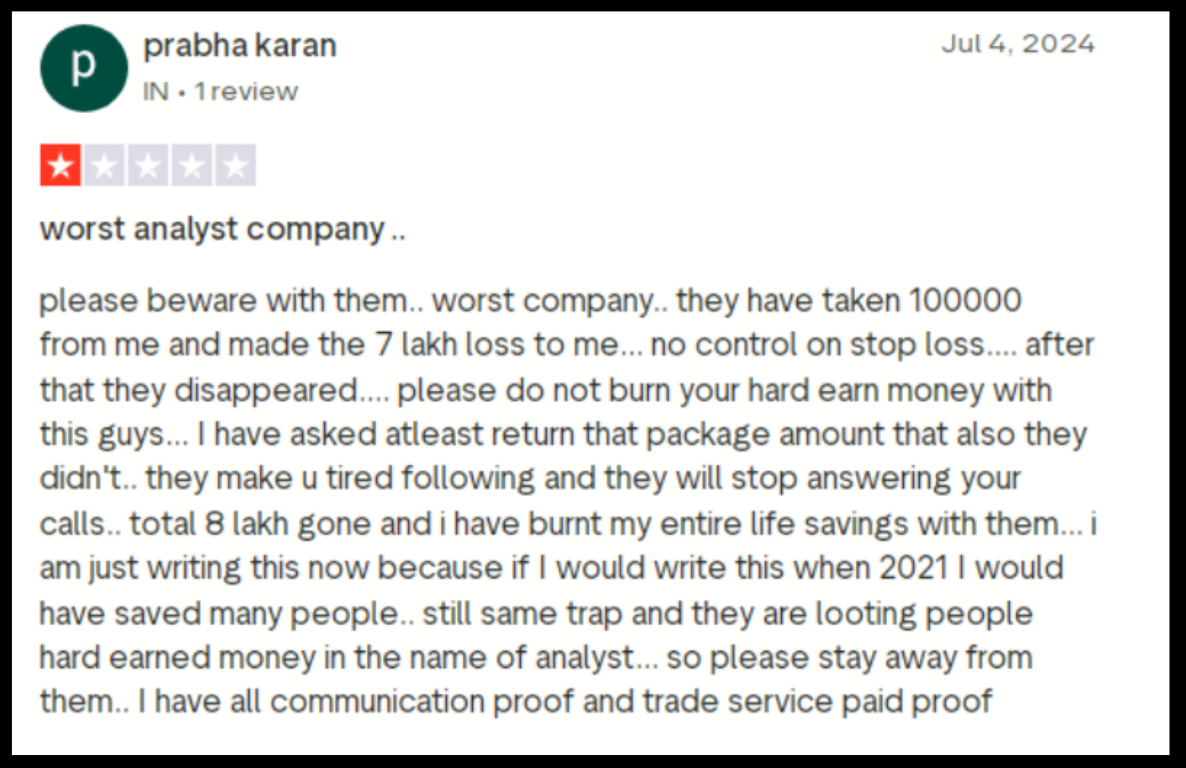
1. Prabha Karan: ₹1,00,000 Taken, ₹8 Lakh Gone Total
Posted on July 4, 2024, this is one of the most direct accounts on record.
Prabha Karan describes paying ₹1,00,000 to Eqwires, followed by a ₹7 lakh trading loss, with no control over stop-loss applied to the trades.
In their own words: “they have taken 100000 from me and made the 7 lakh loss to me… no control on stop loss…. after that they disappeared.”
When they asked for at least the original package amount back as a refund, that request was refused too. Calls eventually stopped being answered entirely.
The total loss across the full relationship came to ₹8 lakh.
2. Three Years, Constant Relationship Manager Changes, and a Shrinking Portfolio
A second reviewer describes a much longer relationship with the firm, over three years, starting with the “Mars Service” plan in August 2021, with ₹94,000 paid upfront.
Initially, the trades showed positive results.
But the account describes a specific, repeating pattern from there: every six months, the relationship manager changed, and the original targets set at the start were never actually completed.
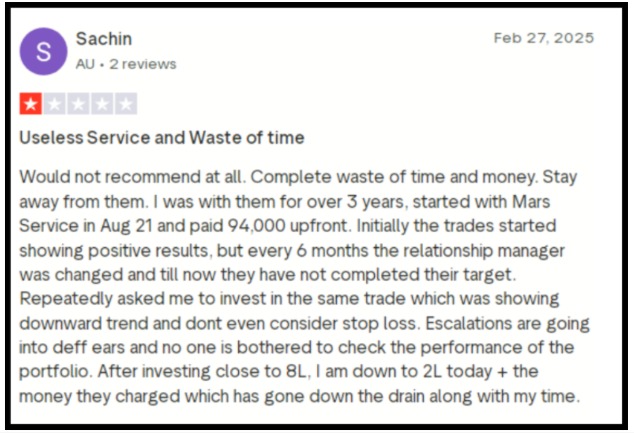
The reviewer says they were repeatedly asked to keep investing in the same trade, even as it showed a clear downward trend, with a stop-loss apparently never seriously considered.
When they tried to escalate the issue, the account describes those escalations going nowhere, with no one checking on the portfolio’s actual performance.
After investing close to ₹8 lakh in total, the portfolio’s value had fallen to ₹2 lakh, on top of the fees already paid.
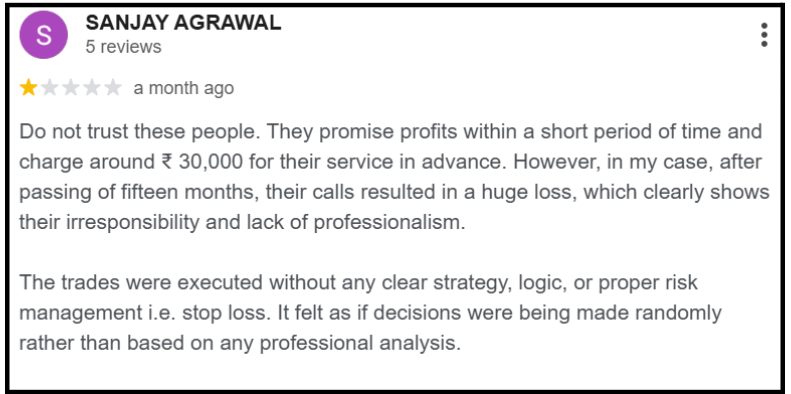
3. Sanjay Agrawal: ₹30,000 Upfront, a Loss After 15 Months
Posted a month ago, this reviewer describes paying around ₹30,000 in advance, on a promise of profits within a short period.
Instead, after fifteen months, the firm’s calls resulted in a significant loss.
In their own words, the trades were “executed without any clear strategy, logic, or proper risk management, i.e., stop loss,” describing the decisions as feeling random rather than based on any professional analysis.
4. Brayn Scalo: ₹1.5 Lakh Lost in One Week, Handled by a False Name
Posted three months ago, this account describes a ₹1.5 lakh loss in just a single week.
The reviewer says their account was handled by someone using the name “Shenky,” describing this person as inexperienced and unqualified, with trades executed with no clear strategy or risk management, as if decisions were made at random.
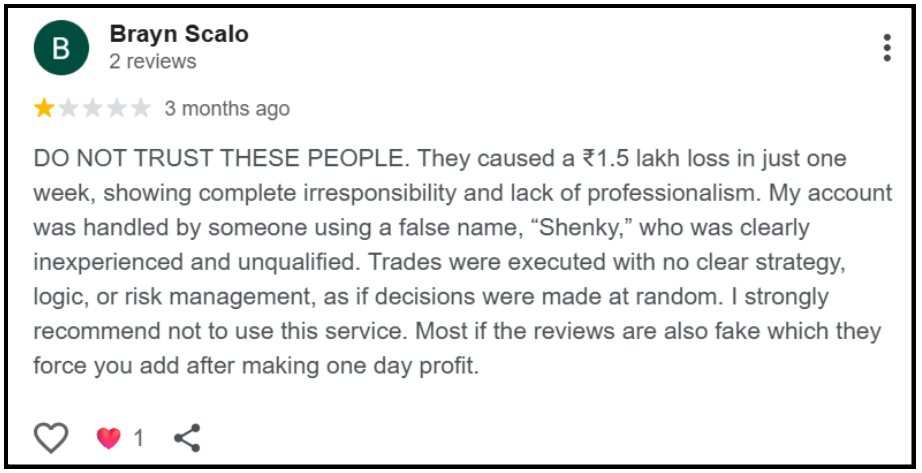
The reviewer also alleges that positive reviews are pressured out of clients specifically after a single profitable day, worth reading as one person’s account, not an independently confirmed practice.
5. Kunal Shenoy: Convinced to Upgrade, Then Told to Hold Losing Trades
Edited six months ago, this reviewer describes being convinced by positive reviews on Quora and other platforms to purchase the futures package, despite originally wanting only the equity package, after being contacted by a representative named Prithvi.
The service was satisfactory initially, with a profit of ₹85,000 on ₹2 lakh capital.
But the reviewer describes suffering significant losses afterward due to what they call an inadequate stop-loss strategy, being advised to carry forward losing trades on the promise that the market would rebound.
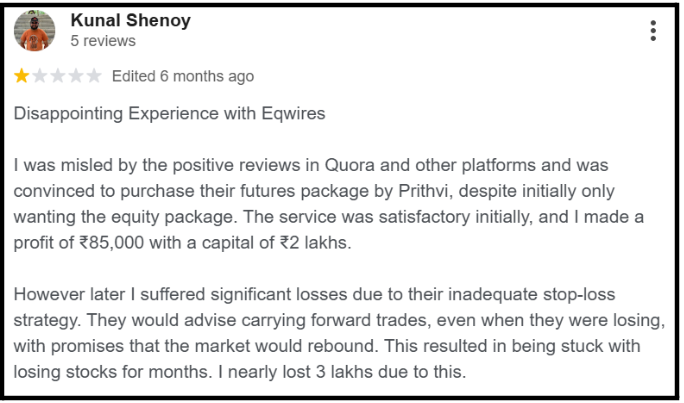
This left them stuck in losing positions for months, nearly losing ₹3 lakh in total.
6. D S: Four Years, Zero Profit, Over ₹6 Lakh Lost
Posted a year ago, this reviewer describes being a customer for four years with what they call a complete disaster of an experience, never generating a single rupee of profit across that entire period.
In their own words, they describe the pattern as “a well-crafted trap,” where the firm “shows some profits in the first 1-2 trades to gain your trust, but after that, it’s a continuous series of losses.”
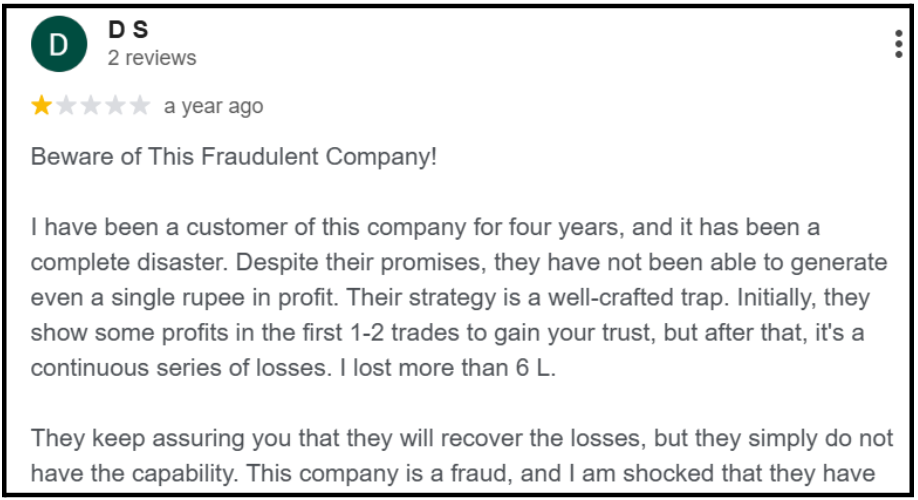
They report losing more than ₹6 lakh total, and state the firm kept assuring them losses would be recovered without ever having the capability to actually do so.
Why Do These Six Accounts Matter Together?
Every one of these reviews independently describes the same core failure: not applying or honoring stop-loss protection across six completely unconnected reviewers, different timeframes, different plans, and different amounts.
One reviewer’s ₹7 lakh loss happened fast.
Another’s ₹8 lakh eroded slowly over three years. A third describes losing ₹6 lakh across four years without ever seeing a profit.
That level of consistency, from six separate, independent sources, is exactly the kind of pattern worth taking seriously before you subscribe to anything.
What Public Review Platforms Show Overall
The tone genuinely varies depending on where you look, and one specific example is worth looking at closely.
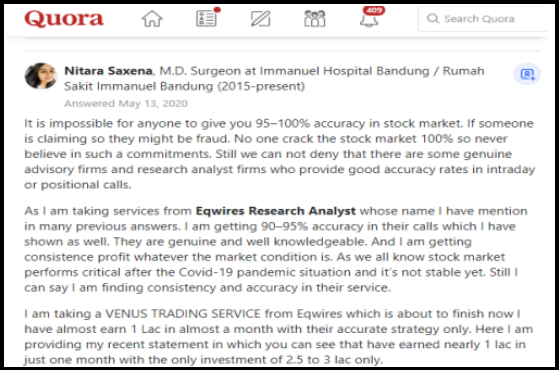
This Quora post, posted under the name Nitara Saxena, describes the poster as an “M.D. Surgeon” and claims 90-95% accuracy on Eqwires’ calls, along with nearly ₹1 lakh in profit in a single month from a service called “VENUS TRADING SERVICE.”
This isn’t just an unverified positive review sitting alongside the negative ones.
SEBI’s own adjudication order specifically named this profile as fabricated.
During SEBI’s inspection, Eqwires confirmed this account was created by a paid marketing agent, not a real client, and certainly not a real surgeon describing a real trading experience.
Why this specific example matters more than a generic “some reviews are fake” statement.
It shows exactly how convincing a fabricated testimonial can look: a specific profession, a specific service name, specific percentages and rupee figures, all designed to feel credible to someone reading it casually.
Also Read: Manish Goel Complaints, here’s how people actually filed their complaints.
Is Eqwires Research Analyst Real or Fake?
Eqwires genuinely holds SEBI registration INH000007465.
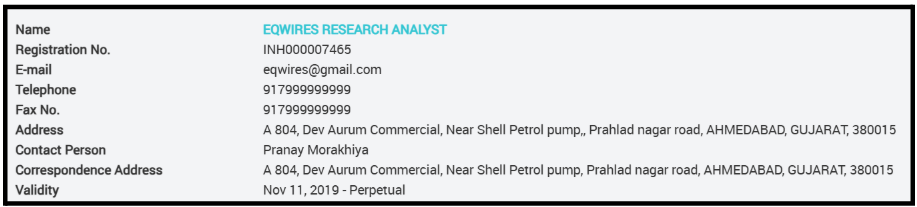
That much is real and checkable.
What’s worth weighing carefully is everything built around that registration.
SEBI itself has already ruled on this exact question, in a formal adjudication order dated August 13, 2025.
The regulator found the firm marketing itself as an Investment Adviser despite holding only a Research Analyst licence, operating a client’s trading account directly without authorisation, and using fabricated testimonials, some from people confirmed not to be real clients at all, to appear more credible than it actually was.
The firm was fined ₹6,00,000.
A separate order against the firm’s own Compliance Officer, for running unregistered advisory schemes on the side, added a further ₹11,00,000 penalty and a two-year market ban.
The complete findings, every specific violation, the exact defence Eqwires raised and why SEBI rejected it, and the full Compliance Officer case, are covered in detail on our page on the SEBI order against Eqwires Research Analyst.
So is it real or fake?
It’s a genuinely registered firm with a regulator-confirmed history of misrepresentation.
That combination is exactly why the user accounts above matter; they’re not standing alone, they line up with what SEBI already found.
Also Read: Streetgains Reviews, another Research Analyst with thirteen documented user complaints and its own SEBI penalty.
What Does Eqwires’ Own Website Claim?
Worth checking directly, since this connects to what SEBI already found problematic.
Eqwires’ own website currently describes itself using language like “Best SEBI registered portfolio manager,” “Best PMS in India,” and “Genuine SEBI registered investment advisory company.”
Here’s why this matters.
Eqwires holds only a Research Analyst registration. Portfolio management and investment advisory services each require entirely separate SEBI registrations, ones Eqwires does not hold.
Language like this on the firm’s own site is worth reading with SEBI’s own finding in mind, not as reassurance, but as something to independently verify before trusting it.
SEBI examined this kind of wording again in a later final order dated September 30, 2026, which ended in a regulatory censure.
We have explained how it weighed the firm’s self-description against its Research Analyst registration in our report on SEBI’s action against Eqwires Research Analyst.
The firm’s website also states a “95% client retention ratio.”
Retention figures like this aren’t independently audited anywhere we could find, worth treating the same way you’d treat any unverified marketing claim.
Does any of this sound exactly like what happened to you?
You don’t have to fight this alone. Tell us what happened, and we’ll help you organise your evidence and draft a clear, factual complaint.
How to Recover Money From Eqwires Research Analyst?
If you’re reading through everything above thinking, “that’s exactly what happened to me,” here’s the complete, step-by-step process to actually do something about it.
Before anything else, save your proof.
Payment receipts, chat logs, call recordings, and screenshots of any promises made are exactly what make a complaint actionable, not just a description of how you feel.
Step 1: Direct Complaint to the Research Analyst
Before you contact anyone, spend a few minutes gathering what you actually have.
Payment receipts, chat messages, call recordings if any exist, and screenshots of any specific promise made to you, an accuracy percentage, a guaranteed return, an assurance about “handling everything.”
Note the dates next to each one. This isn’t optional paperwork; it’s what turns a vague complaint into one that actually gets taken seriously.
Start with a formal, written complaint sent directly to Eqwires. According to the firm’s own published process, first raise the issue with your relationship manager or their senior.
If that doesn’t resolve it, escalate in writing to [email protected], stating clearly what plan you subscribed to, what you were told, what you paid, and exactly what went wrong.
Their own site states a response should come within 48 hours.
If your issue still isn’t resolved at that stage, their process allows a further escalation to [email protected], and beyond that, to [email protected], attaching copies of every earlier email in the chain.
This step alone often opens the door to a settlement before anything needs to escalate further.
Keep every reply you receive, and if nothing comes back at all within a reasonable window, that silence becomes part of your record for the next stage.
Step 2: Lodge a Complaint on SEBI SCORES
If the firm doesn’t resolve things, file a formal grievance through the SEBI SCORES portal, SEBI’s official platform for investor complaints against registered intermediaries.
Select Research Analyst as the category, and enter registration number INH000007465 so your complaint reaches the correct file.
Make sure all your technical evidence, receipts, chat logs, and screenshots are presented clearly and completely in a single submission.
You’ll receive a complaint number once it’s filed; save it, since it becomes your reference for tracking the case and for anything that follows.
You can file complaint in SCORES directly through SEBI’s own official portal, and the process itself is free.
Step 3: File a Complaint Through SMART ODR
If SCORES doesn’t resolve your case, SMART ODR is the next step, an Online Dispute Resolution platform that brings both sides together through structured conciliation to try to solve without a full hearing.
This stage is generally faster than a full regulatory proceeding, and works especially well when your loss is a clear, documented figure rather than a vague grievance.
If conciliation fails to resolve things, the matter moves forward to arbitration.
Register through the SMART ODR portal directly, carrying your existing SCORES complaint number forward into the new filing.
Step 4: Stock Market Arbitration
If no settlement is reached, arbitration through the SEBI-appointed forum is the final, binding stage.
An independent arbitrator reviews both sides’ documents and evidence, and this stage runs entirely on paperwork; screenshots, messages, and payment records carry the most weight here, not how convincingly you can tell your story.
This process results in a full, final, and binding decision on your refund.
The full mechanics of how arbitration in stock market actually works, timelines, costs, and what evidence carries the most weight, are covered separately in complete detail on that page.
Conclusion
Losing money to misleading promises is more than a financial hit; it’s a genuine breach of trust.
Whether you’re reading Eqwires reviews trying to decide if this firm is legitimate, or you already know something went wrong, four separate, individually documented accounts and a formal SEBI order all point in the same direction.
You have real rights as an investor, and a defined process exists to hold firms accountable.
Start documenting your case today.
Report. Recover. Stay Fraud Free.
Reviews are mixed, some are genuinely positive, but SEBI's own investigation found the firm used paid marketing agents to fabricate testimonials in the past, worth keeping in mind when weighing any single glowing review. The most common patterns are large losses tied to poor stop-loss management, constantly changing relationship managers, and pressure to keep holding a losing position on the promise of recovery. Yes, a genuine Research Analyst is legally barred from managing your money directly. They can only provide research for you to act on yourself. Yes, this is a serious violation on the firm's part, not something that removes your right to complain. Document everything and file a formal complaint. Its website uses language suggesting this, but Eqwires holds only a Research Analyst registration. Portfolio management requires a separate SEBI registration it does not hold. Payment receipts, chat logs, call recordings, and screenshots of any promises made, organised by date, are what tribunals and regulators actually respond to.Frequently Asked Questions





 Add us as a preferred source on Google »

