

Quick Summary
Marketing shows you Streetgains on its best day, five star testimonials and profit screenshots. This page shows you what subscribers actually lived. Across independent platforms, thirteen distinct users describe the same handful of patterns, calls arriving after the price has moved, targets edited after the fact, support that vanishes once payment clears, and losses on both basic and premium plans. These are not isolated bad days. SEBI’s own findings echo the same practices, and this page lays out every review, grouped by pattern, with the red flags still visible on the firm’s own channels today.
You searched for Streetgains reviews, or maybe you typed “review,” singular, either way you landed in the right place.
Maybe a friend recommended it, or a Telegram post showing lakhs in profit caught your eye.
Whatever brought you here, you deserve the complete picture, not the curated testimonials on the official website, but what real subscribers actually reported after paying.
Thirteen of them, across four separate patterns, and every one worth five minutes before your money moves.
Streetgains Reviews Complaints
Before the individual voices, the shape of what you are about to read, because scattered complaints only mean something once you see how often they repeat.
These reviews were not cherry-picked to make a point.
They are what came up, unedited, across independent platforms when real subscribers described their own experience, and they cluster into four patterns on their own.
Read them in the order they appear below, because each pattern builds on the one before it, starting with the complaint every single reviewer circles back to in some form.
Pattern 1: Calls That Arrive After the Price Has Already Moved
The single most repeated complaint, and it appears in almost every review below in some form.
1. Vaibhav Gupta: The 74 Percent Accuracy Claim That Excludes Losses
He pointed out that Streetgains markets a 74 percent accuracy claim, but calls that closed at a loss due to intraday square-offs were conveniently excluded from that figure.
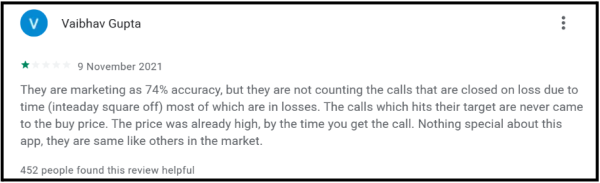
By the time subscribers received the calls, prices had already moved, making entry pointless and exits painful.
2. Rajender: Notified After the Target, Then Told to Buy at CMP
He described a specific trick behind this pattern.
Notifications arrived after the target price had already been hit, then he was asked to buy at CMP, current market price, after which the price would fall.
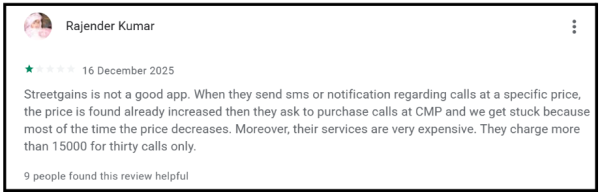
He also flagged the plans as excessively priced, over ₹15,000 for just 30 calls.
3. Bhupender: Four of Five Trial Calls Hit Stop Loss
Writing after downloading the app on a friend’s recommendation, he opted for index options and received five free trial calls.
Four of the five hit their stop loss.
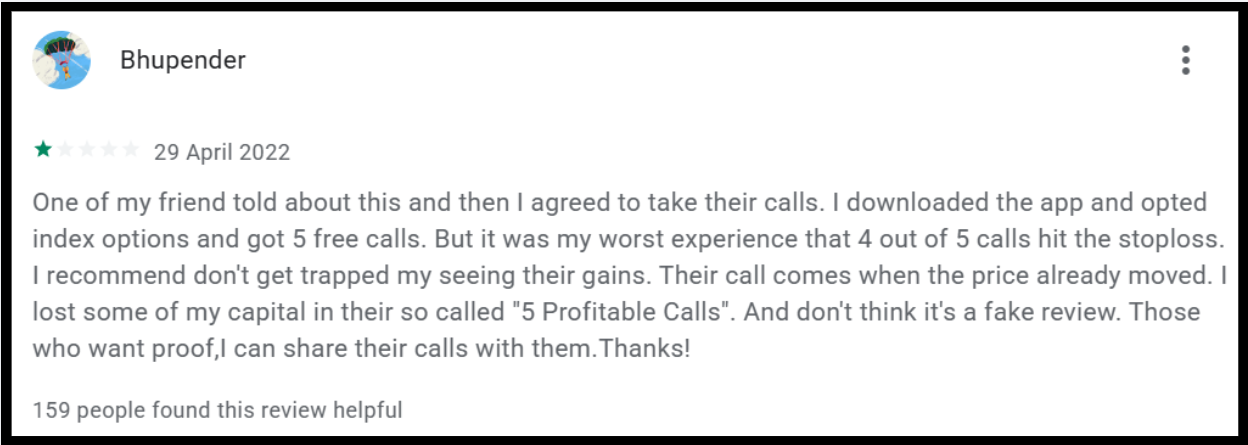
His warning was blunt: the calls arrive after the price has already moved, and he offered to share his actual call records as proof.
Pattern 2: Targets and Accuracy Numbers That Do Not Add Up
The second pattern is quieter but arguably more troubling, because it touches the honesty of the numbers themselves.
1. Abhishek: Targets Changed After the Fact to Show Fake Profits
He reported that targets were frequently changed after the fact to manufacture the appearance of profitable calls, with entries made unfavourable by calls arriving late in the first place.
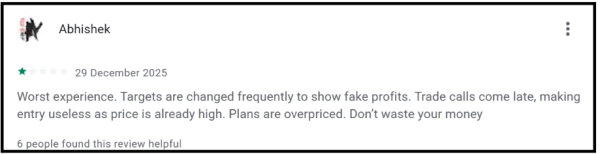
His review directly mirrors what SEBI’s own investigation would later document: selective performance reporting.
2. Ram Prasad Aryal: Only Profit Calls Shown, Accuracy Below 20 Percent After 2 PM
A Local Guide with multiple reviews, he pointed out that the firm’s Telegram channel shows only profitable trades in its reports.
He noted that calls made after 2 PM had less than 20 percent accuracy in his own tracking, and asked directly, “why only profit calls to show in group? To lure people?”
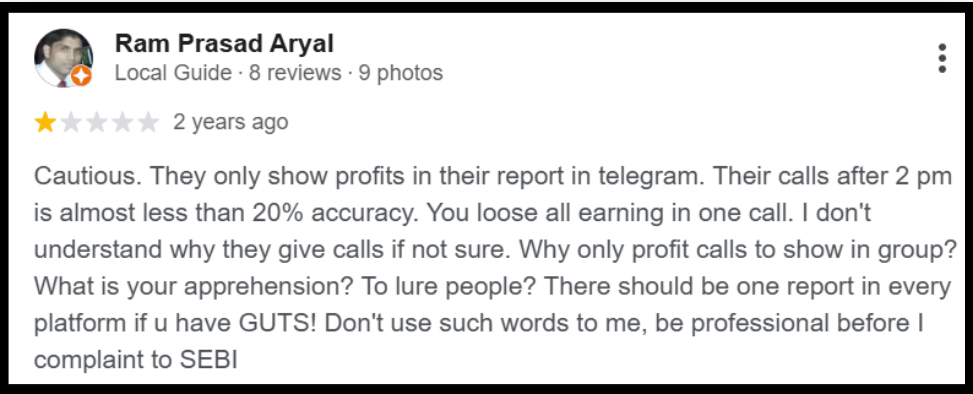
He stated he planned to file a SEBI complaint over the conduct.
3. Zakir Hussain: Stop Loss Levels Never Disclosed Upfront
He described a systematic pattern on the firm’s Telegram channel, losing trades quietly left out of the public feed while stop loss levels stayed undisclosed until a trade had already moved against him.
In his own words, “they don’t show their loss trade on Telegram and all… most of the time they count 2nd or 3rd target when trade hit SL after hit 1st target.”
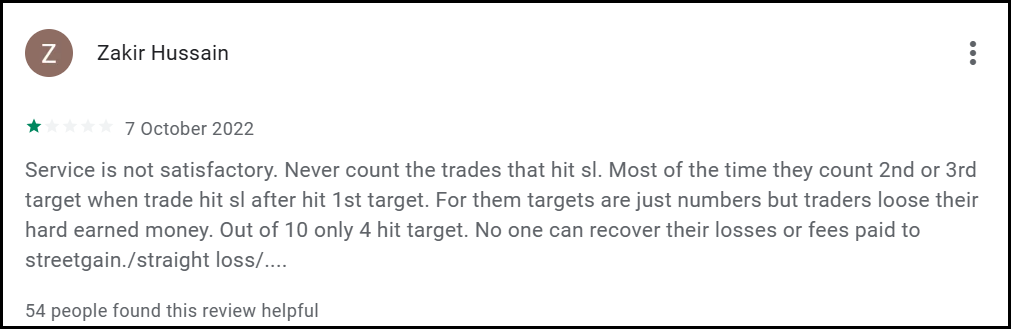
In plain terms, when a trade reversed after touching its first target and went on to hit its stop loss, the platform still counted it as a win by pointing to the target it briefly crossed, a dishonest scoring trick that makes every public accuracy claim harder to trust.
4. Nikita Jain: “Fraud Company” With 45 Trades and a Buried Accuracy Trick
“Not recommended at all, fraud company.” She reported taking the option call program for 45 trades. “They make big promises but fulfil nothing.”
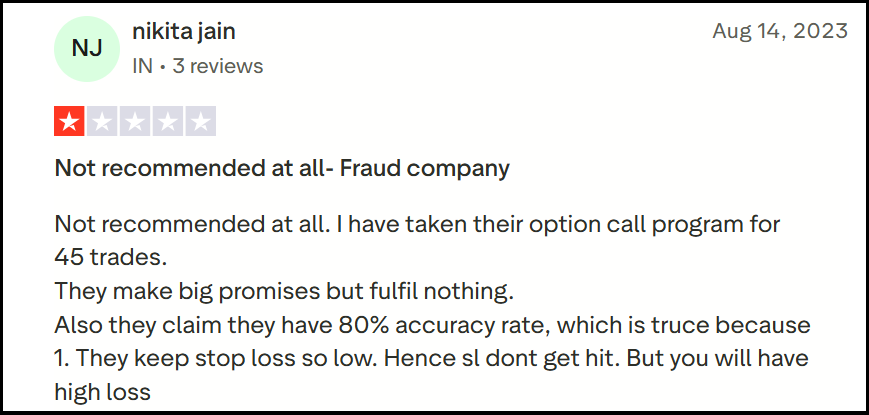
She specifically challenged the firm’s 80 percent accuracy claim, explaining that stop losses were kept so low they rarely triggered, which meant trades stayed open into high losses instead of exiting early.
Pattern 3: Losses That Continue Even After Upgrading
The third pattern hits hardest financially, because it involves subscribers paying more, not less, to escape a losing streak.
1. Priti: Refused a Downgrade and Kept ₹35,000
She subscribed to the basic plan first, and the calls she received produced losses from the start.
Instead of pausing to reconsider, she was pushed to upgrade to the premium plan, told the higher tier would fix the problem. It did not. The premium calls lost money too, on top of what the basic plan had already cost her.
When the losses continued, she asked to downgrade back to basic.
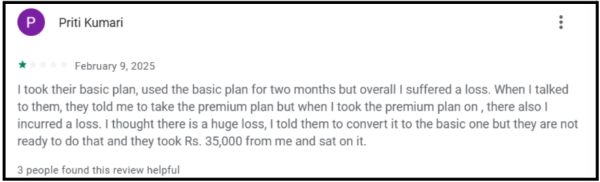
The company refused the request outright and retained ₹35,000 from her payment, money she never got a service that matched.
2. Mohd Sahil: “Teacher of Cheaters”
He left a blunt one-star review with no ambiguity in it.
“They are frauds, they are charging fee to make u bankrupt. Be cautious & never trust these type of services, they all are teacher of cheaters.”

His complaint is the plainest fraud accusation among all thirteen reviews, no specific rupee figures, no drawn-out sequence, just a direct warning that the fee itself is designed to drain the subscriber rather than help them.
3. Arijeet Chaudhry: 80 Percent Stop Losses, Then Support Went Silent
His experience began the way many subscriptions do: trial calls that looked genuinely profitable, which is exactly what convinced him to pay.
Once he subscribed, the pattern flipped. Calls arrived with barely any time to enter before the opportunity had passed, yet the platform still counted them as profit calls in its own record.
After subscribing, 80 percent of his calls hit intraday stop losses, a ratio that turned his subscription into a losing proposition almost immediately.
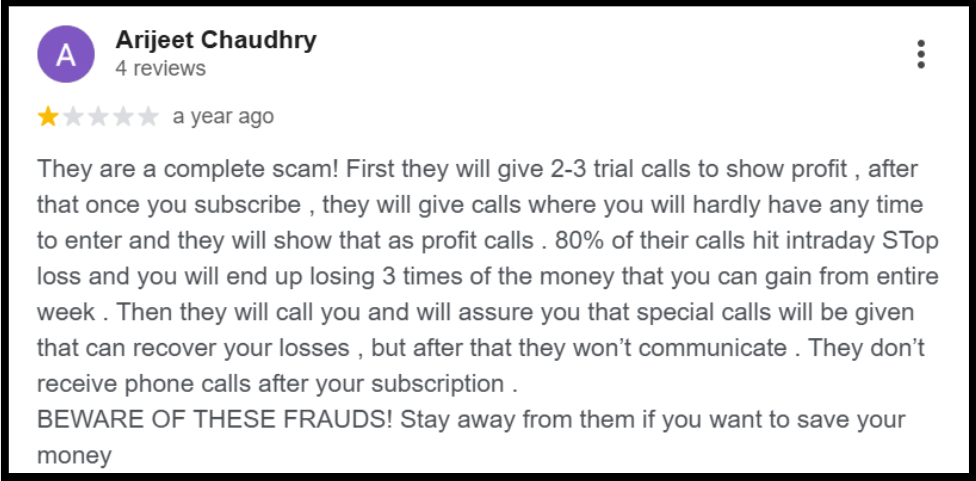
When the losses mounted and he tried to reach out for an explanation, customer support stopped responding, leaving him without answers exactly when he needed them most.
4. Tharakesh Pulikonda: Profits Till You Pay, Then Silence
A Local Guide with 30 reviews on record, his account of the platform followed a clear arc, and he stated it plainly.
Profits are shown until you pay. Before subscribing, the calls and the screenshots he saw suggested consistent success. After paying, the losses began, and the firm became unreachable the moment he needed support.
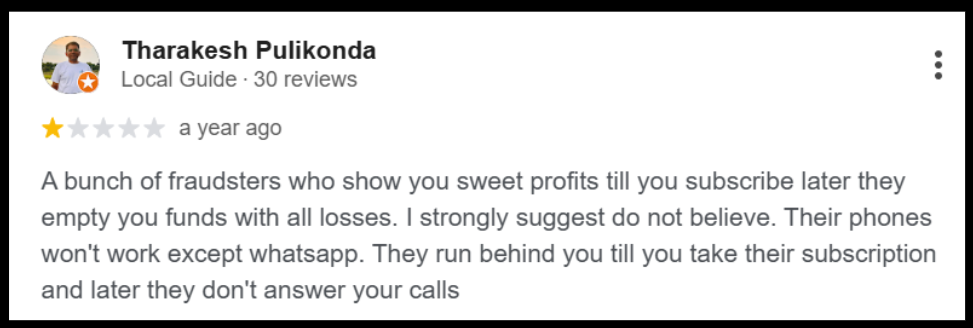
His review matters because it echoes Arijeet Chaudhry’s experience almost exactly: a strong track record shown before payment, a weak one delivered after, and silence when the gap between the two becomes a problem.
5. Tharakesh Pulikonda: “Sweet Profits Till You Subscribe”
Before he paid, the results he saw looked genuinely profitable, which is why he subscribed.
After paying, the trades kept losing, and phone support went unreachable; WhatsApp was the only channel that ever worked.
“A bunch of fraudsters who show you sweet profits till you subscribe, later they empty your funds with all losses… they run behind you till you take their subscription and later they don’t answer your calls.”
Pattern 4: Support That Vanishes, and Reviews That Get Punished
The fourth pattern is the one that turns every other complaint from frustrating into isolating, because it removes the one channel meant to fix the other three, and in two cases, it goes further, retaliating against the customer for speaking up.
1. Karn Kumar: Blocked After Posting a Review
He described asking multiple times for an update on his issue and receiving none. Then, in his own words: “They have blocked my active paid subscription after seeing my review and asking to remove the review to resume their service.”
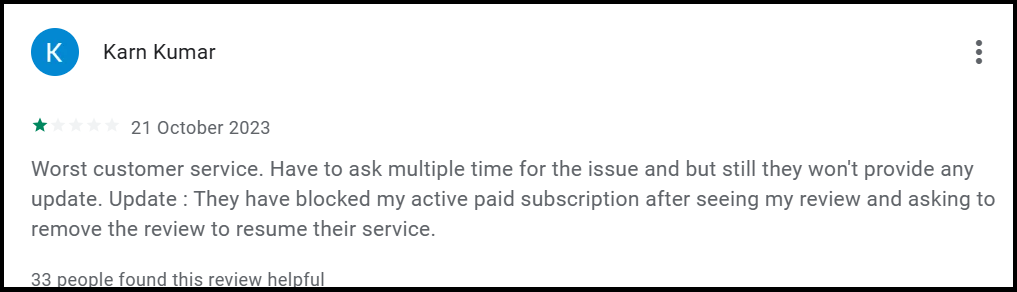
33 people found his review helpful, and the pattern it describes is serious: a paying subscriber losing access to a service he had already paid for, specifically because he posted honest feedback.
2. Royality: “Fraud Company, Block Kar Dete Hain, Loss Kar Ke”
A second reviewer, with 28 reviews on their profile, described the same blocking pattern in different words: “Fraud company fraud block krdete h loss krke. Please nobody’s in this company we request you.”
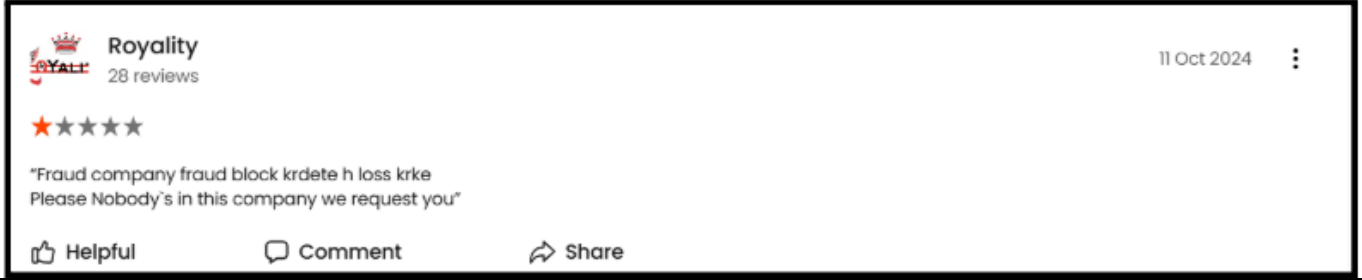
Read alongside Karn Kumar’s account, this is no longer one isolated complaint but two separate reviewers independently describing the same retaliatory blocking behaviour, which is what turns a customer service complaint into a pattern worth real attention.
User reviews are one side of this story. The regulator’s own investigation is the other, and the two describe the same firm from completely different vantage points.
Also read: Aakanksha Gupta reviews, flagging exact trade instructions without risk profiling.
How SEBI’s Findings Match These User Reviews?
These are user reviews, not regulatory findings, and the two should be weighed separately. But they should also be read together, because they describe the same firm from two different vantage points.
SEBI’s own investigation documented return assurances, selective performance posts, and an incentive structure pushing unsuitable products, and the firm was fined ₹8 lakh with a one-month ban on new clients as a result.
The full investigation, every violation, and both orders are told start to finish on our page: is Streetgains safe?
The overlap is the point.
Selective performance display and promised outcomes are not just user complaints here; they are documented regulatory violations, which means the pattern is confirmed twice over.
Red Flags Still Visible on Streetgains’ Own Channels
Beyond individual reviews, three patterns sit in plain sight on the firm’s public channels, and every prospective subscriber should see them before paying.
1. An Account Management Service the Firm Cannot Legally Offer
The Telegram channel promotes directly managing client trading accounts on platforms like Zerodha, AngelOne, and Upstox, under a 50:50 daily profit-sharing arrangement.
A Research Analyst registration does not permit this.
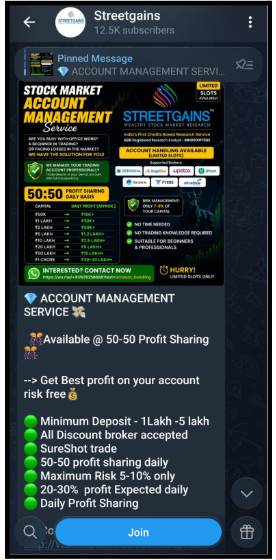
Managing accounts and sharing profits requires a completely separate Portfolio Manager registration, which means this specific offer sits outside what the firm is licensed to do at all.
2. Profit Screenshots Doing the Selling
The same channel regularly posts images of extraordinary gains, positions worth over a crore, capital doubled, alongside testimonials praising the account service.
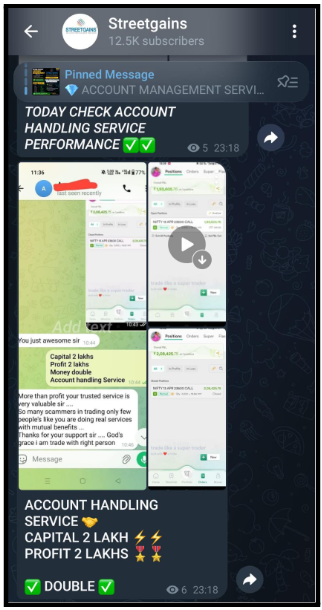
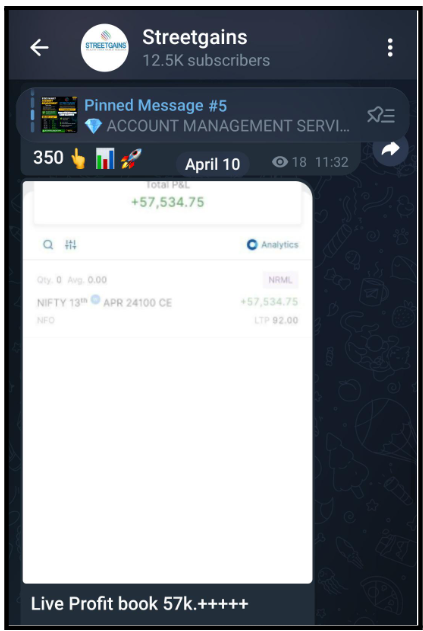
This is the exact practice SEBI’s orders already penalised, using selective screenshots to induce subscriptions.
3. Only Positive Reviews Shown on the Official Website
The official site displays exclusively positive testimonials, no mention of losses, upgrade pressure, or any SEBI order anywhere on the page, a sharp contrast against the pattern above.
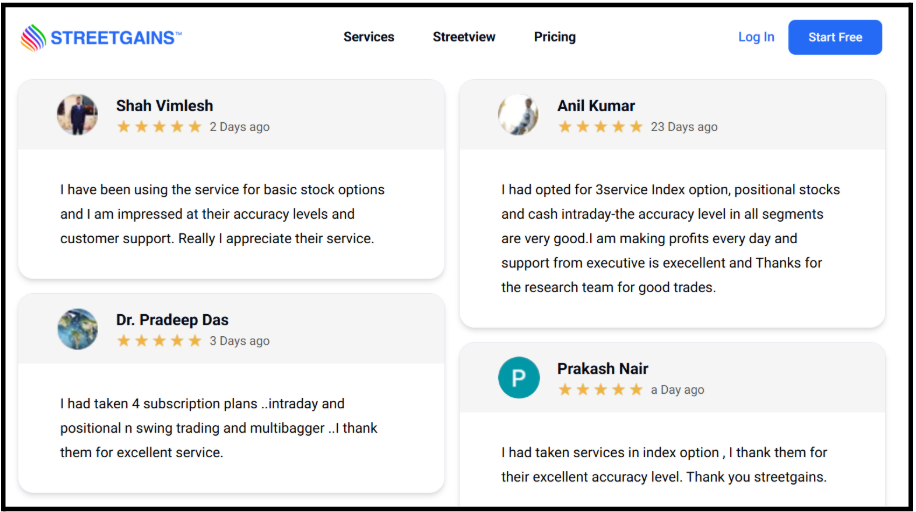
A firm curating away its own negative record deserves more scrutiny, not less.
Recognise your own experience in one of the thirteen reviews above?
You are not the only one, and the pattern is now documented from multiple directions. Tell us what happened, and we will map it against what SEBI has already found and what other subscribers have already reported.
Streetgains Reviews & Complaints: Your Own Next Step
Reading someone else’s experience is only useful up to a point. At some stage, the real question becomes what you do if your own situation matches what you’ve just read.
If a call arrived late, if a target got changed after the fact, if support went silent once you’d already paid, that’s not just a pattern anymore; it’s a reason to act.
The good news is that acting on it isn’t complicated; it just needs to happen in the right order.
How to Complain Against Streetgains?
A complaint against a SEBI-registered firm is not a shot in the dark. There is a defined sequence, and every stage in it has a purpose.
Here is that sequence, laid out fully, one stage at a time:
Step 1: Document Everything Before You Contact Anyone
Before a single email goes out, spend twenty minutes building the file that will carry your entire complaint.
Collect every WhatsApp message, SMS alert, call recording if you have one, payment receipt, subscription invoice, and screenshot of any call, target, or promise made to you.
Note the date and time next to each one.
This step decides how far your complaint goes.
A vague description of feeling misled rarely moves a forum to act. A dated screenshot showing an exact promise, followed by an exact outcome, is what tribunals and regulators actually respond to.
Step 2: Contact Streetgains Directly, in Writing
Before escalating anywhere, raise the issue with the firm itself, and do it in writing, never only over a phone call.
Streetgains Complaint Email
Write to the firm’s compliance function at [email protected], stating plainly what call or promise you received, what you experienced instead, and what resolution you are seeking: a refund, a downgrade, or a formal explanation.
Keep the email itself as your first dated record, and never let a phone conversation replace it, because a written trail is what every later stage will ask you to produce.
Streetgains Complaint Phone Number
If a direct support number is listed on your subscription confirmation or the app, call it to register the same complaint verbally, then follow up immediately by email confirming exactly what was discussed on the call.
Treat the number as your fastest first contact, and the email as the actual record.
If the number is unreachable or unresponsive, that failure itself becomes part of your written complaint at the next stage.
Give the firm reasonable time, typically two to three weeks, to respond. Avoid emotional language in every message; stick to dates, amounts, and facts.
Step 3: File a Formal Complaint on SEBI’s SCORES Platform
If the firm’s response disappoints, or none arrives at all, your next stage is the regulator’s own complaint system.
File through the SCORES SEBI complaint portal, selecting Research Analyst as the intermediary category and entering the firm’s registration number.
Describe your grievance specifically, attach every document from Step 1, and submit.
SCORES forwards your complaint directly to the firm and tracks its response on a fixed timeline, giving your complaint a regulatory record that a private email never carries.
Step 4: Escalate Through the SMART ODR Portal if SCORES Does Not Resolve It
When SCORES closes without a satisfactory outcome, SEBI’s Online Dispute Resolution mechanism is the next stage, and it moves faster than a full regulatory proceeding.
Register your case on the SMART ODR complaint portal, which uses structured mediation and conciliation to resolve disputes, particularly effective when your loss is a clear, documented amount rather than a vague grievance.
This stage exists specifically for situations exactly like a subscription dispute, a defined fee paid, a defined outcome promised, and a defined gap between the two.
Step 5: Arbitration, the Final and Binding Stage
If every earlier stage has run its course and the matter remains unresolved, arbitration is where a documented financial loss gets its final hearing.
Our guide on arbitration in the share market explains the full process: an independent arbitrator reviews your evidence, both sides present their case, and the decision that follows is binding.
This stage suits disputes with a clear, calculable loss, exactly the kind Step 1’s documentation was built to prove.
Conclusion
Thirteen users. Four repeating patterns. Late calls, adjusted targets, losses that follow you into an upgrade, and support that goes quiet exactly when you need it most.
None of this is speculation.
Every pattern above appears in a public review, and several appear inside SEBI’s own findings too.
Read the reviews, check the red flags still live on the firm’s channels today, and weigh all of it against any promise made to you personally before a single rupee moves.
Report. Recover. Stay Fraud Free.
Independent review platforms show a consistent pattern of complaints, late trade calls, changed targets, losses continuing after plan upgrades, and support that fades after payment. The firm's own website shows only positive testimonials, which is itself one of the red flags worth noting. Yes, closely. SEBI's investigation documented selective performance advertising and return assurances, and multiple user reviews describe the exact same practices independently, calls counted as profitable despite late entry, and only winning trades shown publicly. Recovery outcomes depend on individual evidence and the specific violation involved. Users who documented their communications, receipts, and call timestamps are in a stronger position, and the process for pursuing it runs through SCORES and the escalation stages beyond. Streetgains' Telegram channel has promoted directly managing client accounts with a 50:50 profit sharing arrangement, a service that requires a separate Portfolio Manager registration a Research Analyst does not hold. Offers like this fall outside what the firm is legally licensed to provide. Website testimonials are curated and should never be the only source checked. Cross reference them against independent review platforms, the firm's SEBI registration, and its enforcement history before treating any five star review as the complete picture. Yes, cancelling doesn't remove your right to complain about what happened while you were paying. What matters is the documentation from that period, not whether you're still subscribed today. File with what you have. A payment receipt and a few dated screenshots are still a real starting point, more evidence strengthens a case, but incomplete documentation isn't a reason to skip filing altogether.Frequently Asked Questions





 Add us as a preferred source on Google »

