

Jainam broking complaints are surfacing faster than most investors realise, and the stakes could not be higher.
You picked a Gujarat-based broker with two decades of market presence, assumed the brand name offered security, and trusted it with your capital.
However, what if that trust runs into unauthorised square-offs, app failures during live market hours, a SEBI penalty for poor supervision of authorised persons, and an NSE arbitration award where a client recovered ₹5,19,758 after the broker’s employee allegedly traded in her account without consent?
This is not a hypothetical. Every single fact in this article is sourced. Read it before committing your capital.
Jainam Broking Complaints Overview
Many investors choose Jainam Broking based on its growing client base and competitive flat-fee pricing without reading a single Jainam broker review before signing up.
Very few check the complaint history, SEBI orders, or arbitration records before opening an account. That is exactly where the danger begins.
According to Jainam Broking’s official website, the firm holds SEBI Registration No. INZ000198735.
It was founded in Surat in 2003 and serves more than 3 lakh clients across India, offering equity, derivatives, mutual funds, IPOs, and advisory services.
On paper, those credentials look credible. However, credentials and compliance are two very different things.
A specific SEBI Order on Jainam Broking regarding poor supervision of authorised persons, alongside a confirmed arbitration award against the broker, raise questions that every investor deserves to know about.
Types of Jainam Broking Complaints Filed by Clients
Most Jainam broking complaints follow a recognisable pattern. These issues do not appear in isolation.
Instead, they repeat across different client segments, different cities, and different trading instruments.
Here is a breakdown of what investors have actually reported:
- Non-receipt of funds or securities after trade settlement.
- Unauthorised trades or unauthorised square-offs without client consent.
- Disputes over margin calls and forced position closures.
- Non-receipt of contract notes and trade confirmations.
- Excess brokerage or charges beyond mutually agreed rates.
- Misconduct by authorised persons acting under the broker’s name.
- Non-execution or incorrect execution of client orders.
You can file a complaint against a broker through BSE’s Investor Service Centres or its e-Complaint portal with the required documents.
If the broker fails to respond within 3 days or gives an unsatisfactory reply, the case goes to IGRC, which can penalise the broker and even release funds to the investor.
Jainam Broking Exchange Complaint Data
Exchange complaint data tells you something far more important, how often investors face serious issues and how consistently the broker resolves them.
Here is the complete year-by-year breakdown for Jainam Broking:
| Financial Year | Total Clients | No. of Complaints | % of Complaints | Resolved Complaints | % Resolved | Arbitration |
| 2025–26 | 135,861 | 106 | 0.078% | 96 | 90.57% | 0 |
| 2024–25 | 124,481 | 24 | 0.02% | 24 | 100% | 0 |
| 2023–24 | 101,577 | 14 | 0.01% | 14 | 100% | 0 |
| 2022–23 | 101,577 | 41 | 0.04% | 36 | 87.80% | 4 |
Data like this isn’t just informational, it’s diagnostic. It helps you assess patterns, consistency, and the true performance of a broker over time.
When you read between the numbers, you uncover how efficiently issues are handled and how reliable the broker really is.
Complaints exploded by 342% in a single year. From just 24 complaints in 2024–25, the number jumped to 106 in 2025–26. That is a 342% increase in one financial year.
Meanwhile, the active client base grew from 1,24,481 to 1,35,861, a rise of only about 9%. Consequently, Jainam broking complaints are growing at a pace that the client base growth does not come close to justifying.
10 complaints remain unresolved right now. As of 2025–26, ten complaints are still open with real investors waiting for resolution on real money.
In trading, every day of delay on an unresolved dispute means continued financial exposure with no end date.
Resolution consistency varies sharply year to year. The broker resolved 100% of complaints in both 2023–24 and 2024–25. However, in 2025–26, the resolution rate dropped to 90.57% with 10 still pending.
Additionally, in 2022–23, 5 complaints went unresolved. That inconsistency is worth noting before you commit your funds.
Also Read: Moneylicious Securities complaint, a ₹3 lakh SEBI penalty, split across two separate provisions.
Jainam Broking Arbitration Case
Exchange complaint data highlights investor dissatisfaction at a surface level. However, SEBI orders and arbitration records go deeper, exposing confirmed violations and cases where brokers were held accountable.
In some instances, even arbitrators have ruled in favour of investors, proving that the issue wasn’t just a complaint, but a verified lapse in conduct.
Case Overview: Unauthorized Square-Off
This is one of the most investor-relevant complaint cases against Jainam Broking.
As per this NSE Arbitration, a client from Bhavnagar was trading Bank Nifty options through Jainam’s authorised person.
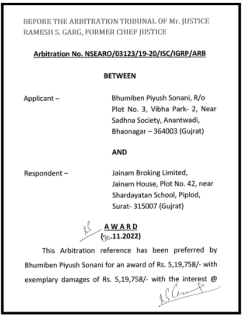
On 26 September 2019, she sold call options within allowed limits.
However, her positions were fully squared off by the broker’s employee without any prior notice or margin call, leading to a loss of ₹5,19,758. She stated that if positions were held till market close, they would have been profitable.
The arbitrator noted that the broker’s own policies required prior intimation and a request for additional margin before squaring off positions.
The broker failed to provide any call records or proof of communication with the client. Also, 56 trades were executed within a single minute, showing there was no attempt to contact the client.
Final Arbitration Award
The final decision directed Jainam to pay ₹5,19,758 to the client.
Interest at 18% per annum was applicable from 26 September 2019 until the award date, and 2% above prevailing rates thereafter until full payment.
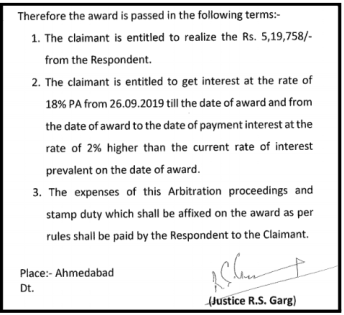
All arbitration costs and stamp duty were also to be paid by the broker.
What to Learn from This Case?
- A broker cannot square off your open position without prior intimation, regardless of what informal conditions were agreed through an authorised person. Such conditions are against the law.
- Always demand a written margin call before any square-off. If the broker acts without calling you first, that action is legally challengeable.
- Keep records of every trade confirmation, ledger statement, and communication with your authorised person. These become your primary evidence in arbitration.
- If the broker’s authorised person makes verbal arrangements with you about trading limits or square-off conditions, get every single detail in writing before you trade.
- Arbitration works. This case proves that even small retail investors from Gujarat can recover significant amounts when they document their claims and see the process through.
Jainam Broking User Reviews
Behind every review is an investor and real money on the line. What appears as simple ratings on Jainam’s Google Play apps actually reflects lived experiences, both good and bad.
Take a closer look, and you start to see what users are truly dealing with:
1. App Freezes and Shows Zero Data Across All Scripts
A user reported that the app stopped working entirely for over two hours during active market hours, displaying “00” across all instruments.
The user pointed out that this made it impossible to check current prices or manage their portfolio.
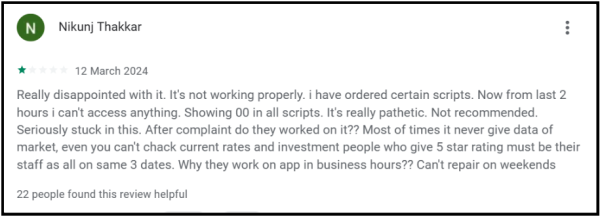
Furthermore, they raised a complaint after the incident but observed no meaningful action from the team.
They also alleged that several 5-star reviews on the same dates appeared suspicious, suggesting coordinated manipulation of app ratings.
This is not a minor bug. When an app goes dark during market hours, investors cannot monitor their open positions, assess P&L, or exit trades before losses deepen.
2. Session Expiry Every 10 to 15 Minutes During Order Execution
A user described the session expiring every 10 to 15 minutes, logging them out at the exact moment they were punching an order.
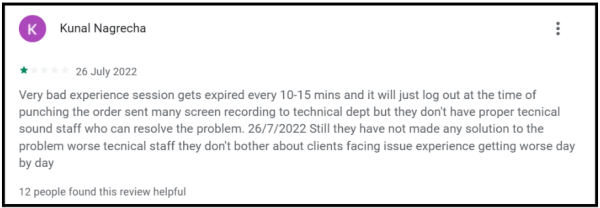
The user sent multiple screen recordings to the technical department but received no resolution. On the date of their review itself, the problem had still not been fixed.
The reviewer noted that the technical staff did not appear to take client issues seriously and that the experience was getting progressively worse over time.
For active traders, a session expiry during order placement is not just annoying; it can mean a missed entry or exit at a critical price level.
3. High Charges, Bug-Ridden App, Broken Promises
A user gave a 1-star rating in December 2025 and summarised their experience in three points: the broker promises a great deal but delivers very little, charges are extremely high compared to competitor brokers, and the app has consistent bugs that are inferior to competing platforms.
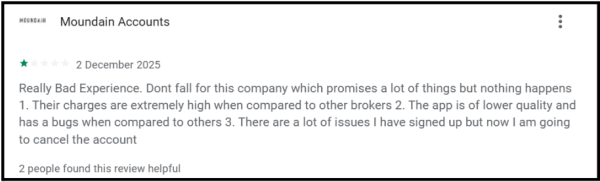
The user registered for the account, hoping for an improved experience, but reached the point of deciding to cancel the account entirely.
This review highlights a trust breakdown that goes beyond individual technical issues.
When investors sign up based on marketing promises and then encounter high charges, unreliable technology, and an apparent lack of urgency from the broker to fix known problems, the result is account closure, not just a bad rating.
When to Take Action Against a Broker?
Most investors delay raising a complaint. That delay, however, compounds the problem significantly.
Take immediate action in the following situations:
- Unauthorised Position Square-Off: Your open position was closed without any margin call or prior intimation. Document the trade log, your account balance at the time, and every communication with the broker.
- App Failures Causing Missed Trades: The platform freezes, logs you out, or shows zero data during live market hours. Screenshot everything with a timestamp and raise it in writing immediately, not the next day.
- Charges Higher Than Agreed: Brokerage or MTF interest deducted from your account exceeds what was disclosed at account opening. Calculate the cumulative difference and raise it formally in writing.
- Conducting Trades Without Confirmation: Your AP executed trades without prior approval. Raise a written complaint immediately, and do not trade further until the matter is resolved.
- No Response Despite Follow-Ups: You have sent complaints, screen recordings, or emails, but received no resolution. Escalate to the exchange without waiting any further.
Even a seemingly small unauthorised square-off matters because, as the NSE arbitration case above shows, it can amount to ₹5 lakh and above when calculated properly and pursued through the right channel.
How Do I Complain About a Broker?
If you are facing an issue with Jainam Broking Limited, follow this process in order. Do not skip steps. Each level builds a documented record and gives you stronger grounds if you need to escalate further.
Step 1: Contact Jainam Broking Directly
Start by raising a formal written complaint with the broker.
Clearly mention your client ID, trade details, dates, and complete issue description. Attach all supporting documents such as contract notes, screenshots, account statements, and communication records.
This is the first and most important step before escalation, as many issues are resolved at this level.
Step 2: File a Complaint in SCORES
If the broker does not resolve the issue, escalate it by filing a complaint on the SEBI SCORES portal.
Register using your PAN, mobile number, email ID, and address, and upload all supporting documents.
After filing, you can track the status of your SEBI complaint directly on the SCORES dashboard, where updates and responses from the broker are recorded.
Step 3: File a Complaint in SMART ODR
If the issue remains unresolved, proceed through the exchange grievance system via Smart ODR (Online Dispute Resolution).
This structured process connects the investor, broker, and exchange to resolve disputes using verified and documented evidence.
It ensures faster and more transparent resolution compared to traditional methods.
Step 4: Arbitration in Stock Market
If all previous steps fail, the case moves to formal arbitration under the stock exchange mechanism.
Here, an independent panel reviews all evidence, such as trade logs, contract notes, fund statements, and communication history.
The final decision is legally binding and based purely on documented proof and transaction records.
Need Help?
Handling a complaint against Jainam Broking and not sure what to do next? You’re not the only one, and you don’t have to figure it out on your own.
Many investors either delay raising concerns or miss important escalation stages. This hesitation benefits the broker every single time, and past arbitration decisions show that delays lead to growing financial damage.
If you’re unsure at any step, gathering proof, knowing your rights, or navigating SEBI and exchange procedures, the right support can make the process significantly smoother.
If you’re facing issues with Jainam Broking or any other broker, you can register with us. We’ll help you act correctly and at the right time.
Conclusion
Jainam Broking Limited is a SEBI-registered firm established in 2003, with memberships across NSE, BSE, and MCX and a growing client base of over 3 lakh investors. That institutional presence is real.
However, every Jainam broker review that digs past the homepage tells a different story.
Institutional presence and investor protection are two very different things, and the documented record makes that distinction impossible to overlook.
Jainam broking complaints jumped by 342% in a single year.
None of this means every Jainam client will face problems. However, it does mean the risk is real, documented, and traceable to specific patterns of regulatory and operational failure.
If you are an existing client, verify every charge, document every trade, and act immediately if anything seems unauthorised or unexplained.



 Add us as a preferred source on Google »

