

Quick Summary
Alice Blue’s complaint volume jumped 95% in a single year, from 66 in 2023-24 to 129 in 2024-25, while its active client base shrank by over 43% across three years. One arbitration case involved ₹11.12 lakh in unauthorised trades, with ₹3.36 lakh still unpaid at the time of the hearing, the full details of which are covered on our account handling page. Real user reviews describe app freezes during live trading, automatic exit orders wiping out positions, and support teams that transfer you endlessly without resolving anything. Technical glitch reports have also risen year over year. This blog covers the full exchange data, four user reviews, and the exact steps to file a complaint if you’re dealing with something similar.
You’ve probably noticed the same thing everyone else searching for this does. Alice Blue’s pricing looks great on paper. Flat ₹20 a trade, free delivery, dead simple signup.
Then you start reading what actual users say, and the picture shifts. Complaints jumped 95% in a single year. The client base shrank by over 40% in that same window, people leaving faster than the broker could keep them.
That gap between the pitch and the reality is what this blog actually digs into. The real exchange data. Four named user reviews, in their own words.
The app glitches are showing up more each year. And how each of these connects to a documented case that’s serious enough to have its own dedicated breakdown elsewhere on this site.
By the end, you’ll know exactly what to watch for in your own account, and what to do the moment something doesn’t add up.
Alice Blue Complaints Review
Alice Blue has been running since 2006, out of Bangalore, offering trades on BSE, NSE, and MCX through its ANT platform.
The pitch is simple. Flat ₹20 per trade. Free equity delivery. Paperless account opening.
For a first-time investor, that’s genuinely hard to say no to.
But flat pricing isn’t the same as reliable service, and that gap is exactly where Alice Blue complaints start piling up. Automatic orders placed without consent. Apps that freeze mid-trade. Support that circles without ever landing on a fix.
What Types of Complaints Do Alice Blue Users File?
Before you can spot a red flag in your own account, it helps to know what red flags actually look like for this specific broker.
These issues aren’t scattered randomly. They cluster around a small set of recurring failures, the same five or six patterns showing up again and again across different users, different years, different reviews.
- Exit orders placed automatically, without the client asking for them. This one shows up most often, and it’s the category behind the arbitration case below: ₹11 lakh in disputed trades tied to exactly this pattern.
- Charts and data freezing during live trading. Traders describe watching a price sit frozen on screen while the actual market keeps moving underneath it.
- Support that transfers you five times and resolves nothing. Calls picked up, then handed off, then handed off again, with no one actually owning the problem.
- Deposited funds taking an hour or more to reflect. For an active trader, that delay alone can mean missing the exact entry you were waiting for.
- Charges that don’t match what you agreed to. If your brokerage or fees seem higher than expected, our page on Alice Blue money excess charges breaks down exactly how common this actually is.
- Profitable options positions that won’t let you exit. The position shows a gain on screen, but the sell order simply won’t go through.
If the broker doesn’t respond within 3 days, a complaint filed through BSE moves automatically to the IGRC, which has the power to penalise Alice Blue directly and recover funds from its own deposits.
Is Alice Blue App Not Working Rare, or a Real Pattern?
App reliability doesn’t show up as its own line in the exchange data table below. It usually gets folded into the broader service complaints instead.
Trading apps like this one run on several systems at once: mobile servers, internet connectivity, exchange integration, and real-time market data feeds, all working together.
When any single piece slows down or fails, you get the usual suspects: slow loading, login failures, delayed data, or the app freezing entirely.
Alice Blue does track technical glitches separately from everything else, and here’s what that shows:
| Year | No. of Complaints |
|---|---|
| 2023-24 | 1 |
| 2024-25 | 3 |
| 2025-26 | 3 |
Small numbers on their own. But small numbers can still matter a lot, depending on timing.
Alice Blue has roughly 93,000 active clients. Even assuming just 10% trade during any given session, that’s over 9,000 people potentially relying on the app at the same moment.
When timing is everything, even a short interruption changes the outcome. Orders placed or modified during a glitch can execute at a worse price than intended.
Exiting a position becomes genuinely difficult right when the market is moving against you, exactly the moment you can least afford a delay.
And it’s also why repeated glitches tend to make traders more hesitant about the platform over time, not less, even once the immediate issue is fixed.
A glitch count of 1, 3, 3 looks tiny in isolation. It looks a lot less tiny once you connect it to how many people were likely trading at that exact moment, and how quickly a few minutes of downtime can turn into a real loss.
If a glitch has cost you a trade, screenshot it immediately, with the timestamp visible, before escalating through the steps later in this blog.
Alice Blue Exchange Complaint Data
User reviews tell you what a problem feels like. They don’t tell you how often it’s actually happening across thousands of accounts, not just the ones loud enough to leave a review.
That’s what this table is for. These numbers come straight from exchange records, not estimates, not guesses, the actual, tracked count of complaints Alice Blue has reported year over year.
| Financial Year | Total Clients | Complaints | % of Complaints | Resolved | % Resolved | Arbitration |
|---|---|---|---|---|---|---|
| 2025-26 | 93,281 | 69 | 0.074% | 65 | 94.20% | 0 |
| 2024-25 | 1,31,289 | 129 | 0.1% | 129 | 100% | 0 |
| 2023-24 | 1,63,442 | 66 | 0.04% | 66 | 100% | 3 |
| 2022-23 | 1,63,442 | 100 | 0.06% | 97 | 100% | 0 |
Two things jump out here. Complaints nearly doubled between 2023-24 and 2024-25, a 95% increase in one year.
Meanwhile, the client base shrank sharply, from 1,63,442 down to 93,281 over three years, a drop of more than 43%.
Fewer clients. More complaints. That combination doesn’t happen by accident.
Three arbitration cases in 2023-24 are also worth sitting with. Arbitration isn’t a quick step; it means an investor already went through the broker directly, then the exchange’s grievance process, and still didn’t get resolution.
Three people hit that wall in a single year, out of just 66 total complaints. That’s roughly 1 in every 22 complaints escalating all the way to arbitration, a real signal of disputes that simply couldn’t be resolved any other way.
The Alice Blue Arbitration Case: What ₹11 Lakh in Disputed Trades Actually Cost One Investor?
One of the most serious disputes on record against Alice Blue involved an Ahmedabad investor who says trades were executed in his demat account without his knowledge, totalling over ₹11 lakh.
Alice Blue’s own representative admitted the lapse during the hearing, and the arbitrator ruled the broker responsible.
The full case, the timeline, the exact figures, and what it teaches you about fighting a similar dispute, lives in complete detail on our page covering Alice Blue unauthorised trading, where it sits next to the full six-year data trend on how often this exact pattern shows up.
Alice Blue Reviews
You can read a company’s own marketing all day and learn nothing about what it’s actually like to use their app at 2 pm when a trade’s going wrong.
Reviews are messier than marketing, and that’s exactly why they’re worth reading.
Here are four users, four different problems, all posted on the Google Play Store in their own words.
1. No Resolution By Support
A user left a 1-star review in September 2023 with 50 users marking it as helpful, describing a support system designed to exhaust the investor rather than help them.
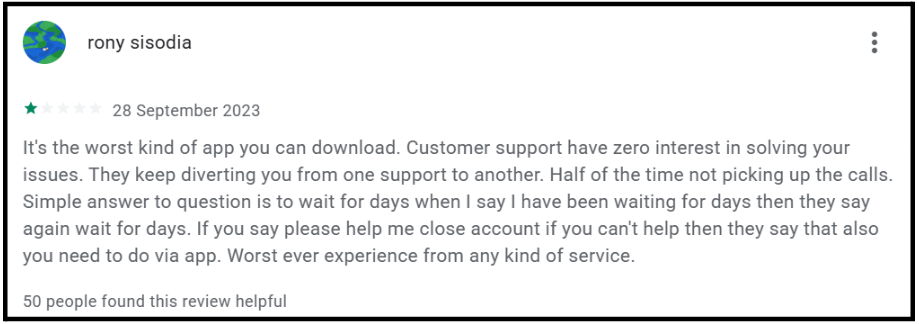
The user reported being transferred from one support person to another, with each new contact offering only a promise to wait longer.
He described it as the worst service experience they had encountered from any kind of company.
2. App Blocks Profitable Options Exits
The complaint was specific and serious: after taking an options position, the user found it impossible to sell when in profit.
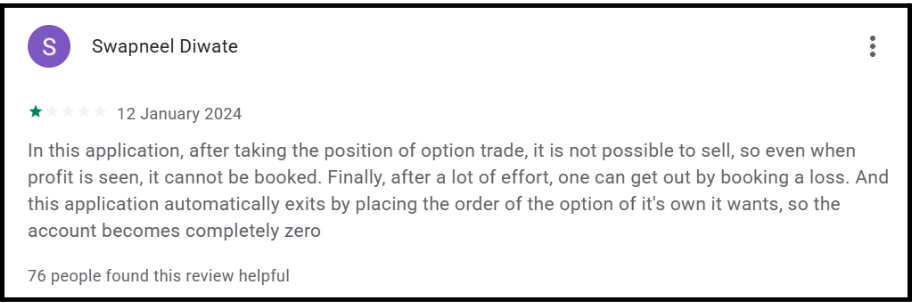
The app blocked the sell action entirely. Eventually, the only way to exit was to book a loss.
The review additionally reported that the application placed exit orders of its own choosing, resulting in the account balance going to zero.
This is one of the most reported categories of Alice Blue complaints, and it matters enormously in options trading.
An investor who cannot book a profit when a position moves in their favour is not trading; they are hostage to a platform that controls the outcome.
3. Data Freezes During Live Trading
A user described that the app and web platform cannot keep up with live market prices.
Charts freeze, data sticks at one point in time, and the platform provides no real-time view of what the market is doing.
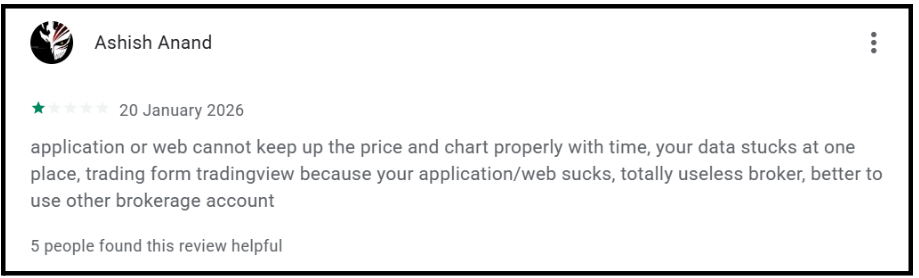
For any broker, losing clients to third-party charting platforms because the native app cannot keep up with real-time data is a significant failure.
4. Auto-Trades Draining Account
A user left a 1-star review in January 2026, warning other investors not to use the trading app, describing automatic trades taking place in the account without the investor placing any order.
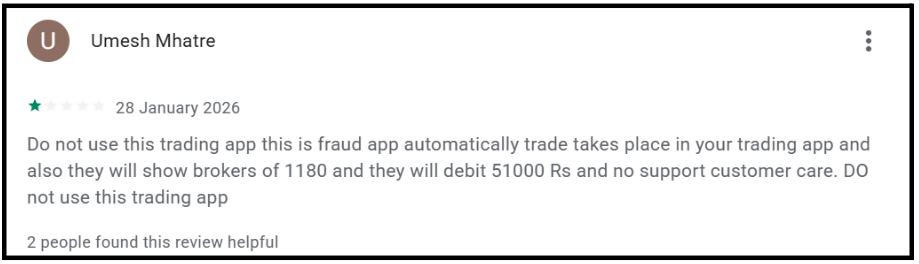
The review additionally reported that the broker was displaying brokerage of ₹1,180 while deducting ₹51,000 from the account and that customer care was entirely unreachable.
The reviewer described it as a fraudulent application.
Stuck in a loop with Alice Blue’s support, or dealing with an app that’s cost you a trade?
Our team will review your records, map exactly where the broker’s response falls short, and help you file a complaint built to get a real result.
When Should You Take Action Against Alice Blue?
Most investors absorb problems quietly. They assume the platform will self-correct, or that support will eventually pick up.
That patience costs you. Waiting almost always makes recovery harder, not easier.
- Unauthorised trades or square-offs you didn’t approve. Act the same day you notice, not after a week of second-guessing yourself.
- Platform failures during market hours that cost you a trade. Screenshot it immediately; the timestamp matters more than you’d think.
- Charges higher than what you agreed to at account opening. Compare your actual statement against what you were originally told.
- Support that goes silent or keeps circling. One delay is normal. Repeated delays mean it’s time to escalate past support entirely.
Also Read: Moneylicious Securities complaint, the complete picture, arbitration cases and SEBI orders together.
How to Complaint Against Alice Blue?
Here’s something most people don’t realise going in: every step of this process is really about taking away one of the broker’s excuses, one at a time.
A verbal complaint gives them room to say “we never heard about this.”
So the first move is closing that door: put it in writing to Alice Blue directly, your account ID, the exact date and time, what happened, and every document that backs it up. Now “we didn’t know” is off the table.
Ignored anyway?
That’s when SCORES SEBI complaint changes the room you’re arguing in.
It’s no longer just you against them; it’s a regulator watching how they respond, with your PAN and contact details creating a record that doesn’t disappear if someone conveniently forgets a call.
If Alice Blue still stalls, SMART ODR registration removes another excuse entirely; the exchange sits at the table too, and the conversation stops being he-said-she-said and starts being about the actual documents in front of everyone.
Trades that ran through BSE get one more specific route: a BSE complaint filed straight with that exchange’s own grievance desk, bypassing the broker’s willingness to cooperate at all.
And if it’s still not resolved after all that, arbitration takes the last excuse away: an independent panel goes through every trade log, contract note, fund statement, and message exchanged, and hands down a decision Alice Blue has to actually follow.
Each step exists because the one before it gave the broker somewhere to hide. Our guide on complaint against stock broker SEBI walks through the same ground in more depth if you want it.
Conclusion
Alice Blue is a legitimately registered broker with nearly two decades in the market and pricing that genuinely undercuts most competitors.
That part isn’t in question.
What’s in question is whether the platform’s reliability and complaint handling actually match the risks investors are taking on. Complaints jumped 95% in a single year.
The client base shrank by over 40% in the same window.
Cheap trades are only cheap when the platform actually works the moment you need it to. If yours hasn’t, don’t wait for it to fix itself.
Report. Recover. Stay Fraud Free.
Complaints rose from 66 in 2023-24 to 129 in 2024-25, a 95% jump, even as the active client base shrank by over 43% across three years. An investor lost ₹11,12,400 in disputed trades. Alice Blue was ordered to pay the remaining ₹3,36,000, plus 9% interest, rising to 18% if not paid within a month. No. The arbitrator ruled that if a secure account is breached and wrongful trades happen, the broker managing that account bears responsibility, not the investor. Reported glitches rose from 1 in 2023-24 to 3 in each of the two years after, small numbers, but with roughly 9,000 traders potentially active at once, even brief outages can matter. Download your account statement immediately, it's your strongest piece of evidence, then file a written complaint with Alice Blue the same day.Frequently Asked Questions




 Add us as a preferred source on Google »

