
Quick Summary
Alice Blue money excess charges accounted for as much as 68.18% of all complaints in 2023-24, and stayed above 47% in every year since. This blog breaks down the real exchange data year by year, two Google reviews from users who say they were charged and never refunded, and what actually counts as brokerage churning versus normal trading costs. You’ll also get the exact steps to follow if your own charges don’t match what you expected, and where each step actually leads.
Alice Blue money excess charges made up more than two out of every three complaints filed against the broker in 2023-24. Not a rare pattern. Not a one-off.
You’ve probably landed here for a reason. Maybe a deduction on your statement doesn’t add up, or someone you know had the exact same experience.
This blog walks you through what the actual numbers show, two real user stories, and exactly what to do if your own account looks like this.
What Are Alice Blue Money Excess Charges?
Alice Blue runs on a flat-fee model. Trade equities, derivatives, commodities, currencies, all at one simple, low brokerage rate.
That pricing is genuinely attractive. It’s also exactly why churning becomes hard to spot when it happens.
Churning is when a broker buys and sells inside your account far more than your actual strategy calls for. Not to grow your money. To generate fees.
Flat pricing doesn’t stop this. It just makes each charge look small enough that you don’t question it, right up until you add up a month’s worth and realise how much it actually came to.
This is different from a trade placed without your consent in the first place.
If that’s closer to what you’re dealing with, our page on Alice Blue account handling covers a real case and the year-by-year data on unauthorised trading complaints.
How Much of Alice Blue’s Complaints Are About Excess Charges?
You could read a hundred user reviews and still not know if what happened to you is common or rare.
Numbers settle that question in a way opinions can’t.
So let’s start with the broader picture before narrowing in on charges specifically:
| Financial Year | Total Clients | Complaints | % of Clients | Resolved | % Resolved | Arbitrations |
|---|---|---|---|---|---|---|
| 2022-23 | 1,63,442 | 100 | 0.06% | 97 | 97% | 0 |
| 2023-24 | 1,63,442 | 66 | 0.04% | 66 | 100% | 3 |
| 2024-25 | 1,31,289 | 129 | 0.09% | 129 | 100% | 0 |
| 2025-26 | 93,618 | 59 | 0.06% | 56 | 94.91% | 0 |
Look at that client column. It drops sharply, from over 1.6 lakh down to under 94,000 in three years.
Complaints didn’t shrink at the same pace. In fact, 2024-25 saw the highest complaint count of the four years shown, even with a smaller client base than 2022-23.
Now here’s the number that actually matters for this blog specifically:
| Financial Year | Total Complaints | Excess Charges Complaints | % of Total |
|---|---|---|---|
| 2022-23 | 100 | Around 34 | 34% |
| 2023-24 | 66 | Around 45 | 68.18% |
| 2024-25 | 129 | Around 61 | 47.28% |
| 2025-26 | 59 | Around 30 | 50.84% |
Worth being upfront about: NSE doesn’t run a dedicated “excess charges” category, so these figures come from identifying charges-related complaints inside the broader data, not an official classification.
Treat them as close estimates, not exact counts.
Even with that caveat, look at 2023-24. More than two out of every three complaints that year traced back to charges. And it never dropped below roughly half in any of the four years shown.
This isn’t a spike. It’s the norm.
Real Users on Alice Blue Money Excess Charges
Numbers are one thing.
Here’s what it actually looked like for two people who lived through it:
1. Charged, Denied, and Never Refunded
One reviewer described being charged money he says he was never supposed to pay. He raised it with customer care directly.

No refund came. Alice Blue told him they’d emailed him about it days earlier.
He says that email never arrived. No record he could point to, no resolution either.
2. A Second, Nearly Identical Story
Another reviewer reported almost the same thing. Charged more than expected, no clear explanation given.
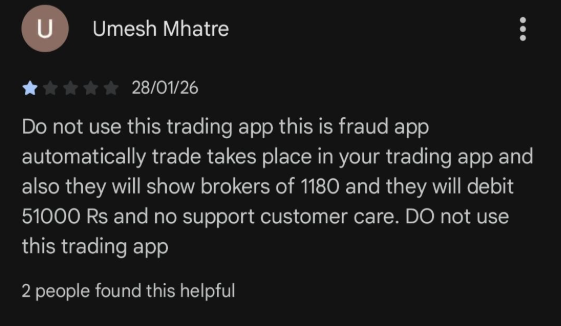
Two unrelated users, same pattern, same outcome. That’s not a coincidence; that’s a system that isn’t catching these disputes before they reach a public review.
Noticed charges on your Alice Blue account that don’t match what you agreed to?
Our team will review your contract notes and statements, identifies the exact gap, and helps you build a complaint that actually gets a response.
What Excess Charges Actually Cost You?
A few extra rupees a trade feels like nothing in the moment. You barely notice it, so you barely question it.
But money doesn’t work in moments.
It works in months, and that’s where the real number actually lives, quietly, in a place you never think to look until someone forces you to.
- Higher costs eat your returns. Every extra trade adds brokerage, taxes, and fees on top. Even a profitable month can end up flat once all of that gets subtracted.
- Complaint patterns are a real signal. Before you commit money anywhere, look at what other investors have actually experienced, not just the marketing.
- Rising complaints should make you more careful, not less. If the numbers are climbing, that’s worth factoring into how closely you watch your own account.
- Your statements tell the truth. Pull your contract notes regularly and check whether the activity actually matches what you intended to do.
- Track your brokerage against your trade count. If the two don’t scale together the way you’d expect, that gap is worth investigating.
This is why checking your statements shouldn’t be a once-a-year habit. It should be routine.
For the fuller picture of how this fits alongside everything else investors report about Alice Blue, our page on Alice Blue complaints covers the exchange data, a real arbitration case, and user reviews across every category, not just charges.
Also Read: Aditya Birla Money excess charges, and the delivery brokerage of 0.5% that one review calls very high.
How to File an Alice Blue Complaint for Excess Charges?
Most people either give up after one angry email or jump straight to threatening legal action. Neither actually works.
What works is a sequence, each step building on the one before it, each one giving you something the last step didn’t.
Here’s the actual order to follow:
- Collect everything first. Contract notes, order history, screenshots, emails, SMS alerts, call recordings if you have them. This is what actually proves your account was charged more than agreed.
- Take it to Alice Blue directly. Email support, explain the exact charges you’re disputing, attach your proof. A real share of these get resolved at this stage alone.
- Escalate through a SCORES SEBI complaint if the broker’s response doesn’t actually resolve it. This puts SEBI on record and forces a formal reply.
- Move to SMART ODR registration next, if SCORES doesn’t settle things. This shifts your dispute into structured conciliation between you and the broker.
- File a BSE complaint if your trades ran through that exchange specifically, since BSE maintains its own investor grievance mechanism separate from SEBI’s process.
- Push to arbitration as the final stage, when nothing above has resolved it. An independent authority reviews your evidence and issues a binding decision.
For the full walkthrough of this entire process end to end, our guide on complaint against stock broker SEBI covers every stage in more detail.
Conclusion
Alice Blue’s flat pricing is genuinely appealing. But the data shows that appeal doesn’t automatically translate into fair treatment once you’re actually trading.
Nearly 70% of complaints in one year came down to charges. That’s not a small footnote; that’s close to the entire complaint volume for that year.
Pull your statements regularly. Question anything that doesn’t add up. Don’t wait for a pattern to repeat five times before you act on it once.
Report. Recover. Stay Fraud Free.
Frequently Asked Questions
As much as 68.18% in 2023-24, and it stayed above 47% in every year measured since, based on figures identified within the broader complaint data.
No. NSE doesn't track a dedicated category for this. The figures here reflect charges-related complaints identified within the broader dataset, not an exact official count.
Normal brokerage is a fee tied to trades you actually planned. Churning is when trading frequency increases mainly to generate fees, not to serve your actual strategy.
Pull your contract notes and compare every charge against what you were told when you opened the account. Any mismatch is your starting evidence.
Possibly, but only with documentation. Start with a written complaint to the broker, then escalate through SCORES if the response isn't satisfactory.





 Add us as a preferred source on Google »

