

Quick Summary
Alice Blue account handling disputes often start with a simple, uneasy feeling: something in the account doesn’t add up. In one case, an Ahmedabad investor lost ₹11,12,400 across two trading days in October 2022, from trades he says he never placed, and won ₹3,36,000 back through arbitration after Alice Blue’s own representative admitted the lapse. Exchange data going back to 2020-21 shows Type IV unauthorised trading complaints have persisted every single year since. This blog covers what account handling actually means under SEBI’s rules, the full case from start to finish, six years of real data, and exactly what to document if your own account is showing warning signs.
You trusted your broker to execute trades safely. So what happens the moment you stop fully understanding what’s actually happening inside your own account?
That’s the exact question one Alice Blue investor was forced to ask in October 2022, and the answer cost him over ₹11 lakh.
This isn’t a hypothetical scenario.
It’s a real, decided arbitration case, and it sits alongside six years of exchange data showing this pattern isn’t as rare as you’d hope.
Both are covered here in full.
Account Handling By Alice Blue
Alice Blue operates inside India’s fast-moving retail trading world, where thousands of intraday and F&O transactions happen every single day.
As that volume grows, so do the conversations.
Concerns about dealer-assisted trading, transaction authorisation, and who’s actually in control of an account show up more and more often across complaint forums and investor discussions tied to Alice Blue complaints broadly.
Some of what gets raised publicly includes alleged unauthorised trades, sudden F&O exposure nobody remembers approving, excessive turnover, margin confusion, account security worries, and plain uncertainty over whether every transaction was properly consented to.
None of this means every loss points to wrongdoing. Derivatives and leveraged trading carry real risk on their own; that part’s just true.
But some investors later say they genuinely didn’t understand how certain positions got taken, why exposure jumped so fast, or whether they’d actually authorised what they’re looking at.
That confusion tends to grow sharpest when someone’s leaning too heavily on a dealer or relationship manager to make calls for them, with barely anything in writing to show what was actually discussed.
Can a broker legally handle your trading account without asking you first?
The short answer is no, not without your clear authorisation.
SEBI’s framework is specific about this: brokers must act only on client instructions; executing trades without consent can breach conduct rules; dealer-assisted trading only holds up when the instruction genuinely came from the client, and a Power of Attorney does not, on its own, hand a broker blanket permission to trade freely.
Many investors misread what a POA actually covers. It typically allows limited settlement-related activity, not discretionary trading dressed up as a technicality.
This is exactly why you should never hand over your password, OTP, or TPIN to anyone at your brokerage.
Once those credentials are out of your hands, proving what happened afterward gets a lot harder, and that gap is precisely where the case below started.
The Alice Blue Unauthorised Trading Case: ₹11 Lakh in Two Days
Most investors who end up in arbitration don’t start there.
They start exactly where this case did, quietly assuming the losses were just bad luck.
When the Losses First Looked Like Ordinary Market Risk?
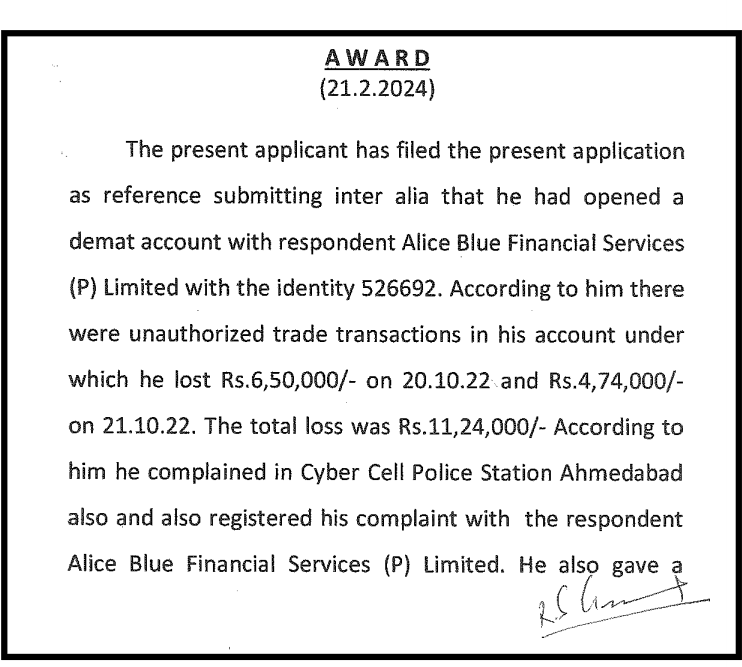
Like a lot of retail F&O traders, the investor at the centre of this case, an Ahmedabad resident named Raval Snehul Kanaiyalal, initially chalked his losses up to normal volatility.
Markets move. Trades go wrong sometimes. There was no obvious reason yet to suspect anything else.
Then he actually sat down and went through his account properly. And the picture stopped making sense.
On 20 October 2022, he lost ₹6,50,000.
The very next day, 21 October 2022, another ₹4,74,000 disappeared. Two trading days. ₹11,24,000 gone, give or take, depending on which record you check; both figures appear across the case documentation.
These weren’t trades he remembered placing. Somewhere between what he understood about his own account and what the ledger actually showed, a gap had opened up, and it was too large to explain away as market movement alone.
The Question That Turned a Loss Into a Dispute
He didn’t go straight to arbitration. Almost nobody does.
First came the confusion phase, rereading statements, trying to line up dates and positions, genuinely trying to understand what had actually happened to his money.
Only once that confusion refused to resolve did the matter start moving through the formal grievance process.
What eventually reached arbitration wasn’t just a dispute about numbers; it became a dispute about account security itself. Who had access. Who was responsible when access went wrong?
Records from February 2023 showed ₹7,88,000 still sitting in his demat account. He went to withdraw it.
He received ₹6,50,000. ₹1,38,000 was withheld, with no explanation offered.
By the time the case reached arbitration, ₹3,36,000 remained unpaid, the exact figure the tribunal would end up ruling on.
What the Arbitrator Actually Found?
During the hearing, something notable happened. Alice Blue’s own representative reviewed the records and didn’t dispute the core fact: ₹3,36,000 was genuinely still owed.
The arbitrator then asked the question that decided everything: if a demat account is supposed to be secure by design, how do wrongful entries happen inside it, and whose fault is that?
Alice Blue’s representative gave a straight answer. Lapses had occurred on their side.
The ruling that followed was direct.
A secure account is the broker’s responsibility to actually secure. If unauthorised entries happen anyway, the broker managing that account carries the liability, not the investor who trusted them with it.
The Award
Alice Blue was directed to pay ₹3,36,000, along with 9% annual interest running from 21 October 2022 until the date of actual payment.
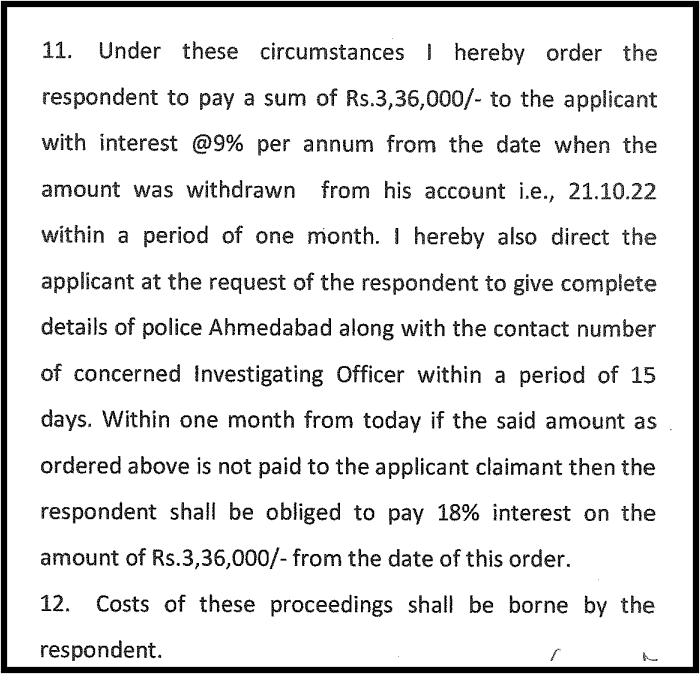
If that payment wasn’t made within one month, the interest rate would climb to 18% per annum.
All arbitration costs were placed on Alice Blue as well.
What This Case Actually Teaches You?
- “Secured account” is not a shield for the broker, it’s an obligation. If unauthorised trades slip through, the broker can’t point to police proceedings or system security claims to dodge liability; the lapse is theirs to own.
- File everywhere at once, not one channel at a time. Cyber cell, SEBI SCORES, the exchange, and the broker directly, simultaneously. Pressure from multiple directions moves faster than a single complaint sitting in one inbox.
- A partial payout is not a full settlement. ₹6,50,000 back doesn’t mean the fight is over if ₹1,38,000 is still missing with no explanation. Keep pursuing the balance through proper channels.
- Save your account statement the same day anything looks wrong. That single document became the backbone of this entire case.
- Arbitration and police action aren’t mutually exclusive. Running both together is legitimate, and often the stronger combined approach.
Six Years of Alice Blue Unauthorised Trading Data
One case shows you what’s possible. Six years of exchange data shows you how often it’s actually happening.
Stock exchanges categorise certain investor complaints under Type IV, which generally covers unauthorised trading or disputes over trade execution.
Here’s what that data looks like for Alice Blue:
| Financial Year | Total Complaints | Type IV (Unauthorised Trades) | % of Complaints Under Type IV |
|---|---|---|---|
| 2020-21 | 38 | 3 | 7.89% |
| 2021-22 | 47 | 4 | 8.51% |
| 2022-23 | 52 | 2 | 3.85% |
| 2023-24 | 56 | 3 | 5.36% |
| 2024-25 | 59 | 2 | 3.39% |
| 2025-26 | 59 | 3 | 5.08% |
Two things stand out once you actually sit with this table.
Total complaints have crept up steadily, from 38 in 2020-21 to 59 in the most recent year. That kind of drift isn’t unusual on its own; more accounts generally means more grievances in absolute terms.
Type IV complaints, though, never disappear. Every single year on this table shows at least two, sometimes four. It’s easy to look at percentages sitting between 3% and 8% and assume the issue is small.
But a percentage doesn’t capture what each complaint actually represents.
Every one of those numbers is a person who believed a trade happened in their account without their say-so. For them, it was never a statistic; it was real exposure, an unexpected position, or money lost on a trade they never intended to place.
That’s exactly what happened to the investor in the case above, and his complaint would have counted as just one line in whichever year’s row it landed in.
Regulators and experienced investors don’t wave these numbers off just because they’re small. They treat them as a standing reminder of why order confirmations, contract notes, and trade alerts matter as much as they do.
The practical takeaway: review your trade confirmations regularly, check your contract notes against what you actually intended, and monitor your account activity as routine, not as an emergency response after something’s already gone wrong.
When Can Regulators Actually Act Against a Broker?
Not every complaint about unauthorised trading leads to a formal investigation or ruling. Authorities weigh the actual evidence before deciding whether the broker followed proper process.
Action tends to move forward in situations like these:
- Trades executed with no evidence the client ever consented.
- Missing order records or audit trails for the disputed transaction.
- No call recording on file for dealer-assisted trades.
- Contract notes that don’t match what the client actually instructed.
- Documentation gaps that fall short of what regulatory guidelines require.
When these show up, exchanges or regulators review the available order logs, communications, and trade confirmations. If the broker didn’t follow proper procedure, the matter moves toward the exchange grievance mechanism or arbitration, exactly the path the case above took from start to finish.
How Do You Document an Alice Blue Account Handling Dispute?
The strength of a case like the one above rarely comes down to how upset you are. It comes down to what you can actually put in front of an arbitrator.
Start the moment you notice something’s off, not a week later once the details have blurred.
Screenshot your portfolio, your transaction history, and any messages tied to the disputed activity; time-stamped records are the single most valuable thing you can produce later.
Put your concern to Alice Blue in writing directly, not over a phone call that leaves no trace. SEBI norms expect a response within 30 days, and that written complaint becomes your official starting point.
If the response doesn’t hold up, that’s when the case above shows exactly what comes next: escalation through the regulator and, if needed, the exchange itself, with your documentation carrying the entire argument.
Where Do You Actually Take an Alice Blue Account Handling Complaint?
Every escalation option here exists to solve one specific weakness in the step before it, not just to add another form to fill out.
A written complaint closes off the broker’s easiest excuse, “we never heard about this.” Once that’s on record, silence stops being a defence.
If Alice Blue still doesn’t respond meaningfully, a SCORES SEBI complaint changes who’s actually watching.
It’s no longer just you against the broker; it’s a regulator tracking the response, with your PAN and contact details creating a record that can’t quietly vanish.
Still stuck after that?
SMART ODR registration pulls the exchange into the room too, shifting the argument away from he-said-she-said and onto the actual documented evidence sitting in front of everyone.
If your trades ran through BSE specifically, a BSE complaint filed directly with that exchange’s grievance desk opens one more door, independent of how cooperative the broker chooses to be.
And if none of that resolves it, arbitration is where the paper trail finally makes the call, exactly the process that decided the case above.
An independent panel goes through the order logs, contract notes, fund statements, and communication history, and hands down a binding decision either way.
Our guide on complaint against stock broker SEBI walks through this entire sequence in more depth if you want the fuller picture before you start.
Conclusion
The case at the centre of this blog isn’t really about a trading loss. It’s about what happens when an investor stops being sure whether the person managing their account is actually acting on their behalf.
₹11 lakh gone across two days. ₹3.36 lakh recovered through arbitration, with interest attached for every day Alice Blue delayed. And six years of data showing this pattern has never fully disappeared, even in the years it looked small on paper.
Stay actively involved in your own account.
Never assume someone else is watching your interests more closely than you are, because as this case shows, sometimes nobody is, until you make them.
Report. Recover. Stay Fraud Free.
No. Brokers are required to act only on client instructions. If disputed trades happen, the authorisation trail and communication records become critical during any investigation or arbitration. An Ahmedabad investor lost ₹11.12 lakh across two trading days in October 2022. Alice Blue's own representative admitted the lapse, and the arbitrator awarded ₹3,36,000 plus interest. Preserve every record immediately, screenshots, statements, timestamps, raise a written complaint with the broker the same day, and document everything before escalating further. Type IV complaints have appeared every single year from 2020-21 through 2025-26, ranging between 2 and 4 cases annually, out of total complaints rising from 38 to 59 over that span. No. A POA typically covers limited settlement-related activity, not discretionary trading. It doesn't hand the broker blanket permission to trade without your instruction.Frequently Asked Questions




 Add us as a preferred source on Google »

