

Quick Summary
Wealthmax Solution Investment Adviser, run by proprietor Piyush Jain from Indore, held SEBI registration number INA000010751 from June 6, 2018, until SEBI cancelled it on April 9, 2026. Across four separate SEBI orders spanning February 2023 to April 2026, the firm was found missing client agreements, running expired NISM certifications, failing to obtain BASL membership, maintaining records with placeholder client names, and failing to resolve investor grievances properly. A ₹7,00,000 penalty preceded the final cancellation. This blog covers the full regulatory timeline, every violation in detail, and the exact process to file a complaint.
You trusted someone to guide your money into the right investments. The registration looked real, the paperwork looked official, and the advice sounded confident.
Wealthmax Solution is a case that shows exactly how that trust can quietly fall apart, not through one dramatic event, but through years of small compliance failures that added up to something SEBI eventually couldn’t ignore.
This page walks through the full regulatory record, every violation SEBI identified, and what to do if you were one of the investors affected.
Is Wealthmax Solution SEBI Registered?
No, not anymore. Wealthmax Solution Investment Adviser, a sole proprietorship run by Piyush Jain, was registered with SEBI as an Investment Adviser on June 6, 2018, under registration number INA000010751.
That registration was formally cancelled through a SEBI order dated April 9, 2026, issued under Section 12(3) of the SEBI Act, 1992, read with the SEBI (Intermediaries) Regulations, 2008.
In plain terms, Wealthmax Solution no longer has legal authority to provide investment advisory services. Any advisory activity carried out under this name today would be operating without valid registration.
The firm operated out of Madhya Pradesh and offered fee-based advisory services covering stock recommendations, mutual fund guidance, and portfolio-related advice.
As a registered adviser, it was required to maintain proper client records, execute formal agreements, conduct suitability assessments, and hold valid certifications throughout its operating period.
None of those obligations were consistently met, which is exactly what the regulatory record shows in detail below.
SEBI Action Against Wealthmax Solution
SEBI has taken regulatory action against multiple entities operating under the Wealthmax Solution name. These orders focused on alleged unauthorised investment advisory activities and investor solicitation practices.
Wealthmax Solution SEBI Order 2024
SEBI inspected Wealthmax Solution Investment Advisor (Proprietor: Piyush Jain), a registered Investment Adviser, for the period April 2020 to January 2023.
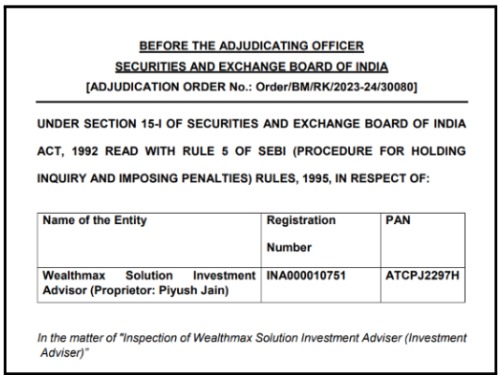
The inspection revealed multiple violations of the SEBI (Investment Advisers) Regulations, 2013, leading to adjudication proceedings and a final order dated March 13, 2024.
Violations by Wealthmax Solution Investment Advisor
Here are some of the key regulatory violations and compliance-related issues associated with the firm:
1. Failure to Report Change in Registered Address
The IA’s registered office at Sayaji Plaza, Indore, was found non-operational during inspection. The Noticee gave contradictory explanations: first denying any address change, then claiming it had shifted and informed SEBI via the SI portal.

2. NISM Certification Lapse and Non-Membership of BASL
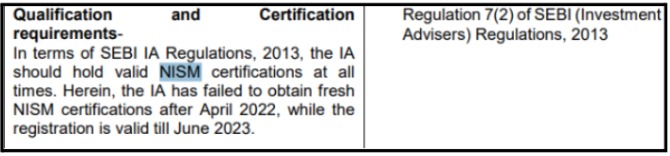
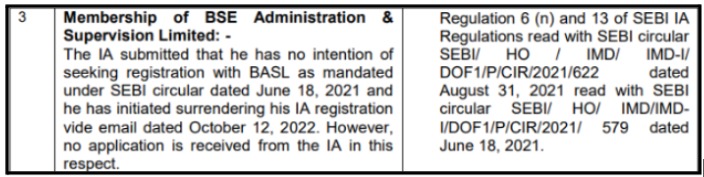
The IA’s NISM certifications expired by early 2022 and were not renewed, despite the registration remaining valid until June 2023. The IA also failed to obtain mandatory BASL membership. The AO treated these as technical violations, noting the IA had ceased services in September 2021 and was in the process of surrendering its registration.
3. Non-Execution of Client Agreements
From April 1, 2021, IAs were required to execute formal agreements with clients before rendering advice or charging fees. The IA collected fees from clients on five occasions without compliant agreements. Agreements submitted for three clients did not meet the mandatory Annexure-A requirements under the September 2020 SEBI Circular.
4. Failure to Maintain Mandatory Records
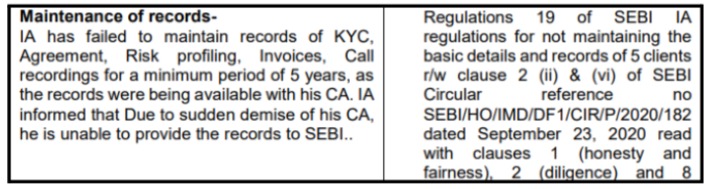
Across all 8 clients onboarded, the IA maintained severely deficient records. KYC entries for 5 clients used placeholder names like “AAAAAA” and “BBBBBBB.” Risk profiling was absent for 5 clients. No invoices were maintained for any payment received, and no call recordings, emails, or SMS records were preserved.

5. Non-Cooperation with the Inspection Team
The IA submitted incomplete responses to the Post-Inspection Questionnaire and failed to provide a Net Worth Certificate during inspection. Producing documents after inspection concluded did not satisfy the statutory obligation under Regulation 25(1) and 25(2).
Penalty on Wealthmax Solution
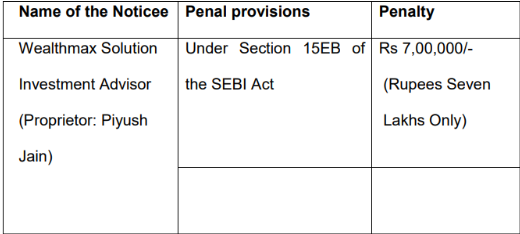
Taking into account the established violations, the IA’s prior penalty record, and the crucial role IAs play in protecting small investors, the Adjudicating Officer imposed a monetary penalty of ₹7,00,000 (Rupees Seven Lakhs) under Section 15EB of the SEBI Act, 1992, payable within 45 days.
Also Read: StockDunia publicly available complaint disclosure stops at March 2025.
Wealthmax Solution SEBI Order 2026
This case is between SEBI and Wealthmax Solution Investment Adviser, a proprietorship firm run by Piyush Jain investment advisor.
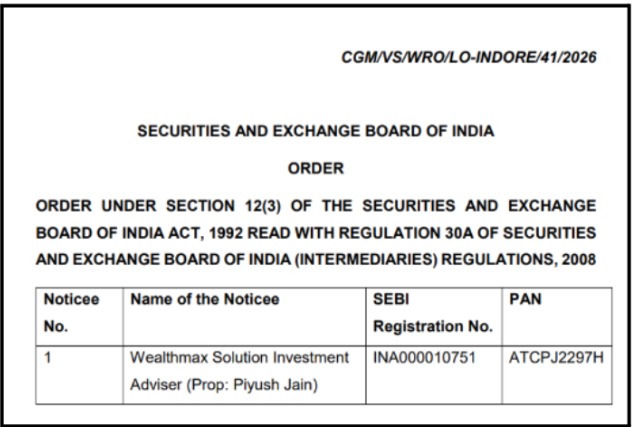
SEBI initiated proceedings for failure to pay renewal fees, failure to renew NISM certification, and failure to obtain mandatory BASL membership, which are all required to keep the IA registration active.
What Was the Case?
Wealthmax was granted SEBI IA registration on June 6, 2018. Its renewal fee fell due on June 5, 2023, but was never paid.
The proprietor’s NISM certificate had already expired on April 1, 2022 and was not renewed.
The firm also never obtained mandatory BASL membership.
The proprietor claimed he had stopped all advisory activities since 2022, believing his registration had already lapsed after being removed from SEBI’s registered IA portal following a BASL email in May 2024.
Despite multiple Show Cause Notices sent via post and email, no substantive compliance defence was offered.
Penalty on Wealthmax Solution
No monetary penalty was imposed here.
Instead, SEBI took the more severe action of outright cancellation of Wealthmax’s certificate of registration (No. INA000010751) under Section 12(3) of the SEBI Act.
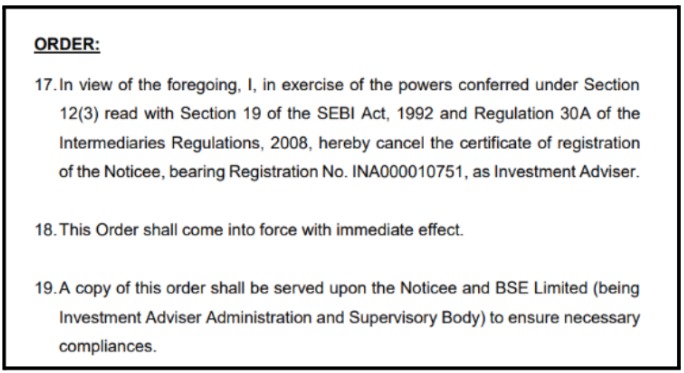
The cancellation took effect immediately from the date of the order, April 9, 2026.
The COVID-Era Address Confusion
Part of what fed directly into SEBI’s broader finding of non-cooperation was a pattern of shifting, inconsistent statements around the firm’s registered office.
When the COVID-19 pandemic struck in early 2020, Jain indicated to SEBI that he had closed office operations and shifted to working from his residential address for select clients. He later disclosed relocating from Sayaji Plaza to Vardhman Plaza in February 2020.
SEBI’s records show real inconsistency in how this was actually communicated over time. Jain initially denied any change in registered address at all.
He later acknowledged having filed an address change on the SI portal on 19 February 2020. Then, in a further submission made in March 2024, four years after the original move, he disclosed the Vardhman Plaza relocation for the first time in that specific context.
SEBI did not find these shifting, delayed explanations consistent or credible, and this pattern is a meaningful part of why the regulator ultimately viewed the firm’s conduct as non-cooperative rather than simply disorganized.
Also Read: ResearchInn Investment Advisor privacy policy and social links leave transparency gaps worth checking.
Why Was Wealthmax Solution’s Registration Cancelled?
Although SEBI had already penalized the firm in March 2024 for operational lapses, the persistent failure to resolve core compliance requirements led to further regulatory action.
In December 2025 and January 2026, SEBI issued multiple Show Cause Notices.
While the proprietor stated he had ceased business operations in 2022 and believed his registration had automatically lapsed, SEBI rejected this argument.
Under regulatory guidelines, stopping business operations or assuming a licence has expired does not replace the formal surrender process or wipe away ongoing statutory duties.
Because the firm failed to formally maintain its registration or execute a legal exit, SEBI moved past monetary penalties and issued an outright cancellation of its registration (No. INA000010751) under Section 12(3) of the SEBI Act, effective April 9, 2026.
Key Takeaways From This Case
Beyond the specific violations, four broader lessons come directly out of how SEBI handled this case, and they apply to any registered adviser, not just this one.
1. Non-Payment of Renewal Fees Can Mean Cancellation, Not Just a Fine
Failing to pay the mandatory renewal fee is not treated as a minor lapse. It directly puts an adviser’s entire registration at risk of permanent cancellation, not merely a monetary penalty.
2. NISM Certification and BASL Membership Are Non-Negotiable
These are continuing compliance obligations, not one-time boxes to check. Letting either lapse without renewal is treated as a fundamental breach of the conditions attached to holding an IA registration.
3. Believing Your Registration Has Lapsed Is Not a Legal Defence
Jain’s assumption that removal from SEBI’s portal meant automatic cancellation was not accepted. A formal SEBI cancellation order is the only legally valid route to properly exit the registration framework.
4. Voluntarily Stopping Business Doesn’t Close Out Regulatory Obligations
Simply stopping advisory services does not end an adviser’s compliance duties. Formal surrender or cancellation through proper SEBI procedure is required; otherwise those obligations continue accumulating in the background.
Not sure whether your own experience with Wealthmax Solution rises to the level worth formally reporting?
We will review the specifics of your situation and help you build a complaint that holds up.
Can You Trust Wealthmax Solution?
If you invested through this firm, it’s worth thinking honestly back through your own experience. Ask yourself whether any of the following happened to you.
You were charged fees or advised without ever being provided a client agreement. You received recommendations, but nobody properly completed your risk profiling or KYC process.
You made payments but never received invoices, receipts, or written confirmation.
The firm’s contact details changed, and you were never informed. Your calls, messages, or emails went unanswered when you asked for records or explanations.
You were eventually told the business had closed, or that nothing could be done because the registration had lapsed.
If even one of these sounds familiar, that experience is worth documenting, not dismissing. Every complaint filed, even a small one, becomes part of an official record.
According to a related report, the original SEBI investigation into this firm’s conduct began with a single investor complaint filed in August 2021, a complaint that eventually contributed to a ₹7 lakh penalty and, ultimately, full cancellation of the registration.
Also Read: Dynamic Money Research Advisory Services, a firm with a clean complaint record, though that is not the end of the story either.
How to File a Complaint Against an Investment Adviser?
The right complaint process depends entirely on one thing: whether the adviser you’re dealing with still holds an active SEBI registration or not.
Wealthmax Solution’s own licence is cancelled, so if you’re specifically pursuing action against this firm, the cancelled-registration path below applies to you.
If you’re reading this because you’re evaluating a different adviser who is still actively registered, the process is meaningfully different, and it’s worth knowing both paths before assuming which one fits your situation.
If the Firm Is Still SEBI Registered
- Preserve every relevant record. Payment receipts, chat conversations, emails, call recordings, trade recommendations, and signed agreements, arranged chronologically before you do anything else.
- Send a formal written complaint to the firm directly. Raise the matter in writing, give a reasonable window, typically 15 to 30 days, for a response, and keep copies of everything, including messages that go unanswered.
- File a complaint through SCORES. If the firm doesn’t resolve it, escalate through the SEBI SCORES portal. This becomes an official regulatory record, and the firm is obligated to respond under SEBI’s oversight.
- Move to SMART ODR if unresolved. The SMART ODR login provides structured, mediated resolution, generally faster than formal proceedings.
- Consider arbitration as a final step. If earlier stages don’t resolve things, formal stock market arbitration offers a binding decision through an independent authority.
If the Firm’s Licence Has Been Cancelled or It Was Never Registered
This is the path that applies specifically to Wealthmax Solution, since standard SCORES complaints are built around firms with an active registration to hold accountable in real time.
- Secure every piece of evidence immediately. Payment receipts, screenshots of recommendations, subscription confirmations, and all communication records.
- Contact the entity and document every response. Raise your concern formally, preferably by email, and record the response you get, including no response at all.
- File a written complaint directly with SEBI. Submit a detailed complaint with full supporting documentation, creating an official regulatory trail even though the firm’s registration is no longer active.
- File a cyber crime complaint if fraud is involved. Relevant where digital communication, online payments, or misleading representations played a role.
- Consult a legal expert for significant losses. A securities or financial dispute lawyer can outline civil recovery options, and earlier guidance tends to prevent delays that weaken your documentation later.
Conclusion
Wealthmax Solution entered the market as a properly registered, seemingly legitimate Investment Adviser in 2018.
Over the following years, the compliance obligations that underpinned that credibility quietly fell apart: certifications went unrenewed, fees went unpaid, records were kept carelessly, and investor grievances went unresolved.
The gap between what a SEBI registration implies and what was actually happening behind it is the entire story of this case. The April 2026 cancellation order didn’t create that gap, it simply made it official and public.
If you were affected, document what happened, follow the process outlined above, and don’t assume a cancelled registration means there’s nothing left to do.
Report. Recover. Stay Fraud Free.
Frequently Asked Questions
Yes. SEBI accepts complaints against firms regardless of current registration status, and your grievance will be recorded and reviewed as part of the official regulatory process.
Collect everything available, payment receipts, fee invoices, advisory emails or messages, WhatsApp conversations, any signed agreements, and account statements. Even partial documentation strengthens your case.
Yes, and this case proves it directly. The original SEBI investigation reportedly began with a single complaint filed in August 2021, which eventually contributed to a ₹7 lakh penalty and full cancellation.
By the final review, the same violations from the earlier penalty order remained unresolved, renewal fees still unpaid, certification still expired, BASL membership still missing, which led SEBI to conclude cancellation was the appropriate response rather than another fine.





 Add us as a preferred source on Google »

