

When you’re choosing a financial advisor or investment service, one question matters more than almost anything else: Are they actually registered with SEBI?
For many retail investors in India, investment advisers registered with the Securities and Exchange Board of India (SEBI) appeared to be exactly that, a safe, regulated choice.
Wealthmax Solution Investment Adviser was one such entity.
In this blog, we’ll walk through the case of Wealthmax Solutions, based on the official order issued by the Securities and Exchange Board of India (SEBI) in April 2026.
We’ll break down what the order says, what went wrong, and what you should take away from it as an investor.
Is Wealthmax Solutions SEBI Registered or Not?
This is the question most people type into a search engine before they hand over their money.
Let’s answer it directly.
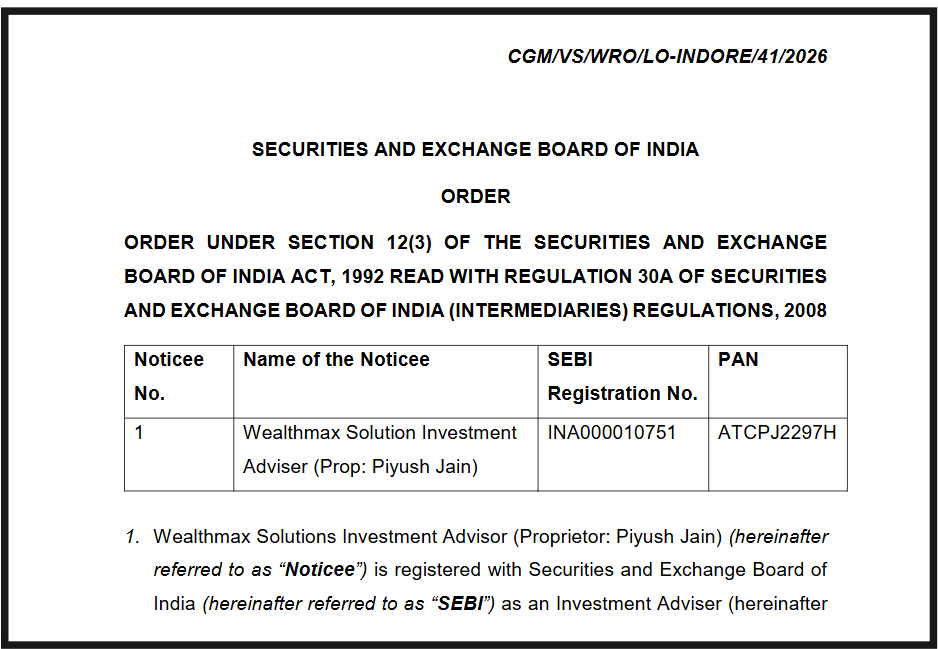
Owned and operated by Piyush Jain, it first obtained SEBI registration as an Investment Adviser (IA) back in June 2018, under the SEBI (Investment Advisers) Regulations, 2013.
For years, it carried the weight of that registration, a credential that, in the minds of most investors, implies active oversight, ongoing compliance, and a firm that is “on the right side” of the regulator.
Through an order dated 9 April 2026, SEBI formally cancelled the certificate of registration of Wealthmax Solution Investment Adviser with immediate effect.
The legal basis for this action is Section 12(3) of the SEBI Act, 1992, read with the SEBI (Intermediaries) Regulations, 2008.
What that means in plain language: Wealthmax Solution no longer has legal authority to provide investment advisory services. Any advisory activity carried on from this point would be without valid registration.
The real question is not whether Wealthmax Solutions exists or holds registration.
The more important question is: can you trust Wealthmax Solution?
The answer requires looking beyond registration and examining complaints, disclosures, fees, and investor experiences.
SEBI Action Against Wealthmax Solution
The story begins the way many such cases do.
Investors came across an advisory service promising structured guidance and trading-related inputs. Over time, SEBI initiated an investigation into the activities of Wealthmax Solutions.
-
Background Story of the case
In June 2018, Wealthmax Solution obtained SEBI registration as an Investment Adviser.
Registration came with clear responsibilities under the SEBI (Investment Advisers) Regulations, 2013, from maintaining valid certifications to signing client agreements, collecting fees in prescribed limits, and renewing registration on time.
For a while, the entity operated within this framework. But the cracks began to show around 2020.
-
The COVID Complications and Its Impact
When the COVID-19 pandemic struck in early 2020, Piyush Jain indicated to SEBI that he had closed office operations and shifted to working from his residential address for select clients.
He later disclosed relocating from Sayaji Plaza to Vardhman Plaza in February 2020.
SEBI records show inconsistencies in how this was communicated. I
nitially, Jain denied any change in registered address. Later, he acknowledged filing an address change on the SI portal on 19 February 2020. And in a further submission in March 2024, he disclosed the Vardhman Plaza relocation.
SEBI did not find these explanations consistent or credible.
More critically, this period saw the beginning of compliance lapses that would compound over the following years.
Key Violations Identified by SEBI
The order outlines multiple violations. Let’s break them down so they’re easy to understand.
-
NISM Certification Expired
For any registered investment adviser, holding a valid National Institute of Securities Markets (NISM) certification is not optional, it is a legal requirement.
Piyush Jain’s NISM XA and XB certifications expired in October and December 2020 respectively. SEBI, in recognition of COVID-related disruptions, had extended the validity of such certifications until 31 March 2022.
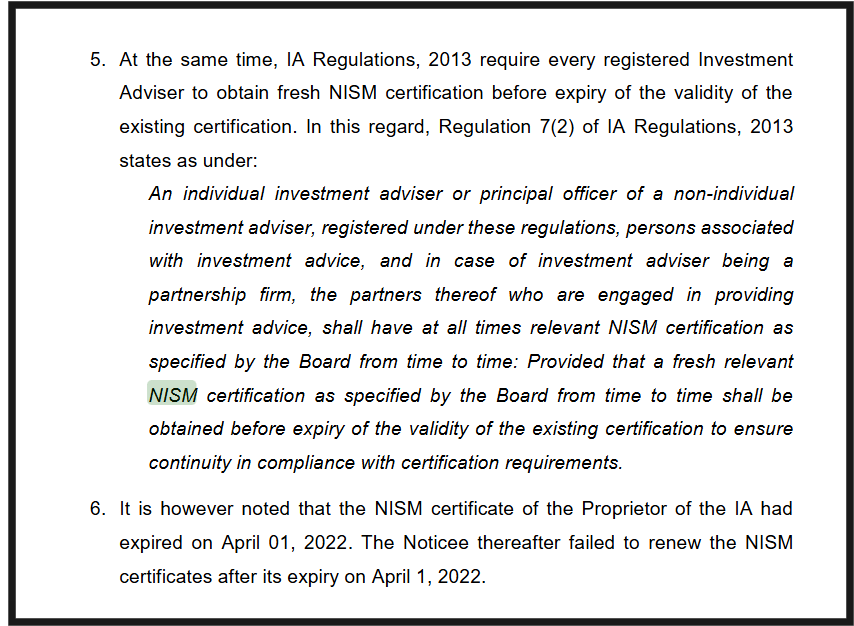
But after April 2022, when this extension ended, Jain did not obtain fresh certifications. His NISM certification had expired from 1 April 2022 onwards, and was never renewed thereafter.
This meant that from April 2022, Wealthmax Solution was operating (or at minimum, registered as an operational entity) without the proprietor holding a mandatory qualification.
-
Renewal Fees Not Paid
SEBI registration is not a one-time grant. It requires periodic renewal, along with the payment of applicable fees. For Wealthmax Solution, the renewal fees became due on 5 June 2023.
Those fees were never paid. This alone is a fundamental condition for continued registration, and its non-fulfilment triggered SEBI’s escalation process.
-
No Client Agreements, No Documentation
SEBI’s inspection of Wealthmax Solution also revealed something that should concern any investor who may have paid for advice or services: the entity was unable to produce signed client agreements.
Under SEBI regulations, no investment adviser can provide advice or charge a fee until a formal written agreement has been executed with the client and a copy handed over.
When pressed, Jain could not demonstrate that any such agreements existed.
He attributed the absence of documents to his chartered accountant having passed away, an explanation SEBI found insufficient, noting that mandatory regulatory documents cannot be held contingent on a third party’s availability.
The Show-Cause Notices and the Response
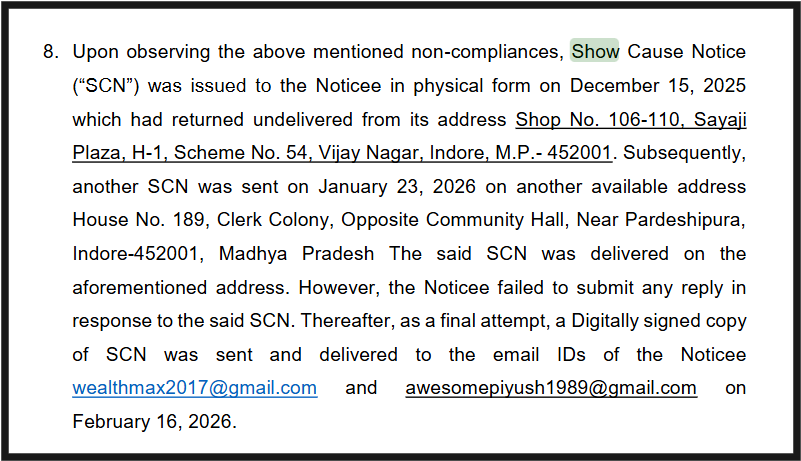
By December 2025 and January 2026, SEBI had issued multiple Show-Cause Notices (SCNs) to Wealthmax Solution, asking it to explain these violations and demonstrate its compliance.
The initial notices were returned undelivered; they couldn’t reach the address on file. SEBI then served subsequent notices at alternate addresses and via email, eventually securing a response.
Wealthmax Solution’s reply was notably candid and notable for what it conceded.
The entity stated that it had effectively ceased operations as an investment adviser since 2022, had earned no income from advisory activities after that point, and had been under the impression that its registration had already lapsed or been cancelled.
It pointed to earlier SEBI communication about removal from the list of registered advisers due to non-payment of fees as the basis for that belief.
Given such regulatory actions, it becomes essential for investors to understand how to check SEBI registration number is valid or not to avoid relying on outdated or misleading claims.
-
Final Order
The April 2026 cancellation was not Wealthmax Solution’s first brush with SEBI enforcement. Records show two earlier adjudication orders.
In February 2023, SEBI passed an adjudication order in the matter of Wealthmax Solution Investment Adviser.
The inspection had flagged the expired certifications, the absence of client agreements, and the inconsistent statements about the office address.
SEBI’s adjudicating officer observed in that order that the role of an investment adviser is crucial to the development of the securities market, particularly for small investors who rely on such advisers.
The non-compliance demonstrated a failure in fiduciary duties owed to clients.
After weighing the totality of violations, expired certifications, unpaid renewal fees, no BASL membership, missing client agreements, and the entity’s own admission of having ceased operations, SEBI concluded on 9 April 2026 that this was a fit case for cancellation of registration under Section 12(3) of the SEBI Act, 1992.
The certificate of registration of Wealthmax Solution Investment Adviser was cancelled with immediate effect.
What Investors Can Learn From This Case?
Whether or not you’ve ever heard of Wealthmax Solution, the story above has lessons that apply to every investor evaluating any financial advisory, trading education service, or broker in India.
Think of this as advice from someone who has seen these cases play out many times.
- Verify SEBI registration yourself: Don’t trust a screenshot, a website badge, or a verbal claim. Go directly to sebi.gov.in and use the “Registered Intermediaries” search function. Enter the entity’s name. See what comes up. This takes two minutes and can save you a great deal of money.
- Registered is not the same as endorsed: SEBI registration means the entity met certain minimum criteria at the time of registration. It does not mean SEBI has vetted the quality of advice, approved any product, or endorsed any strategy.
- Get fee structures and profit-sharing terms in writing: If an adviser offers to share profits or charge a percentage of gains, ask for that in writing, with clearly defined terms. Verbal promises are difficult to enforce.
- Check for disciplinary history before you commit: SEBI publishes enforcement orders, adjudication orders, and settlement orders on its website.
What To Do in Such Cases?
If you have paid for services from Wealthmax Solution or any other entity and feel that you were misled or received services that fell short of what was promised, you have regulatory recourse.
If the Firm is SEBI Registered the follow these steps:
Step 1: Approach the Entity First
Before escalating to any regulator, most processes require that you first raise the issue directly with the entity.
Send a written complaint by email, with a clear subject line, stating what happened, the amount paid, when, and what you are asking for. Keep a copy of everything you send and any response you receive.
Give them a reasonable time to respond (typically 15–30 days).
Step 2: File a Complaint in SCORES
SCORES stands for the SEBI Complaints Redress System. It is SEBI’s official online platform for investors to register complaints against SEBI-regulated entities.
Any investor who has a complaint against a registered (or formerly registered) SEBI intermediary can use SCORES.
Step 3: Lodge a Complaint in SMART ODR
If your complaint involves a specific financial dispute, for example, a dispute over fees paid or services not rendered, you may also explore Smart ODR (Online Dispute Resolution).
This platform handles investor disputes with SEBI-regulated entities through a structured conciliation and arbitration process. It is particularly useful for disputes involving clear monetary claims.
Step 4: Share Market Arbitration
If the issue remains unresolved, you can move towards arbitration through stock exchanges, where a formal dispute resolution process will take place.
If the firm is not SEBI registered, or the licence has been cancelled, then follow these steps:
Step 1: Save Every Possible Record Immediately
Secure all available evidence as early as possible.
This may include payment confirmations, subscription details, screenshots of recommendations, promotional material, emails, and chat conversations.
These records become extremely important if the matter later requires regulatory or legal review.
Step 2: Contact the Entity and Maintain a Written Trail
Even if the registration status is inactive or cancelled, you should still formally contact the entity and explain your concern.
Prefer written communication such as email so there is proper documentation of replies, promises made, or non-responsiveness.
Step 3: File a Complaint with SEBI
You may also file a written complaint with SEBI along with all supporting documents and evidence available.
This helps create an official regulatory trail regarding the issue and preserves your grievance on record.
Step 4: File a Cyber Crime Complaint
If you believe there were misleading representations, false promises, payment-related issues, or suspicious conduct, you may additionally report the matter through the cybercrime reporting portal.
This step may become relevant where digital communication or online transactions were involved.
Step 5: Seek Legal Advice for Major Financial Losses
In cases involving significant financial damage, consulting a securities or financial dispute lawyer may help you understand the available recovery options.
Early legal guidance can sometimes prevent delays that weaken documentation or affect future proceedings.
Need Help?
Navigating the complaint process is easier when someone walks you through it. That’s what we’re here for.
We help investors like you review their situation, understand what happened, and take the right steps.
This includes case review, drafting your complaint in a clear and structured format, guiding you through SEBI SCORES filing, explaining how Smart ODR works and whether your dispute qualifies, and, where relevant, referring you to legal professionals for arbitration support.
Conclusion
The case of Wealthmax Solutions is a reminder of something every investor should remember: Regulation matters.
Registered with SEBI in June 2018, it entered the market as a recognised, regulated entity, the kind of credential that many investors rightly treat as a mark of credibility.
But over the years that followed, the regulatory compliance that underpins that credibility quietly fell apart. Certifications were not renewed. Fees were not paid. Memberships were not obtained.
The gap between what a registration implies and what was actually happening on the ground is at the heart of this case. SEBI’s April 2026 cancellation order did not create that gap; it simply made it official and public.
For you as an investor, the takeaway is this: regulatory registration is a starting point for your due diligence, not the end of it.
Verify actively. Ask questions. Get things in writing. And if something feels off, trust that instinct, and use the tools available to you to investigate further before committing your money.
You are not powerless in this space.
The regulators provide pathways, the information is public, and the complaint mechanisms exist for exactly these situations. The first step is simply knowing how to use them.





 Add us as a preferred source on Google »

