

Before choosing any brokerage or advisory service, investors often rely on reviews to understand real user experiences.
Goodwill Wealth Management reviews across platforms show mixed feedback on pricing, service quality, and overall experience.
This blog takes a closer look at publicly available information, including user reviews, complaint trends, and regulatory records, to help you form a clear and informed perspective before making a decision.
Goodwill Wealth Management Overview
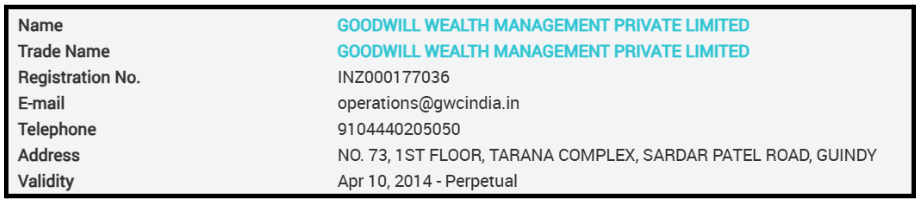
Goodwill Wealth Management Private Limited (GWC India) is a Chennai-based broker established in 2008.
The company holds SEBI Broker Registration No. INZ000177036, valid from April 10, 2014, on a perpetual basis.
Additionally, GWC India offers insurance products, mutual funds, and currency trading alongside its core equity and commodity broking services.
GIGA app covers equity, F&O, currency, and commodity trading across NSE, BSE, and MCX segments.
Types of Goodwill Wealth Management Complaints Clients File
Exchanges formally handle the following categories of investor complaints against registered brokers:
| Type | Count | Description |
| Type V | 222 | Service related |
| Type IV | 127 | Unauthorised trades/misappropriation |
| Type IX | 59 | Others |
| Type I | 4 | Non-receipt / delay in payment |
| Type VIII | 3 | IPO related |
| Type II | 2 | Non-receipt / delay in securities |
| Type III | 2 | Non-receipt of documents |
| Type VI | 1 | Closing out / squaring up |
| Type VII | 0 | Non-implementation of the arbitration award |
Service-related complaints (Type V) are the highest in Goodwill Wealth Management reviews, involving poor support, delays, and platform inefficiencies that affect trading decisions. Issues like the Goodwill app not working are often reported under this category, impacting real-time trading experience.
Unauthorised trades/misappropriation (Type IV) are the second highest and far more serious, as they involve trades without consent, leading to direct financial losses and loss of trust in the brokerage.
The Investor Grievance Redressal Committee (IGRC) at NSE and BSE offers the first formal hearing stage beyond the broker level.
Also Read: PhonePe Wealth Broking complaints, why a low complaint percentage still deserves a closer look.
Goodwill Wealth Management Exchange Complaint Data
The following data comes from NSE’s publicly available complaint monitoring records for Goodwill Wealth Management Private Limited.
| Financial Year | Active Clients | Complaints Filed | Complaint % | Resolved | Unresolved | Arbitration Cases |
| 2025–26 | 24,335 | 193 | 0.793% | 189 | 4 | 0 |
| 2024–25 | 31,649 | 152 | 0.480% | 152 | 0 | 0 |
| 2023–24 | 34,650 | 47 | 0.130% | 45 | 2 | 0 |
| 2022–23 | 34,650 | 35 | 0.100% | 32 | 3 | 0 |
What does this data really mean for Investors?
Goodwill Wealth Management reviews from investors match exactly what this data reveals.
Do these numbers surprise you?
They should.
- Client base down, complaints up: Clients fell about 30 per cent (34,650 to 24,335), while complaints rose from 35 to 193, showing worsening service quality
- Complaint ratio sharply higher: Increased from 0.10 per cent to 0.793 per cent, meaning about 1 in 125 clients filed a formal complaint in 2025–26
- Unresolved cases continue: Pending complaints appeared in multiple years (2022–23, 2023–24, 2025–26), indicating incomplete resolution
- Sudden spike is concerning: Complaints increased from 47 to 152 to 193, coinciding with the SEBI inspection period and raising risk concerns
- No arbitration does not mean no issues: Despite zero arbitration cases, separate SEBI action indicates serious underlying violations
Overall, Goodwill Wealth Management reviews and data reflect rising complaints, declining client trust, and persistent resolution gaps.
Goodwill Wealth Management SEBI Order
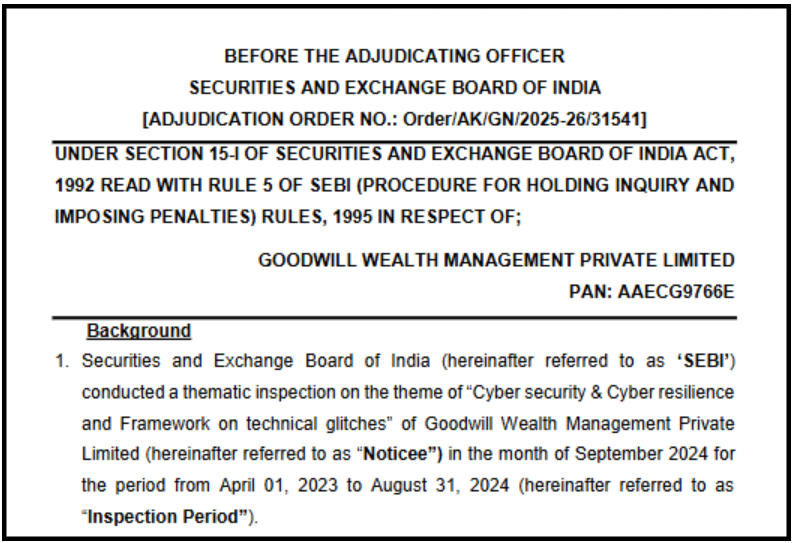
According to SEBI Adjudication Order No. Order/AK/GN/2025-26/31541, dated July 18, 2025, SEBI imposed a penalty of ₹5,00,000 on Goodwill Wealth Management Private Limited under Section 15HB of the SEBI Act, 1992.
Violations By Goodwill Wealth Management
SEBI conducted a thematic inspection of GWC India in September 2024, covering the period April 1, 2023, to August 31, 2024.
The inspection theme covered cyber security, cyber resilience, and the technical glitch framework, directly relevant to every investor who uses the GIGA trading platform.
SEBI confirmed these violations, all admitted or established through findings:
Violation 1: No Disaster Recovery Drills on Live Trading Days
The broker conducted all disaster recovery drills only on non-trading days, which does not reflect real market stress conditions. In one instance, no drill was conducted for an entire month.
This means the system’s ability to recover during actual market hours was not properly tested.
Violation 2: Critical Servers Not Connected to Exchange Monitoring
Out of 9 identified critical servers, only 4 were connected to the exchange’s real-time monitoring system. Even these did not fully match the broker’s own server list.
As a result, a large part of the trading infrastructure remained outside exchange visibility and oversight.
Violation 3: Risk Alert Threshold Set Too High
The required system capacity alert threshold is 70 per cent, but the broker configured it at 80 per cent for key trading systems.
This means warnings would trigger late, increasing the chance of system overload or slowdowns during high volatility market conditions.
Violation 4: No Proper Software Testing Before Deployment
The broker did not provide evidence of a structured testing framework before deploying software updates to live systems.
This increases the risk that untested changes could directly affect order execution, pricing accuracy, or platform stability during trading hours.
Violation 5: No Independent Internal Risk Policies
Instead of maintaining its own board-approved disaster recovery, business continuity, and change management policies, the broker relied on documents provided by its external vendor.
This reduces accountability, as internal governance systems were not formally defined or approved by the company’s board.
Violation 6: No Formal Incident Response Team
The broker did not maintain an internal incident response or crisis management team led by senior management as required.
Instead, it relied on vendor processes that were not formally structured under the broker’s own leadership, limiting clear accountability during system failures.
Penalty
SEBI imposed a penalty of ₹5,00,000 on the noticee after evaluating the violations and found the amount proportionate to the misconduct.
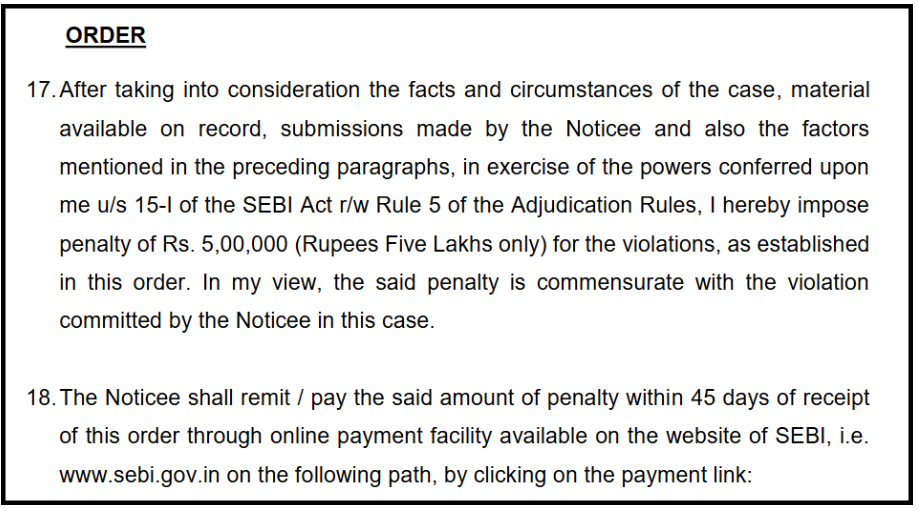
The noticee has been directed to pay the penalty within 45 days through SEBI’s online payment system.
Final Takeaway
These violations suggest weak internal governance, heavy dependence on vendors, and insufficient system testing and monitoring.
For investors, this directly translates into higher operational risk during market disruptions, where speed, control, and system reliability are critical.
Also Read: Alice Blue complaints, a 43% client drop in three years. The complaint rate didn’t follow.
Goodwill Wealth Management User Reviews
Goodwill Wealth Management reviews highlight recurring issues in pricing transparency, advisory practices, and overall service quality.
1. Hidden Charges Not Disclosed at Onboarding
An April 2025 review states that the investor was unaware of a ₹50 per lot per side charge until after account opening.
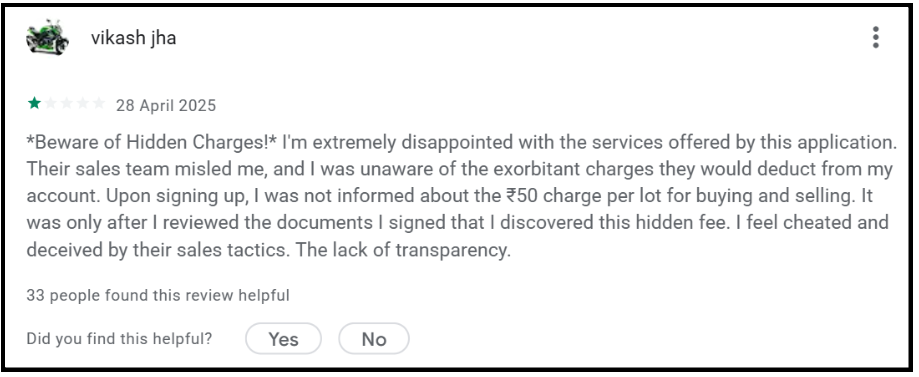
The reviewer described the sales process as misleading rather than an oversight.
Many users are now coming forward to report Goodwill Wealth excess charges that were never mentioned during the initial sales pitch
Notably, 33 users marked this review helpful, indicating a repeated concern among investors.
2. Heavy Losses Under Advisor Guidance
A May 2025 review stated that an investor lost ₹43,000 in just 15 days across four trades while following a broker-assigned advisor.
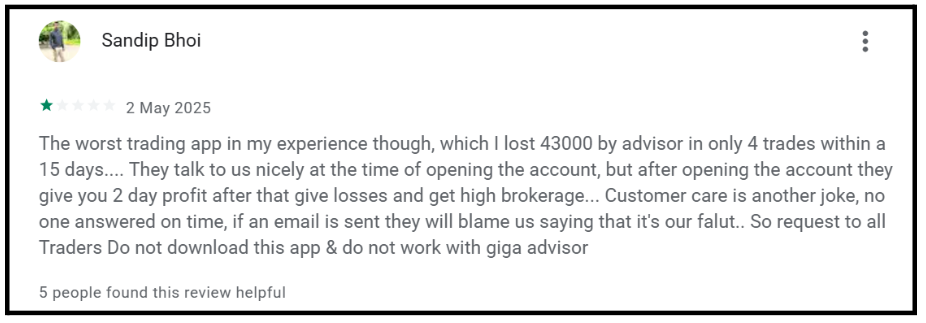
The reviewer noted an initial phase of small profits followed by consistent losses and high brokerage.
When the issue was raised, customer support reportedly shifted the blame to the investor.
3. Misleading Trading Calls and Lack of Accountability
A May 2023 review stated that employees allegedly provided false trading calls and withheld important information.
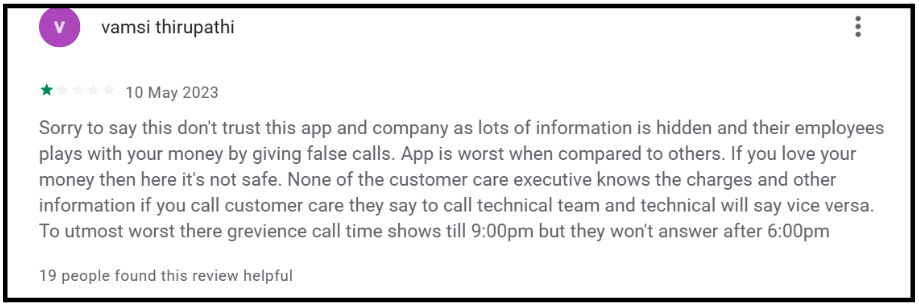
The reviewer also reported poor coordination between support teams, with no clear resolution provided.
Despite advertised support hours, no assistance was available beyond early evening, leaving grievances unresolved.
4. Unauthorised Trading to Generate Brokerage
An April 2026 review states that trades were executed in the client’s account without consent to generate brokerage.
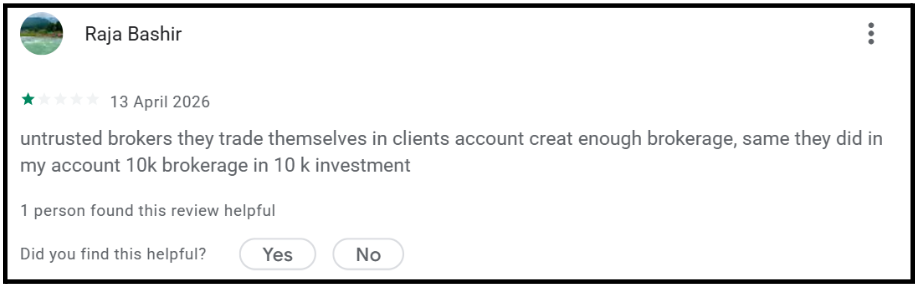
The investor reported ₹10,000 brokerage on a ₹10,000 investment, effectively wiping out capital.
Reports of Goodwill Wealth unauthorised trading often involve these high-frequency trades that serve the broker’s interest rather than the client’s.
Such practices, if proven, fall under serious regulatory violations and require immediate escalation.
When to Take Action Against a Broker?
Waiting for the broker to self-correct does not recover your money.
These six situations require immediate action:
- Undisclosed Charges at Onboarding: If actual charges differ from what was promised, compare documents with deductions and file a complaint.
Misrepresentation of fees is a valid grievance under SEBI rules. - Trades Without Consent: If trades are executed without your approval, stop activity and capture all trade records.
Report immediately to the broker and exchange. - Brokerage Eating Profits: If profits are wiped out by high brokerage, calculate the ratio and raise it formally.
Repeated patterns may indicate churning and require escalation. - App Failure Causing Losses: If the app crashes or shows errors during trading, document the time, issue, and impact.
Technical failures affecting trades can be reported as formal complaints. - Support Not Available as Promised: If support is unreachable despite stated timings, record call attempts with timestamps.
Misleading service availability is a complaint-worthy issue. - No Resolution Within 30 Days: If complaints remain unresolved beyond 30 days, escalate to higher authorities.
Delays strengthen your case for formal escalation.
The core principle is simple: document every interaction on the day it happens, escalate in writing before calling, and treat verbal commitments from any sales team or advisor as unenforceable until you confirm them in writing.
How to File a Complaint Against a Stock Broker in India?
If your issue remains unresolved, following a structured escalation process can help you seek proper redressal.
Taking timely action with the right documentation improves your chances of a fair resolution.
Step 1: Reach Out to the Broker
Start by submitting a formal written complaint to Goodwill Wealth Management through email so there is a clear, time-stamped record of your issue.
Include your client ID, exact transaction details, advisor involvement, and the resolution you expect to ensure clarity.
The broker is required to respond within 30 days under SEBI’s grievance redressal framework.
Step 2: Escalate the Complaint with SCORES
If the broker does not respond or fails to resolve your issue satisfactorily, escalate the matter through the SEBI SCORES platform.
Submit all supporting documents, including email communication, trade records, and proof of loss, to strengthen your complaint.
This ensures your grievance is officially recorded and monitored under a regulatory mechanism.
Step 3: File a Report in Smart ODR
For disputes that remain unresolved, you can move to the SMART ODR platform, which provides an organised system for resolving conflicts between investors and brokers.
The process involves mediation and conciliation, making it accessible even for investors without legal knowledge. It serves as an important step before formal arbitration.
Step 4: File for Arbitration in Stock Market
If all prior steps fail, proceed with arbitration through the relevant stock exchange, where the matter is reviewed formally.
Arbitration decisions are legally binding and enforceable, offering a final resolution mechanism for investors.
Having complete and well-organised documentation significantly strengthens your case during this stage.
Need Help?
If you’re facing unexpected charges, unauthorised trades, or unresolved complaints, acting quickly is crucial. Delays can weaken your case and limit your options for escalation.
Here’s how we help:
- Case Review and Issue Identification: We assess your situation to identify the exact issue and the right course of action.
- Evidence Organisation: We help you organise documents like trade records, emails, and payment proofs to strengthen your case.
- Complaint Drafting and Filing: We assist in drafting and filing clear complaints with the broker and regulatory platforms.
- Guided Escalation and Resolution: We guide you through SEBI SCORES, SMART ODR, and arbitration if needed, ensuring you follow the right process.
If you’re facing issues with Goodwill Wealth Management or any broker, register with us, and we’ll help you take the right steps at the right time.
Conclusion
Goodwill Wealth Management Private Limited holds a valid SEBI Broker Registration (INZ000177036) and operates across major exchanges with over 15 years of experience.
However, legitimacy does not always equate to reliability.
Complaint data shows a rise from 35 in 2022–23 to 193 in 2025–26 (451% increase), alongside a decline in active clients. SEBI’s July 2025 order also confirmed multiple compliance violations and imposed a ₹5 lakh penalty.
Goodwill Wealth Management reviews further highlight recurring concerns such as hidden charges, advisor-led losses, unauthorised trades, and poor customer support.
For existing clients, reviewing transactions and understanding escalation options is essential. For prospective investors, this information provides important context before making a decision.


 Add us as a preferred source on Google »

