

If you have ever wondered whether a SEBI registration actually means a firm is safe to trust, this article about SEBI action against Wealthmax Solution is worth reading carefully.
Wealthmax Solution Investment Adviser was a registered firm. It had a registration number, a listed office, and was operating under SEBI’s framework.
And yet, over a period of four years, SEBI passed four separate orders against it, ending with a complete cancellation of its registration in April 2026.
This is not a scare story.
It is a real case that teaches you exactly what to look for before you hand your money to anyone.
Wealthmax Solution
Wealthmax Solution Investment Adviser was a proprietary firm run by Piyush Jain. A common question investors have asked is: is Wealthmax Solution SEBI registered, and the answer is yes, it was. SEBI granted it registration as an Investment Adviser on June 6, 2018, under registration number INA000010751.
Its business was straightforward: providing investment advisory services to retail clients.
On paper, it looked entirely legitimate.
It had gone through SEBI’s registration process, which involves meeting eligibility criteria, qualification requirements, and agreeing to follow a detailed regulatory framework.
That is precisely what makes this case instructive.
The firm was not operating from the shadows. It was visible, registered, and findable. And still, things went wrong in ways that investors could have spotted early.
SEBI Orders Against Wealthmax Solution
SEBI has taken regulatory action against multiple entities operating under the Wealthmax Solution name.
These orders focused on alleged unauthorised investment advisory activities and investor solicitation practices.
Wealthmax Solution SEBI Order 2024
SEBI inspected Wealthmax Solution Investment Advisor (Proprietor: Piyush Jain), a registered Investment Adviser, for the period April 2020 to January 2023.
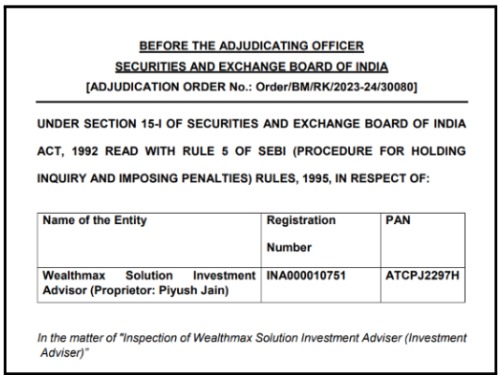
The inspection revealed multiple violations of the SEBI (Investment Advisers) Regulations, 2013, leading to adjudication proceedings and a final order dated March 13, 2024.
Violations by Wealthmax Solution Investment Advisor
Here are some of the key regulatory violations and compliance-related issues associated with the firm:
1. Failure to Report Change in Registered Address
The IA’s registered office at Sayaji Plaza, Indore, was found non-operational during inspection. The Noticee gave contradictory explanations: first denying any address change, then claiming it had shifted and informed SEBI via the SI portal.

2. NISM Certification Lapse and Non-Membership of BASL
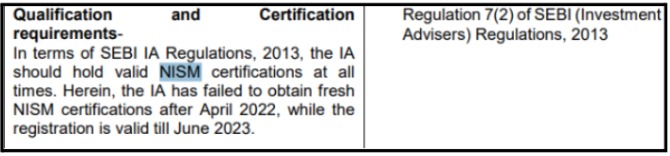
The IA’s NISM certifications expired by early 2022 and were not renewed, despite the registration remaining valid until June 2023.
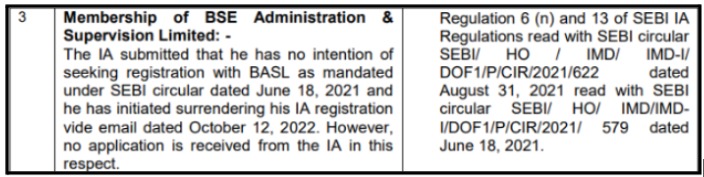
The IA also failed to obtain mandatory BASL membership. The AO treated these as technical violations, noting the IA had ceased services in September 2021 and was in the process of surrendering its registration.
3. Non-Execution of Client Agreements
From April 1, 2021, IAs were required to execute formal agreements with clients before rendering advice or charging fees.
The IA collected fees from clients on five occasions without compliant agreements. Agreements submitted for three clients did not meet the mandatory Annexure-A requirements under the September 2020 SEBI Circular.
4. Failure to Maintain Mandatory Records
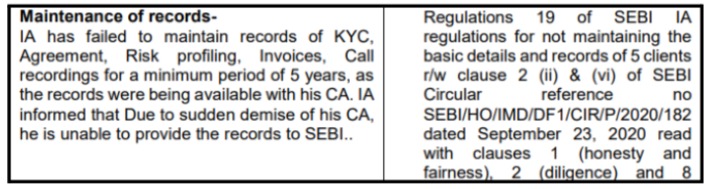
Across all 8 clients onboarded, the IA maintained severely deficient records. KYC entries for 5 clients used placeholder names like “AAAAAA” and “BBBBBBB.”
Risk profiling was absent for 5 clients.
No invoices were maintained for any payment received, and no call recordings, emails, or SMS records were preserved.

5. Non-Cooperation with the Inspection Team
The IA submitted incomplete responses to the Post-Inspection Questionnaire and failed to provide a Net Worth Certificate during inspection.
Producing documents after inspection concluded did not satisfy the statutory obligation under Regulation 25(1) and 25(2).
Penalty on Wealthmax Solution
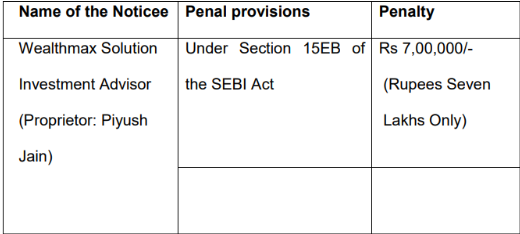
Taking into account the established violations, the IA’s prior penalty record, and the crucial role IAs play in protecting small investors, the Adjudicating Officer imposed a monetary penalty of ₹7,00,000 (Rupees Seven Lakhs) under Section 15EB of the SEBI Act, 1992, payable within 45 days.
Wealthmax Solution SEBI Order 2026
This case is between SEBI and Wealthmax Solution Investment Adviser, a proprietorship firm run by Piyush Jain, registered as a SEBI Investment Adviser.
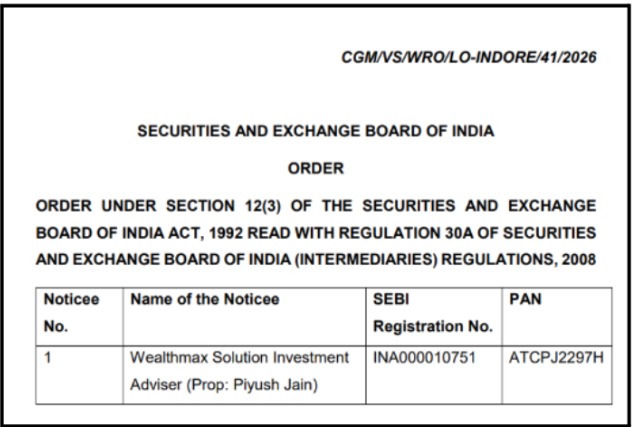
SEBI initiated proceedings for failure to pay renewal fees, failure to renew NISM certification, and failure to obtain mandatory BASL membership, which are all required to keep the IA registration active.
What Was the Case?
Wealthmax was granted SEBI IA registration on June 6, 2018. Its renewal fee fell due on June 5, 2023, but was never paid.
The proprietor’s NISM certificate had already expired on April 1, 2022 and was not renewed.
The firm also never obtained mandatory BASL membership.
The proprietor claimed he had stopped all advisory activities since 2022, believing his registration had already lapsed after being removed from SEBI’s registered IA portal following a BASL email in May 2024.
Despite multiple Show Cause Notices sent via post and email, no substantive compliance defence was offered.
Penalty on Wealthmax Solution
No monetary penalty was imposed here.
Instead, SEBI took the more severe action of outright cancellation of Wealthmax’s certificate of registration (No. INA000010751) under Section 12(3) of the SEBI Act.
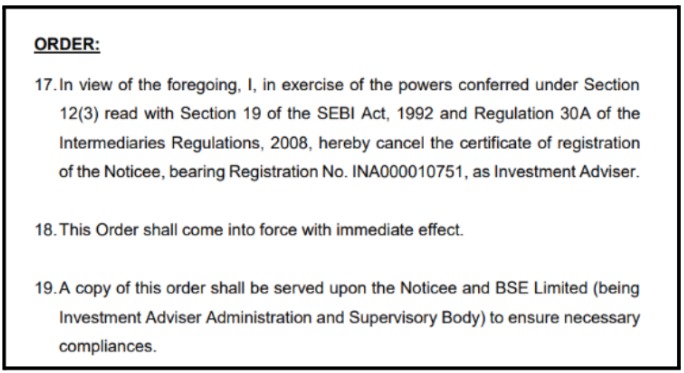
The cancellation took effect immediately from the date of the order, April 9, 2026.
Key Takeaways
- Non-payment of renewal fees equals registration cancellation: Failing to pay the mandatory five-year renewal fee is not a minor lapse; it directly puts an IA’s registration at risk of permanent cancellation, not just a fine.
- NISM certification and BASL membership are non-negotiable: These are continuing compliance obligations; letting either lapse without renewal is treated as a fundamental breach of IA registration conditions.
- Believing registration has lapsed is not a legal defence: The proprietor’s assumption that removal from the SEBI portal meant automatic cancellation was not accepted; formal SEBI cancellation orders are the only legally valid route to exit.
- Voluntarily ceasing business does not close regulatory obligations: Simply stopping advisory services does not end compliance duties; an IA must formally surrender or cancel its registration through proper SEBI procedure to avoid regulatory action.
What Can Investors Learn From This?
Let’s be honest, this case is not about one bad actor who was hiding in the shadows. WealthMax was publicly registered with SEBI. The registration number was real. And yet, investors still lost money.
That is the uncomfortable truth this case forces every investor to confront.
Here are the real lessons:
- SEBI registration is a starting point, not a guarantee: Always verify that an investment adviser is actively registered. Visit SEBI’s intermediary portal and check the current status. Registration can lapse, be suspended, or be cancelled.
- Fixed return promises are always a red flag: No SEBI-registered investment adviser is allowed to promise guaranteed or assured returns. If someone is promising you 3% daily profit or a fixed amount in six months, stop. That is either illegal, or impossible, or both.
- If an adviser cannot produce basic documents, that is a problem: Your KYC, risk profile, and client agreement are not bureaucratic formalities. They are your legal protection. An adviser who doesn’t have them is either careless or hiding something.
- Always sign a proper advisory agreement before paying any fee: After April 2021, this became mandatory. If an adviser is collecting money from you without a written, signed agreement that meets SEBI standards, they are already in violation of the rules.
After reviewing the SEBI action and the allegations discussed above, many investors naturally ask: can you trust Wealthmax Solution?
The answer is that trust should not be based on marketing claims alone. Investors should carefully evaluate the firm’s regulatory history, compliance record, and the facts disclosed in official proceedings before making any financial commitment.
What Can You Do In Such Cases?
If you find yourself in a situation similar to this, here is how to proceed. The steps differ depending on whether the firm you dealt with holds an active SEBI registration or not.
If the Firm is SEBI Registered
- Preserve All Important Records: Before anything else, collect and organise every document tied to the advisory relationship, payment proofs, chat conversations, emails, call recordings, trade recommendations, and signed agreements, arranged chronologically.
- Send a Formal Written Complaint to the Firm: Raise the matter directly with the firm in writing before approaching any regulator. Give them a reasonable deadline to respond and retain copies of all communication, including unanswered messages.
- File a Complaint with SCORES: If the firm fails to resolve the issue, escalate to SEBI’s SCORES platform. The complaint becomes an official record, and the firm is obligated to respond under regulatory oversight.
- Lodge a Complaint with SMART ODR: If SCORES does not deliver a satisfactory outcome, SMART ODR offers a structured digital resolution process through mediation, often faster than traditional proceedings.
- Arbitration in Stock Market: If all prior steps fail, arbitration provides a final binding resolution through an independent authority reviewing both sides of the matter.
If the Firm’s Licence Has Been Cancelled or It Was Never Registered:
As is the case with WealthMax, where SEBI cancelled the licence, the complaint pathway changes entirely.
- Secure All Your Evidence Immediately: Save payment receipts, screenshots of calls or recommendations received, subscription confirmation messages, and any communications with the platform. These form the evidence base for any complaint.
- Contact the Entity and Document Every Response: Raise your concern formally, preferably via email, so there is a written trail. Ask for what you were promised and document the response, or lack of it.
- File a Complaint with SEBI: Submit a detailed written complaint to SEBI with all supporting evidence to create an official regulatory trail.
- File a Cyber Crime Complaint: If you believe you were misled, charged for undelivered services, or affected by fraudulent claims, you may also file a report through the cybercrime portal.
- Consult a Legal Expert: For larger losses, a securities lawyer can help you understand civil recovery options before delays weaken your case further.
Need Help?
If you are unsure how to proceed, our team can help you review your case and understand the next steps clearly. We assist investors with reviewing advisory communications, organising evidence, and preparing complaint documentation.
Whether it involves SEBI complaints, cybercrime reporting, or possible legal escalation, we can guide you through the process.
Register with us today and get the support needed to act confidently and effectively.
Conclusion
The Wealthmax case is not an outlier buried in regulatory archives.
It is a documented, publicly available example of how things can go wrong even with a registered firm and how the warning signs, in hindsight, were visible throughout.
SEBI acted, penalised the firm, and ultimately cancelled its registration. The regulatory system worked, but slowly, and not without cost to the investor involved.
You do not have to wait for a problem to become a four-year regulatory case before you act.
Verify before you invest. Question what feels unclear. And if something goes wrong, move quickly, because delays rarely work in the investor’s favour.
Protecting your money starts with asking the right questions. This case gives you a very clear picture of what those questions should be.





 Add us as a preferred source on Google »

