

Quick Summary
Wealthy Ways has two documented public complaints on record, one describing a subscriber who felt misled and financially trapped, and one citing a specific loss of around ₹20,000 following the firm’s recommendations. Neither complaint appears contested by the firm, and both echo a pattern already visible in the firm’s own disclosed numbers, complaints jumping from 2 to 23 in a single year. This page lays out both accounts in full, what they do and don’t prove, and where to go if your own experience matches either one.
Every advisory pitch sounds the same at first, confident voice, structured process, a SEBI number that’s supposed to put your mind at ease.
Wealthy Ways runs on that exact pitch, daily options calls for Nifty, BankNifty, and Finifty, dressed up with promises of structured targets and live market support.
But a pitch is only ever half the story. The other half lives in what actually happens once someone pays and the calls start arriving.
That’s where Wealthy Ways reviews come in, real accounts from people who already made that decision, written in places a firm can’t quietly edit away.
Two of those accounts are laid out in full below, worth reading slowly before you make yours.
Wealthy Ways Company Reviews
Before anything else, it’s worth being upfront about scope.
This isn’t a page with dozens of reviews to sift through, it’s two specific, documented complaints, and that’s exactly why each one deserves a proper reading rather than a passing mention.
A firm with only a handful of public complaints isn’t automatically safer than one with many, sometimes it just means fewer people have spoken up publicly, or the firm is newer to wider public scrutiny.
What matters here isn’t the count, it’s what each complaint actually describes, and whether the pattern in it echoes anything found elsewhere in this firm’s own disclosed record.
Read both below, then decide for yourself how much weight they deserve alongside everything else:
1. The First Complaint: An Allegation of Being “Trapped”
One public comment describes a subscriber who felt actively misled and financially cornered by the experience, using language that goes beyond simple dissatisfaction with results.
The core of the complaint isn’t about a single losing call or a bad month in the market.
It’s about a feeling of being pulled in through one set of expectations, then finding the actual experience of the subscription to be something considerably harder to exit or get value from than what was described upfront.
That distinction matters, because ordinary trading losses are a known risk every subscriber accepts going in, but a sense of being trapped or misled describes something closer to a conduct problem, not a market outcome.
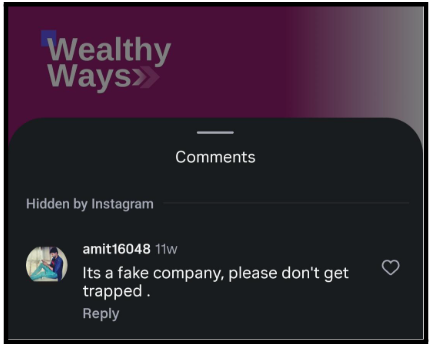
This kind of complaint is difficult to independently verify in isolation.
One public comment, without a screenshot or a documented timeline attached, can’t be checked against the firm’s own records the way a regulatory disclosure can.
That’s exactly why this page treats it as one data point, not as proof on its own, worth reading alongside the second complaint and the firm’s own disclosed complaint numbers found elsewhere in this series.
2. The Second Complaint: A ₹20,000 Loss Following the Firm’s Recommendations
The second documented account is more specific, and specificity is exactly what makes a complaint easier to weigh honestly.
A subscriber alleges a loss of approximately ₹20,000 following recommendations received through the service.
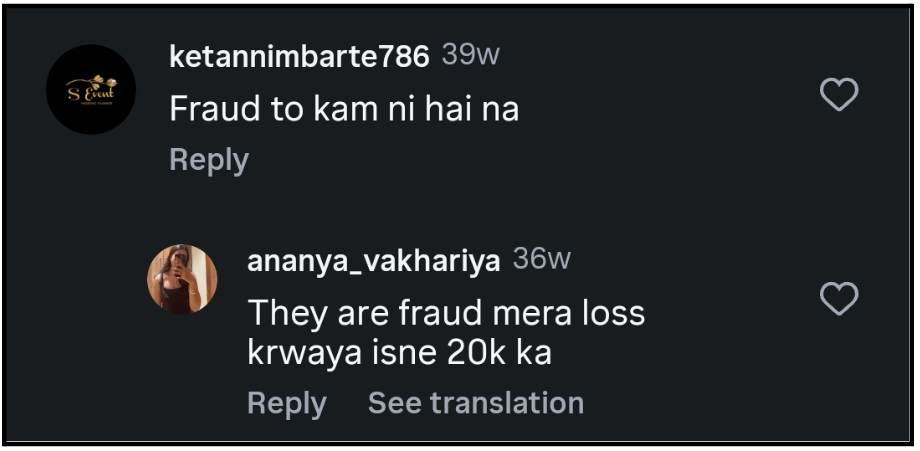
Unlike a general complaint about feeling misled, this one attaches a concrete number to a concrete outcome, which makes it the kind of claim that’s at least theoretically checkable against real trade records, contract notes, and payment history, if that documentation exists.
It’s worth being precise about what this complaint does and doesn’t establish.
It doesn’t, on its own, prove misconduct, negligence, or a violation of any rule, since losing money following an options call is an outcome every subscriber accepts is possible the moment they sign up for high risk derivatives research.
What it does establish is that at least one real subscriber experienced a real financial loss large enough to publicly complain about, which is a different thing from a hypothetical risk mentioned in a disclaimer.
Read on its own, this is one person’s experience.
Read alongside the firm’s own disclosed complaint trend, jumping from 2 to 23 complaints in a single year, it starts to look less like an isolated unlucky trade and more like a pattern showing up in more than one place.
Also Read: Eqwires Reviews, another Research Analyst SEBI fined for fabricated testimonials and mismanaged stop-losses.
Wealthy Ways Complaints: How Big Is This Pattern, Really?
You’ve just read two individual accounts, and a fair question is forming in your mind right now, are these rare exceptions, or is something bigger going on here?
That question matters more than it might seem, because two complaints read very differently depending on whether they’re isolated incidents or part of a documented trend already showing up elsewhere in this firm’s own records.
This firm is required to publicly disclose how many formal complaints it receives every year, and that number tells its own story.
In the year before last, only two complaints were on record, both resolved.
The very next year, that number jumped to twenty-three, more than a tenfold rise in just twelve months. A chunk of those complaints were still sitting unresolved by the time the disclosure period ended.
That kind of jump doesn’t happen by accident.
A firm doesn’t go from two complaints to twenty-three because its subscriber base suddenly grew tenfold in a year.
Something changed in how the service was delivered, how expectations were set, or how disputes were handled, and the two accounts described above may well be part of that same rising number.
The complete year-by-year breakdown, along with how this fee and complaint pattern compares to what a typical registered advisory looks like, is examined in full on our page: can you trust Wealthy Ways.
Worth remembering too, since this runs as a sole proprietorship, no team or department is absorbing these complaints, just one person accountable for all of them.
You can read more about who exactly that is on our page about Adarsh Dey research analyst.
What These Complaints Really Add Up To?
You’ve now seen both sides, two individual voices, and a documented pattern in the firm’s own disclosed numbers.
Here’s what that combination actually tells you, and where its limits sit.
The two reviews on their own are just two people’s word. Read alone, either could be dismissed as one unhappy customer or one bad trade.
But neither of them sits alone, they sit next to a complaint count that jumped tenfold in a single year, on the firm’s own records, not ours.
That’s what makes this more than isolated dissatisfaction. When individual accounts and disclosed regulatory numbers point in the same direction, that’s no longer just anecdote, it’s corroboration.
Neither complaint appears to have been contested or explained away publicly by the firm either, which is itself worth noting.
What this still doesn’t tell you is how representative these two accounts are of the full subscriber base.
With two public voices against a backdrop of twenty three disclosed complaints, there’s clearly more happening than what’s visible here, but exactly how widespread the problem runs remains genuinely uncertain.
Weigh all of it together, the two accounts, the disclosed trend, and what neither one alone can prove, before deciding what this means for you.
Recognise your own experience in either of these two stories?
You don’t need a public complaint or a screenshot to start. Just tell us what happened, the calls, the losses, the promises that didn’t hold up, and we’ll help you figure out whether it’s worth taking further.
Wealthy Ways Complaint: What to Do If This Happened to You?
Recognising your own situation in someone else’s complaint is one thing. Knowing what to actually do next is another, and that’s where most readers get stuck.
A public comment, however honest, doesn’t create a formal record the way a written complaint does.
If what you’ve experienced echoes either account above, the stronger move is turning it into a documented complaint rather than another public comment that a firm can simply ignore.
Start with the firm itself, in writing, before anything else.
If that doesn’t resolve things, the next step is a formal filing with the regulator directly, and the exact process for that is covered in our guide on file complaint in SCORES.
If your matter involves a specific financial dispute, there’s a faster route worth knowing about too.
Once your SCORES complaint is registered, you can pursue resolution through SMART ODR login, which handles online dispute resolution in a more structured, time bound way.
And if none of those stages resolve things and real money is involved, there’s one final option built specifically for financial disputes like this.
Share market arbitration is the last stage, where a binding decision gets made based on the evidence both sides present.
The complete filing route, every stage explained in order with what to prepare for each one, is walked through fully in our guide on how to complaint against Wealthy Ways online.
Also read: Aakanksha Gupta reviews, where disclaimers don’t match how calls are delivered.
Conclusion
Two documented complaints, one describing a feeling of being trapped, one citing a specific ₹20,000 loss, aren’t a large sample size, and this page has been honest about that limitation throughout.
But they’re also not nothing.
Both describe real subscribers, in their own words, in public spaces where a firm can’t quietly erase an uncomfortable truth.
Weigh them alongside the firm’s own disclosed complaint numbers and the fee question covered elsewhere in this series, because no single piece of evidence, on its own, tells the complete story.
Report. Recover. Stay Fraud Free.
Yes, Wealthy Ways is registered as a SEBI Research Analyst under proprietor Adarsh Dey, registration number INH000018373. No, registration confirms regulatory oversight, but investors still need to independently assess suitability and risk before acting on any recommendation. Yes, Wealthy Way's recovery case shows ₹5,00,000 recovered against ₹7,80,000 in losses through organised evidence and formal SCORES escalation. Stop making further payments immediately and start organising your records before you respond to any new offer.Frequently Asked Questions





 Add us as a preferred source on Google »

