
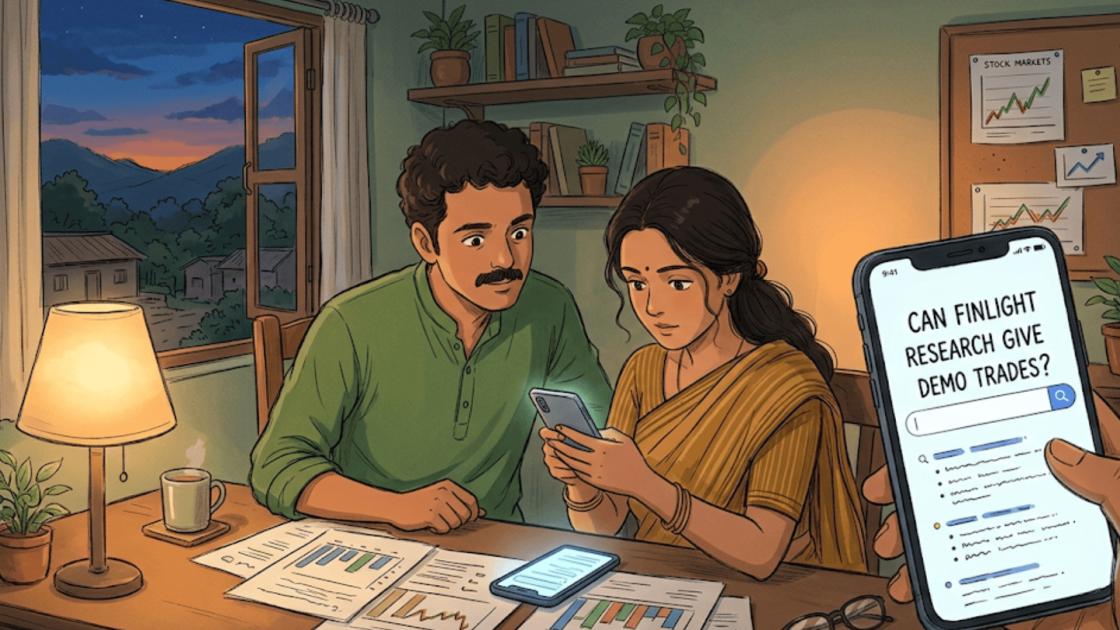
A small profit is often all it takes.
You receive a message, watch the stock move exactly as predicted, and see a crisp screenshot showing a quick ₹15,000 profit. It feels effortless, reliable, and incredibly convincing.
In India’s fast-paced advisory landscape, this is known as the “hook trade”, and it is the single most powerful sales tool in the industry.
If you’re searching: can Finlight Research give demo trades, you’re probably trying to understand whether those demonstrations are genuine, what they actually mean, and whether they should influence your decision to pay for a subscription.
Before you trust any demo trade, it is important to understand what demo trades can and cannot prove.
Why Investors Pay Attention to Demo Trades?
Imagine this situation.
You receive a WhatsApp message from someone claiming to represent a research firm. They share a trade idea. You follow it with a small quantity and make a profit.
The next day, another trade works. Suddenly, the service feels trustworthy.
This is exactly why demo trades are such powerful sales tools; they create instant confidence.
However, confidence is not the same as verification.
A successful demo trade does not automatically prove:
- Long-term profitability.
- Consistent performance.
- Risk management quality.
- Regulatory compliance.
- Suitability for your financial situation.
This is the demo trade playbook. It is not unique to any single firm.
It is a structured trust-building technique used widely across India’s advisory industry, and it works precisely because the demo trade is designed to work.
Finlight Research is a registered SEBI Research Analyst (INH000013518), and while sharing sample analysis is permitted, aggressive sales pitches often rely on highly curated, low-risk, or high-probability setups.
The demo is rarely a representative sample of daily performance; it is simply the best possible advertisement for the service.
Understanding this before you receive a demo call is the difference between a cautious investor and an expensive lesson.
Can Finlight Research Give Demo Trades or Not?
This is the regulatory core of the question, and the answer has significant implications for every investor considering this platform.
A research analyst may share research views, market analysis, model portfolios, educational examples, and past recommendations, subject to applicable regulatory requirements and disclosures.
However, investors should understand an important distinction.
A demo trade is not the same as a verified performance record.
If any advisory service shares demo trades, investors should ask:
- Was this an actual recommendation issued to clients?
- Was the trade executed in a real account?
- Were losses also disclosed?
- Is the performance independently verifiable?
- Were brokerage, taxes, and slippage considered?
Without those answers, a demo trade should be viewed as information, not proof.
So, can Finlight Research give demo trades?
There is no outright regulatory prohibition on sharing a sample research call.
But the manner in which demo trades are typically used in practice crosses into territory that SEBI’s framework is specifically designed to prevent.
A demo trade presented as proof of guaranteed future performance is misleading.
A demo trade used to create emotional investment before soliciting payment operates in ethically grey and potentially legally problematic territory.
Recognising The Demo Trade Sequence
Most investors who end up in advisory disputes don’t describe a single obvious issue.
They describe a sequence that felt reasonable at each step and only looked like a pattern from the outside.
This is where many investors get surprised.
A screenshot may show a profitable trade.
But it may not show:
- Losing trades.
- Stop-loss hits.
- Missed entries.
- Delayed execution.
- Capital required.
- Risk exposure.
For example, a trade that shows a ₹20,000 profit may also have carried a potential ₹50,000 downside risk.
Without seeing the complete picture, investors can develop unrealistic expectations.
That is why professional investors evaluate risk first and profit second.
Many investors only start questioning the process after additional payments, larger trade sizes, or recovery discussions begin.
If you are unsure whether the communication you received was appropriate, preserving records early can help clarify your options.
How to File a Complaint Against Finlight Research?
If you’ve already paid once, twice, or more after a demo trade that felt convincing, you are not without options.
And acting earlier is always better than acting later.
Here is the structured path forward:
Step 1: Preserve Every Piece of Evidence Immediately
Before anything else, save everything: payment receipts, bank records, WhatsApp conversations (export the full chat history), emails, SMS messages, the demo trade call details, any screenshots of profit claims or guaranteed return language, and call recordings where legally permissible.
Organise these chronologically. This is your case file. Everything that follows depends on its completeness.
Step 2: Send a Formal Written Complaint to The Firm
Write to the firm’s official grievance channel.
State factually: what service you subscribed to, what was communicated during the demo and sales process, what was actually delivered, and what resolution you are requesting. Attach your evidence.
Under SEBI’s framework, registered Research Analysts are required to respond to investor grievances within 21 calendar days. Note the date from your submission.
If the window closes without a meaningful response, escalate immediately.
Step 3: File a Complaint with SCORES
Escalate to SEBI’s official grievance portal.
Your complaint is now formally on record with India’s securities regulator.
SEBI SCORES has resolved thousands of complaints against registered intermediaries, and many firms resolve cases quickly once they know SEBI is actively monitoring the complaint.
Step 4: Lodge the Complaint in SMART ODR
If SCORES doesn’t produce resolution, the SMART Online Dispute Resolution platform offers structured digital mediation, often faster than formal arbitration, and specifically designed for investor-intermediary disputes.
Many investors find this the stage at which stalled cases finally move.
Step 5: Stock Market Arbitration
If all earlier steps are exhausted, the stock exchange arbitration delivers a legally binding decision from an independent arbitrator.
At this stage, your organised documentation is your most decisive asset. Preparation here determines outcomes.
Need Help?
If a demo trade, profit screenshot, or recovery promise influenced your decision to pay, and the service later failed to match those expectations, reviewing your records early may help clarify the options available to you.
Do not wait till it’s too late.
Our team helps investors review advisory communications, payment records, screenshots, trade-related discussions, and available grievance options.
We also guide investors through documentation, complaint preparation, SCORES filings, SMART ODR procedures, and other available escalation mechanisms where appropriate.
If a demo trade from Finlight Research has led to repeated payments, recovery promises, or losses you didn’t expect, don’t wait for the situation to resolve itself.
It rarely does.
Register with us for a confidential case review with our team today.
Conclusion
Demo trades can attract attention, but they should never be the sole basis for trusting an advisory service.
A profitable demonstration does not automatically prove long-term performance, service quality, or suitability for your financial goals.
Before paying Finlight Research or any other advisory service, investors should independently verify registration details, review risk disclosures, understand the fee structure, and preserve all important communications.
In investing, proper verification is often far more valuable than a convincing screenshot.
Frequently Asked Questions
1. Finlight Research’s demo trade worked, and I made a profit. Does that mean the service is reliable?
Not necessarily. Demo trades used in the sales process are typically selected for their high probability of success; they are the best-case example, not a representative sample.
SEBI-registered Research Analysts are required to maintain records of all recommendations.
2. After the demo trade, Finlight Research’s representative is asking me to pay quickly for a “limited slots” offer. Is that normal?
Urgency and scarcity language in advisory sales pitches are specifically flagged in SEBI’s fair practice guidelines as forms of aggressive selling that registered intermediaries are prohibited from using.
If you are being pressured to make a payment decision quickly, that pressure itself is a warning sign, regardless of whether the demo trade worked.
3. Can I get a refund from Finlight Research if the service didn’t deliver what was promised during the demo?
Refund eligibility depends on Finlight Research’s published refund policy and the specific circumstances of your case.
Under SEBI’s MITC requirements, the refund policy must be disclosed to clients before service commencement.
4. Should I trust screenshots showing trading profits?
Screenshots should never be treated as proof on their own. Investors should seek supporting documentation and independent verification where possible.



 Add us as a preferred source on Google »

