

You download a trading app that promises daily intraday calls, exact entry and exit points, and a clean performance dashboard. It looks professional, it has 100K+ downloads, and it claims SEBI registration.
But before you hit “Unlock Today’s Trade” and pay a subscription fee, here is what a closer look at the Traders Circuit app actually reveals.
Traders Circuit Review
The Traders Circuit app is a stock market advisory platform available on both Google Play and the Apple App Store.
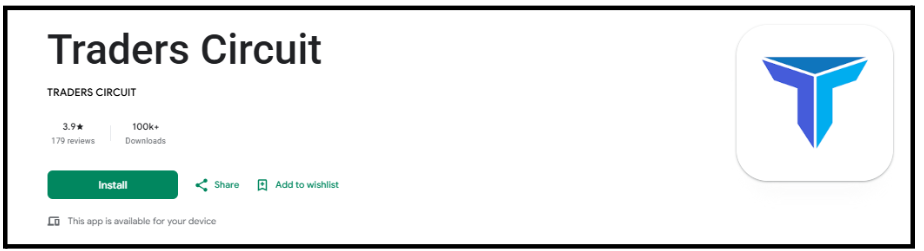
It currently holds a 3.9-star rating across 179 reviews on Google Play with 100K+ downloads.
The app offers three paid products: Swing Master (daily equity trade, 15-20 day holding), Trade Options (daily intraday Nifty and Bank Nifty calls), and Portfolio 365 (12-15 handpicked stocks for 365 days).
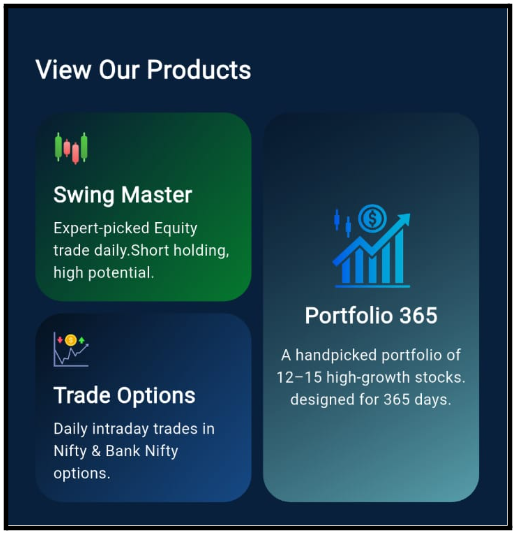
Each product shows a live trade card with entry price, and locks the target and stop-loss behind a paid subscription.
The app also includes a “Past Performance” section displaying monthly strike rates and average P&L, and a “Trade Talks” section with short market commentary videos.
On the surface, the app is clean, well-designed, and functional. The real question is what sits behind that design.
Is Traders Circuit App Genuine?
The app has real features and a functioning interface. At the same time, several things visible directly within the app and from its store listing raise legitimate questions.
Here is an honest look at both sides.
1. Each Call Includes Exact Entry Price, Target, and Stop-Loss
Every live trade card on the app shows a specific entry price range, and the subscription unlocks the corresponding target and stop-loss levels.
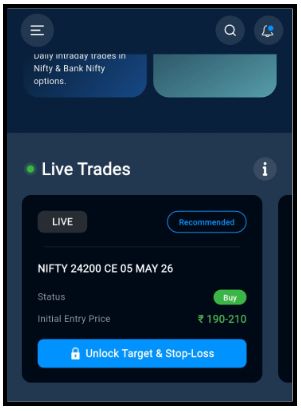
This structure follows SEBI’s expectation that research recommendations include clear buy/sell levels and risk parameters.
It also reflects the mandatory stop-loss policy mentioned in their disclaimer, which requires every trade to have a pre-defined stop-loss.
2. SEBI Registration Number Not Prominently Displayed
The SEBI registration number INH000019859 does not appear anywhere on the app’s home screen, product pages, or recommendation cards.
If you are still wondering is Traders Circuit SEBI registered, the answer is yes, but the number is buried in the disclaimer rather than prominently displayed as SEBI regulations require.
SEBI’s April 2023 circular requires the registration number to be prominently displayed across all client communications and correspondence.
An app that delivers daily trading recommendations directly to subscribers qualifies as client correspondence. Burying the number in the disclaimer does not meet the “prominently displayed” standard.
3. Potentially Misleading Performance Disclosures
As per guidelines of the Securities and Exchange Board of India, performance communication by a Research Analyst must be fair, standardized, and supported by complete disclosures, failing which it may be considered non-compliant.
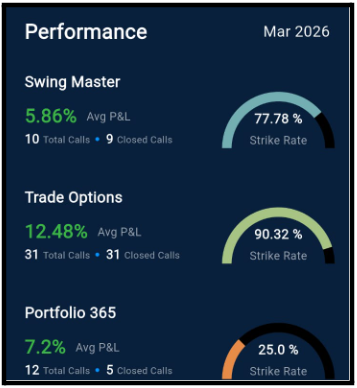
The snapshot from the app shows:
- Trade Options: 12.48% Avg P&L, 90.32% Strike Rate (31 calls)
- Swing Master: 5.86% Avg P&L, 77.78% Strike Rate
- Portfolio 365: 7.2% Avg P&L, 25% Strike Rate (only 5 closed calls)
Performance metrics such as “Avg P&L” and “Strike Rate” are presented without any disclosed methodology, time period, or clarity on whether returns are realized or include open positions.
There is also no disclosure of transaction costs, slippage, or other factors that materially impact actual investor returns.
In the absence of these details and standard risk disclaimers, such metrics can create a misleading impression when used in a promotional context.
4. Past Performance Data Is Displayed Within the App
The app shows a “Past Performance” section with monthly data, including total calls, closed calls, and strike rate per product.
Displaying this data, including the poor Portfolio 365 result of 25% strike rate, shows some willingness to show unflattering numbers rather than hiding them.
5. No Founder or Analyst Identity in the App
The app shows no information about who manages the research team, who makes the trading calls, or what qualifications they hold.
SEBI’s regulations require that the principal research analyst be identifiable and accountable.
An app delivering daily paid trading calls with zero analyst attribution gives subscribers no way to assess who is responsible for their financial recommendations.
Traders Circuit App User Reviews
The app has 179 reviews on Google Play with a 3.9-star overall rating. The most helpful negative reviews point to two distinct problems, one operational and one commercial.
1. Closing Notifications Arrive Too Late for Intraday Trades
User Mohamed Touseef raised a critical operational concern: trade closing notifications arrive after the window to act has already closed, making the intraday service practically unusable.
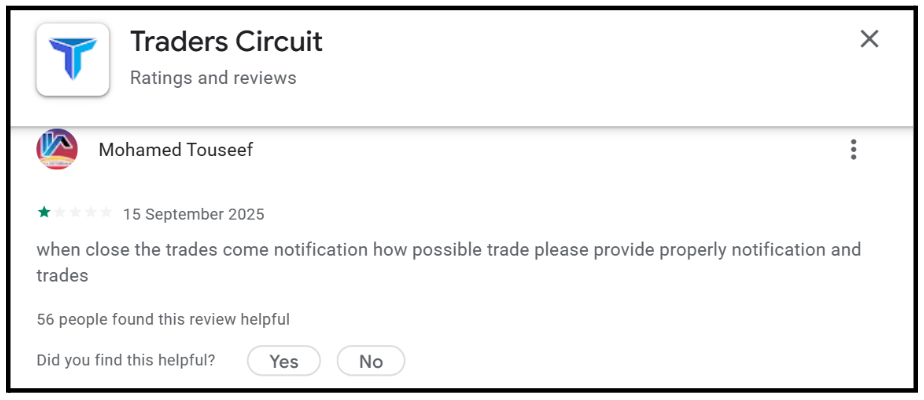
This review received 56 helpful votes, confirming that this is a widespread experience and not an isolated technical issue.
2. No Monthly Subscription Option, Mandatory Long-Term Commitment Reported
User Dhanasekar Rukmangathan could not access a one-month plan and faced a mandatory 10-year subscription with no flexibility.
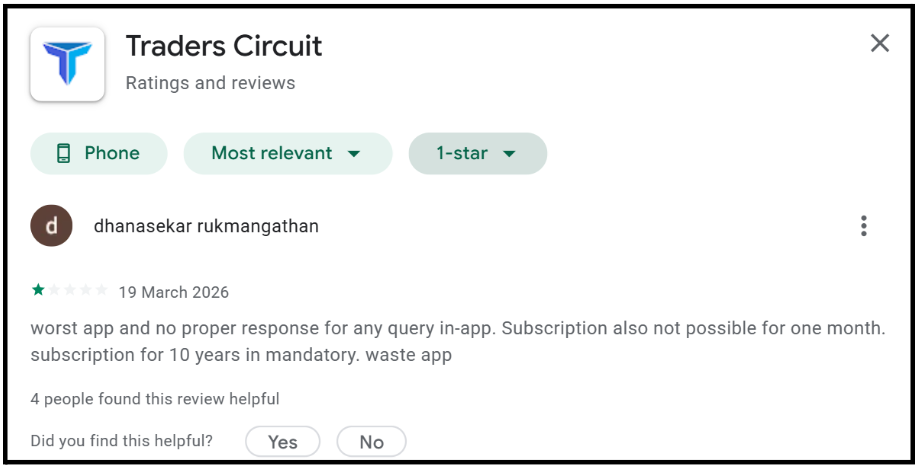
He received no proper response to in-app queries, resulting in unresolved issues and a poor overall experience.
What Investors Must Keep in Mind?
Before subscribing to any trading app, regardless of how polished the interface looks, these points protect you more than any disclaimer will.
- Self-reported strike rates are not verified performance data: a 90% strike rate displayed in the app has no independent audit behind it
- Intraday options require real-time notifications: if the app’s alert system is unreliable, the service is unsuitable for its stated purpose, regardless of call quality
- No analyst identity means no accountability: you cannot assess the credentials of whoever is recommending trades you pay for
- SEBI registration is not prominently displayed: verify the number independently on SEBI’s website before subscribing
- A zero-refund policy on a subscription service with operational failures leaves you with no recourse. Understand this before committing to any plan
- Never trade a buy call without knowing the stop-loss; entry without exit is the highest-risk position in options trading
Treat every claim with skepticism and verify before you trust; your capital depends on it.
If transparency, accountability, and execution reliability aren’t clear, it’s better to walk away than risk your money.
How to Complain Against Traders Circuit?
If you subscribed to the Traders Circuit app, suffered losses due to late notifications or misleading performance data, or could not get a refund after a service failure, you have options.
Step 1: Document Everything From the App
Screenshot every trade call you received, the time it arrived, the time the market moved, and the outcome.
Also, save all subscription confirmation messages, payment records, and any in-app support interactions. Timestamped evidence from the app itself is your strongest proof.
Step 2: File a Formal Written Complaint With Traders Circuit
Send a written complaint to Traders Circuit’s grievance officer by email and registered post.
State the specific trades, the notification failure dates, the financial impact, and the amounts paid. A written complaint creates a mandatory paper trail and starts the resolution clock.
Step 3: File a Complaint in SCORES
Step 4: Lodge a Complaint in SMART ODR
Step 5: Stock Market Arbitration
If your complaint is not resolved satisfactorily through regulatory channels, and your agreement contains an arbitration clause, you can consider initiating arbitration through the relevant exchange mechanism.
This option is especially appropriate in cases involving significant financial losses.
Need Help?
If you’ve incurred losses by following Traders Circuit’s calls, experienced delayed alerts, or paid for services that didn’t meet expectations, structured support can help you move forward.
Even if your loss feels small or your case seems weak, a service failure in a paid financial product is valid grounds. Register with us to get your case properly evaluated.
Conclusion
The Traders Circuit app is a professionally built platform with a clear product structure, real-time market data, and some willingness to display unflattering performance numbers.
At the same time, the most critical operational failure, late intraday notifications validated by 56 users, strikes at the core of what an intraday advisory app exists to do.
Add to this the buried SEBI registration number, the unverified strike rate claims, the no-refund policy, and zero analyst attribution, and the picture becomes more complicated than the app’s clean design suggests.
For intraday options trading, the difference between a timely and a late notification is not a minor inconvenience, it is the difference between following a call and missing it entirely. That is worth knowing before you subscribe.





 Add us as a preferred source on Google »

