

If you are thinking about filing a complaint against Equentis, you are probably at a point where something has gone wrong, and the firm has not fixed it.
Maybe a representative promised returns that never came. Maybe you were guided into unlisted stocks that lost most of their value.
Maybe you paid a subscription fee, and the recommendations consistently failed to match what was marketed.
Whatever the specific situation, this page tells you exactly when a formal complaint is appropriate, what evidence you need before you file, and how to move through each stage of the process from writing to Equentis directly all the way through to arbitration if needed.
How to Complaint Against Equentis?
Four stages stand between you and a resolution: Equentis, SEBI SCORES, SMART ODR, and arbitration.
Each one runs on its own clock, so follow them in order.
Step 1: Save Your Evidence Before You Do Anything Else
This is the most important step and the one most investors skip because they want to take action immediately. Collecting evidence first makes every step that follows significantly more effective.
Save all of the following before contacting Equentis or anyone else:
All WhatsApp messages, voice notes, and Telegram communications with Equentis representatives, with timestamps intact. Do not delete anything, even if it seems irrelevant.
Your payment receipts and the subscription confirmation email or document. This establishes what you paid, when you paid it, and what you paid for.
Any marketing material, presentation slides, or session recordings that show the performance claims or return figures that influenced your decision to subscribe.
Your trading account statements show the specific recommendations you received and the results of acting on them. Contract notes for all disputed trades.
The written client agreement, if one was provided. If no written agreement was provided before you paid, note that specifically as part of your complaint.
Any communications where return promises were made, upgrade pitches were offered, or recovery language was used. Even a screenshot of a WhatsApp message saying losses will be recovered is valuable evidence.
Do all of this before raising any dispute with Equentis. Once a formal complaint begins, communication patterns change and documents become harder to collect.
Step 2: Write to the Equentis Grievance Officer
Your first formal step is a written complaint to the Equentis Grievance Officer, who is Rakesh Gupta.
Address the complaint to him by name using Equentis’s official contact channels listed on their website and on SEBI’s intermediary register.
In your written complaint, state clearly:
- The specific plan or service you subscribed to and the fee you paid.
- What was represented to you during the sales process, including any specific return figures mentioned, any assurances about performance, and any claims about the service scope?
- What was actually delivered and where it differed from what was promised or from what the service agreement specified.
- The losses incurred or the specific harm caused, with amounts.
- The resolution you are requesting, whether a refund, partial compensation, or a written explanation.
Complaint Against Equentis Email
Send your complaint to Equentis’ official grievance email address listed on its website or in SEBI’s intermediary records.
Keep all communication in writing and retain copies of your email, attachments, and any replies as evidence.
Complaint Against Equentis Customer Care Number
You may call the Equentis customer care number to report your issue or request an update.
However, always follow up with a written email, as phone conversations do not create the same documentary record as a formal written complaint.
Step 3: File on SEBI SCORES
If Equentis does not respond within 30 days or the response does not resolve the actual issue, file on SEBI SCORES at scores.gov.in.
The most common mistake investors make at this stage is filing under the wrong intermediary category.
Equentis’s subscription advisory business operates under the Investment Adviser registration, not a Research Analyst registration. Filing under the wrong category delays the complaint.
When filling the SCORES form:
- Select Investment Adviser as the intermediary type.
- Enter Equentis Wealth Advisory Services Limited as the firm name.
- Enter INA000003874 as the registration number.
If you need to file a complaint against portfolio managers specifically for the PMS service, select Portfolio Manager as the intermediary type and enter INP000008969 as the registration number instead.
In the complaint description, describe the sequence of events factually. What you paid for, what was promised, what was delivered, and what specific SEBI regulation was violated.
The most applicable regulations for most Equentis complaints are Investment Adviser Regulation 13(d) for guaranteed return promises and the suitability provisions for unlisted stock guidance.
Attach your evidence in organised, clearly labelled files. A well-organised evidence package makes the SCORES process significantly more effective.
SEBI SCORES creates a formal regulatory record. Equentis is required to respond within the mandated period. Non-response or an inadequate response triggers SEBI’s direct intervention.
Step 4: Escalate to SMART ODR
If SCORES does not produce a satisfactory resolution within the mandated response window, escalate to SEBI’s SMART ODR portal.
SMART ODR stands for Online Dispute Resolution.
t is SEBI’s structured mediation system designed to streamline cases, operating as a centralized SMART ODR platform for disputes between investors and registered intermediaries.
The process is fully online and does not require physical attendance. Both sides submit their positions and evidence; an independent conciliator reviews the matter, and a resolution is facilitated within defined timelines.
SMART ODR has produced binding recovery awards in similar IA cases.
For investors who have tried the direct complaint route without success, the SMART ODR login provides access to a meaningful escalation path that produces documented outcomes.
Step 5: Arbitration in Stock Exchange
If SMART ODR does not resolve the matter, exchange arbitration is the final step within the regulatory framework.
Arbitration produces a legally binding decision from an independent arbitrator appointed by the exchange. Equentis is required to comply with the award within a defined period.
For claims below Rs. 10 lakh, there is no investor filing fee for exchange arbitration. For larger claims, a filing fee applies on a slab basis.
Arbitration is particularly effective when the evidence clearly documents a specific regulatory violation.
Cases involving documented return promises or unlisted stock guidance without suitability assessment have the clearest fact patterns for arbitration.
Time limit: File your initial complaint and begin the process within 3 years of the incident. The earlier you act, the stronger your evidence trail. Delays allow records to be deleted and make the case harder to reconstruct.
Also Read: Sai Proficient complaints, a service that stopped abruptly, then asked for more money.
When Should You File a Complaint Against Equentis?
Not every disappointing investment outcome qualifies as a formal complaint.
Before going through the process, it helps to know whether your situation fits within the regulatory framework that SEBI’s complaint process is designed to address.
These are the six specific situations where you have clear grounds for a formal complaint against Equentis.
Situation 1: A representative promised a specific return percentage on a sales call.
SEBI Investment Adviser Regulation 13(d) prohibits any registered IA from making statements that promise or imply assured returns.
If a named Equentis representative told you on a call that you would earn 40 percent or 50 percent annually, or implied any specific return figure to convert your subscription, that statement was made in violation of SEBI regulations.
The name of the representative, the date of the call, and what was said are the key details to document.
Situation 2: You were guided into unlisted stocks without adequate risk disclosure.
SEBI’s IA regulations require that every recommendation be suitable for the specific client and that the client be fully informed of the risks before investing.
Unlisted stocks are illiquid, difficult to value independently, and can decline in value without any exit option available to the investor.
If you were not fully informed of these risks before being guided into unlisted stocks, the suitability and disclosure obligations were not met.
Situation 3: The hit rate on recommendations was significantly lower than what was marketed.
If the plan you paid for was marketed with accuracy or success rate claims that did not match the actual performance you experienced, the gap between marketing and delivery is a suitability and disclosure issue.
Keep a record of the specific claims made in the marketing material and compare them with the actual performance you received.
Situation 4: Fees were collected without a proper written client agreement.
Every IA engagement must begin with a written agreement specifying the service scope, the fee amount, the duration, and the terms.
If you paid Equentis without receiving a written agreement beforehand, or if additional fees were collected beyond what was specified in the original agreement, those charges were collected without proper regulatory authorisation.
Situation 5: Support and communication stopped after your losses appeared.
A pattern documented across multiple Equentis investor accounts is that support quality drops significantly after subscription fees are paid and losses appear.
While reduced responsiveness alone is not always a formal regulatory violation, if the reduction in support meant that you could not access services you paid for or could not get responses to specific questions about your portfolio, that gap forms part of your complaint alongside the primary violations.
Situation 6: The Equentis PMS service did not disclose required information or failed to deliver what the Disclosure Document specified.
For PMS investors, SEBI’s Portfolio Manager Regulations require specific disclosures before investment and ongoing reporting after.
Failure to provide the Disclosure Document before you invested, failure to deliver regular portfolio statements, or investment decisions that fall outside the strategy parameters you agreed to are all complaint grounds specific to the PMS service.
How to Organize Your Proof for a Faster Refund?
Across all five steps, the strength of your case depends on the quality and completeness of your evidence. This is the specific package that makes an Equentis complaint most effective.
The return promise documentation is the single strongest piece of evidence if you have it.
A WhatsApp message, voice note, session recording, or written communication where a specific return figure was mentioned gives you a documented SEBI Regulation 13(d) violation.
The original subscription or service agreement establishes the baseline of what you paid for. Every deviation from that baseline is documentable.
The trading statement showing the actual results of following Equentis recommendations establishes the financial harm.
The gap between what was promised and what the trading statement shows is the basis of your monetary claim.
Any upgrade or recovery pitch documentation, where a representative offered a higher-tier service specifically to recover previous losses, is particularly strong evidence because the recovery pitch itself is a prohibited representation.
Is Recovery From Equentis Possible?
Yes, recovery from a SEBI-registered IA like Equentis is entirely possible, but it requires rock-solid proof, not just a standard complaint.
If you want to recover money from a SEBI registered investment advisor, you cannot rely on emotional pleas. You need a strategic framework.
To show you how the process works, look at a similar case our team recently handled against another registered IA, Auro Star Investment Advisory Pvt. Ltd. (SEBI Reg. No. INA000018434).
We fought this case using the same framework you need for Equentis, proving how exchange arbitration works in an investor’s favor.
The arbitrator’s award flagged these violations:
- No Risk Profiling: Large trades are advised without checking income or risk appetite.
- No Stop-Loss Given: Trades advised with no stop-loss or exit plan.
- No Record of Advice: No call recordings or written record produced.
- Undisclosed Premium Plan: Costly add-on sold verbally, no agreement.
The missing records worked against the IA, not the investor.
Our team acted as the investor’s authorised representative, built the case on contract notes, call logs, and SEBI’s Investment Adviser Regulations.
Every missing document was tied back to a specific regulatory breach.
The arbitrator agreed Auro Star could not explain away its lack of records. Since there was no proof of proper advice, the tribunal held them responsible for a share of the investor’s trading losses.
This is what a documented, well-argued complaint can achieve.
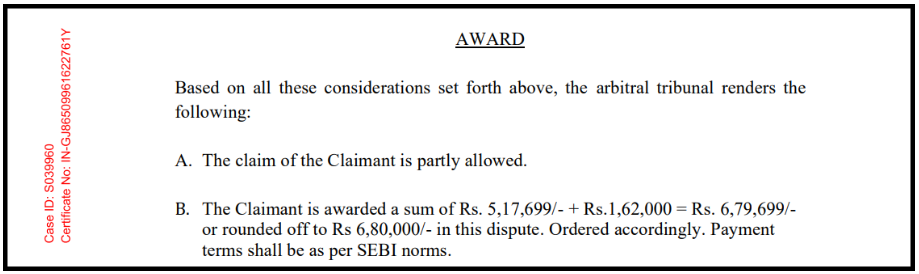
The investor was awarded Rs. 6,80,000 (Arbitration Case ID: S039960), covering a share of the trading loss plus a refund of fees paid. That’s real proof that recovery from a SEBI-registered IA is achievable when the case is built right.
Worried your evidence won’t hold up?
Our team will professionally organize your package, pinpoint every SEBI violation, and handle your complaint from start to finish.
Conclusion
Filing a complaint against Equentis involves five steps done in the right order.
Evidence gathered first. Formal written complaint to Rakesh Gupta as the Grievance Officer.
SCORES is filing under the Investment Adviser category with registration number INA000003874. SMART ODR escalation if SCORES does not resolve.
Exchange arbitration is the final binding step.
The process works when the violations are correctly identified and the evidence is complete. Six specific situations qualify for a formal complaint against Equentis.
If your situation matches any of them, act within the 3-year window and act with organised evidence from the start.
Frequently Asked Questions
1. How do I file a complaint against Equentis?
Write formally to Rakesh Gupta, the Equentis Grievance Officer, through official Equentis contact channels.
If unresolved within 30 days, file on SEBI SCORES at scores.gov.in, selecting Investment Adviser as the intermediary type and entering INA000003874 as the registration number. Escalate to SMART ODR and then exchange arbitration if needed.
2. Which SEBI category do I use when filing against Equentis?
Use the Investment Adviser and registration number INA000003874 for subscription service complaints. Use Portfolio Manager and registration number INP000008969 for PMS-specific complaints.
Filing under Research Analyst, which is a common mistake, delays the complaint because Equentis does not hold an RA registration.
3. What evidence do I need to file a complaint against Equentis?
You need payment receipts, the subscription agreement, all WhatsApp and email communications with timestamps, marketing material showing performance claims, trading account statements showing the results of following recommendations, and documentation of any return promises or upgrade pitches.
Collect everything before raising any dispute.
4. Can I file a complaint if I signed a no-refund agreement with Equentis?
Yes. A no-refund clause cannot override SEBI regulatory obligations.
If Equentis violated its IA registration obligations through guaranteed return promises, unsuitable product recommendations, or misleading marketing, the no-refund clause does not protect the firm from regulatory action.
5. How long does the SEBI SCORES process take for an Equentis complaint?
Equentis is required to respond to SCORES complaints within the mandated period, typically 21 to 30 days. If the response is unsatisfactory, escalation to SMART ODR typically adds 2 to 4 months.
Exchange arbitration can take 3 to 6 months, depending on complexity. Filing with complete, organised evidence shortens the process at every stage.
6. What is the time limit to file a complaint against Equentis?
File within 3 years of the incident. Acting early is significantly better because your evidence is freshest and communication records are easiest to retrieve.
If you experienced issues in 2023 or 2024, you can still act now.
7. Do I need a lawyer to file against Equentis?
You do not need a lawyer for SCORES filing. For SMART ODR and arbitration, you can represent yourself, but expert support significantly improves your chances of a favourable outcome, particularly when it comes to organising evidence correctly and responding to the firm’s submissions.
Our team provides this support.





 Add us as a preferred source on Google »

