

“Is Equentis SEBI registered?” is one of the most common questions investors search for.
It’s also one of the easiest to misunderstand.
A registration number tells you something important but not necessarily what you think it does.
This blog looks beyond the registration itself, showing where it matters, where it doesn’t, and what options are available if your experience with the firm raises concerns.
Is Equentis SEBI Registered or Not?
Yes, Equentis is SEBI registered. It holds two separate and active registrations.
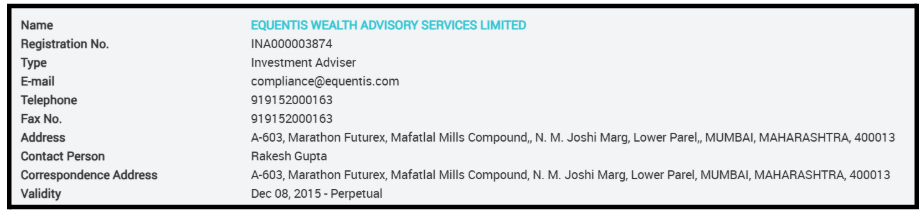
The first registration, INA000003874, is as a SEBI Investment Adviser.
This is the registration that covers the subscription business most investors interact with when they pay for the 5 in 5 wealth creation strategy or the MPO plan.
This registration has been active since December 2015.
The second registration, INP000008969, is as a SEBI Portfolio Management Services provider.
This covers the PMS business where Equentis manages client portfolios directly.
The minimum investment for PMS under SEBI rules is Rs. 50 lakh.
Both registrations are active. Neither has a publicly recorded adjudication order or suspension against it as of June 2026.
The fact that Equentis holds two separate SEBI registrations actually puts it in a more regulated category than most advisory firms. Most small advisory firms hold only an RA registration.
An IA registration requires higher standards of compliance, suitability assessment, and disclosure than an RA registration. A PMS registration requires even more.
What this means is that Equentis has taken on a higher level of regulatory obligation by holding both licences.
The complaints that have been documented against the firm are therefore complaints about conduct that sits outside the boundaries of licences with elevated compliance requirements.
How to Check Equentis’s SEBI Status?
Verifying SEBI registration takes less than two minutes.
Do not take any firm’s word for its own registration status.
To verify the IA registration:
Go to sebi.gov.in. Click Intermediaries in the top navigation. Select Registered Intermediaries.
Choose Investment Adviser from the category dropdown. Search for Equentis Wealth Advisory Services Limited or enter INA000003874 directly.
You will find the entity name, registration number, registration date, registration status, and the Grievance Officer listed for the firm, which is Rakesh Gupta.
To verify the PMS registration:
Follow the same path but select Portfolio Manager from the category dropdown instead of Investment Adviser.
Search for Equentis Wealth Advisory Services Limited or enter INP000008969.
If either registration returns no result or shows a suspended or cancelled status, that is information you need before paying anything.
Also Read: Is Wealthmax Solution SEBI registered, a registration real since 2018, formally ended in 2026.
What SEBI Allows Equentis to Do Under IA Regulations?
When you subscribe to an advisory service, it is crucial to know exactly what a license permits a firm to do.
Equentis operates under a SEBI Investment Adviser (IA) registration, which subjects them to strict code-of-conduct rules.
Unlike a standard Research Analyst who broadcasts identical market reports to thousands of users at once, a registered Investment Adviser is legally authorized, and required, to provide a much more customized experience.
Under the SEBI (Investment Advisers) Regulations, Equentis is permitted to:
- Provide Personalized Advice: They are authorized to give tailored stock and investment recommendations based directly on your unique financial situation, risk appetite, and long-term goals.
- Charge Transparent Fees: They can collect fees for their advisory services, provided the pricing follows a fixed, pre-disclosed structure that you agree to in writing before any services begin. These fees cannot be tied to your trading profits.
- Conduct Suitability Assessments: They are allowed to recommend financial assets, but only after mapping them to your profile. This duty becomes even stricter when dealing with highly volatile or illiquid assets, such as unlisted shares.
- Maintain Compliance Records: They are authorized (and mandated) to keep formal logs of all the advice given to you, alongside the logic and data used to justify why those specific stocks were a good fit for your portfolio.
What SEBI Strictly Prohibits Under IA Regulations?
A SEBI registration is not a blank check to conduct business format-free; it acts as a legal boundary wall to protect retail investors.
If a firm’s day-to-day sales practices conflict with regulatory guidelines, their registration doesn’t shield them, it holds them accountable.
If you have already paid for a subscription and feel misled, comparing your experience against these strict prohibitions will help you spot compliance failures.
Under SEBI regulations, Equentis is strictly forbidden from:
- Promising Guaranteed Returns: SEBI Regulation 13(d) leaves zero room for loopholes here. Equentis cannot promise or even subtly hint at assured profits. If a representative tells you over a phone call or writes in an email that a strategy will yield “40% to 50% annual returns,” they are operating in direct violation of the law.
- Pushing Unsuitable High-Risk Products: They cannot recommend high-risk or illiquid assets without completely laying out the potential downsides. Recommending complex assets to an everyday retail investor without detailed risk disclosures is a serious compliance breach.
- Onboarding Clients Without a Written Agreement: They are prohibited from charging you fees based on informal or verbal arrangements. A formal relationship only begins once a comprehensive, bilateral client agreement is signed by both parties.
- Employing Aggressive Sales Tactics or Misleading Ads: They are banned from using high-pressure marketing strategies, creating false urgency, or deploying ad campaigns that paint an unrealistic picture of effortless wealth creation.
What the PMS License Authorizes Equentis to Do?
A Portfolio Management Services (PMS) license shifts the dynamic from a simple advisory relationship to a hands-on investment partnership.
Instead of giving you a list of stocks to buy yourself, an active PMS registration legally permits a firm to operate as an institutional money manager.
However, before looking at a specific Equentis PMS review to see how their actual strategies perform, it is important to understand what this license fundamentally empowers them to do.Check Equentis’s active SEBI IA & PMS registrations. Learn what their dual licences allow, what rules they prohibit, and how to verify them.
Under SEBI’s PMS regulations, Equentis is authorized to:
- Directly Manage Your Funds: They are legally permitted to take physical control of your capital and execute buy or sell trades directly inside your dedicated demat account on your behalf.
- Exercise Investment Discretion: Depending on whether you sign up for a discretionary or non-discretionary plan, they are authorized to make immediate, real-time buy and sell decisions without waiting for your individual approval for every transaction.
- Charge Structure-Based Management Fees: They are allowed to charge formal fees for managing your wealth. These typically include fixed management fees, performance-linked profits (above a certain hurdle rate), and setup fees, all of which must be clearly detailed in your contract.
- Invest Across Approved Asset Classes: They are authorized to build and rebalance a diversified portfolio for you using a variety of SEBI-approved securities, including listed equities, debt instruments, mutual funds, and unlisted shares.
What the PMS Registration Does Not Allow Equentis to Do
Because portfolio managers hold direct access to your capital, SEBI surrounds this license with strict operational boundaries.
A PMS registration is not a license to pool funds indiscriminately or hide investment risks.
If your experience with their PMS onboarding or sales reps feels untransparent, it likely crosses into these prohibited areas.
Under SEBI regulations, Equentis is strictly forbidden from:
- Accepting Investments Below ₹50 Lakh: They cannot onboard you into their PMS with an investment of less than ₹50 lakh. This threshold is a rigid, non-negotiable regulatory floor established by SEBI to protect smaller retail investors from high-ticket risk.
- Pooling Client Capital Into One Account: They are prohibited from mixing your money with their corporate funds or pooling it into a single omnibus account with other investors. Every client’s portfolio must be kept strictly segregated in an individual bank and demat account.
- Locking You In Without an Upfront Disclosure Document: They cannot invest a single rupee of your money until they have provided you with a comprehensive SEBI-mandated Disclosure Document. This file must details their past performance, fee structures, corporate financials, and any active legal disputes.
- Guaranteeing Capital Protection or Returns: Just like with an Investment Adviser license, promising fixed returns or claiming “zero downside risk” is entirely prohibited. They cannot offer any guarantees, verbal or written, regarding the performance of their PMS strategies.
If you are facing issues with your portfolio manager or suspect a violation of these SEBI rules, learn how to file a complaint against portfolio managers online using our step-by-step guide to escalate your grievance effectively.
Filing Mistakes: Why Your Complaint Category Matters
Because Equentis holds an IA registration, your complaint on SEBI SCORES must be filed under the Investment Adviser category.
This is the most common filing mistake investors make with Equentis complaints.
If you file under Research Analyst, which is the more commonly known category, your complaint may be routed incorrectly and delayed.
Equentis’s subscription advisory business runs under the IA registration, not an RA registration.
When filing on SEBI SCORES at scores.gov.in, select Investment Adviser as the intermediary type, enter Equentis Wealth Advisory Services Limited as the firm name, and enter INA000003874 as the registration number.
Need Further Guidance?
If your experience with Equentis matches these prohibited practices, you have formal legal recourse.
To help you take the next steps, we have put together comprehensive guides detailing exactly how to build your case:
- Analyze the Precedents: To understand how SEBI evaluates these violations, review our breakdown of documented Equentis Wealth Advisory complaints, which covers real-world investor losses and specific rupee amounts.
- File Your Case Correctly: When you are ready to act, follow our step-by-step walkthrough on How to file a complaint against Equentis. This guide takes you through the entire legal framework, from gathering undeniable evidence to navigating SEBI SCORES, SMART ODR, and exchange arbitration.
Did Equentis make promises that violate SEBI regulations?
Our team will identify their specific compliance failures and file a bulletproof complaint on your behalf.
Conclusion
Equentis is SEBI registered under two active licences: Investment Adviser INA000003874 and Portfolio Management Services INP000008969.
Both are real, verifiable, and currently active.
The dual registration places Equentis in a higher compliance category than most small advisory firms.
What those registrations permit is clearly defined. Personalised investment advice, portfolio management, and transparent fee structures. What they prohibit is equally clear.
Guaranteed return promises, unsuitable product recommendations without adequate disclosure, and misleading marketing.
The documented complaints against Equentis describe conduct that sits in that prohibited column.
If what happened to you during your Equentis engagement matches what the regulations prohibit, the complaint process is available through SEBI SCORES under the Investment Adviser category.
That is where it needs to go.
Frequently Asked Questions
1. Is Equentis SEBI registered?
Yes. Equentis Wealth Advisory Services Limited holds two active SEBI registrations: Investment Adviser registration INA000003874 and Portfolio Management Services registration INP000008969.
Both can be verified on SEBI’s intermediary portal at sebi.gov.in.
2. What is the difference between Equentis’s IA and PMS registrations?
The IA registration (INA000003874) covers personalised investment advice for subscribers, which is the service most Equentis investors pay for.
The PMS registration (INP000008969) covers direct portfolio management where Equentis manages client money on their behalf. PMS requires a minimum investment of Rs. 50 lakh as mandated by SEBI.
3. What does the IA registration permit Equentis to do?
It permits personalised investment advice tailored to each client’s financial situation, risk tolerance, and goals.
It requires suitability assessment before any product recommendation and a written client agreement before services begin.
4. Can Equentis promise guaranteed returns under its SEBI registration?
No. SEBI Investment Adviser Regulation 13(d) explicitly prohibits any statement that promises or implies assured returns.
This prohibition applies to verbal statements, written communications, and marketing material. No exception exists.
5. How do I verify Equentis’s SEBI registration myself?
Go to sebi.gov.in, click Intermediaries, select Registered Intermediaries, choose Investment Adviser from the dropdown, and search for Equentis Wealth Advisory Services Limited or enter INA000003874.
For the PMS registration, repeat the process selecting Portfolio Manager from the dropdown and entering INP000008969.
6. Under which category do I file a SCORES complaint against Equentis?
File under Investment Adviser, not Research Analyst. Equentis’s subscription advisory business operates under the IA registration INA000003874.
Filing under the wrong category is the most common reason valid Equentis complaints are delayed.
7. Does Equentis have any SEBI orders against it?
No SEBI adjudication order or penalty notice has been publicly recorded against Equentis Wealth Advisory Services Limited as of June 2026.
The firm does have complaints registered on SEBI SCORES. Absence of a formal order means SEBI has not yet concluded a formal adjudication, not that no complaints exist.





 Add us as a preferred source on Google »

