

When someone searches for Equentis wealth advisory complaints, they are usually not browsing out of curiosity.
They are either thinking about paying and want to know what other investors experienced, or they have already paid and something has gone wrong.
Equentis Wealth Advisory Services Limited holds valid SEBI registrations and has been around since 2015.
It also has documented investor complaints involving unlisted stock losses, broken return promises, and a 2.2 out of 5 rating from 699 verified app reviews.
This page covers the specific cases with names and rupee amounts, what each case means under SEBI regulations, and what the pattern tells you about the gap between what Equentis promises and what some investors actually received.
Are Equentis Complaints Genuine or Just Bad Market Outcomes?
This is the first question worth answering before anything else.
Not every loss from an investment advisory is a complaint. Markets go up and down and sometimes good advice produces bad outcomes because of conditions no one could predict.
That is market risk and it is not something SEBI can or should adjudicate.
But there is a clear difference between market risk and advisory misconduct. When a representative promises a specific return percentage to convert a sale, that is not market risk.
When an investor is guided into unlisted stocks without adequate risk disclosure, that is not market risk.
When subscription fees are charged for services that consistently fail to deliver at the level marketed, the question of whether the marketing itself was misleading becomes relevant.
The cases below are not stories about bad luck in markets. They are stories about specific conduct that sits outside what SEBI’s Investment Adviser Regulations permit.
That distinction is what makes them complaints rather than just disappointments.
Case 1: Saurabh Singh and the Unlisted Stock That Lost 98 Percent
This is the most documented case in the Equentis complaint record and the one that illustrates the most serious concern about the firm’s advisory practices.
Saurabh Singh paid Rs. 1.5 lakh in subscription fees to Equentis over the course of his engagement. During that engagement, he was advised to invest in unlisted stocks.
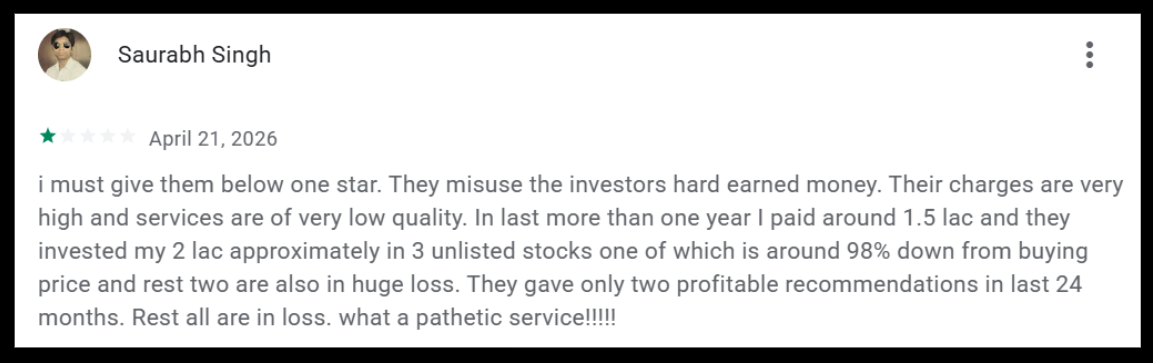
One of those unlisted stocks declined by 98 percent.
To understand why this is more than just a bad investment outcome, you need to know what unlisted stocks are and what the rules say about advising investors into them.
Unlisted stocks are shares in companies that are not traded on any stock exchange. You cannot buy or sell them through your regular brokerage account.
Their prices are not publicly visible.
They are valued based on private transactions and their liquidity is extremely limited, meaning you may not be able to sell them even if you want to.
A 98 percent decline in an unlisted stock does not just mean you lost money. It means you may be holding something you cannot sell at all.
SEBI’s Investment Adviser Regulations require registered IAs to assess suitability before recommending any product.
For a product as illiquid and high-risk as an unlisted stock, the suitability assessment and risk disclosure requirements are especially important.
If Saurabh Singh was not fully informed of these risks before being guided into unlisted stocks, the advisory fell short of what the regulations require.
After the losses appeared, he tried to get meaningful support from Equentis. No meaningful response came.
If you were also guided into unlisted stocks by Equentis, your situation is directly comparable to this case. The suitability and disclosure question applies to your case too.
You’re right, the cases didn’t match the actual screenshots. Here they are rewritten to reflect exactly what’s in your four images, in easy, human-written language.
Case 2: Buying Ranges Changed Without Any Notice
One investor, a subscriber for close to two years, used both the 5 in 5 and MPO portfolios.
He said the overall idea behind these plans looked structured on paper, but his actual experience raised real doubts about how transparent and consistent things really were.
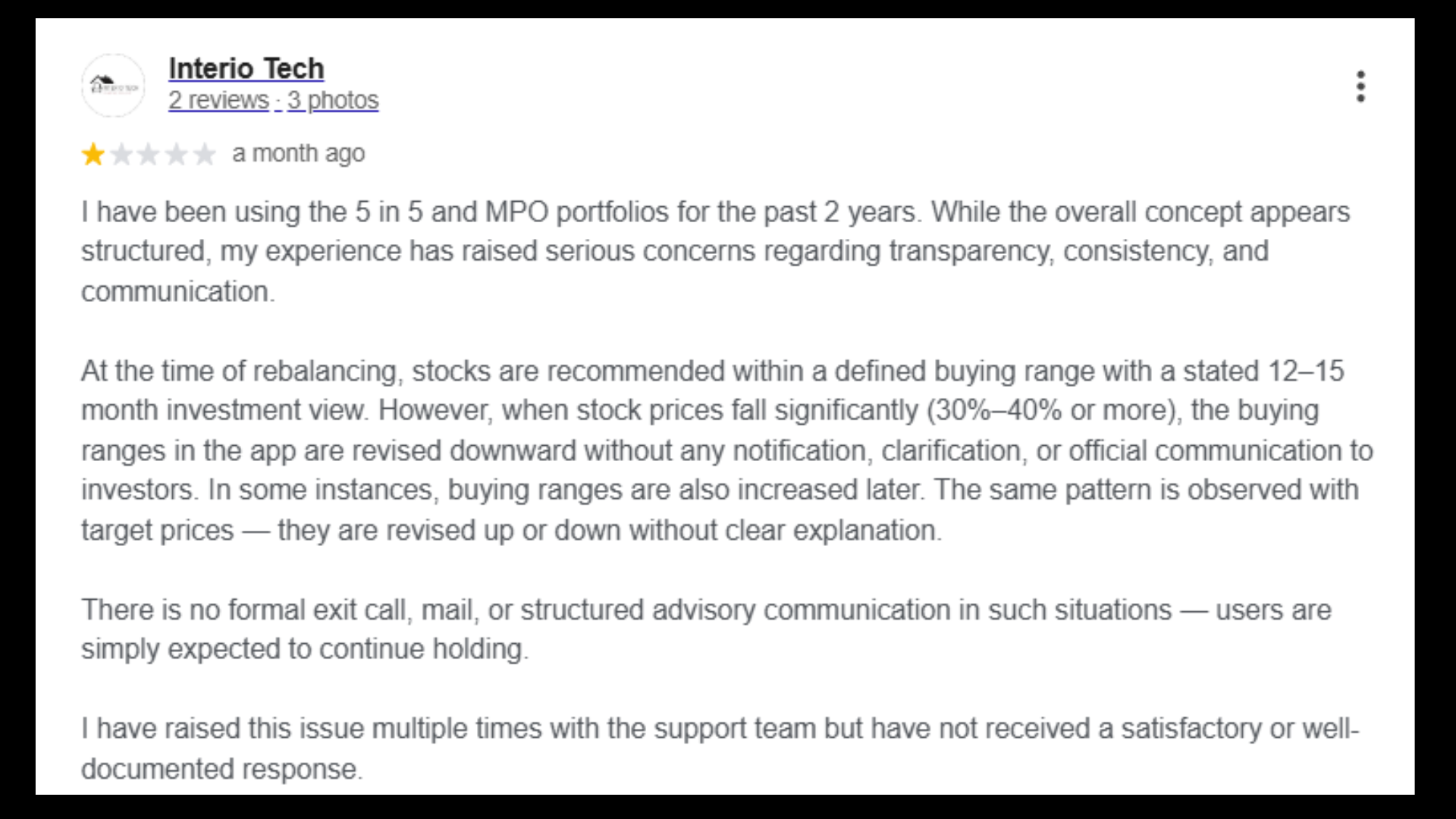
His specific issue was this. Stocks were recommended within a set buying range, along with a 12 to 15 month investment view.
But when a stock price dropped sharply, sometimes 30 to 40 percent or more, the buying range shown in the app would quietly get revised downward, with no notification, no explanation, and no communication to investors.
He also noticed the same thing happening in reverse, with buying ranges being raised later on. Target prices followed the same pattern, moving up or down without any clear reasoning given.
Just as concerning, he said there was no formal exit call, no email, and no structured advisory message when this happened. Investors were simply left holding the stock, expected to figure things out on their own.
He raised this more than once with the support team and said he never got a response that actually addressed the problem.
Case 3: Paying the Subscription Fee Felt Like a Direct Loss
A subscriber named Niranjan Bhumkar said in blunt terms that paying the subscription fee turned out to be a direct loss for him.
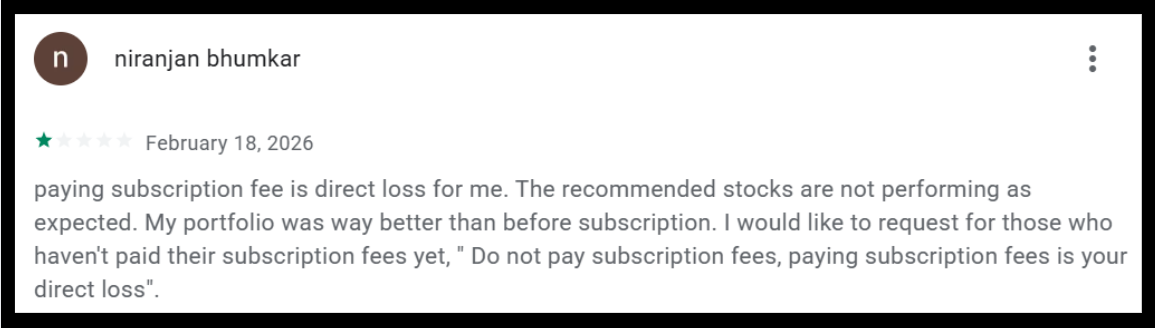
The stocks recommended to him did not perform the way he expected, and he pointed out that his portfolio had actually done better before he subscribed than after.
His message to other investors was equally direct.
For anyone who has not yet paid their subscription fee, his advice was simple, do not pay, since in his experience, paying the fee was itself the loss.
Case 4: Sales Staff Calling Themselves Financial Advisors
A user going by the name Mindian Yes raised a different kind of concern, one about how the service was sold rather than how it performed.
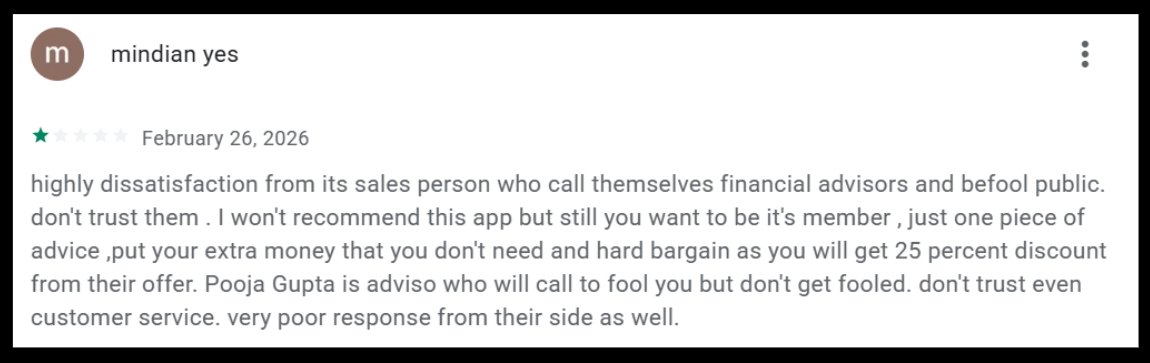
He said he was highly dissatisfied with the sales staff, who introduced themselves as financial advisors while, in his words, trying to talk him into subscribing.
He specifically named a representative, Pooja Gupta, as the one who called him and pushed for the sale.
His advice to others was to stay cautious, to only ever consider putting in money they could genuinely afford to lose, and to negotiate hard, since he mentioned being able to get a 25 percent discount simply by pushing back on the price.
He also said the customer service experience afterward was poor, with slow and unhelpful responses once he raised concerns.
Case 5: Nayana Dawkhar and the 40 to 50 Percent Return Promise
An investor named Nayana Dawkhar left a detailed account of what happened during her sign up process.
She said she was specifically assured by a named representative, referred to as Mr. Vishal Gupta, that she would see a 40 to 50 percent return every month if she subscribed.
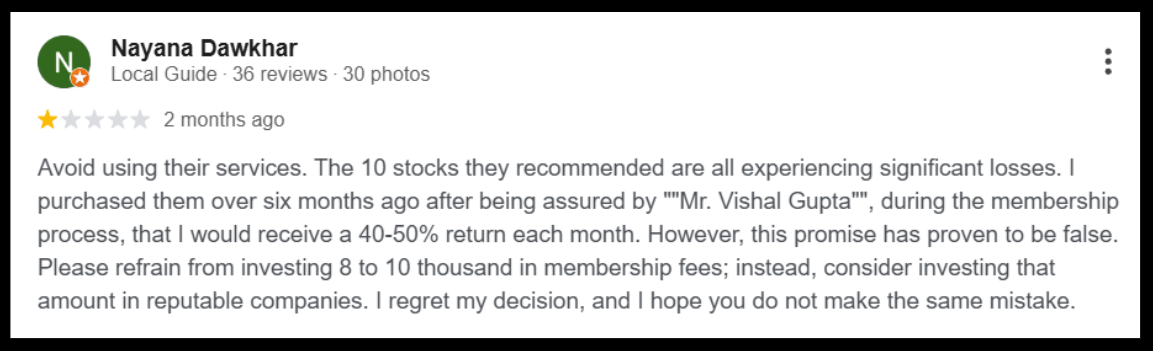
She paid for the service more than six months before writing her review, and by her account, all 10 of the stocks recommended to her were sitting at significant losses.
She said the performance did not come anywhere close to what had been promised to her at the time of sale.
Her advice to others was direct as well.
She urged people not to invest the 8 to 10 thousand rupees typically required for the membership fee, and suggested that same money would be better placed in established, reputable companies instead.
She said she regretted her own decision and hoped others would not repeat the same mistake.
Why these four patterns matter together: Looked at individually, these could each be dismissed as one unhappy customer.
But looked at together, a pattern starts to form, return promises made during the sales process that do not hold up afterward, buying ranges and targets that shift without warning or explanation, and a sales approach that some investors experienced as pressure rather than advice.
When the same type of complaint shows up across multiple, separately written investor accounts, it becomes harder to treat each one as an isolated incident.
Understanding who holds executive authority is critical when tracking accountability.
For details on who runs the firm and the official corporate identity risks to watch out for, see: Equentis owner.
Also Read: Sai Proficient complaints, Google reviews describing the exact pattern SEBI later confirmed.
The Unlisted Stock Trap: Why It’s a Different Kind of Risk
The unlisted stock issue in Saurabh Singh’s case deserves a separate explanation because most investors do not fully understand the risks involved until they are already inside one.
When you buy a listed stock, you can check its price at any moment on the NSE or BSE website.
You can sell it any time the market is open. If you want to exit, you can exit.
Unlisted stocks work differently. The company is not listed on any exchange. There is no publicly visible price. Buying and selling happens through informal or semi-formal channels.
If you want to exit, you need to find a buyer yourself, which can take months or longer, and you may have to accept a fraction of what you paid.
A 98 percent decline in an unlisted stock is not just a large loss. It may mean the investment is effectively worthless and unsellable.
SEBI’s IA regulations specifically require investment advisers to ensure that any product recommended is suitable for the client’s financial situation, risk tolerance, and investment goals.
Recommending an illiquid unlisted stock to an investor who does not fully understand these characteristics raises a clear suitability question.
If you were guided into unlisted stocks by Equentis and you were not clearly informed of the illiquidity, the valuation opacity, and the specific risks before you invested, that is a suitability failure and it forms the basis of a formal complaint.
The 2.2-Star Reality: Decoding the Public App Reviews
The official Equentis app on Google Play has 699 reviews and a 2.2 out of 5 rating as of June 2026.
The most common themes across those reviews are consistent with the named cases above. Recommendations did not perform as expected. Support became hard to reach after losses appeared.
The gap between what was promised in the sales process and what was delivered in practice is the complaint that runs through hundreds of independent accounts.
Equentis responds to most negative reviews with a templated message directing the reviewer to call their support number.
There is no visible resolution recorded in any of the public review threads.
A company that responds to its negative reviews by routing people to a phone number rather than addressing the specific concern is telling you something about how it handles dissatisfied investors outside of formal regulatory complaint channels.
Did this happen to you?
Don’t let misleading promises slide.
Register with us for a free consultation today and let our team file your complaint correctly.
Investment Adviser vs. Research Analyst: Where to File Your Complaint?
This is a detail that matters practically when you go to file.
Most investors who have had bad experiences with financial advisories file on SEBI SCORES as a Research Analyst complaint.
Equentis is not a Research Analyst. It is an Investment Adviser.
These are different SEBI registrations and they sit in different complaint categories on the SCORES form.
If you file under the wrong category, your complaint may be delayed or returned for correction.
The 3-Step Escalation Process
If your dispute isn’t resolved directly by Equentis, you can escalate it through these official regulatory channels:
- SEBI SCORES: The first formal step. You lodge an official grievance on the SEBI SCORES portal under the “Investment Adviser” category. The firm is given a set timeline to respond and offer a resolution.
- SMART ODR: If the SCORES resolution is unsatisfactory, the case moves to the SMART ODR platform. Here, an independent conciliator reviews the evidence and attempts to mediate a fair settlement between you and the firm.
- Arbitration in Stock Exchange: If conciliation fails, the matter goes to formal arbitration under the exchange mechanism. An independent arbitrator reviews the legal violations and passes a binding final order.
For full instructions on gathering evidence and navigating the SCORES and arbitration process, see: Complaint Against Equentis.
Conclusion
Equentis Wealth Advisory complaints cover a range of documented situations: a 98 percent loss in an Equentis-recommended unlisted stock combined with Rs. 1.5 lakh in fees, a 5 percent hit rate on a Rs. 32,000 options plan, and multiple named investors who say return promises made during sales calls were never delivered.
Each of these situations maps to specific SEBI Investment Adviser Regulations. Unlisted stock guidance without adequate suitability assessment and risk disclosure.
Return promises that are explicitly prohibited under Regulation 13(d). Marketing performance claims that do not match live delivery.
These are not complaints about bad luck.
They are complaints about specific conduct. If your experience matches what is described here, the formal complaint process is available and it works when the violations are correctly identified and documented.
Frequently Asked Questions
1. What are the most common Equentis complaints?
The most common documented complaints involve recommendations that significantly underperformed what was marketed, return promises made during sales calls that were not delivered, guidance into unlisted stocks without adequate risk disclosure, and difficulty getting meaningful support after losses.
2. Is the Saurabh Singh case against Equentis real?
Yes. Saurabh Singh’s case is documented in a formal complaint record.
He paid Rs. 1.5 lakh in fees to Equentis and was guided into unlisted stocks, one of which declined by 98 percent. The case raises specific suitability and risk disclosure concerns under SEBI’s Investment Adviser Regulations.
3. Can Equentis legally promise 40 to 50 percent annual returns?
No. SEBI Investment Adviser Regulation 13(d) explicitly prohibits registered IAs from making statements that promise or imply assured returns.
A specific return percentage stated by a named representative during a sales call is a documented compliance violation regardless of whether it was put in writing.
4. Are unlisted stock recommendations by Equentis legal?
Recommending unlisted stocks is not automatically illegal. But SEBI’s IA regulations require that any product recommended be suitable for the investor’s financial situation, risk tolerance, and investment goals.
Recommending illiquid unlisted stocks without fully disclosing the liquidity risk, valuation opacity, and potential for total loss raises a clear suitability question that can form the basis of a formal complaint.
5. How do I file a complaint against Equentis Wealth Advisory?
File on SEBI SCORES at scores.gov.in. Select Investment Adviser as the intermediary type. Enter Equentis Wealth Advisory Services Limited as the firm name and INA000003874 as the registration number.
Do not select Research Analyst, as Equentis’s primary registration for the subscription business is as an Investment Adviser.
6. I signed a subscription agreement with Equentis that says no refunds. Can I still complain?
Yes. A no-refund clause cannot override SEBI regulatory obligations.
If the firm made prohibited return promises, guided you into unsuitable products without adequate disclosure, or delivered services that materially differed from what was marketed, the no-refund clause does not protect them from regulatory action.





 Add us as a preferred source on Google »

